
Patent CN105459665B
Updated October 25, 2026Rotating Business Card Stand with Removable Sliding Holders
Flat card trays force you to dig through a stack to find one contact. This rotating stand turns a pile of cards into a browsable ring. Each card sits in its own angled holder that attaches to a central ring. You spin the holders around the ring to page through them one by one, and when your network grows or shrinks, you can add or remove extra holders through a shaped opening.
- China invention patent - lapsed
- No filings outside China
- Office & desk organization
- Base, ring and removable card seats
Splat! What let you down?
🔄
Page-through rotation
Each card seat rotates around a central ring so you browse contacts like flipping book pages.
➕
Add or remove seats
An entrance in the retaining ring lets you add or remove seats.
📐
Angled card slots
The diagonal opening on every seat has a width matching the thickness of a business card.
⚪
Ball-and-groove joint
A sliding ball on each seat rides inside an outward-opening groove to allow rotation.
Bring this product to market
- ✓ Patent vetted China-only family and legal status checked
- 2 Product brief · now How it works, uses and options written up
- 3 Prototype First samples for buyers to review
- 4 Pilot run Small first batch for launch customers
- 5 Volume production Repeat orders at scale
Buyer interest
– of 100 buyers needed to start prototyping
One click, no sign-up. Each vote is one real visitor, and products with the most interest go to prototyping first.
Build team: no members yet. Need a partner, co-funding or skills to build this? Join and we introduce the team once it forms.
The problem
Keeping business cards organized on a desk usually means stacking them in a box or spreading them across the surface. When you need to find a specific contact, you have to lift, shuffle, or fan through the pile. Stacked cards hide the ones at the bottom, and loose cards clutter the workspace. According to the patent, the goal is to provide a name card stand that makes browsing and looking up contacts convenient.
The solution
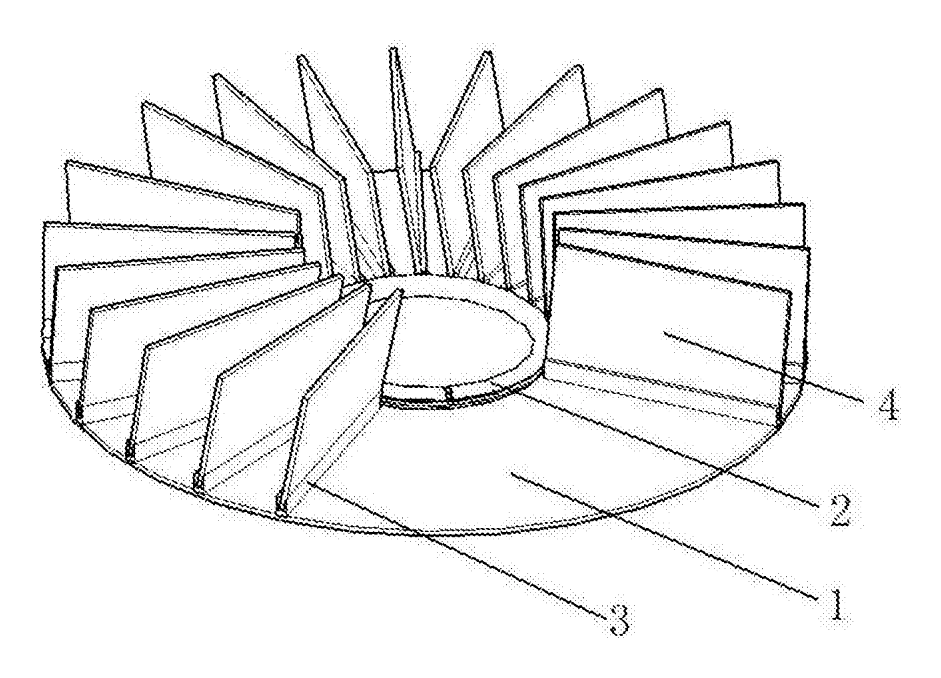
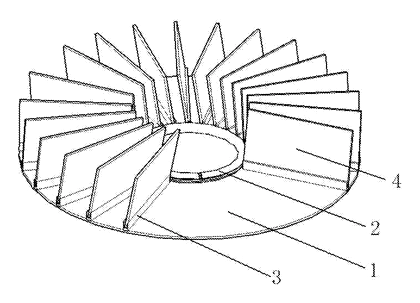
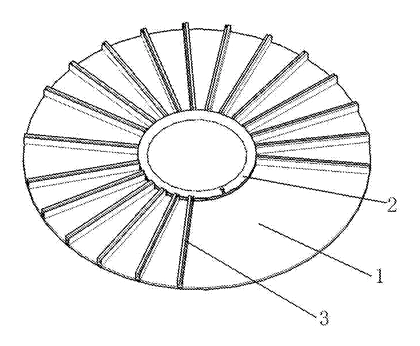
- A base (1) serves as the chassis on which the retaining ring is mounted.
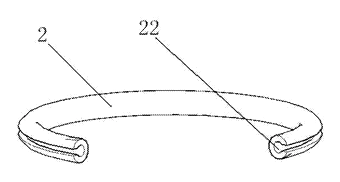
- A retaining ring (2) is fixed in the center of the base. It features an outward-opening sliding groove (22) running around its circumference and a shaped entrance (21).
- Multiple rotation seats (3) each carry a sliding ball (31) at their lower end. The ball passes through the entrance and engages the sliding groove, while the bottom of the seat rests against the base for support.
- Every rotation seat includes a name card slot (32) cut at a diagonal angle. The width of this opening matches the thickness of a business card (4), allowing the card to slide in and out.
- The seats are connected to the ring by the ball-and-groove joint and can rotate around the center. You can also add or remove seats through the entrance whenever your collection changes.
Who it is for
- Sales professionals and account managers who collect dozens of cards at trade shows and need quick access to specific contacts between meetings.
- Reception desks and front offices that display partner or vendor cards for visitors to browse without handling a messy stack.
- Corporate gift suppliers looking for a functional, mechanical desk accessory to brand and distribute at conferences.
- Small business owners and freelancers who prefer keeping physical networking cards visible and organized rather than immediately scanning and discarding them.
How it works
The main parts
| No. | Part | What it does |
|---|---|---|
| 1 | Base (chassis) | Platform that supports the entire assembly. |
| 2 | Retaining ring | Central ring fixed to the base; holds the seats. |
| 21 | Entrance | Shaped opening in the ring matching the sliding ball size. |
| 22 | Sliding groove | Outward-opening channel circling the ring for the balls to ride in. |
| 3 | Rotation seat | Individual holder that attaches to the ring and rotates around it. |
| 31 | Sliding ball | Spherical protrusion at the bottom of the seat that engages the groove. |
| 32 | Name card slot | Diagonal opening on the seat sized for a business card. |
| 4 | Business card | Paper card inserted into the slot. |
Using the stand
- Insert a card - slide a business card (4) into the diagonal name card slot (32) on any rotation seat (3). The slot width matches the thickness of the card.
- Browse contacts - push a seat gently. The sliding ball (31) slides along the sliding groove (22) of the retaining ring (2), letting the seat orbit the center. Spin through the seats sequentially to read each card face, similar to turning the pages of a book.
- Remove a card - pull the card straight out of the diagonal slot.
- Add more seats - align the sliding ball of a new rotation seat with the entrance (21) on the retaining ring and press it through until the ball enters the groove. The seat is now part of the carousel.
- Remove seats - slide a seat around the ring until its ball reaches the entrance, then pull it outward to remove the seat.
Applications
Trade show follow-up
After collecting cards at an exhibition, a salesperson inserts them into the rotating seats back at the office. Instead of sorting through a pocketful of mixed cards, they spin the ring to review each contact’s details sequentially before entering them into a CRM system.
Reception area display
A hotel concierge or co-working space receptionist places local partner cards—restaurants, transport services, tour guides—into the stand. Guests spin the carousel to browse options visually without asking staff to hand over a stack.
Executive desk organizer
Managers who still exchange physical cards keep their most frequent contacts loaded in the stand. The diagonal slots keep the text facing outward, making it faster to glance at a phone number than digging through a traditional leather card case.
Conference table centerpiece
During multi-party meetings, attendees drop their cards into the shared stand placed in the middle of the table. Everyone can reach out and spin the ring to see who is present and review titles without passing cards hand-to-hand.
Retail point-of-sale
Boutiques or service counters display loyalty program sign-up cards or local business partnerships. Customers waiting in line can spin the stand to read offers, keeping the counter tidy compared to scattered flyers.
Where it is less suitable
- High-volume archival storage - the stand is designed for active browsing of a limited set of cards, not for storing hundreds of archived contacts.
- Digital-only workflows - teams that scan and discard cards immediately will not benefit from a physical desktop carousel.
- Outdoor or field use - the open slots and rotating mechanism are intended for stable indoor environments where wind or vibration won’t dislodge the cards.
Frequently asked questions
How do the card holders stay on the ring?
Each rotation seat has a sliding ball at its bottom. This ball passes through a shaped entrance on the retaining ring and sits inside an outward-opening groove that circles the ring. The groove captures the ball, preventing the seat from lifting off, while still allowing the seat to rotate around the center.
Can I add more seats later?
Yes. The patent describes an entrance on the retaining ring whose size and shape match the sliding ball. To expand capacity, you align the ball of a new seat with this entrance and push it through into the groove. Seats can also be removed by sliding them back to the entrance and pulling them out.
Will my business cards fall out when spinning?
The name card slot on each seat is cut at a diagonal angle, and the opening width is designed to match the thickness of a business card. Slot tolerance can be adjusted during production to suit different card thicknesses.
What materials work best for this design?
The patent does not specify materials. For mass-market office supplies, injection-molded plastics like ABS or polystyrene keep costs low and allow precise molding of the sliding ball and groove. For executive gifts, zinc alloy or aluminum provides weight, which improves stability, and accepts premium finishes like plating or anodizing.
Is the base heavy enough to stop it from tipping?
The bottom of each rotation seat contacts the base. However, the patent focuses on the mechanical connection rather than base weight. In production, the base diameter and material density must be calculated so that a fully loaded stand with all seats pushed to one side remains stable on a desk.
Does it fit international business cards?
Standard US cards are 3.5 x 2 inches, while European and Asian cards vary slightly. The diagonal slot width is sized for card thickness, not length. Length and height variations are accommodated as long as the card edge fits into the slot depth, which is confirmed on prototypes.
Can this design be made and sold in the US?
The patent was filed only in China and has lapsed, so it does not restrict the design in the US or in China. Desk organizers with spinning mechanisms may be covered by other US patents - see Patent & Production - so we recommend a freedom-to-operate check before volume production.
Are you affiliated with the patent owner?
No. IP2M is an independent design and manufacturing service working from the public patent document.
Request a quote
Click Request a Quote below to see our email address - copy it, or open your email app with a ready-made message. Please mention patent CN105459665B in the subject.
Helpful details to include:
- Your company and channel (office supply brand, corporate gift distributor, Amazon seller, promotional products agency)
- Material preference (plastic type or metal alloy)
- Base dimensions and shape (diameter, footprint, target weight)
- Number of seats included per retail unit
- Branding requirements (logo placement, printing or engraving method)
- Estimated quantity and target price
- Timeline - when you would like samples and the first shipment
You can also reach us at (332) 203-9997.
Explore this product
Interested in building this?
Tell us your target market, quantity and timeline. We reply with options for prototyping, small-batch runs or volume production.
Send your inquiry to
Please put CN105459665B in the subject line and tell us your company, country, estimated quantity and timeline.
Prefer to talk? Call (332) 203-9997.
More product-ready patents
All School, Office & Art patents →
School, Office & Art
Long-Point Sketch Pencil Sharpener
Crank sharpener that cuts only the wood of sketch pencils, leaving a long, round lead about 30 mm long.
Patent CN207241257U
School, Office & Art
Fold-Out Desk Organizer Insert for School Backpacks
Backpack insert that unfolds into a hanging desk organizer for workbooks, stationery and a water bottle.
Patent CN209436546U
School, Office & Art
Smart Pencil Cap That Checks the Point with a Camera
Electronic pencil cap that photographs the point, measures it and reminds you to sharpen.
Patent CN106427302B
School, Office & Art
Expanding Clipboard Folder with Spring-Mounted Hinge and Catch
Hard folder whose spring-mounted hinge and catch let the cover clamp any thickness of paper.
Patent CN105667120B
School, Office & Art
Slide-Action Retractable Pen with a Friction-Loaded Cam That Ignores Gravity
Slide-action retractable pen whose spring-pressed cam latch stays put whichever way the pen is held.
Patent CN217671900U
School, Office & Art
Carousel Business Card Holder with Rolling Card Trays on Twin Ring Tracks
Desk card holder: angled card trays roll on wheels around two concentric ring tracks and lift out.
Patent CN105774300B
Browse by category
- Apparel & Accessories (22)
- Baby & Kids (16)
- Bags & Luggage (9)
- Bath & Personal Care (16)
- Car Accessories (10)
- Furniture, Bedding & Storage (12)
- Garden & Outdoor (18)
- Health & Wellness (8)
- Home, Kitchen & Cleaning (24)
- Lighting (12)
- Packaging & Containers (6)
- Pet Products (6)
- Phone & Camera Accessories (4)
- Retail Display (13)
- School, Office & Art (19)
- Sports & Recreation (25)
- Tools & Workshop (27)
- Toys & Games (12)
This page is based on the public patent document CN105459665B, assigned to Guangxi Dazhou International Logistics Co ltd. IP2M is an independent manufacturing service and is not affiliated with, endorsed by or licensed by the patent owner. Images marked as concept renderings are illustrations, not photos of an existing product. Patent status information is provided for reference only and is not legal advice; confirm freedom to operate for your market before production. Full disclaimer.