
Patent CN105559311B
Updated October 29, 2026Hair Dryer with a Built-In Adjustable Airflow Mechanism
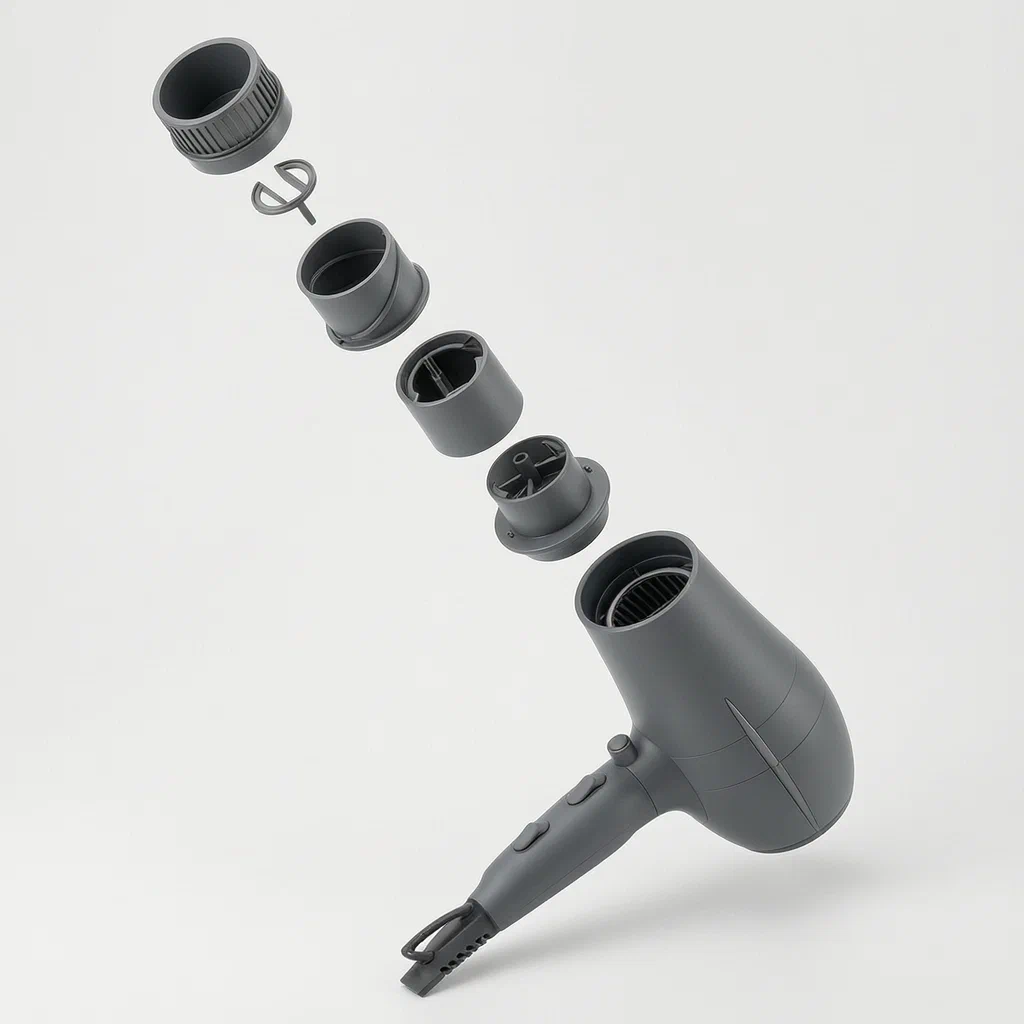
Most hair dryers rely on snap-on nozzles to change the airflow from wide to focused. Those attachments get lost, take up drawer space, and add weight to the end of the barrel. This design builds the adjustment directly into the air outlet. A rotating ring at the nozzle turns a telescopic cylinder inside a track cylinder. Helical openings in the track guide sliding blocks on the telescopic cylinder so it rises, lowers, and rotates when the ring is turned. That motion shifts a wind-shielding edge relative to a fixed disc in the center of the outlet, switching the airflow among three states: central, narrowed, and diffused. A second disc with matching notches sits behind the fixed one; as the cylinder moves, the notches either align or stagger to open different air channels. Everything happens by turning the outer ring—no extra parts to attach or store.
- China invention patent - lapsed
- No filings outside China
- Personal care appliance
- Built-in airflow adjustment, no snap-on attachments
Splat! What let you down?
🌀
Three airflow modes
Turn the ring to switch between central, narrowed and diffused airflow without adding attachments.
⚙️
Helical track mechanism
Sliding blocks follow helical openings so the inner cylinder lifts, lowers and rotates together.
💨
Notched air-path discs
A fixed disc and a rotating disc with notches align or stagger to shape the air channel.
📦
Attachment-free
The adjustment parts are built into the outlet, removing the need for separate concentrators or diffusers.
Bring this product to market
- ✓ Patent vetted China-only family and legal status checked
- 2 Product brief · now How it works, uses and options written up
- 3 Prototype First samples for buyers to review
- 4 Pilot run Small first batch for launch customers
- 5 Volume production Repeat orders at scale
Buyer interest
– of 100 buyers needed to start prototyping
One click, no sign-up. Each vote is one real visitor, and products with the most interest go to prototyping first.
Build team: no members yet. Need a partner, co-funding or skills to build this? Join and we introduce the team once it forms.
The problem
Hair dryers typically ship with one or two plastic attachments—a concentrator nozzle for a narrow stream and a diffuser bowl for spreading the air. Users have to clip them on and pull them off depending on the styling step. These pieces are easy to misplace, they fill up bathroom drawers, and clipping a heavy diffuser onto the end of the barrel shifts the balance forward, which can cause arm fatigue during longer drying sessions. Some users simply stop using the attachments because swapping them interrupts the routine.
The solution
This design places an adjustment mechanism directly at the air outlet of the hair dryer body. The mechanism uses four nested components around a central support:
- A cylindrical support extends outward from the air outlet barrel. At its center is a fixed seat, and a support rod holds a fixed wind-shielding disc that has first notches cut into opposite edges.
- A telescopic cylinder fits over the cylindrical support. Its inner wall forms a wind-shielding edge and a vertical slideway. At least two sliding blocks protrude from its outer wall.
- A track cylinder fits over the telescopic cylinder and locks onto the end of the cylindrical support. Its side wall contains at least two helical openings.
- A rotating ring fits over the track cylinder and connects rotatably to the air outlet barrel. Its inner wall has vertical sliding grooves.
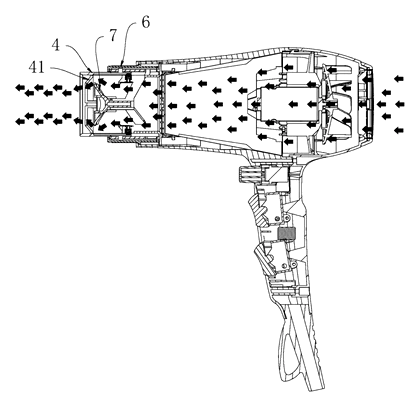
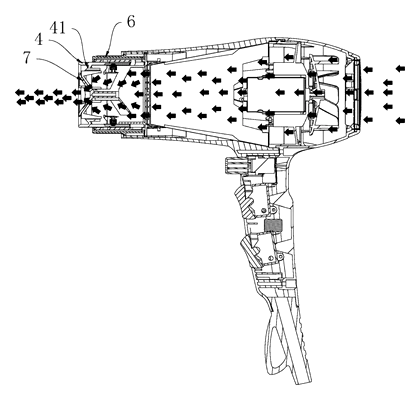
Each sliding block passes through a helical opening and sits inside a sliding groove. When the user turns the rotating ring, the grooves push the blocks along the helical paths, forcing the telescopic cylinder to rise or lower while rotating. That movement changes the distance between the wind-shielding edge and the fixed disc, redirecting the air.
A rotating disc with second notches sits on the support rod behind the fixed disc. A convex block on its edge rides in the slideway of the telescopic cylinder. As the cylinder rotates, it turns this disc so the first and second notches either overlap or stagger, forming different air channels.
Who it is for
- Hair dryer brands and OEM buyers looking for a single-barrel product that covers multiple styling steps without shipping loose plastic attachments.
- Hotel and hospitality purchasing teams that need durable room appliances where small snap-on parts cannot be lost or stolen by guests.
- Professional salon equipment suppliers serving stylists who switch between concentrated and diffused airflow many times per client.
- Amazon private-label sellers in the personal care category seeking a distinct product feature that reduces packaging volume and accessory count.
How it works
The main parts
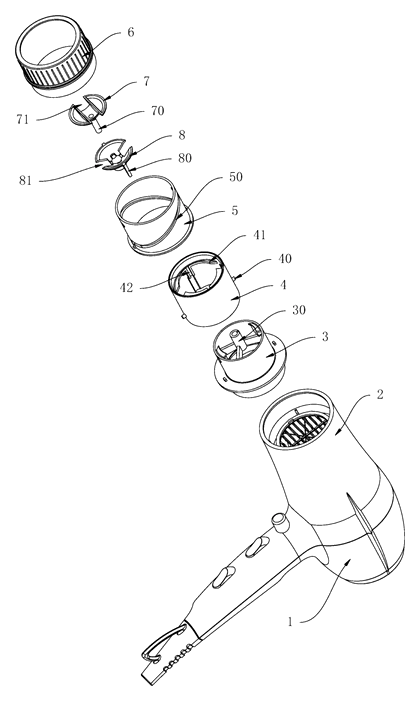
| No. | Part | What it does |
|---|---|---|
| 1 | Hair dryer body | Houses the motor, heater and controls. |
| 2 | Air outlet barrel | Directs heated air toward the adjustment mechanism. |
| 3 | Cylindrical support | Extends from the barrel; holds the fixed seat and support rod. |
| 4 | Telescopic cylinder | Slides and rotates to move the wind-shielding edge. |
| 5 | Track cylinder | Provides the helical openings that guide the sliding blocks. |
| 6 | Rotating ring | Turned by the user; its vertical grooves drive the blocks. |
| 7 | Fixed wind-shielding disc | Stationary disc with first notches at its edges. |
| 8 | Rotating disc | Turns with the telescopic cylinder; has second notches. |
| 30 | Fixed seat | Anchors the support rod in the center of the cylindrical support. |
| 40 | Sliding blocks | Protrude from the telescopic cylinder into the helical openings. |
| 41 | Wind-shielding edge | Inner rim of the telescopic cylinder that shapes the airflow. |
| 42 | Vertical slideway | Guides the convex block of the rotating disc. |
| 50 | Helical openings | Spiral slots in the track cylinder. |
| 60 | Vertical sliding grooves | Straight slots in the rotating ring. |
| 70 | Support rod | Holds the fixed disc and rotating disc in place. |
| 71 | First notches | Cut into the edges of the fixed wind-shielding disc. |
| 80 | Convex block | On the rotating disc, engages the slideway. |
| 81 | Second notches | Cut into the edges of the rotating disc. |
Operating steps
- Set to central airflow (0°) – The rotating ring is at its starting position. The wind-shielding edge and the fixed disc sit in a defined relationship, and the first and second notches align or stagger to direct air straight out through the center.
- Switch to narrowed airflow (90°) – Turning the ring pushes the sliding blocks along the helical openings. The telescopic cylinder rises or lowers and rotates. The wind-shielding edge moves closer to or further from the fixed disc, narrowing the exit path. The rotating disc turns so the notches shift position, changing the air channel shape.
- Switch to diffused airflow (180°) – Further rotation continues the travel of the telescopic cylinder. The gap between the shielding edge and the disc opens wider, and the notches realign to spread the air outward.
- Return – Rotating the ring back reverses the sequence.
Applications
Home styling routines
A person drying their hair at home often starts with a wide flow to remove bulk moisture, then needs a focused stream to smooth specific sections. Instead of reaching for a clip-on nozzle mid-dry, the user simply twists the ring at the barrel. This keeps both hands free and speeds up the process.
Hotel guest rooms
Hotels frequently supply basic hair dryers in bathrooms. Snap-on concentrators and diffusers are small enough to walk away in luggage or fall behind counters. A built-in adjustment mechanism means the appliance arrives ready to use with no loose parts to inventory or replace.
Professional salons
Stylists alternate between diffusing curls and smoothing straight styles throughout the day. Constantly attaching and detaching accessories slows down service. The rotating ring allows a quick mode change between clients or even during a single blowout without setting tools down.
Travel and compact kits
Travelers packing light want fewer items in their bags. Eliminating separate attachments saves space in a toiletry kit. The overall length of the dryer remains unchanged because the mechanism nests within the existing outlet profile.
Retail display and e-commerce
Sellers listing hair dryers online must photograph and describe every included accessory. A model that adjusts itself simplifies the listing and reduces the chance of customers reporting missing parts. Packaging can be smaller since there are no extra plastic pieces to protect.
Where it is less suitable
- High-wattage professional hood dryers – Hood units use a completely different airflow architecture and do not benefit from a handheld barrel mechanism.
- Cordless battery-powered mini dryers – The added mechanical rings and cylinders increase part count and weight, which matters more in very small cordless models where every gram counts.
Frequently asked questions
How does the ring change the airflow?
Turning the outer rotating ring pushes sliding blocks along helical openings in the track cylinder. This forces the inner telescopic cylinder to lift or lower while rotating. The movement changes the gap between the cylinder’s wind-shielding edge and the fixed disc, redirecting the air.
What are the three airflow modes?
The patent identifies a central airflow, a narrowed airflow, and a diffused airflow. The exact spread angle and velocity for each mode are set in design and confirmed on prototypes.
Do I still need a concentrator or diffuser attachment?
No. The mechanism that shapes the air is built into the barrel. The rotating ring replaces the need for separate snap-on accessories.
What materials handle the heat near the outlet?
The patent does not specify materials. In production, the nested cylinders and discs are molded from heat-resistant engineering plastics chosen to withstand the heater output without warping or binding. Material grades are confirmed on prototypes.
How many sliding blocks and grooves are there?
The patent states “at least two” sliding blocks, helical openings, and vertical grooves. The described embodiment uses exactly two of each, but the design allows for more if a larger barrel requires additional support points.
Does the rotating disc inside serve a purpose?
Yes. The rotating disc has second notches that align or stagger with the first notches on the fixed disc. As the telescopic cylinder turns, it drives this disc via a convex block in a slideway, opening or closing specific air channels to fine-tune the flow pattern.
Is the mechanism loud or hard to turn?
The patent text does not provide noise or torque figures. Smoothness depends on mold precision, plastic selection, and the fit between the sliding blocks and the helical tracks, all of which are tuned during prototyping.
Can this design be made and sold in the US?
The patent was filed only in China and has lapsed, so it does not restrict the design in the US or in China. However, later US and foreign patents in the hair dryer airflow field exist (held by companies such as Sharkninja Operating LLC, LG Electronics Inc. and others), so we recommend a freedom-to-operate check before volume production.
Are you affiliated with the patent owner?
No. IP2M is an independent design and manufacturing service working from the public patent document.
Request a quote
Click Request a Quote below to see our email address - copy it, or open your email app with a ready-made message. Please mention patent CN105559311B in the subject.
Helpful details to include:
- Your company and sales channel (brand, Amazon seller, hotel supplier, salon distributor)
- Voltage and plug type for your target market
- Preferred airflow modes and number of ring positions
- Housing finish, colors and branding requirements
- Estimated quantity and target retail price range
- Timeline – when you need prototypes and the first shipment
You can also reach us at (332) 203-9997.
Explore this product
Interested in building this?
Tell us your target market, quantity and timeline. We reply with options for prototyping, small-batch runs or volume production.
Send your inquiry to
Please put CN105559311B in the subject line and tell us your company, country, estimated quantity and timeline.
Prefer to talk? Call (332) 203-9997.
More product-ready patents
All Bath & Personal Care patents →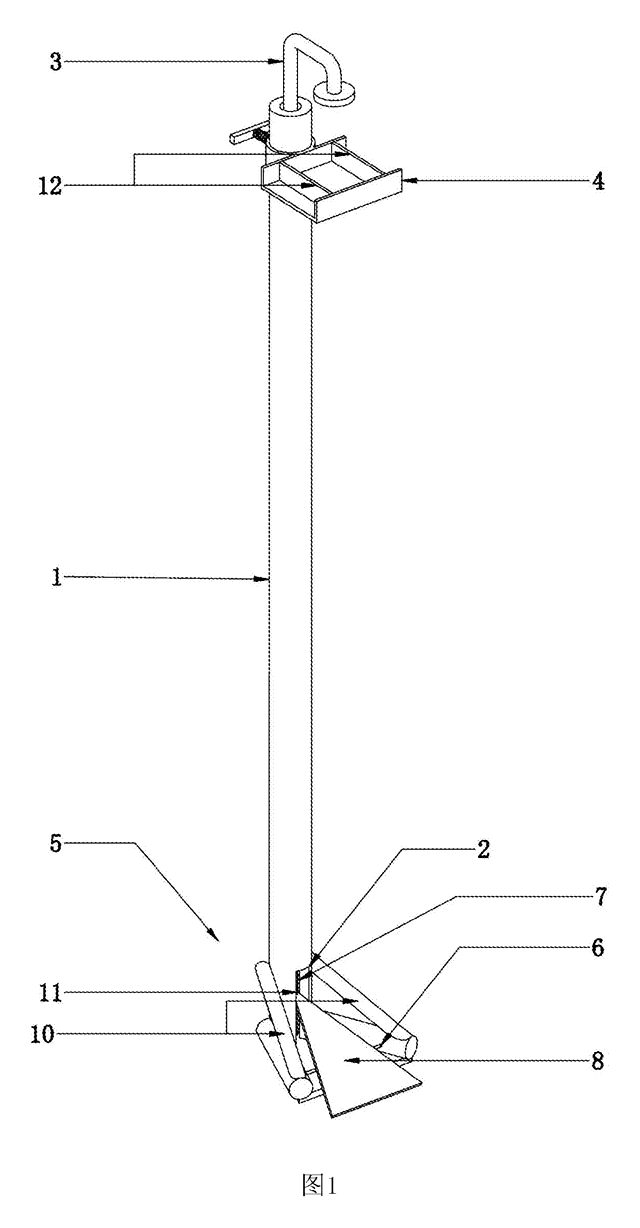
Bath & Personal Care
Foot-Pedal Soap & Sanitizer Dispenser Stand
Hands-free, battery-free dispenser stand - step on a pedal to press the pump of any soap or sanitizer bottle.
Patent CN207461995U
Bath & Personal Care
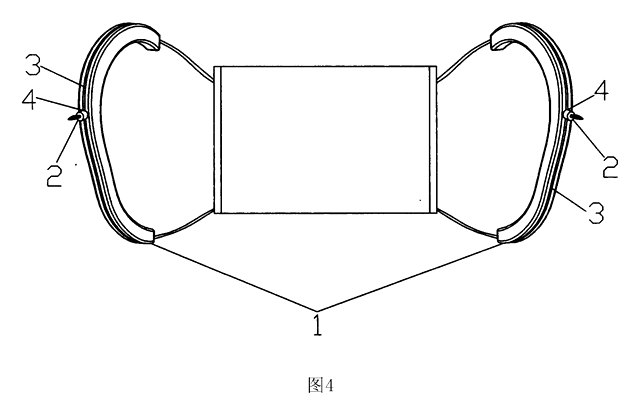
Ear-Shaped Mask Strap Guard with Tension Adjuster
Ear-shaped silicone guard and strap-length adjuster that make ear-loop masks comfortable to wear for long hours.
Patent CN205456233U
Bath & Personal Care
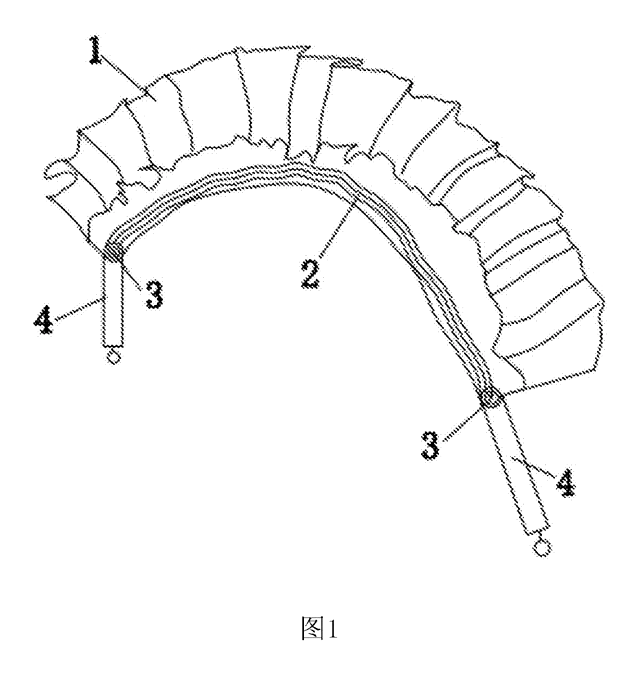
Adjustable-Length Back Scrubber Strap with Push-Button Handles
Back-scrubber strap with push-button handles that set its length and a spring that keeps it taut.
Patent CN207041452U
Bath & Personal Care
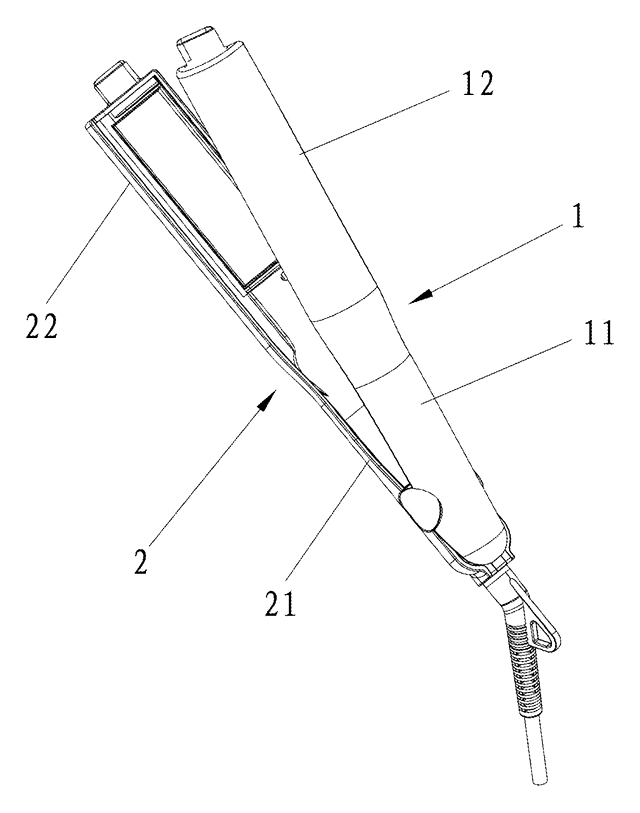
Angled-Plate Hair Straightener
Flat iron with plates twisted 45-75° to the handle, a curling groove and rubber-capped tips.
Patent CN206137462U
Bath & Personal Care
Refillable Lipstick Case with Sealed Snap-In Refill Pods
Reusable twist-up lipstick case; sealed refill pods unlock at the top of the stroke for shade swaps.
Patent CN206909979U
Bath & Personal Care
Quick-Release Toilet Seat Hinge with a Push-Button Two-Strip Latch
Toilet seat hinge: drop the shaft onto a grooved post to lock; one push parks the latch open to lift it off.
Patent CN210370292U
Browse by category
- Apparel & Accessories (22)
- Baby & Kids (16)
- Bags & Luggage (9)
- Bath & Personal Care (16)
- Car Accessories (10)
- Furniture, Bedding & Storage (12)
- Garden & Outdoor (18)
- Health & Wellness (8)
- Home, Kitchen & Cleaning (24)
- Lighting (12)
- Packaging & Containers (6)
- Pet Products (6)
- Phone & Camera Accessories (4)
- Retail Display (13)
- School, Office & Art (19)
- Sports & Recreation (25)
- Tools & Workshop (27)
- Toys & Games (12)
This page is based on the public patent document CN105559311B, assigned to Sun Luen Electrical Manufacturing Co Ltd. IP2M is an independent manufacturing service and is not affiliated with, endorsed by or licensed by the patent owner. Images marked as concept renderings are illustrations, not photos of an existing product. Patent status information is provided for reference only and is not legal advice; confirm freedom to operate for your market before production. Full disclaimer.