At a glance
| Patent number | CN105559311B (application CN201610070669) |
| Type | China invention patent (发明专利) - protects product shape, structure and method |
| Original title | Hair drier capable of changing blowing effect (一种能改变吹风效果的吹风机) |
| Patent owner | Sun Luen Electrical Manufacturing Co Ltd |
| Inventors | Yang Qichang, Zhang Huaxing, Ruan Ziheng |
| Filing date | 2016-02-01 |
| Grant date | 2019-04-16 |
| Status (China) | Lapsed - terminated for non-payment of annual fees (recorded 2023-01-10) |
| Patent family | Chinese filings only - no US, European, Japanese, PCT or other filings listed |
| Cited by | 19 later documents |
| Source | Google Patents (search for CN105559311B) |
What the claims cover, in plain language
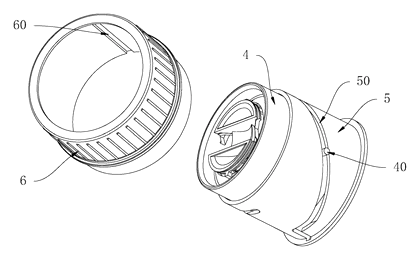
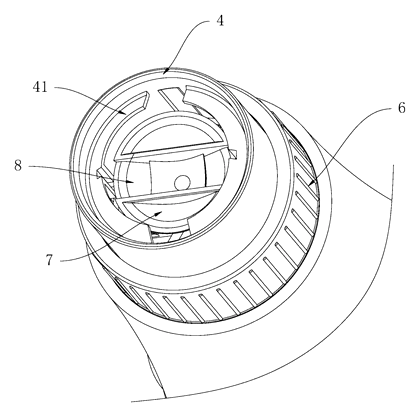
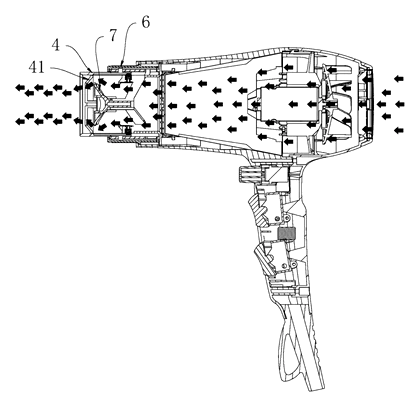
Claim 1 describes a hair dryer body with an air outlet barrel. At the barrel is an adjustment mechanism that produces a central airflow, a narrowed airflow, and a diffused airflow. The mechanism includes a cylindrical support extending from the barrel, a telescopic cylinder sleeved over it, and a track cylinder sleeved over the telescopic cylinder with its end locked to the support. A rotating ring fits over the track cylinder and connects rotatably to the barrel. The telescopic cylinder has at least two sliding blocks on its outer wall. The track cylinder has at least two helical openings. The rotating ring has vertical sliding grooves on its inner wall. Each sliding block passes through a helical opening into a corresponding groove. A fixed wind-shielding disc sits at the center of the support, and the inner wall of the telescopic cylinder forms a wind-shielding edge. Turning the ring slides the blocks along the openings, driving the telescopic cylinder to rotate and lift, adjusting the airflow direction via the changing position between the shielding edge and the fixed disc.
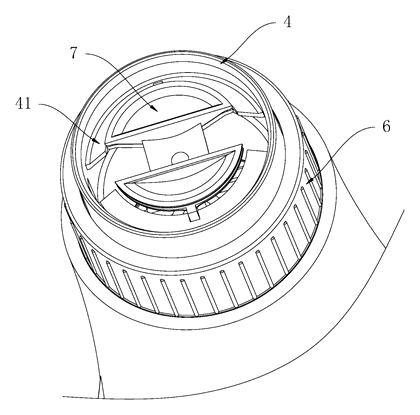
Claim 2 adds a fixed seat in the middle of the cylindrical support and a support rod at the center of the fixed disc. A rotating disc is sleeved on the rod, with a convex block on its edge riding in a vertical slideway on the telescopic cylinder’s inner wall. The fixed disc has first notches and the rotating disc has second notches; rotating the telescopic cylinder turns the rotating disc so the notches overlap or stagger.
Claim 3 specifies that when the telescopic cylinder lifts the shielding edge above or below the fixed disc, the notches stagger to form an air channel through the gaps. When the shielding edge moves adjacent to the fixed disc, the notches overlap to form the channel.
Claim 4 notes the first and second notches are provided on both side edges of their respective discs.
This is a simplified reading for orientation only. The legal scope is defined by the exact claim wording in the official Chinese document.
What this means for US production
This patent was filed only in China and has lapsed due to non-payment of annual fees, so it no longer restricts anyone in China either. It has no US or other foreign counterpart.
Two points to settle early:
- Other patents may exist. Companies including Sharkninja Operating LLC, LG Electronics Inc., and Dreame Technology (Suzhou) Co., Ltd. hold later US and foreign patents citing this document in the hair dryer and airflow-adjustment field, so a freedom-to-operate (FTO) review of the rotating ring and helical track mechanism is needed before tooling.
- Thermal clearances. The nested cylinders sit directly in the hot air path; material selection and dimensional tolerances must account for heat expansion to prevent binding after prolonged use.
Customization and manufacturing
What can be customized
| Area | Options |
|---|---|
| Motor and wattage | AC or DC motor, voltage and power rating to be confirmed in design |
| Barrel diameter | Sized to match the chosen motor and fan assembly |
| Ring positions | Number of click stops (e.g., three for central/narrow/diffuse, or continuous) |
| Materials | Heat-resistant plastics such as PA or PBT for the cylinders and discs |
| Finish and color | Housing colors, matte or glossy textures, metallic coatings on the ring |
| Controls | Separate heat and speed switches, cool-shot button placement |
| Cord and plug | Length, gauge and plug type for the target market |
Things to plan for (US market)
- UL 859 – Standard for household electric personal grooming appliances; covers construction, temperature limits, strain relief and abnormal operation tests.
- FCC Part 15 – If the motor or any electronic control generates radio frequency energy above the threshold, unintentional radiator rules apply.
- California Proposition 65 – Plastics, paints and cord materials must be screened for listed chemicals.
- Immersion protection (16 CFR 1120) – CPSC treats hand-held hair dryers without integral immersion protection as a substantial product hazard, so the cord plug needs an ALCI or equivalent shock protection.
How a project runs
- Inquiry – target market, voltage, preferred airflow modes, quantity and timeline.
- Design – 3D modeling of the barrel, cylindrical support, telescopic and track cylinders, rotating ring, discs and notches; thermal simulation.
- Prototype – machined or printed samples to verify the helical tracking, notch alignment and airflow patterns at each ring position.
- Pilot run – injection molds opened; assembled units undergo heat endurance, drop, cycle testing on the rotating ring, and safety standard pre-tests.
- Production – molding, assembly, wiring, final safety testing and packing.
Quantities & timeline
The nested cylinders, rotating ring, fixed disc and rotating disc each require dedicated injection molds, and the helical openings demand precise core pins. Motor integration and heating element mounting follow standard hair dryer assembly lines. Safety certification testing for the US market runs concurrently with pilot validation. Send us your voltage, target airflow modes, finish preferences, estimated quantity and launch date and we will reply with options.
Patent drawings
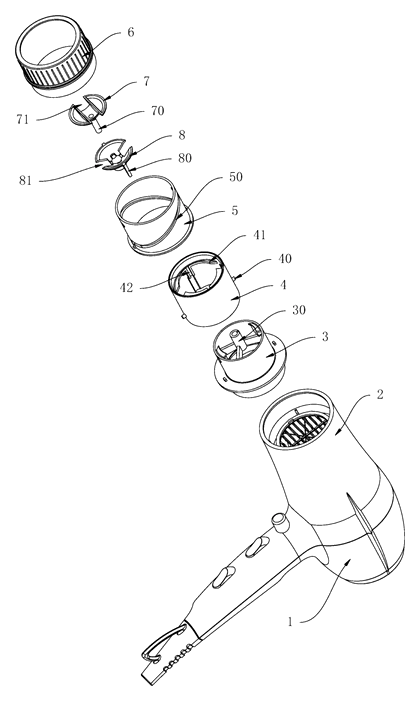
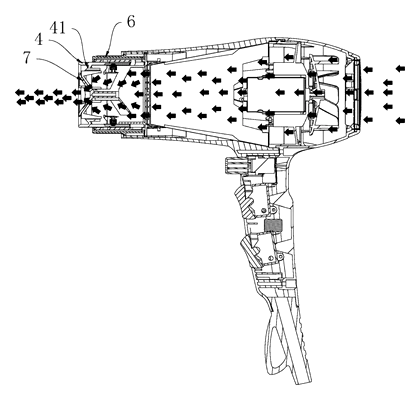
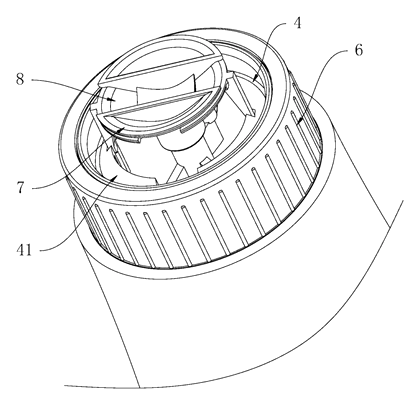
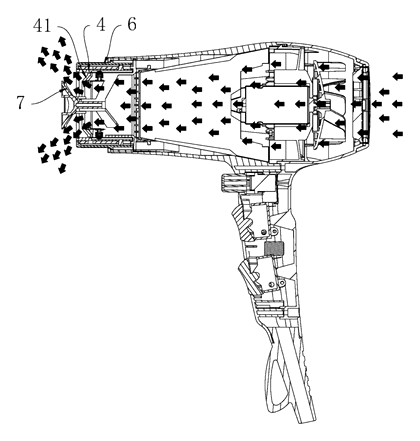
Drawings reproduced from the public patent document for reference.