
Patent CN105751782B
Updated October 26, 2026All-in-One Chalk Plotter for Lines, Angles, Circles and Ellipses
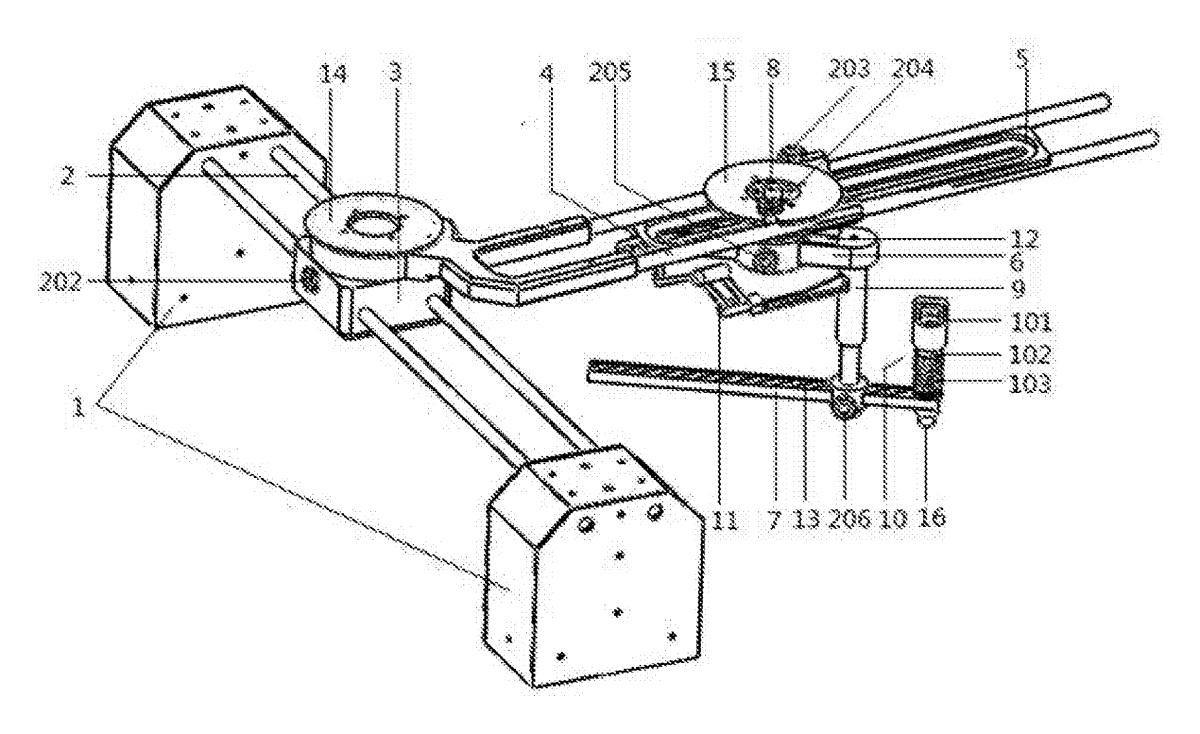
Teachers and designers who sketch geometry on boards usually juggle a ruler, a protractor and a compass, switching tools between every line and curve. This all-in-one plotter combines those functions into a single linkage mechanism. Two bases anchor the unit to a board with suction cups. A first polished rod shaft connects the bases, and a slider on it carries a hinged second polished rod shaft. Below a sliding groove on the second shaft, an M rod and a parallel N rod pivot through a sliding block and a shaft sleeve. The N rod ends in a spring-loaded chalk support frame, while two connecting rods tie the sliding groove to the shaft sleeve. By loosening and tightening six adjustment knobs, the user sets lengths and angles to draw straight lines, measure angles, sweep circles and arcs, or trace ellipses, keeping the chalk tip steady against the drawing surface.
- China invention patent - lapsed
- No filings outside China
- Teaching & board drawing tool
- Metal rods, suction cups, spring-loaded chalk holder
Splat! What let you down?
📐
Multi-shape drawing
One linkage mechanism produces straight lines, angles, circles, arcs and ellipses without changing tools.
🔒
Suction-cup bases
Two bases with suction cups hold the plotter firmly on a board or smooth surface during use.
✏️
Spring-loaded chalk frame
The chalk support uses a sleeve, a spring and a cover to keep constant pressure on the chalk tip.
⚙️
Six adjustment knobs
Knobs at each hinge lock the rods in position once the desired shape and size are set.
Bring this product to market
- ✓ Patent vetted China-only family and legal status checked
- 2 Product brief · now How it works, uses and options written up
- 3 Prototype First samples for buyers to review
- 4 Pilot run Small first batch for launch customers
- 5 Volume production Repeat orders at scale
Buyer interest
– of 100 buyers needed to start prototyping
One click, no sign-up. Each vote is one real visitor, and products with the most interest go to prototyping first.
Build team: no members yet. Need a partner, co-funding or skills to build this? Join and we introduce the team once it forms.
The problem
Drawing precise geometric shapes on a classroom board or large drafting surface normally requires several separate instruments. A teacher reaches for a long ruler to draw a line, picks up a protractor to mark an angle, and then switches to a large compass to sweep a circle or arc. Each time a tool is swapped, the reference point can shift, reducing accuracy. Carrying and storing a full set of oversized board tools takes space, and holding them steady against a vertical surface demands extra effort, especially when tracing complex curves like ellipses.
The solution
This integrated plotter solves the problem by combining the drawing functions into a single mechanical linkage anchored to the work surface.
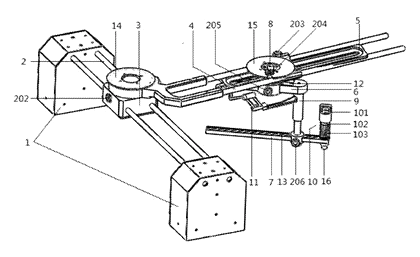
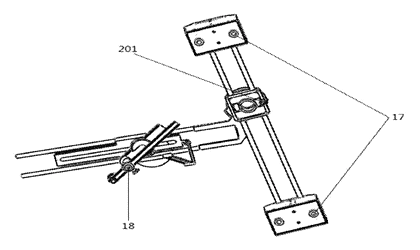
- Two bases (1) sit on the board, each fitted with a suction cup (17) on its bottom to hold the unit in place.
- A first polished rod shaft (2) connects the two bases. A slider (3) moves along this shaft.
- One end of a second polished rod shaft (4) hinges to the first shaft through the slider, allowing the second shaft to pivot and slide.
- A sliding groove (5) on the second shaft accepts a sliding block (8), which hinges to an M rod (6) positioned below the groove.
- An N rod (7) runs on a parallel surface beneath the M rod, joined to it by a shaft sleeve (9).
- A chalk support frame (10) is mounted at one end of the N rod, holding the drawing medium against the surface.
- Two connecting rods (11) are movably joined together; one end mates with the sliding groove and the other with a horizontal protruding end of the shaft sleeve, coordinating the movement for ellipse generation.
Who it is for
- Educational equipment suppliers sourcing geometry tools for primary and secondary schools that want to reduce the number of separate board instruments teachers carry.
- Art and design studios needing a mechanical aid for drawing large-scale ellipses and arcs directly on walls or boards during layout work.
- Office and training room outfitters equipping conference spaces where presenters sketch diagrams on whiteboards or chalkboards frequently.
- Toy and game manufacturers developing home or club teaching kits for geometry and board-game design exercises.
How it works
The main parts
| No. | Part | What it does |
|---|---|---|
| 1 | Bases | Anchor the device to the board via suction cups. |
| 2 | First polished rod shaft | Connects the bases; carries the slider. |
| 3 | Slider | Hinges the second shaft to the first shaft. |
| 4 | Second polished rod shaft | Pivots from the slider; holds the sliding groove. |
| 5 | Sliding groove | Guides the sliding block along the second shaft. |
| 6 | M rod | Hinges below the sliding groove via the sliding block. |
| 7 | N rod | Runs parallel under the M rod; carries the chalk frame. |
| 8 | Sliding block | Connects the M rod to the sliding groove. |
| 9 | Shaft sleeve | Hinges the N rod to the M rod. |
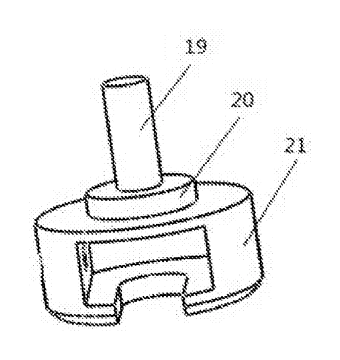
| 10 | Chalk support frame | Holds the chalk with a sleeve, spring and cover. |
| 11 | Connecting rods | Link the sliding groove to the shaft sleeve for ellipse drawing. |
| 14, 15 | Angle plates | Mounted above the slider and sliding block; marked with angle scales. |
| 18 | Rolling steel ball | Placed under the N rod near the shaft sleeve hinge to reduce friction. |
| 201–206 | Adjustment knobs | Six knobs that lock the hinges and sliders in place. |
Operating steps
- Mount the bases. Press the suction cups against the board so the first polished rod shaft is fixed horizontally.
- Set the shape. Loosen the relevant adjustment knobs. To draw a line, align the rods straight. For an angle, pivot the second shaft using the angle plate scale. For a circle, fix the slider and swing the N rod around it. For an ellipse, engage the two connecting rods between the sliding groove and the shaft sleeve.
- Lock the dimensions. Tighten the six adjustment knobs (201 through 206) to secure the slider, the hinges, the sliding groove and the rods at the chosen positions.
- Insert the chalk. Place a piece of chalk into the chalk support frame, where the spring pushes the sleeve downward.
- Draw. Move the linkage smoothly across the board. The rolling steel ball under the N rod helps it glide over the surface.
Applications
Classroom geometry lessons
Mathematics teachers use the plotter to demonstrate how lines, angles and circles relate to one another without putting down one tool to pick up another. The suction cups keep the base steady on a vertical chalkboard, letting the instructor focus on the explanation rather than holding the instrument in place.
Architectural and interior layout sketches
Designers marking large arcs or elliptical arches on a wall or floor plan board can set the connecting rods to the required proportions. The integrated linkage maintains the ratio throughout the stroke, producing a consistent curve faster than plotting individual points by hand.
Art studio composition
Artists preparing murals or large canvases often need precise geometric under-drawings. The spring-loaded chalk frame applies even pressure, preventing skipped lines on textured surfaces, while the angle plates help establish perspective grids directly on the working surface.
Teacher training workshops
Instructors learning board-work techniques benefit from a single device that demonstrates multiple drafting principles. Trainers can show how adjusting the slider position changes a circle into an ellipse, making the geometric relationship visible in one continuous motion.
Home education and board games
Parents teaching geometry at home or running educational board-game clubs can use the plotter as a hands-on aid. Its compact linkage folds together for storage, and the marked scales on the rods and chutes allow children to read measurements as they draw.
Where it is less suitable
- Paper drafting desks - the suction cups and overall size are intended for boards or large smooth surfaces, not standard desk pads.
- Permanent ink or paint applications - the chalk support frame is designed for dry chalk; liquid markers or paint brushes would require a different holder.
- CNC or digital plotting - this is a manual mechanical linkage for visual demonstration, not a motorized or computer-controlled machine.
Frequently asked questions
What shapes can this plotter draw?
The linkage mechanism allows the user to draw straight lines, angles, circles, arcs and ellipses. Different shapes are achieved by locking or freeing specific hinges and engaging the two connecting rods between the sliding groove and the shaft sleeve.
How does it stay on the board?
Each of the two bases has a suction cup installed on its bottom. When pressed against a smooth surface like a glass or porcelain chalkboard, the suction cups hold the device in place during drawing.
How many adjustments are needed to change shapes?
The patent describes six adjustment knobs located at the key joints: below the slider on the first shaft, above and beside the sliding groove, at the angle plates, and at the shaft sleeve connections. Loosening these knobs allows the rods to move; tightening them locks the chosen geometry.
What keeps the chalk touching the board evenly?
The chalk support frame includes a sleeve with a spring inside and a chalk cover on top. The spring pushes the sleeve downward, maintaining constant pressure on the chalk as the rods move across the surface.
Are there measurement scales on the device?
Yes. The first and second polished rod shafts are marked with scales. Additionally, the M rod and N rod have chutes that are also marked with scales, and angle plates above the slider and sliding block carry angle scales.
What material are the main rods made of?
According to the patent, the first and second polished rod shafts are each formed by two hollow metal rods arranged in parallel, with a diameter of about 8 mm. Other dimensions and materials would be set in design and confirmed on prototypes.
Can it be used with markers instead of chalk?
The original design specifies a chalk support frame. Adapting it for dry-erase markers would require modifying the sleeve and spring mechanism to fit a marker barrel, which is a customization option to discuss during the design phase.
Can this design be made and sold in the US?
The patent was filed only in China and is lapsed due to non-payment of annual fees, so it does not restrict the design in the US or in China. Mechanical drawing aids may be covered by other US patents - see Patent & Production - so we recommend a freedom-to-operate check before volume production.
Are you affiliated with the patent owner?
No. IP2M is an independent design and manufacturing service working from the public patent document.
Request a quote
Click Request a Quote below to see our email address - copy it, or open your email app with a ready-made message. Please mention patent CN105751782B in the subject.
Helpful details to include:
- Your company and channel (educational supplier, art studio outfitter, toy brand, office equipment distributor)
- Target board size and preferred rod length
- Drawing medium (chalk, dry-erase marker, or other)
- Base mounting preference (suction cup, magnetic, or other)
- Estimated quantity and target price
- Timeline - when you would like samples and the first shipment
You can also reach us at (332) 203-9997.
Explore this product
Interested in building this?
Tell us your target market, quantity and timeline. We reply with options for prototyping, small-batch runs or volume production.
Send your inquiry to
Please put CN105751782B in the subject line and tell us your company, country, estimated quantity and timeline.
Prefer to talk? Call (332) 203-9997.
More product-ready patents
All School, Office & Art patents →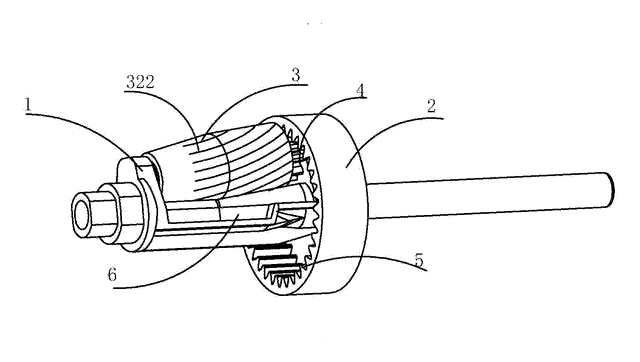
School, Office & Art
Long-Point Sketch Pencil Sharpener
Crank sharpener that cuts only the wood of sketch pencils, leaving a long, round lead about 30 mm long.
Patent CN207241257U
School, Office & Art
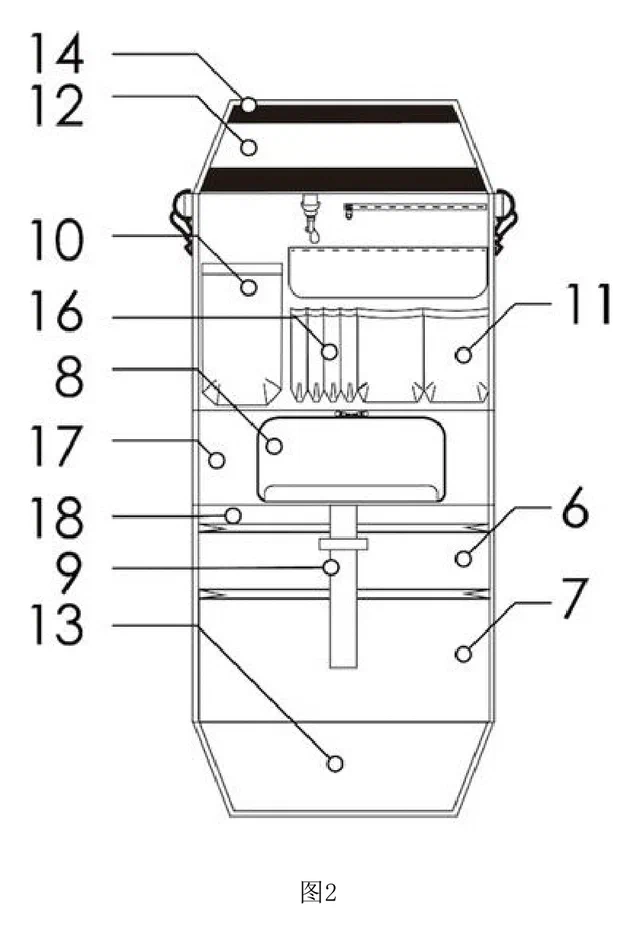
Fold-Out Desk Organizer Insert for School Backpacks
Backpack insert that unfolds into a hanging desk organizer for workbooks, stationery and a water bottle.
Patent CN209436546U
School, Office & Art
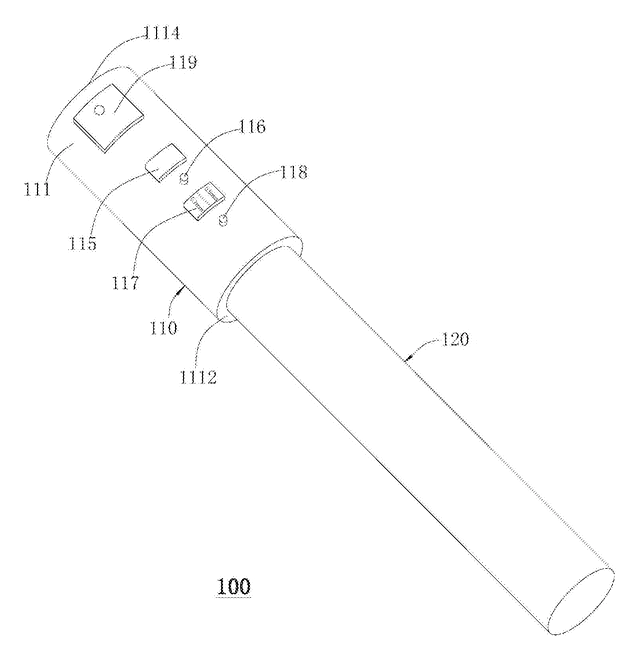
Smart Pencil Cap That Checks the Point with a Camera
Electronic pencil cap that photographs the point, measures it and reminds you to sharpen.
Patent CN106427302B
School, Office & Art
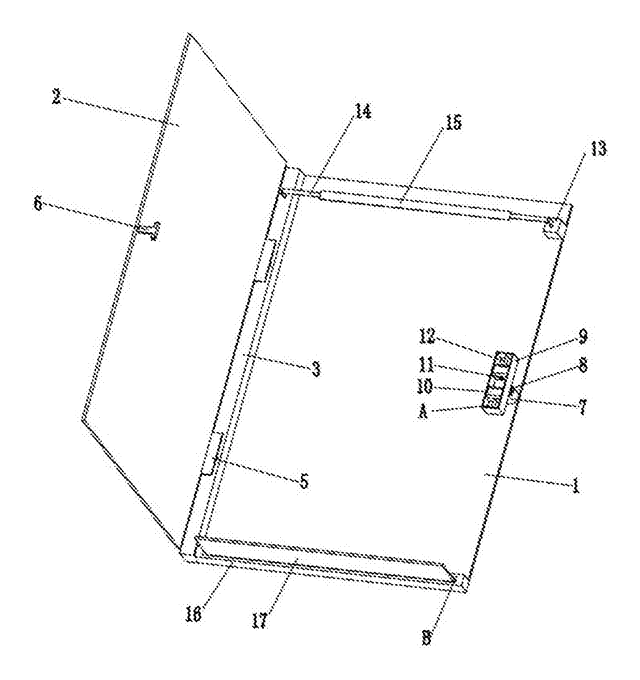
Expanding Clipboard Folder with Spring-Mounted Hinge and Catch
Hard folder whose spring-mounted hinge and catch let the cover clamp any thickness of paper.
Patent CN105667120B
School, Office & Art
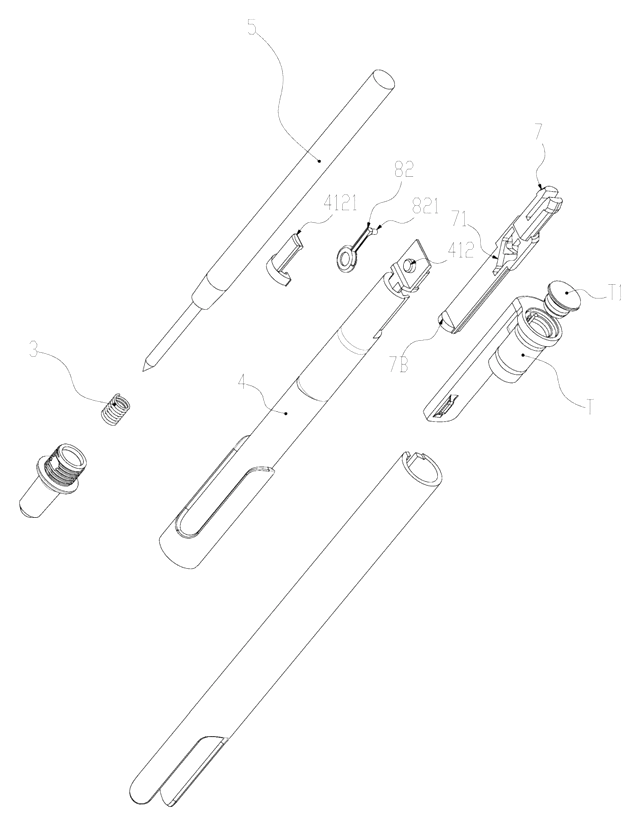
Slide-Action Retractable Pen with a Friction-Loaded Cam That Ignores Gravity
Slide-action retractable pen whose spring-pressed cam latch stays put whichever way the pen is held.
Patent CN217671900U
School, Office & Art
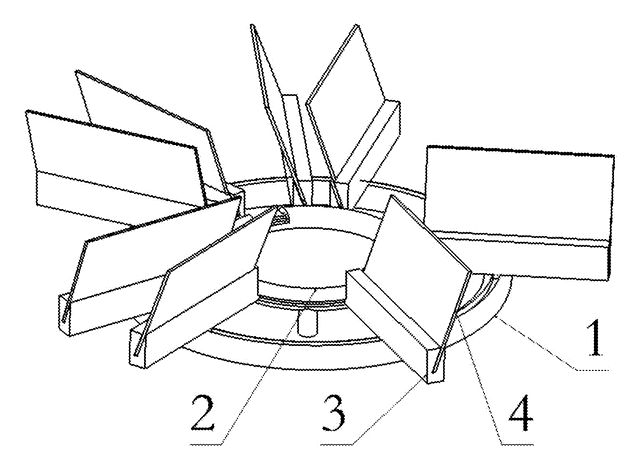
Carousel Business Card Holder with Rolling Card Trays on Twin Ring Tracks
Desk card holder: angled card trays roll on wheels around two concentric ring tracks and lift out.
Patent CN105774300B
Browse by category
- Apparel & Accessories (22)
- Baby & Kids (16)
- Bags & Luggage (9)
- Bath & Personal Care (16)
- Car Accessories (10)
- Furniture, Bedding & Storage (12)
- Garden & Outdoor (18)
- Health & Wellness (8)
- Home, Kitchen & Cleaning (24)
- Lighting (12)
- Packaging & Containers (6)
- Pet Products (6)
- Phone & Camera Accessories (4)
- Retail Display (13)
- School, Office & Art (19)
- Sports & Recreation (25)
- Tools & Workshop (27)
- Toys & Games (12)
This page is based on the public patent document CN105751782B, assigned to Yantai Nanshan University. IP2M is an independent manufacturing service and is not affiliated with, endorsed by or licensed by the patent owner. Images marked as concept renderings are illustrations, not photos of an existing product. Patent status information is provided for reference only and is not legal advice; confirm freedom to operate for your market before production. Full disclaimer.