At a glance
| Patent number | CN105815903B (application CN201610306499) |
| Type | China invention patent (发明专利) - protects product shape, structure and method |
| Original title | A kind of Windproof parasol (一种防风遮阳伞) |
| Patent owner | Individual |
| Inventors | Liu Xiangyu, Liu Jiucai |
| Filing date | 2016-05-11 |
| Grant date | 2018-01-26 |
| Status (China) | Lapsed - terminated for non-payment of annual fees (recorded 2026-05-12) |
| Patent family | Chinese filings only - no US, European, Japanese, PCT or other filings listed |
| Cited by | 3 later documents |
| Source | Google Patents (search for CN105815903B) |
What the claims cover, in plain language
Claim 1 - a windproof sunshade umbrella comprising a main support rod, an umbrella surface, and multiple auxiliary support rods that slide up and down along the main support rod via a sliding sleeve. The umbrella surface consists of multiple independent blade surfaces. When stretched, the blades are centered on the top of the main support rod and overlap longitudinally outward. Each blade is arranged obliquely along the circumferential direction. The tail of one blade and the head of the next are staggered vertically, forming a longitudinal gap. When the inner side receives wind, the umbrella surface and auxiliary support rods rotate around the main support rod. There are two groups of auxiliary support rods: the first group’s upper ends connect to the blade heads, and the second group’s ends connect to the blade tails of adjacent blades. The lower ends of the second group connect to the first group, and the lower ends of the first group connect to the sliding sleeve. The second group includes a telescopic locking mechanism to control the gaps. The main support rod is divided into a rotating rod and a fixed rod with a bearing between them; the sliding sleeve sits on the rotating rod when stretched.
Claim 2 - a disc that rotates around the main support bar is fixed by a bearing at the top of the main support bar. The umbrella surface connects to this disc via ribs, and the sliding sleeve can rotate on the main support rod. Claim 3 - a connecting belt is arranged between two blade surfaces. Claim 4 - the front ends of the multiple independent blade surfaces are connected by a skirt that joins them as a whole.
This is a simplified reading for orientation only. The legal scope is defined by the exact claim wording in the official Chinese document.
What this means for US production
This patent was filed only in China and is now lapsed due to non-payment of annual fees, so it no longer restricts anyone in China either. It has no US or other foreign counterpart.
Two points to settle early:
- Other patents may exist. Godox Photo Equipment Co., Ltd. holds a later European patent (EP4398033A4) citing this document, indicating ongoing patent activity in related fields. Wind-resistant umbrellas and vented canopies are covered by various US and international patents held by major outdoor furniture companies, so a freedom-to-operate (FTO) review of the rotating blade mechanism and bearing assembly is needed before tooling.
- Blade material and UV resistance. The patent describes the blade arrangement mechanically but does not specify fabrics or plastics; material selection for outdoor sun exposure and wind load must be confirmed on prototypes.
Customization and manufacturing
What can be customized
| Area | Options |
|---|---|
| Canopy diameter | To be confirmed in design based on target market (e.g., about 7 to 11 ft for commercial patios) |
| Blade count | Number of independent blade surfaces set in design to balance shade coverage and airflow |
| Materials | Aluminum or steel for rods; acrylic, polyester, or olefin for blades; POM or nylon for sleeves and bearings |
| Base interface | Standard round insert, bolt-down plate, or freestanding weighted base adapter |
| Colors and prints | Solid colors, stripes, or custom dye-sublimation per blade |
| Locking mechanism | Manual pin-lock, spring-loaded latch, or friction collar for the telescopic rod |
Things to plan for (US market)
- Pinch points and wind warnings - the two-group rib linkage and the telescopic locking struts create pinch points; on-product warnings should cover closing in high wind and securing the base.
- California Proposition 65 - fabrics, metal finishes, and plastic components must be screened for listed chemicals.
- Flammability standards - commercial buyers often require canopy fabrics to meet CPAI-84 or NFPA 701 flame resistance specifications.
How a project runs
- Inquiry - canopy size, blade count, materials, base type and quantity.
- Design - engineering drawings for the bearing joint, rod profiles, blade geometry and locking mechanism.
- Prototype - functional samples assembled to test rotation smoothness, gap adjustment and wind behavior.
- Pilot run - small batch for durability testing, fabric UV checks and flammability certification.
- Production - extrusion or roll-forming of poles, injection molding of plastic parts, fabric cutting and sewing, final assembly.
Quantities & timeline
The main support rod requires extrusion dies or tube-drawing tooling, the sliding sleeve and disc need precision injection molds, and the bearing assembly must be sourced to match the rod dimensions. Fabric blades require cutting dies and sewing jigs. Wind-tunnel or field testing takes most of the development phase. Send us your canopy size, blade count, material preferences, base type, quantity and target price and we will reply with options.
Patent drawings
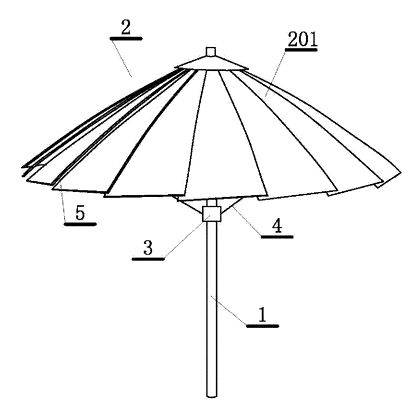
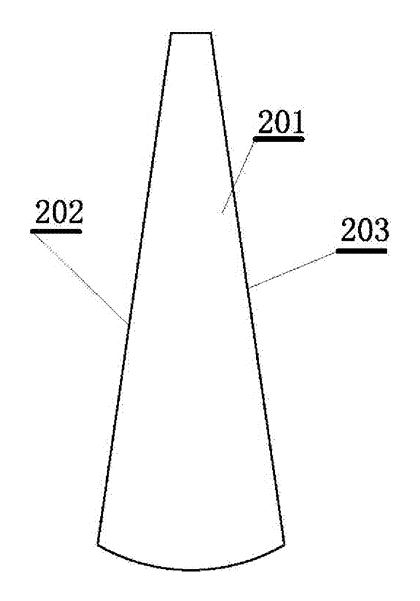
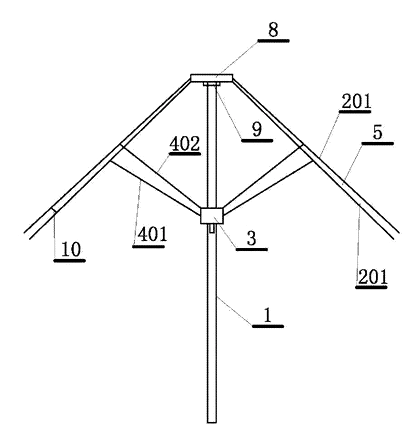
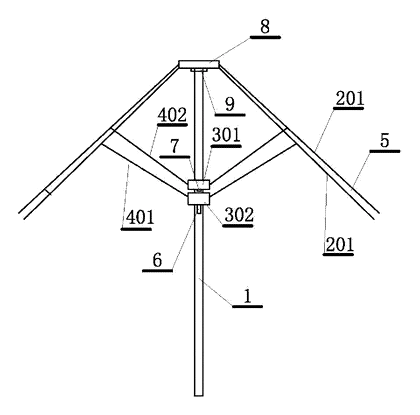
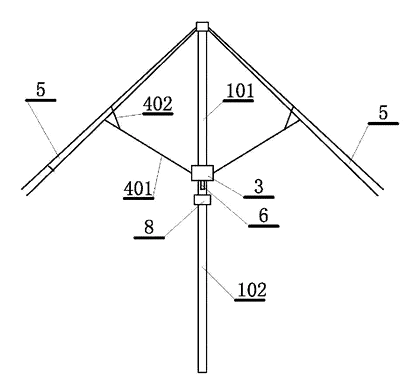
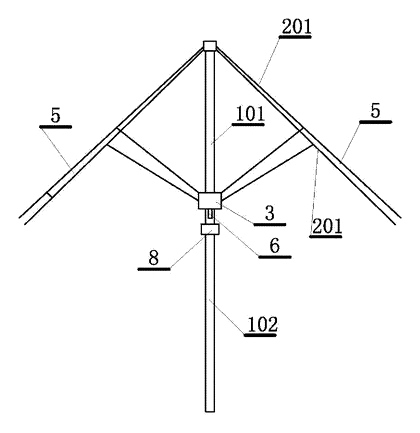
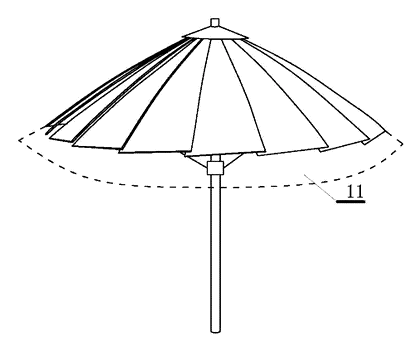
Drawings reproduced from the public patent document for reference.