At a glance
| Patent number | CN106113990B (application CN201610659024) |
| Type | China invention patent (发明专利) - protects new technical solutions |
| Original title | Card holder with rack and pinion engagement structure (带有齿轮齿条啮合结构的名片盒) |
| Patent owner | Anyang County Intellectual Property Operation Co Ltd |
| Inventors | Liu Qingquan |
| Filing date | 2016-08-11 |
| Grant date | 2019-01-22 |
| Status (China) | Active - In force until at most 2036-08-11 (if annual fees are paid) |
| Patent family | Chinese filings only - no US, European, Japanese, PCT or other filings listed |
| Cited by | 0 later documents |
| Source | Google Patents (search for CN106113990B) |
What the claims cover, in plain language
Claim 1 defines a card holder comprising a bottom plate, a business card box body, and two parallel arc-shaped racks. A connection cross bar is provided on the front top surface of the bottom plate. The box body includes a box body, a box cover, and two gears. The gears are rotatably connected to the top rear side of the box body. The lower end of the box cover is hinged to the top rear side of the box body. Rectangular protrusions are arranged on the left and right ends of the box cover. Rectangular openings are provided on the gears, arranged radially. The protrusions fit into the openings and are fixedly connected. The lower ends of the arc-shaped racks are permanently connected to the bottom plate. The front lower end of the box body is hinged to the connection cross bar. The gears mesh with the arc-shaped racks.
Claim 2 specifies that the holder further includes a distance rod. Both ends of this rod are vertically connected to the upper ends of the two parallel arc-shaped racks. This rod stabilizes the racks to prevent swinging or breaking and ensures the gears remain engaged.
This is a simplified reading for orientation only. The legal scope is defined by the exact claim wording in the official Chinese document.
What this means for US production
This patent was filed only in China and is currently active in China. Making or selling this specific design in China requires permission from the patent owner. However, since there are no corresponding patents in the US or Europe, the design itself is not restricted by this patent in those markets.
Two points to settle early:
- Other patents may exist. Mechanical office accessories and self-closing mechanisms are common fields. While this specific rack-and-pinion arrangement appears unique to this filing, broader patents covering “tilting storage containers” or “gravity-assisted lids” could apply. A freedom-to-operate (FTO) review is recommended before mass production for the US market.
- Material and Tolerance Sensitivity. The function depends heavily on the precise meshing of the gears and racks. If the materials warp or tolerances drift, the auto-close feature will fail. Prototype testing for mechanical reliability is critical.
Customization and manufacturing
What can be customized
| Area | Options |
|---|---|
| Materials | ABS, PP, or Metal (Aluminum/Steel) for durability and weight balance |
| Dimensions | Standard business card sizes (85x55mm, 90x50mm) or custom internal volumes |
| Finish | Matte, glossy, textured, or soft-touch coatings |
| Color | Pantone matching for corporate branding |
| Mechanism Tuning | Gear ratio and rack curvature adjusted for different lid weights |
| Base Design | Non-slip pads, weighted bottoms, or mounting holes for desks |
Things to plan for (US market)
- Consumer Product Safety Commission (CPSC): If marketed to children, ASTM F963 applies. For general office use, ensure small parts do not pose choking hazards if disassembled.
- California Prop 65: Screening for chemicals in plastics and finishes is required for sales in California.
- Durability Standards: While no specific federal standard exists for card holders, BIFMA (Business and Institutional Furniture Manufacturers Association) guidelines for office furniture durability can serve as a benchmark for cycle testing.
How a project runs
- Inquiry - Define target dimensions, material preferences, and estimated volume.
- Design - CAD modeling of the gear/rack interface and housing.
- Prototype - 3D printed or CNC machined samples to test the tilt-and-close mechanism.
- Pilot Run - Injection molding tool creation; assembly of first batch; quality control checks.
- Production - Mass manufacturing, packaging, and shipping.
Quantities & timeline
Injection molds for the box body, lid, and gears are necessary for cost-effective production. The arc-shaped racks may require specialized forming or molding depending on the material. Cycle testing to verify the auto-close functionality across temperature variations takes time. Send us your target quantity, material choice, and brand color requirements and we will reply with options.
Patent drawings
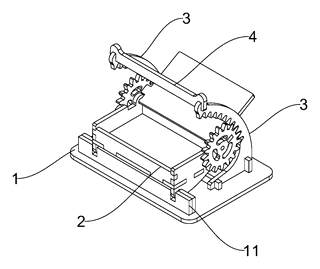
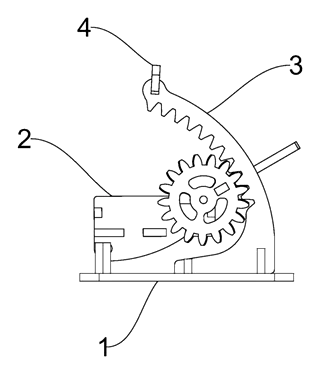
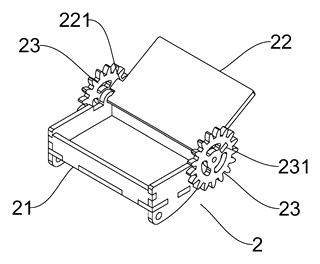
Drawings reproduced from the public patent document for reference.