
Patent CN106143332B
Updated November 6, 2026Wedge-Lock Roof Rack Clamp for Rooftop Tents
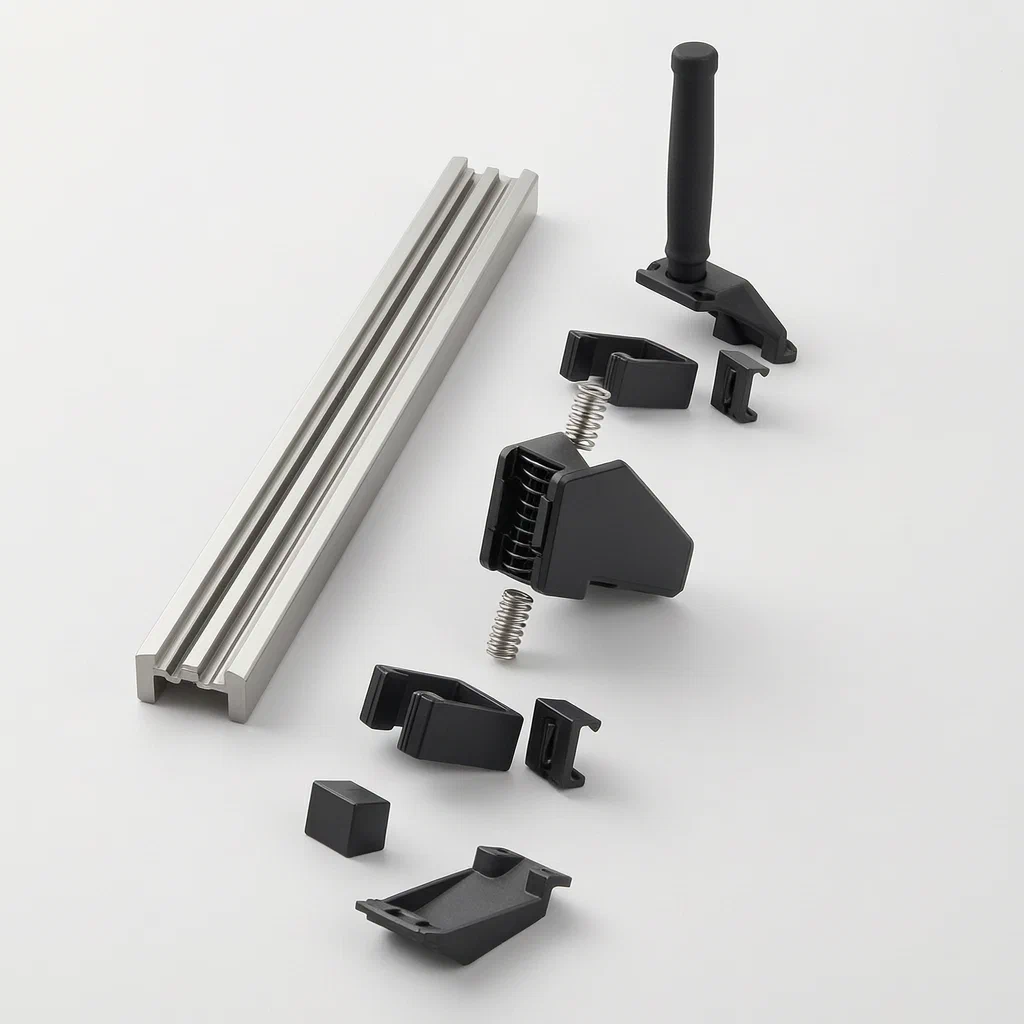
Mounting rooftop tents often requires complex brackets or loose bolts that vibrate over time. This design simplifies attachment with a self-tightening mechanism. Two symmetrical clamping blocks slide onto the tent base frame. Inside each block, a wedge-shaped piece interacts with a compression spring. When a single bolt is turned, it pushes the wedges apart, forcing the outer arms of the blocks to hug the roof rack tightly. This creates a rigid connection that resists loosening from road vibration, while allowing easy removal when needed.
- China invention patent - lapsed
- No filings outside China
- Automotive & outdoor gear
- Wedge-lock mechanism, compression springs, molded housings
Splat! What let you down?
🔒
Wedge-Lock Mechanism
Bolts drive internal wedges to expand clamp arms, securing the roof rack.
🛠️
Tool-Free Adjustment
Single-bolt tightening allows quick mounting and removal of the tent base.
🏕️
Vibration Resistant
Mechanical interference fit prevents loosening during off-road travel.
🔄
Modular Design
Clamps slide onto standard tent base channels for flexible positioning.
Bring this product to market
- ✓ Patent review Patent family and legal status reviewed in the relevant jurisdictions.
- 2 Product brief · now How it works, uses and options written up
- 3 Prototype First samples for buyers to review
- 4 Pilot run Small first batch for launch customers
- 5 Volume production Repeat orders at scale
Buyer interest
– of 100 buyers needed to start prototyping
One click, no sign-up. Each vote is one real visitor, and products with the most interest go to prototyping first.
Build team: no members yet. Need a partner, co-funding or skills to build this? Join and we introduce the team once it forms.
Patent Rights & Team Participation
Before joining a development team, participants should ensure they have the necessary rights or authorization to participate in the project.
Participation is generally appropriate where:
- You own the relevant patent rights or have obtained permission or a license from the rights holder.
- The relevant patent rights have expired or have been legally invalidated in the jurisdictions where the planned activities will take place.
- The planned development, manufacturing, and commercialization activities have been independently assessed and do not infringe applicable patent rights in the relevant jurisdictions.
Important: Being located outside a country where a patent is protected does not automatically exempt you from patent infringement risks. Patent rights may apply based on where development, manufacturing, use, sale, or import activities take place.
IP2M does not grant any patent license or authorization through team participation. Joining a project does not provide permission to use, manufacture, or commercialize patented technology.
The problem
Traditional roof rack mounts for rooftop tents often rely on friction-based clamps or multiple separate brackets. These systems can loosen due to vehicle vibration, especially on rough terrain. Installation typically requires holding heavy components in place while tightening several bolts, which is awkward and time-consuming. Additionally, many existing solutions lack a standardized way to attach securely to various roof rack bar profiles, leading to compatibility issues and potential safety concerns during high-speed travel.
The solution
The patent introduces a fixation kit consisting of two symmetrical clamping blocks and a central bolt.
- Clamping Blocks: Each block has an upper section that slides into a channel on the rooftop tent base and a lower section with arms that embrace the roof rack bar.
- Internal Wedges: Inside each block, a wedge-shaped locking piece is positioned against a compression spring.
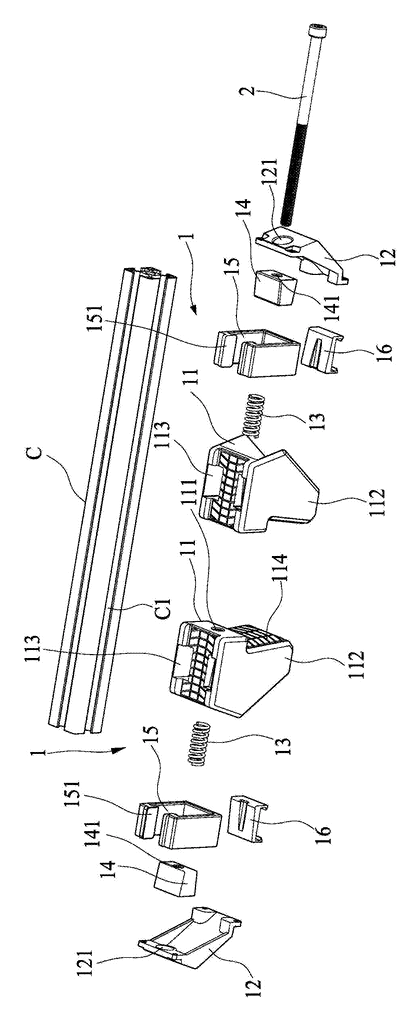
- Bolt Action: A single bolt passes through both blocks. Turning the bolt drives the wedges inward, causing them to push against inclined surfaces within the block housing.
- Expansion: This action forces the lower arms of the blocks outward, creating a tight grip on the roof rack bar.
- Release: Loosening the bolt allows the springs to retract the wedges, releasing the grip for easy removal.
Who it is for
- Outdoor Gear Brands looking to differentiate their rooftop tents with a faster, more secure mounting system.
- Overland Vehicle Builders who need reliable attachments that withstand harsh trail conditions.
- RV and Camper Suppliers offering add-on roof tent packages for existing vehicles.
- DIY Enthusiasts seeking a simple, tool-light upgrade for their current roof setup.
How it works
The main parts
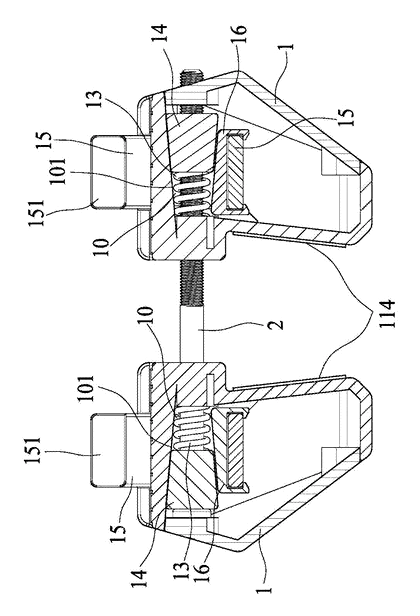
| No. | Part | What it does |
|---|---|---|
| 1 | Clamping Block | Main housing that holds the wedge and arms. |
| 11 | Front Housing | Contains the front half of the cavity and slide arm. |
| 12 | Rear Housing | Covers the back, completing the cavity. |
| 13 | Compression Spring | Pushes the wedge back when the bolt is loosened. |
| 14 | Wedge-Shaped Locking Piece | Drives the arms outward when pushed by the bolt. |
| 15 | U-Shaped Block | Forms the upper sliding arm that fits into the tent base. |
| 16 | Inclined Plane Clip | Provides the surface for the wedge to act against. |
| 2 | Bolt | Central fastener that activates the wedging action. |
Operating Steps
- Position: Slide the clamping blocks into the designated channels on the rooftop tent base.
- Align: Place the tent base onto the vehicle’s roof rack crossbars.
- Insert Bolt: Pass the bolt through the aligned holes in the front housing, wedge, spring, rear housing, and the second block.
- Tighten: Turn the bolt. The head pushes the first wedge, which moves along the inclined plane, expanding the lower arms around the rack bar. Simultaneously, the second wedge is pulled in, also expanding its arms.
- Secure: Continue tightening until the arms firmly grip the rack. The compression springs maintain tension to resist vibration-induced loosening.
Applications
Overlanding Vehicles
Drivers frequently traverse uneven terrain where standard bolts may loosen. This clamp maintains a consistent grip on the roof rack, ensuring the tent remains stable during off-road excursions without constant re-torquing.
Weekend Camping Trips
Campsites often require quick setup. Users can remove the tent base from the car for storage or swap between different vehicles easily. The single-bolt mechanism reduces setup time compared to multi-bracket systems.
Rental Fleet Management
Companies renting out rooftop tents need durable, easy-to-service equipment. The modular nature of the clamps allows for rapid inspection and replacement of worn parts without disassembling the entire tent structure.
Urban Commuter Storage
For users who store their tents indoors to save space, the ability to quickly detach the tent from the car is crucial. This design facilitates frequent mounting and demounting cycles without damaging the vehicle’s paint or the rack.
Where it is less suitable
- Heavy Industrial Racks: Extremely wide or irregularly shaped commercial racks may not fit the standard clamp arm span.
- Permanent Installations: If the tent is never removed, simpler fixed brackets might be cheaper and equally effective.
- Non-Standard Tent Bases: Tents without compatible sliding channels would require custom adapters, negating the ease-of-use benefit.
Patent & Production
At a glance
| Patent number | CN106143332B (application CN201610573983) |
| Type | China invention patent (发明专利) - protects product structure and method |
| Original title | Luggage Carrier Fixation Kit (行李架固定组件) |
| Patent owner | Autumn Field (xiamen) Outdoor Equipment Technology Co Ltd |
| Inventors | Zhou Nanqing, Mao Muhua, Chen Ming |
| Filing date | 2016-07-21 |
| Grant date | 2018-07-06 |
| Status (China) | Lapsed - terminated for non-payment of annual fees (recorded 2025-07-18) |
| Patent family | Public record shows Chinese filings only - no US, European, Japanese, PCT or other filings listed |
| Cited by | 1 later document |
| Source | Google Patents (search for CN106143332B) |
What the claims cover, in plain language
Claim 1 defines a luggage carrier fixation kit matching a rooftop tent pedestal. It includes two opposite clamping blocks and a bolt. The blocks slide onto the pedestal via upper arms forming a slot. Lower arms form a clamp. The bolt passes through both blocks, changing the distance between the lower arms to grip the roof rack. Each block contains a front and rear housing, a compression spring, and a wedge-shaped closing piece. The housing forms a cavity with an inclined seat for the wedge. The wedge has a threaded hole for the bolt. The front surface of the clamp arm may have male/female patterns for grip.
Claims 2-6 detail specific implementations: the use of a U-shaped block to form the upper arms, the inclusion of an inclined-plane clip to create the seat for the wedge, and variations in how the sliding slot is integrated into the tent base (on the frame, crossbar, or via a connecting rod).
This is a simplified reading for orientation only. The legal scope is defined by the exact claim wording in the official Chinese document.
What this means for US production
This patent was filed in China and has lapsed, so it no longer restricts anyone in China either. The public record shows no US or other foreign counterpart.
Two points to settle early:
- Other patents may exist. Roof rack accessories are a competitive field with numerous active patents covering various clamping mechanisms, quick-release levers, and anti-theft features. Notably, iKamper Co., Ltd. and Qiye Di (Xiamen) Outdoor Equipment Technology Co., Ltd. have cited this patent in subsequent filings (EP4141199A4 and WO2018014273A1), indicating they hold related intellectual property in this space. A freedom-to-operate (FTO) review is essential before mass production to ensure no infringement of these or other third-party rights.
- Material and Safety Standards. The structural integrity of the clamp under dynamic loads must meet automotive industry standards, which may influence material choices beyond what the patent strictly specifies.
Customization and manufacturing
What can be customized
| Area | Options |
|---|---|
| Housing Material | High-strength ABS, PC, or aluminum alloy for weight/strength balance |
| Finish | Textured black, matte gray, or custom brand colors |
| Arm Geometry | Adjusted to fit round, square, or aerodynamic roof rack bars |
| Spring Rate | Tuned for specific preload requirements |
| Bolt Type | Standard hex, security torx, or integrated knob for hand-tightening |
Things to plan for (US market)
- SAE J1401 / SAE J1263: While not directly applicable to aftermarket accessories, general automotive durability and corrosion resistance principles apply.
- Consumer Product Safety Commission (CPSC): Ensure no sharp edges or pinch points violate general safety guidelines.
- California Prop 65: If plasticizers or specific metal finishes are used, screening is required.
How a project runs
- Inquiry - Define target roof rack types and tent base dimensions.
- Design - CAD modeling of the wedge mechanism and housing integration.
- Prototype - 3D printed functional samples for fit checks in a vehicle.
- Pilot Run - Injection molding trials and heat-cycle testing.
- Production - Mass molding, spring assembly, and quality control.
Quantities & timeline
Molds for the front and rear housings are the primary lead-time driver. Spring coiling and machining of the wedge pieces follow. Assembly tolerance is critical for smooth operation. Send us your target materials, finish preferences, quantity estimates and we will reply with options.
Production notes
Tooling and process
Injection molding is likely required for the complex geometry of the front and rear housings. Aluminum machining could be an alternative for higher-strength applications, depending on the final design.
Cost drivers
Tooling complexity is significant due to the internal cavities for the wedge and spring. Heat-resistant material grades may increase costs if exposed to direct sunlight in closed environments.
Prototyping path
We would typically start with 3D-printed fit checks in a vehicle to validate the sliding interface. Follow with functional samples to test the wedge engagement and release cycle.
What we would change before tooling
We would likely review the wall thickness and joint design to prevent deformation under load. Ensure thread engagement tolerances allow for easy bolt insertion without stripping.
Common failure points
Deformation in cabin heat is a risk for plastic housings. Poor fit at gaps could cause rattling. Spring fatigue and rate consistency must be monitored to maintain clamping force over time.
Patent drawings
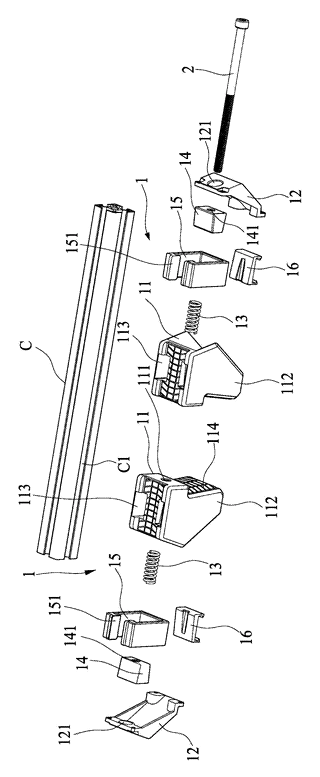
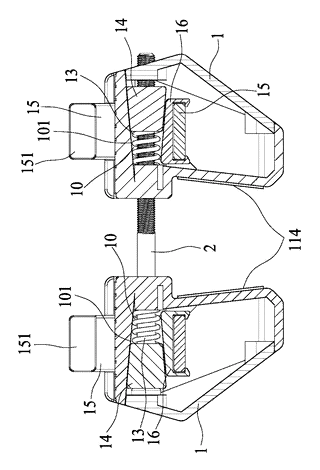
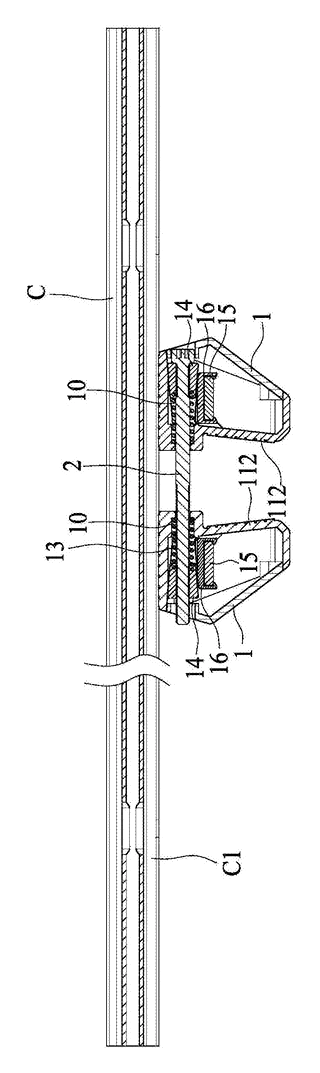
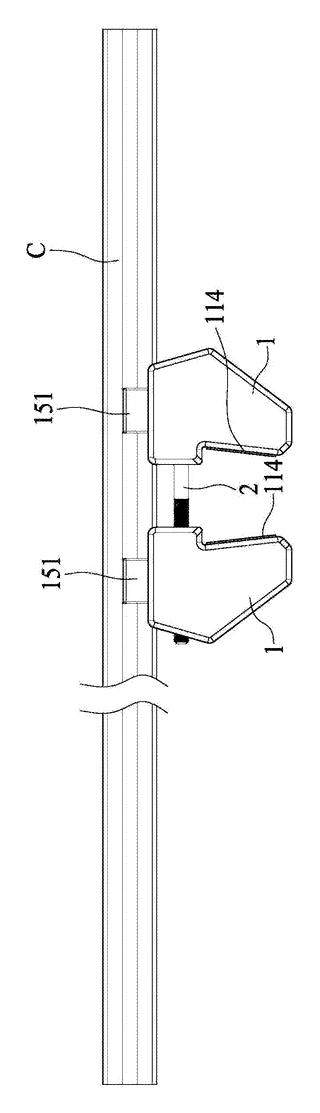
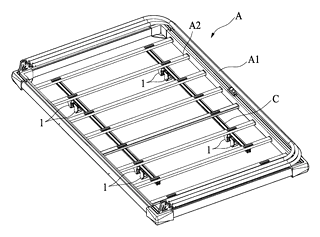
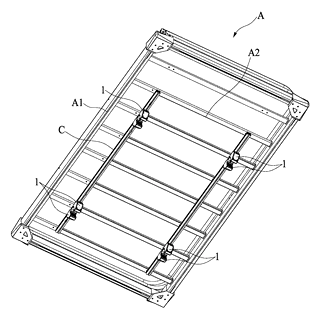
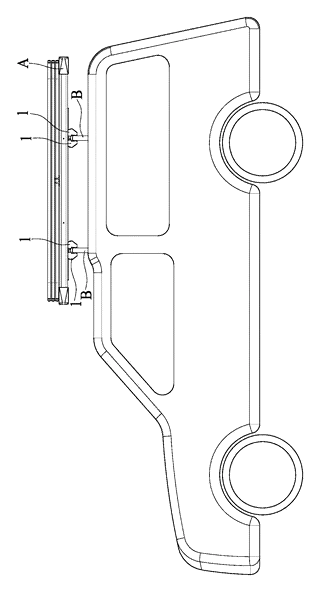
Drawings reproduced from the public patent document for reference.
Frequently asked questions
How does the clamp stay tight?
The design uses a wedge mechanism. When you tighten the bolt, it pushes internal wedges against inclined surfaces. This forces the outer arms of the clamp to expand outward, gripping the roof rack bar tightly. Compression springs help maintain this pressure, resisting loosening from vibrations.
Is it difficult to install?
No. You slide the clamping blocks into the channels on your tent base. Then, position the tent on the roof rack and insert the bolt. Tightening the bolt secures the whole assembly. It requires only one common tool (wrench or socket) for the initial setup.
Will it damage my roof rack?
The clamp arms are designed to embrace the rack bar. To prevent scratching, manufacturers often add rubber pads or use softer materials on the contact surfaces. The patent mentions textured surfaces for grip, but protective coatings are typically added in production to ensure paint safety.
Can I use it on any roof rack?
It depends on the size of your roof rack crossbars. The clamp arms have a specific range of motion. You need to confirm the inner width of the clamp matches your rack’s profile. Custom adjustments to the arm geometry are possible during manufacturing.
What happens if the spring breaks?
The spring provides return force for the wedge. If it fails, the clamp may still hold when tightened, but releasing it becomes harder, and vibration resistance decreases. Springs are standard industrial components chosen for fatigue life; replacement kits are usually available.
Is this safe for high speeds?
The mechanical lock is robust, but safety relies on correct installation. The patent describes a positive interference fit. For US sales, adherence to general automotive accessory stability standards is recommended. Always check torque specifications provided by the manufacturer.
Can this design be made and sold in the US?
The patent was filed in China and has lapsed, and the public record shows no US counterpart, so it does not restrict the design in the US or in China. However, roof rack technology is heavily patented globally. We recommend a freedom-to-operate check to avoid infringing on active US patents held by companies like iKamper or others in the outdoor sector.
Are you affiliated with the patent owner?
No. IP2M is an independent design and manufacturing service working from the public patent document.
Request a quote
Click Request a Quote below to see our email address - copy it, or open your email app with a ready-made message. Please mention patent CN106143332B in the subject.
Helpful details to include:
- Your company and channel (outdoor brand, auto accessory distributor, custom builder)
- Target roof rack types (round, square, aero bars) and tent base dimensions
- Material preference (ABS, PC, Aluminum) and finish
- Estimated quantity and target price
- Timeline - when you would like prototypes and the first shipment
You can also reach us at (332) 203-9997.
Page editor: Emily Zhang, Product Editor · IP2M
Last updated November 6, 2026. If something on this page looks wrong, email [email protected] and we will check it against the patent.
Interested in building this?
Tell us your target market, quantity and timeline. We reply with options for prototyping, small-batch runs or volume production.
Send your inquiry to
Please put CN106143332B in the subject line and tell us your company, country, estimated quantity and timeline.
Prefer to talk? Call (332) 203-9997.
More product-ready patents
All Car Accessories patents →
Car Accessories
Car Headrest Pillow with Ratchet Side Wings and Push-Button Reach
Post-mounted car headrest pillow with ratchet side wings and a push-button forward adjustment.
Patent CN212195197U
Car Accessories
Hard-Shell Rooftop Tent That Doubles as a Cargo Box
Roof box whose hard frames lift on gas struts into a tent with door and skylight, and fold back for luggage.
Patent CN206327275U
Car Accessories
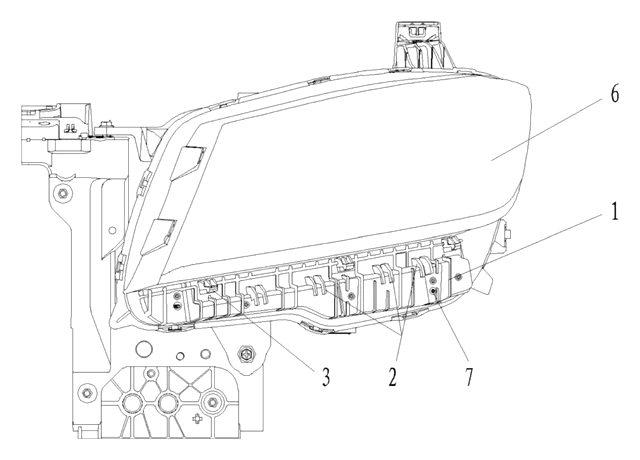
Headlamp-to-Bumper Adapter Bracket That Sets Gap and Flush in Three Directions
Molded bracket under the headlamp: support blocks and snap teeth locate the bumper flange for an even gap.
Patent CN216580316U
Car Accessories
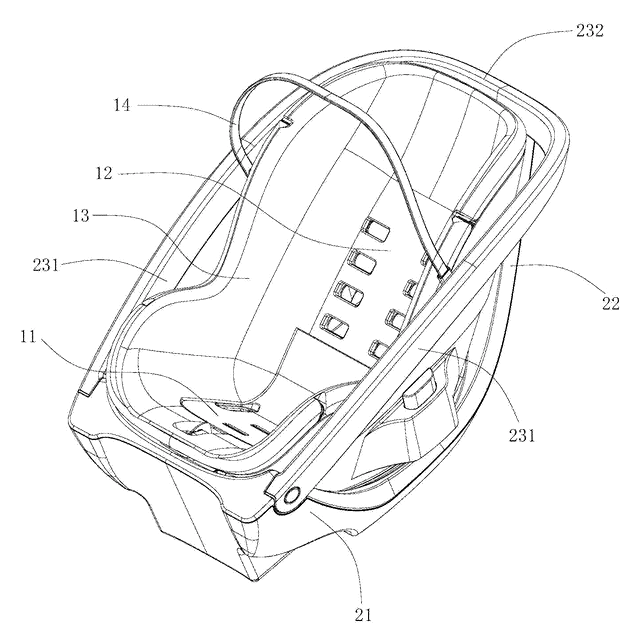
Infant Car Seat with a Load-Bearing Base That Wraps the Carrier
Infant car seat whose base has a backrest and swing-up side rails, so the carrier can be lighter.
Patent CN206383856U
Car Accessories
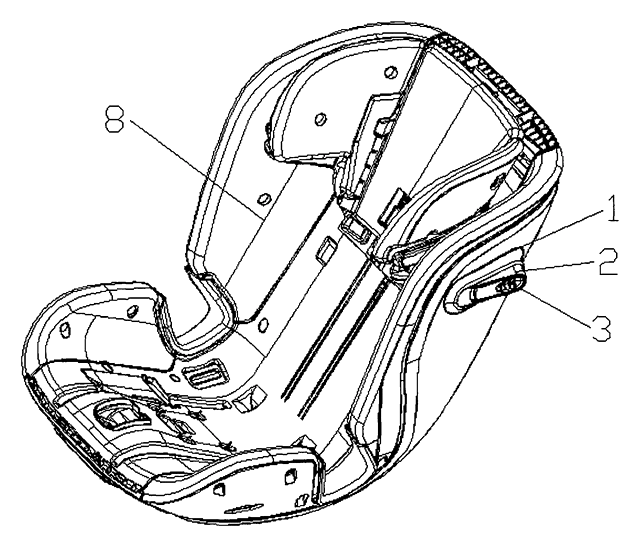
Retractable Side Impact Protection Block for Child Car Seats
Retractable side-impact block for child seats: springs out to provide side-impact buffering, folds flat.
Patent CN207028930U
Car Accessories
Rain-Deflecting Side Mirror with a Pivoting Air-Guide Plate
Side mirror with a top air duct and folding guide plate that directs airflow across the glass.
Patent CN207345672U
Browse by category
- Apparel & Accessories (45)
- Baby & Kids (28)
- Bags & Luggage (16)
- Bath & Personal Care (30)
- Car Accessories (24)
- Furniture, Bedding & Storage (23)
- Garden & Outdoor (31)
- Health & Wellness (13)
- Home, Kitchen & Cleaning (48)
- Lighting (22)
- Packaging & Containers (12)
- Pet Products (11)
- Phone & Camera Accessories (9)
- Retail Display (24)
- School, Office & Art (34)
- Sports & Recreation (44)
- Tools & Workshop (53)
- Toys & Games (22)
This page is based on the public patent document CN106143332B, assigned to Autumn Field (xiamen) Outdoor Equipment Technology Co Ltd. IP2M is an independent manufacturing service and is not affiliated with, endorsed by or licensed by the patent owner. Images marked as concept renderings are illustrations, not photos of an existing product. Patent status information is provided for reference only and is not legal advice; confirm freedom to operate for your market before production. Full disclaimer.