At a glance
| Patent number | CN106144192B (application CN201610782184) |
| Type | China invention patent (发明专利) - protects product shape, structure and method |
| Original title | A kind of cylindrical plastic bottle cap with soup ladle and the plastics for manufacturing the bottle cap (一种带汤勺的圆柱形塑料瓶盖及制造该瓶盖的塑料) |
| Patent owner | Shandong Loqi Intelligent Technology Co Ltd |
| Inventors | Cao Rongrong, Cao Wenling, Cao Lixin |
| Filing date | 2016-08-31 |
| Grant date | 2017-10-10 |
| Status (China) | In force in China until at most 2036-08-31 (if annual fees are paid) |
| Patent family | Chinese filings only - no US, European, Japanese, PCT or other filings listed |
| Cited by | 2 later documents |
| Source | Google Patents (search for CN106144192B) |
What the claims cover, in plain language
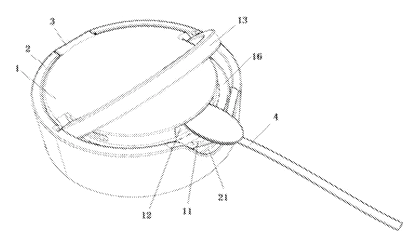
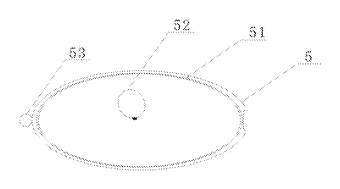
Claim 1 - a cylindrical plastic bottle cap with a soup ladle, comprising a hollow cylindrical fixed lid (2) that connects to a bottle neck. An annular flange (22) is set in the middle of the fixed lid’s inner wall, with an easy tearing lid (23) inside the flange, connected by an easily tearing structure and having a draw ring (24). A concave arc bayonet socket (21) is at the front end of the fixed lid’s top. A turnover lid (1) is hinged at the rear end of the fixed lid’s top. The turnover lid fastens into the storage tank formed by the easy tearing lid and the fixed lid wall, featuring an annular inner ring (15) and a catching groove that mates with the fixed lid’s flange. A soup ladle chamber (12) is inside the turnover lid, with an opening blocked by a pull-up handle (13) seated in a groove. An arc block tongue (11) on the turnover lid locks into the arc bayonet socket. Below the easy tearing lid, a circular closure (5) is hinged to the fixed lid’s inner wall, with a diameter larger than the flange’s inner diameter. An annular elastic sealing strip (51) on the closure fits into a seal groove on the flange’s lower surface. A globe joint (53) on the closure opposite the hinge fits into a spherical groove on the fixed lid wall via an interference fit, allowing the closure to hang vertically under its own weight when released. A shackle (52) is provided on the closure’s upper surface.
Claim 2 - the groove for the handle is semicircular; both ends of the handle (13) are hingedly connected to bearing pins (14) on the left and right sides of the turnover lid, which match corresponding necks (25) on the fixed lid. Claim 3 - the arc bayonet socket (21) is positioned directly opposite the pin joint connecting the fixed lid and turnover lid. Claim 4 - the draw ring (24) is located at the front end of the easy tearing lid (23).
This is a simplified reading for orientation only. The legal scope is defined by the exact claim wording in the official Chinese document.
What this means for US production
This patent was filed only in China and is currently in force in China until at most 2036-08-31 (if annual fees are paid). It has no US or other foreign counterpart. However, making or selling this specific cap design in China needs the owner’s permission while the patent remains in force.
Two points to settle early:
- Other patents may exist. Closure mechanisms with integrated spoons or tamper-evident bands are widely patented. Notably, Sharkninja Operating Llc holds a later US patent in this field (US12005408B1) that cites this Chinese document. A freedom-to-operate (FTO) review of the hinge geometry, tear-strip arrangement and globe-joint locking mechanism is necessary before committing to tooling for the US market.
- Material formulation. The patent specification describes a detailed plastic compound involving modified montmorillonite, polyethylene, polyamide, glass fiber and other additives mixed via twin-screw extrusion. If you intend to use this exact material recipe, verify its compliance with US food-contact regulations, or substitute a standard FDA-compliant resin.
Customization and manufacturing
What can be customized
| Area | Options |
|---|---|
| Neck finish | Diameter and thread profile to match existing bottle preforms |
| Ladle size | Volume and shape of the soup ladle (4) and chamber (12) |
| Tear strip | Pull-ring shape, perforation depth and tear force |
| Sealing strip | Material and durometer of the elastic sealing strip (51) |
| Colors | Multi-color molding for the turnover lid, fixed lid and closure |
| Material | Standard food-grade PP/PE, or the modified montmorillonite compound described in the patent |
Things to plan for (US market)
- FDA 21 CFR 177 - any plastic resin or additive contacting food must comply with US Food and Drug Administration indirect food additive regulations.
- CPSC / Poison Prevention Packaging Act (PPPA) - if the cap will be used for products requiring child-resistant packaging, the flip-top and globe-joint mechanism must be evaluated against 16 CFR 1700 testing protocols.
- California Prop 65 - the specific plastic compound described in the patent includes antimony oxide and other chemicals; screening is required for California sales.
How a project runs
- Inquiry - bottle neck dimensions, ladle capacity, target materials and annual volumes.
- Design - 3D modeling of the turnover lid, fixed lid, closure and hinge joints to ensure proper snap-fit forces.
- Prototype - CNC or printed samples to test the arc block tongue engagement, globe joint interference fit and tear-ring ergonomics.
- Pilot run - injection mold trials, top-load testing, seal integrity tests and drop tests.
- Production - multi-cavity injection molding, assembly of the hinge pins and closure, inline quality checks on the sealing strip seating.
Quantities & timeline
Each cap assembly consists of multiple interlocking parts (turnover lid, fixed lid, easy tearing lid, closure, handle, ladle), requiring separate injection molds or a complex family mold. Tooling for the hinge bearing pins and the globe joint sockets demands tight tolerances to achieve the specified interference fit. Certification tests for food contact and seal integrity add time before the first shipment. Send us your bottle neck specs, ladle volume, material preference, estimated quantity and target price and we will reply with options.
Patent drawings
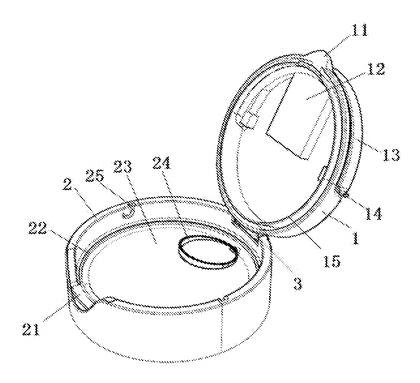
Drawings reproduced from the public patent document for reference.