At a glance
| Patent number | CN106388234B (application CN201610887753) |
| Type | China invention patent (发明专利) - protects product shape, structure and method |
| Original title | Portable drinking water bag (便携式饮水水袋) |
| Patent owner | Zhongshan Himalaya Outdoor Production Co ltd |
| Inventors | Lin Wenming, Lin Ling |
| Filing date | 2016-10-12 |
| Grant date | 2021-11-12 |
| Status (China) | In force - In force in China until at most 2036-10-12 (if annual fees are paid) |
| Patent family | Chinese filings only - no US, European, Japanese, PCT or other filings listed |
| Cited by | 0 later documents |
| Source | Google Patents (search for CN106388234B) |
What the claims cover, in plain language
Claim 1 - a portable drinking water bag comprising an outer bag, an inner bag, and a water taking component. The outer bag sleeves outside the inner bag. The water taking component includes a fixed disc, a fixed body, a water taking needle head, a one-way valve, and a water taking cover. The lower surface of the fixed disc is a downward-arched arc-shaped surface and connects to the fixed body by rotation or sliding. A sealed space forms among the fixed disc’s lower surface, the fixed body, the outer bag, and the top of the inner bag. The fixed body’s bottom attaches to the outer bag’s top via a threaded, clamping, or rotating connection. The water taking needle head connects to the fixed disc, with its bottom extending into the inner bag’s top. The one-way valve connects to the top of the needle head. The hemispherical water taking cover rotates on the fixed body’s top. A water taking pipeline connects to the needle head’s top, housing the one-way valve inside the cover. The inner bag includes a sealed plastic film bag body and a clamping ring (plastic, rubber, or silica gel) at its top. The outer bag’s inner wall has a groove or step surface to secure the clamping ring.
This is a simplified reading for orientation only. The legal scope is defined by the exact claim wording in the official Chinese document.
What this means for US production
This patent was filed only in China and is currently in force there. It has no US or other foreign counterpart. However, because it is active in China, making or selling this specific double-bag structure with the described intake assembly in China needs the owner’s permission.
Two points to settle early:
- Other patents may exist. Hydration bladders and portable water containers are actively patented fields globally. Even though no foreign patents cite this specific Chinese document, other companies hold US and international patents covering one-way valves, bite valves, and multi-layer hydration bags. A freedom-to-operate (FTO) review focused on the valve mechanism and double-bag configuration is recommended before tooling.
- Material selection for the inner bag. The patent specifies a plastic film bag. For US food-contact applications, the exact film formulation must be selected early to meet regulatory requirements and pass migration testing.
Customization and manufacturing
What can be customized
| Area | Options |
|---|---|
| Capacity | Volume to be confirmed in design based on target use |
| Outer bag material | Fabric type, thickness, and color to be confirmed in design |
| Inner bag film | Plastic film grade selected for flexibility and food-contact compliance |
| Clamping ring | Plastic, rubber, or silica gel ring as specified in the patent |
| Needle head tip | Inclined opening or conical surface with a through hole |
| Connection type | Threaded, clamping, or rotating joint between the fixed body and outer bag |
| Cover shape | Hemispherical as described, with custom colors or surface textures |
Things to plan for (US market)
- FDA 21 CFR - any plastic film, silicone ring, or valve material contacting drinking water must comply with US Food and Drug Administration regulations for food-contact substances.
- California Proposition 65 - plastics, films, and printed outer bags must be screened for listed chemicals to avoid mandatory warning labels.
- CPSC / CPSIA - if the product is marketed for children aged 12 and under, it must meet lead and phthalate limits and undergo third-party testing.
How a project runs
- Inquiry - confirm capacity, materials, connection type, and target audience.
- Design - engineer the outer bag pattern, inner bag film dimensions, fixed disc arch profile, and valve integration.
- Prototype - produce samples to test the sealing space, the tensioning effect of the arched disc, and the one-way valve function.
- Pilot run - conduct drop tests, leak tests, and submit materials for food-contact certification.
- Production - cut and sew the outer bag, blow or seal the inner film, mold the fixed disc and body, assemble the valve and pipeline, and package.
Quantities & timeline
Manufacturing requires cutting dies or sewing patterns for the outer bag, heat-sealing tooling for the plastic film inner bag, and injection molds for the fixed disc, fixed body, needle head, and hemispherical cover. The one-way valve components may be sourced or molded depending on the chosen design. Certification tests for food-contact materials add time to the initial schedule. Send us your target capacity, preferred materials, quantity, and timeline and we will reply with options.
Patent drawings
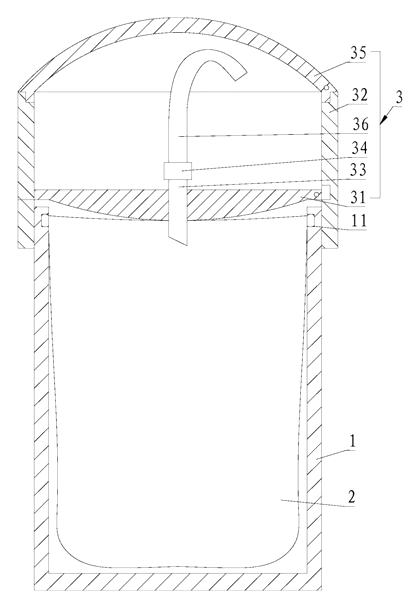
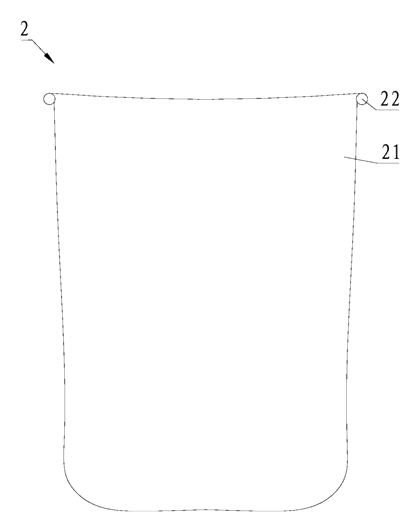
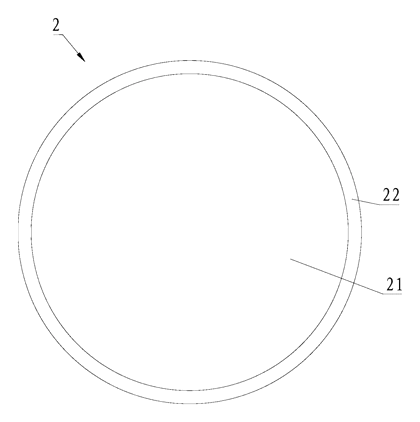
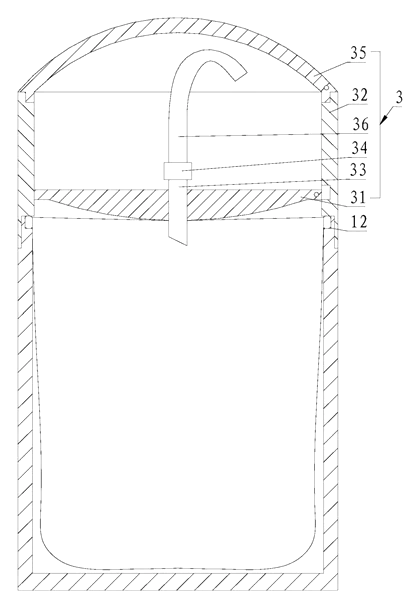
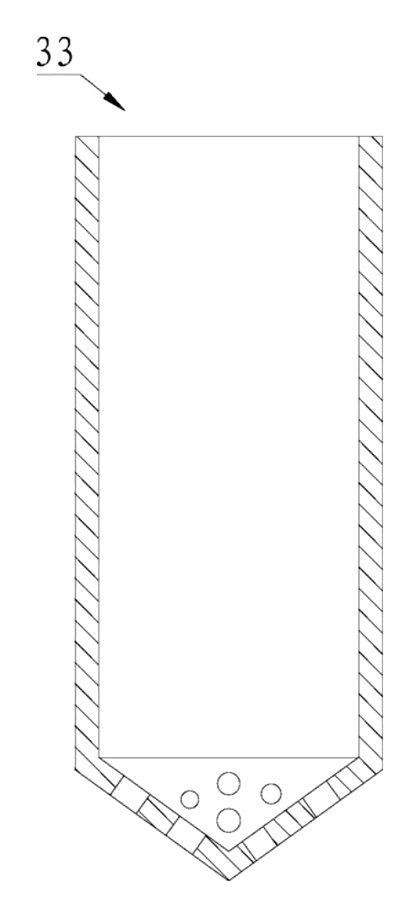
Drawings reproduced from the public patent document for reference.