
Patent CN106618998B
Updated October 26, 2026Shoulder-Detecting Massage Chair Mechanism with Forked Swing Arms
Standard massage chairs run the same program regardless of where a user's shoulders sit, often pressing too high on the neck or too low on the upper back. This design solves that alignment issue mechanically. Each massage assembly carries two pairs of swing arms—one upper, one lower—angled to form a fork opening shaped to clamp around the shoulder. Soft rubber rollers at the ends of the arms contact the body. Because the assembly is mounted on a cylindrical boss via a guide component, it can turn over when the user's back presses against just one swing arm. A trigger piece on the assembly interacts with a position sensor (such as a photoelectric or Hall sensor) on the base. When the assembly tilts to a set position, the sensor sends a signal to the control circuit's judgment module. The system reads this signal as shoulder information and commands the driving device—a motor, transmission mechanism, shaft, and cylindrical cam—to deliver a massage routine matched to the detected shoulder height.
- China invention patent - in force
- No filings outside China
- Massage & wellness hardware
- Motor-driven cylindrical cam, photoelectric or Hall sensors
Splat! What let you down?
🦾
Forked swing arms
Upper and lower arms incline toward each other to form a fork opening that clamps around the user's shoulder.
🔄
Overturn detection
The assembly turns over when pressed by one arm; a sensor reads this tilt to find the shoulder position.
⚙️
Cylindrical cam drive
A motor drives a cylindrical cam via a transmission shaft to move the massage assemblies inward and outward.
🎛️
Auto-adjusting circuit
The control circuit uses the detected shoulder information to select a suitable massage operation automatically.
Bring this product to market
- ✓ Patent vetted China-only family and legal status checked
- 2 Product brief · now How it works, uses and options written up
- 3 Prototype First samples for buyers to review
- 4 Pilot run Small first batch for launch customers
- 5 Volume production Repeat orders at scale
Buyer interest
– of 100 buyers needed to start prototyping
One click, no sign-up. Each vote is one real visitor, and products with the most interest go to prototyping first.
Build team: no members yet. Need a partner, co-funding or skills to build this? Join and we introduce the team once it forms.
The problem
Users of different heights sit in standard massage chairs, but the mechanical rollers follow a fixed path. If the rollers do not align with the user’s actual shoulder line, the massage heads press against the neck vertebrae or miss the trapezius muscles entirely. Manual adjustment requires the user to stop the session, change settings, and restart, which interrupts the experience. Relying solely on optical sensors or pressure mats adds electronic complexity and cost without solving the physical alignment of the rollers to the shoulder contour.
The solution
This massage machine places a moving core inside a backrest seat. The core contains at least one pair of massage assemblies driven by a motor, transmission mechanism, transmission shaft, and cylindrical cam.
- Forked swing arms - Each assembly has two pairs of arms arranged at upper and lower positions along the length of the user’s back. The arms incline toward each other to create a fork opening sized to clamp the shoulder.
- Soft rubber rollers - The ends of the swing arms hold massage heads made of soft rubber that abut the body during operation.
- Movable mounting - The assembly sits on a cylindrical boss extending from a guide component. A tensioning spring and a limiting structure (an arc-shaped notch and a stop block) keep it stable but allow it to turn over in the thickness direction of the back when the user leans against only one swing arm.
- Sensor detection - A trigger piece (such as a shading sheet or magnet) on the assembly interacts with a position sensor (photoelectric or Hall sensor) on the base. When the assembly tilts to a set position, the sensor generates an electrical signal.
- Automatic adjustment - A judgment module in the control circuit processes this signal to generate shoulder information, directing the core to perform a massage operation suited to the user’s specific shoulder placement.
Who it is for
- Massage chair brands looking for a mechanical shoulder-detection method to integrate into their premium or mid-range seating lines.
- Contract furniture manufacturers supplying wellness centers, airports, or corporate breakrooms where users of varying sizes share the same equipment.
- Amazon private-label sellers sourcing differentiated massage chairs with automatic fit features to stand out in a crowded catalog.
- Wholesalers and distributors of health and wellness electronics seeking mechanisms that reduce manual calibration steps for the end user.
How it works
The main parts
| No. | Part | What it does |
|---|---|---|
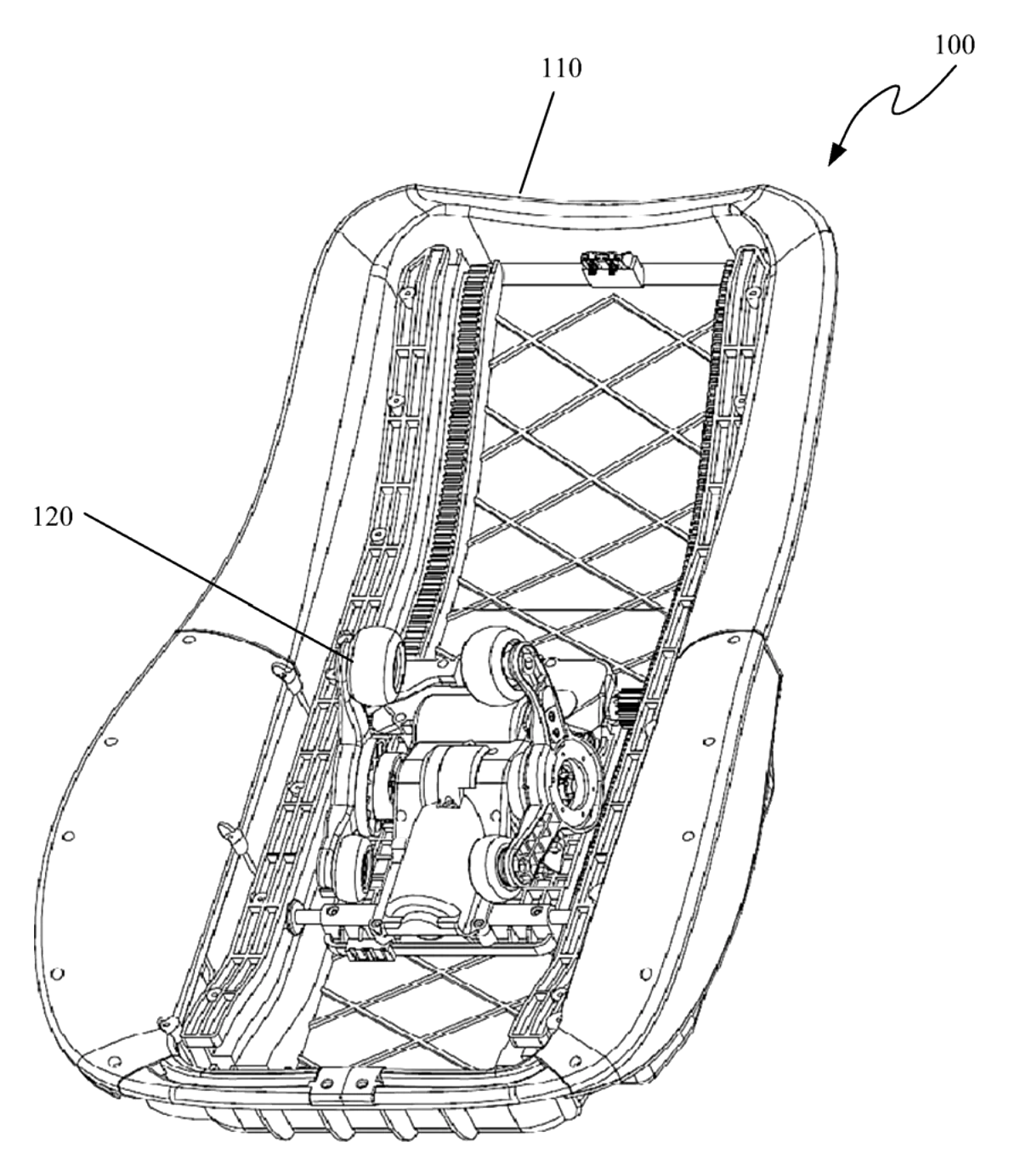
| 110 | Backrest | Houses the moving core. |
| 120 | Massage movement | Travels up and down inside the backrest. |
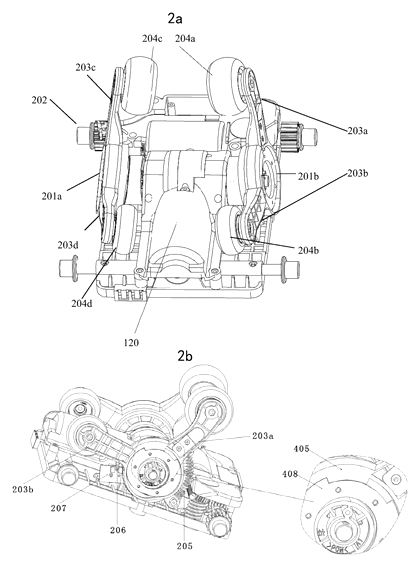
| 201a, 201b | Massage assemblies | Move toward or away from each other across the back width. |
| 202 | Driving device | Motor, transmission mechanism, shaft, and cylindrical cam. |
| 203a–203d | Swing arms | Upper and lower arms forming the fork opening. |
| 204a–204d | Massage heads | Soft rubber rollers contacting the body. |
| 205 | Tensioning spring | Connects the assembly to the base to maintain stability. |
| 206 | Trigger piece | Shading sheet or magnet mounted on the assembly. |
| 207 | Position sensor | Photoelectric or Hall sensor on the base detecting the trigger. |
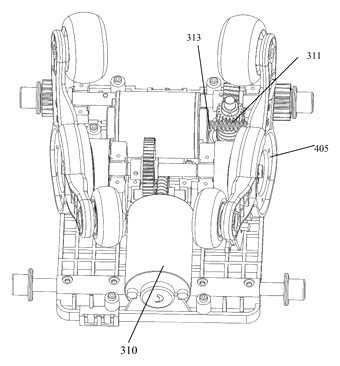
| 403 | Transmission shaft | Carries the cylindrical cam. |
| 405 | Massage member | The rotating body sleeved on the cylindrical boss. |
| 510 | Base | Mounts the sensors and shields moving parts. |
Operating steps
- The user sits against the backrest (110). The driving device (202) moves the massage assemblies (201a, 201b) along the transmission shaft (403).
- As the assemblies travel, the fork openings formed by the swing arms (203a–203d) encounter the user’s shoulders.
- When the back presses against only one swing arm, the massage member (405) rotates around the cylindrical boss against the tensioning spring (205), limited by the stop block inside the arc-shaped notch.
- This rotation moves the trigger piece (206) past the position sensor (207), generating a position signal.
- The judgment module reads the signal, determines the shoulder location, and commands the cylindrical cam to adjust the yawing motion of the arms for a targeted massage.
Applications
Home wellness rooms
Homeowners buy full-body massage chairs for use at home. Users of different heights in the same household need the chair to adapt without manual recalibration every time they switch seats.
Corporate breakrooms and offices
Employees use shared wellness chairs during short breaks. The automatic shoulder detection ensures the mechanism aligns correctly for each person immediately upon sitting down, saving time.
Airport lounges and waiting areas
Travelers of all sizes rest in lounge seating equipped with massage functions. According to the patent, the fork-arm assembly finds the shoulder mechanically, so the chair can match its routine to each seated user without a manual height setting.
Spas and recovery centers
Wellness facilities offer automated massage stations between treatments. The patent describes the control circuit choosing the massage operation from the detected shoulder information, which suits a facility where many different people use the same station.
Retail showroom demonstration units
Electronics and furniture stores display massage chairs for customer testing. Automatic detection allows shoppers to experience the correct massage routine instantly without staff assistance to program the remote.
Where it is less suitable
- Portable or handheld massagers - this mechanism relies on a backrest seat and a vertical moving core, which cannot be miniaturized for handheld devices.
- Leg and foot-only massage units - the forked arms and shoulder sensors are designed exclusively for the back and shoulder region.
- Basic entry-level chairs - the cylindrical cam, sensors, and judgment module add mechanical and electronic complexity compared to simple fixed-roller designs.
Frequently asked questions
How does the chair find my shoulders?
The massage assembly has upper and lower swing arms angled to form a fork. When you lean back, your shoulder pushes against one arm, causing the entire assembly to tilt. A sensor detects this tilt and tells the control circuit exactly where your shoulder is located.
What kind of sensors are used?
According to the patent, the detection module uses either a photoelectric sensor paired with a light-shielding sheet, or a Hall sensor paired with a magnet. The trigger piece is mounted on the moving assembly, and the sensor sits on the stationary base.
How do the massage arms move?
A motor drives a transmission shaft connected to a cylindrical cam. As the cam rotates, it pushes the pair of massage assemblies toward or away from each other across the width of the back, creating a yawing motion.
What are the massage heads made of?
The patent describes the massage heads at the ends of the swing arms as soft rubber rollers that abut against the user’s body during operation.
Does it work for very tall or short users?
The mechanism is designed to detect the shoulder position dynamically rather than relying on a fixed path. The exact height range depends on the total travel distance of the massage movement core inside the backrest, which is set in design and confirmed on prototypes.
Is the massage strength adjustable?
The patent focuses on the mechanical detection of the shoulder position and the cam-driven movement of the arms. Specific intensity levels or speed settings are controlled by the software logic, which is configured during product development.
Can this design be made and sold in the US?
The patent was filed only in China and is currently in force there until at most 2036-12-30 (if annual fees are paid); it has no US counterpart. However, other companies hold US patents citing this technology in the massage device field - see Patent & Production - so a freedom-to-operate review is necessary before manufacturing or selling in the US.
Are you affiliated with the patent owner?
No. IP2M is an independent design and manufacturing service working from the public patent document.
Request a quote
Click Request a Quote below to see our email address - copy it, or open your email app with a ready-made message. Please mention patent CN106618998B in the subject.
Helpful details to include:
- Your company and channel (massage chair brand, contract furniture maker, Amazon seller, wholesaler)
- Backrest dimensions and target user size range
- Sensor preference (photoelectric or Hall effect)
- Electrical specifications (voltage, plug type for the US market)
- Estimated quantity and target price
- Timeline - when you would like functional prototypes and the first shipment
You can also reach us at (332) 203-9997.
Explore this product
Interested in building this?
Tell us your target market, quantity and timeline. We reply with options for prototyping, small-batch runs or volume production.
Send your inquiry to
Please put CN106618998B in the subject line and tell us your company, country, estimated quantity and timeline.
Prefer to talk? Call (332) 203-9997.
More product-ready patents
All Health & Wellness patents →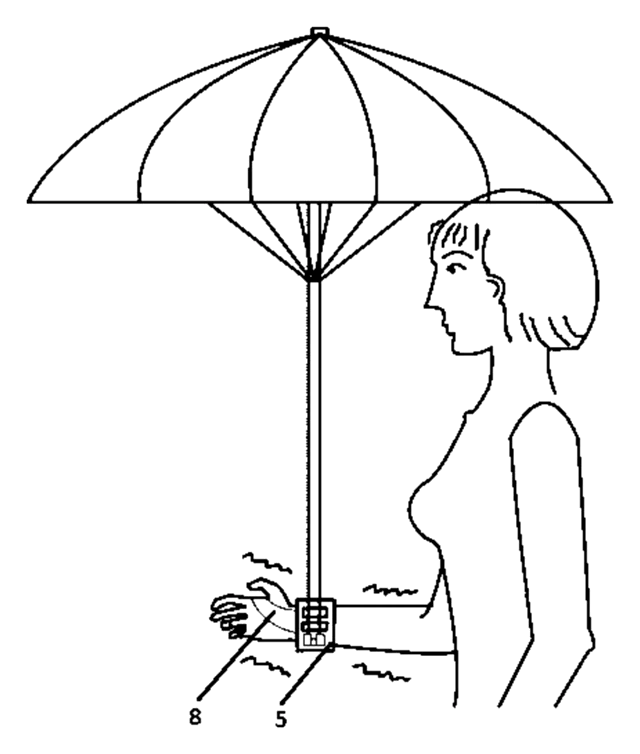
Health & Wellness
Wrist-Mounted Umbrella Stabilizer
Wrist-worn umbrella holder with an anti-shake link; the patent designs it for people with tremor.
Patent CN212545964U
Health & Wellness
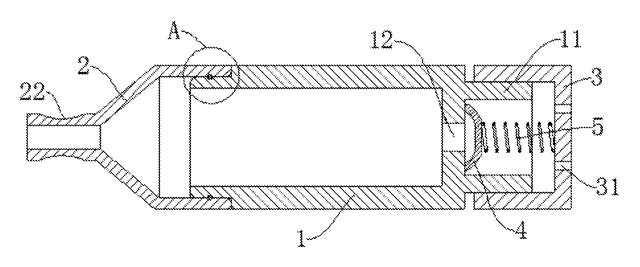
Spring-Valve Breath Trainer for Singers
Pocket breath trainer: blow against a spring-loaded valve to practice breath support for singing.
Patent CN207833725U
Health & Wellness
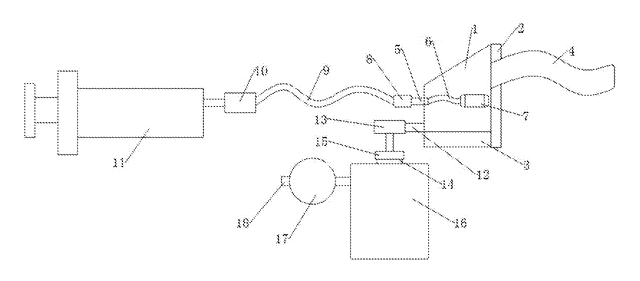
Closed-Loop Nasal Rinse Kit with Collection Bottle
Nasal rinse set: syringe-fed nose plug inside a sealed hood, with used solution drawn into a bottle.
Patent CN208017763U
Health & Wellness
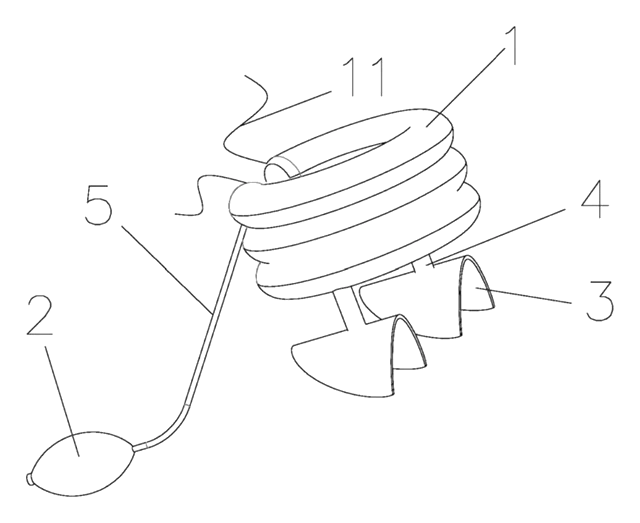
Inflatable Cervical Traction Collar Shaped for a Child's Neck
Child-size three-ring air collar on telescoping shoulder struts, inflated with a hand bulb.
Patent CN208958444U
Massage & Wellness
Pneumatic Multi-Directional Neck Traction Collar
Three-airbag cervical collar that inflates in sequence to guide the head in multiple directions.
Patent CN207202980U
Health & Wellness
Switchable Rotation Device for Handheld Massagers
Massage attachment mechanism that switches between locked and free-rotating positions.
Patent CN214968684U
Browse by category
- Apparel & Accessories (22)
- Baby & Kids (16)
- Bags & Luggage (9)
- Bath & Personal Care (16)
- Car Accessories (10)
- Furniture, Bedding & Storage (12)
- Garden & Outdoor (18)
- Health & Wellness (8)
- Home, Kitchen & Cleaning (24)
- Lighting (12)
- Packaging & Containers (6)
- Pet Products (6)
- Phone & Camera Accessories (4)
- Retail Display (13)
- School, Office & Art (19)
- Sports & Recreation (25)
- Tools & Workshop (27)
- Toys & Games (12)
This page is based on the public patent document CN106618998B, assigned to Ogawa Intelligent Health Technology Group Co Ltd, Zhangzhou Easepal Industrial Co Ltd. IP2M is an independent manufacturing service and is not affiliated with, endorsed by or licensed by the patent owner. Images marked as concept renderings are illustrations, not photos of an existing product. Patent status information is provided for reference only and is not legal advice; confirm freedom to operate for your market before production. Full disclaimer.