At a glance
| Patent number | CN106696541B (application CN201710109260) |
| Type | China invention patent (发明专利) - protects method and structure |
| Original title | Pen with luminous lighting pen cap (一种笔帽可以发光照明的笔) |
| Patent owner | Chen Youzhi, Chu Tianning, Dongguan Equity Exchange Center |
| Inventors | Chen Youzhi, Chu Tianning |
| Filing date | 2017-02-27 |
| Grant date | 2018-08-07 |
| Status (China) | Lapsed - terminated for non-payment of annual fees (recorded 2025-02-28) |
| Patent family | Chinese filings only - no US, European, Japanese, PCT or other filings listed |
| Cited by | 0 later documents |
| Source | Google Patents (search for CN106696541B) |
What the claims cover, in plain language
Claim 1 defines a pen comprising a body (1) and a cap (2) that covers the nib. The cap includes a top mouth shell (21) housing a circuit board (24) with an LED (29). A battery (13) is placed in a groove (22) within the shell, sealed by a threaded end cap (26). A spring (27) and switch (28) allow the end cap to control power flow. A transparent lampshade (4) sits between the shell and the outer cap. A pen clip (3) is mounted on a connecting seat (5) via a shaft (7) in a U-shaped groove (6), allowing the clip to rotate 90 degrees to support the cap. The pen body has flat surfaces and an ink window (12).
Claim 2 specifies that rotating the end cap clockwise compresses the spring to press the battery, lighting the LED; counter-clockwise rotation turns it off.
Claim 3 adds that the outer surface of the pen cap has multiple arc-shaped concave surfaces (14) spaced apart, likely for grip or aesthetics.
This is a simplified reading for orientation only. The legal scope is defined by the exact claim wording in the official Chinese document.
What this means for US production
This patent was filed only in China and has lapsed, meaning it no longer restricts anyone in China either. It has no US or other foreign counterpart.
Two points to settle early:
- Other patents may exist. Novelty pens with integrated lights are a competitive field. While this specific mechanical configuration (rotating clip as stand + twist-switch) appears unique to this filing, similar concepts (flashlight pens, clip-stand hybrids) may be covered by other active US patents. A freedom-to-operate (FTO) review is recommended before mass production.
- Component Sourcing. The design relies on specific small-form-factor LEDs and coin-cell or AAA/AA batteries (size not specified in patent, confirmed in design). Ensuring consistent supply of these micro-components is critical.
Customization and manufacturing
What can be customized
| Area | Options |
|---|---|
| Light Color | White, warm white, or blue LED (change diode type). |
| Battery Type | Coin cell (CR2032) or cylindrical (AAA) depending on internal volume. |
| Body Material | ABS plastic standard; PP or recycled plastics possible. |
| Finish | Matte, glossy, rubberized coating for grip. |
| Clip Design | Plastic or metal clip; color matching body. |
| Ink Refill | Standard G2 refill compatibility or proprietary. |
Things to plan for (US market)
- CPSC Safety Rules: If marketed to children, strict rules apply. For general use, ensure small parts (batteries, screws) do not pose choking hazards if disassembled.
- Battery Compliance: UN 38.3 testing required for shipping lithium batteries (if used). Alkaline batteries generally exempt from transport restrictions but must meet labeling standards.
- FDA 21 CFR: Not applicable unless marketed as a medical device. General consumer goods.
- Proposition 65: California warning labels may be required for certain plastics or electrical components.
How a project runs
- Inquiry - Define battery size, LED brightness, and target price point.
- Design - Finalize mold layouts for cap internals, clip pivot, and body.
- Prototype - 3D-printed samples for fit checks; assemble with off-the-shelf springs/LEDs.
- Pilot Run - Test switch durability (cycle test) and drop resistance.
- Production - Injection molding, PCB assembly, final packaging.
Quantities & timeline
Tooling involves molds for the body, cap shell, shade, and clip seat. PCB assembly is automated. The primary lead time driver is mold creation and component sourcing. Send us your target battery type, quantity, and logo details and we will reply with options.
Production notes
Tooling and process
Injection molding is likely the primary process for the ABS body and cap components. Metal stamping may be used if a metal clip is chosen, though the patent suggests a plastic shaft system. PCB assembly involves placing the LED and switch contacts.
Cost drivers
Number of molds is typically significant due to the multi-part cap assembly (shell, shade, end cap, seat). Spring quality affects switch feel and longevity. Assembly steps increase labor costs compared to a simple pen.
Prototyping path
3D-printed samples are typically the first step to verify the 90-degree clip rotation and stand stability. Use off-the-shelf springs and batteries to test the twist-switch mechanism before tooling.
What we would change before tooling
Battery compartment security should likely be verified to prevent accidental opening by children. Ensure the transparent shade material resists yellowing from UV exposure if stored in windowsills.
Common failure points
Hinge fatigue at the clip shaft could cause the stand function to fail. Spring fatigue may reduce switch sensitivity. Ink compatibility with the viewing window seal is critical to prevent leaks.
Patent drawings
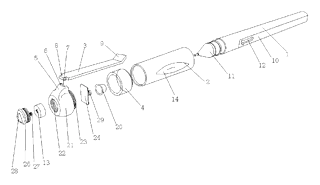
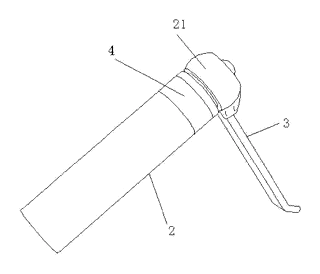
Drawings reproduced from the public patent document for reference.