At a glance
| Patent number | CN106739658B (application CN201611130074) |
| Type | China invention patent (发明专利) - protects product shape, structure and method |
| Original title | A kind of posture corrects ball pen (一种姿势校正圆珠笔) |
| Patent owner | Individual |
| Inventors | Xu Ke |
| Filing date | 2016-12-09 |
| Grant date | 2018-04-27 |
| Status (China) | Lapsed - terminated for non-payment of annual fees (recorded 2024-07-02) |
| Patent family | Chinese filings only - CN106739658B |
| Cited by | 2 later documents |
| Source | Google Patents (search for CN106739658B) |
What the claims cover, in plain language
Claim 1 - A posture-correcting ballpoint pen comprising an outer shell, an inner casing inside the shell, and a head cover mounted on top of the shell. The inner casing holds a ball-point pen refill. The lower end side of the shell is equipped with two elastic portions, and the bottom has a nib hole. The inner casing features a circular arc-shaped lug boss, with the elastic portions positioned slightly above the maximum gauge position of this lug boss. The head cover has a raised outer connecting portion on its outermost layer and a raised circular interior connecting portion inside, which divides the head cover into an outer layer and an internal layer; the outer layer possesses elasticity. A spring is arranged at the lower part of the inner casing, with one end contacting the lower part of the lug boss and the other end touching the bottom connection of the shell. The shell, inner casing, and head cover are joined by threaded coupling or engaging connection.
Claim 2 - The posture correction ballpoint pen according to claim 1, wherein the internal layer is made of hard material.
This is a simplified reading for orientation only. The legal scope is defined by the exact claim wording in the official Chinese document.
What this means for US production
This patent was filed only in China and is currently lapsed due to non-payment of annual fees, so it no longer restricts anyone in China either. It has no US or other foreign counterpart.
Two points to settle early:
- Other patents may exist. Writing instruments and ergonomic pens are actively patented globally. Notably, BIC Violex Single Member S.A. holds later US patents in this field (US11951762B2 and US12083818B2) that cite this Chinese document, so a freedom-to-operate (FTO) review of the elastic-portion actuation and internal spring mechanism is needed before tooling.
- Elastic material selection. The durometer of the elastic portions on the shell must be tuned so that normal finger pressure activates the mechanism without accidental triggering during transport.
Customization and manufacturing
What can be customized
| Area | Options |
|---|---|
| Shell material | ABS, PP, or TPR overmold for the elastic portions |
| Elastic portions | Size, shape, and stiffness to be confirmed in design |
| Spring force | Spring rate chosen so retraction is smooth but firm |
| Refill type | Standard ballpoint refill dimensions to fit the inner casing |
| Colors | Shell, head cover, and elastic portion colors per brand guidelines |
| Assembly method | Threaded coupling or snap-fit engaging connection between shell and head cover |
Things to plan for (US market)
- ASTM D4236 - Art materials, including writing instruments marketed for creative use, must be evaluated for chronic health hazards and properly labeled.
- CPSIA / 16 CFR 1500 - If marketed to children 12 and under, the pen must meet lead and phthalate limits, and undergo third-party testing at a CPSC-accepted lab.
- California Prop 65 - Plastics, inks, and springs are screened for listed chemicals.
How a project runs
- Inquiry - Target audience, material preferences, refill type, and quantity.
- Design - CAD modeling of the shell, inner casing, lug boss geometry, spring rate, and head cover layers.
- Prototype - 3D printed or soft-tooled samples to test finger pressure, nib extension, and automatic retraction.
- Pilot run - Injection molding trials, assembly verification, and functional cycle testing of the elastic portions.
- Production - Mass injection molding, spring insertion, refill loading, and final assembly.
Quantities & timeline
The shell and inner casing require precision injection molds, and the elastic portions may need a secondary overmolding die or specific tooling depending on the material chosen. Springs are sourced to match the tested force requirements. Certification tests for children’s products add time before shipment. Send us your target audience, material preferences, refill specifications, estimated quantity and target price and we will reply with options.
Patent drawings
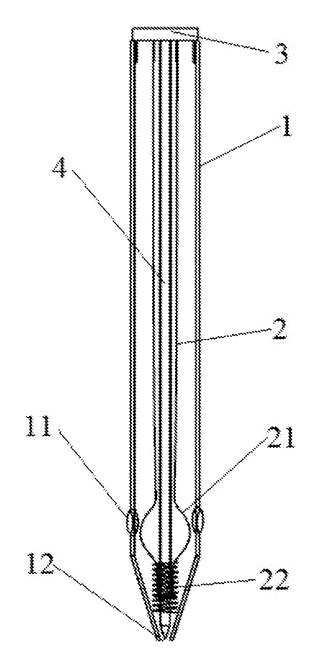
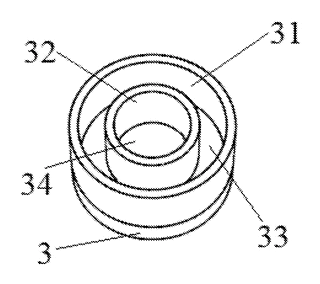

Drawings reproduced from the public patent document for reference.