
Patent CN106827894B
Updated October 30, 2026Universal Compass Intelligence Drawing Template
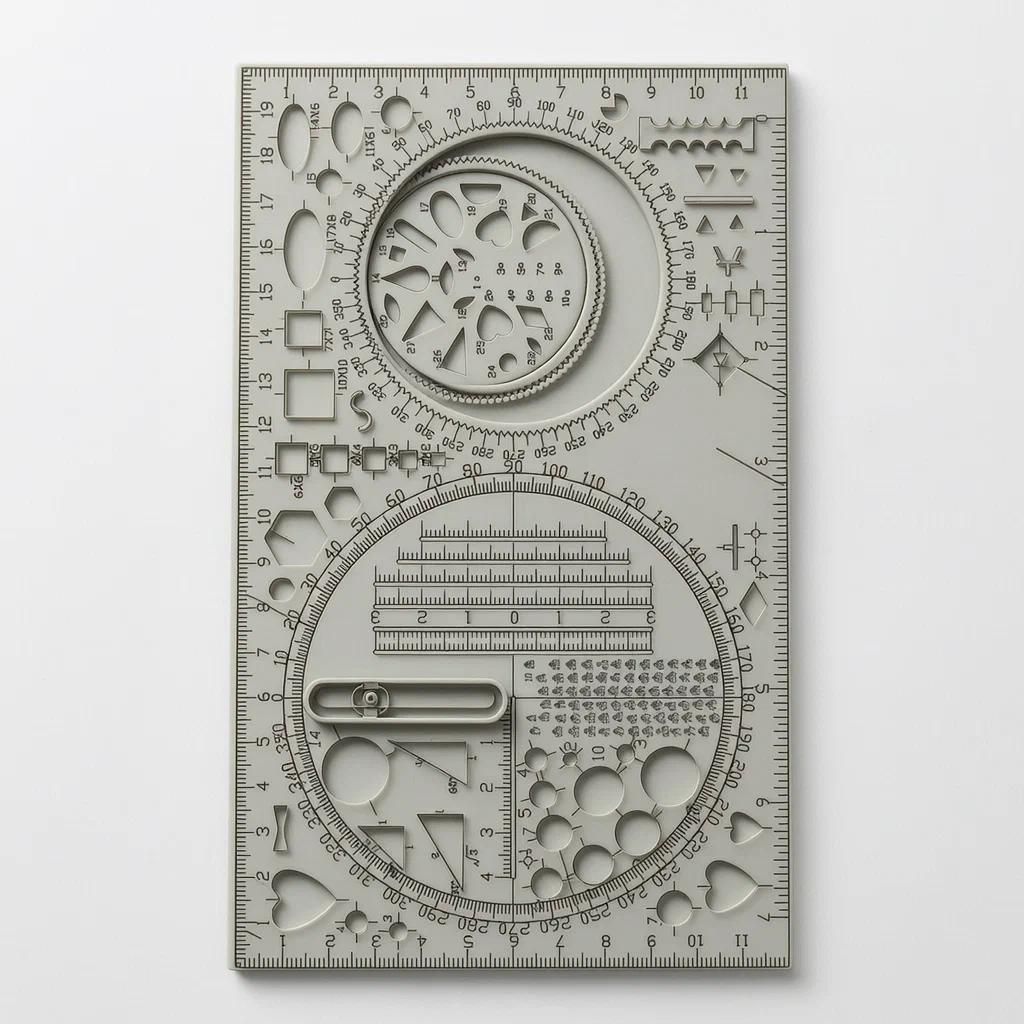
Standard geometry sets require students and drafters to switch between a ruler, a protractor and a metal-point compass that can slip or tear the paper. This drawing template combines those functions into one flat board. A circular disc sits inside a recessed hole in a rectangular frame and turns smoothly on an inner boss ridge. Small holes arranged at set distances from the center act as compass guides: insert a pencil, rotate the disc, and a clean circle appears. Parallel straight slots, angled lines and shape cutouts let the user trace triangles, rectangles, pentagons, stars and schematic symbols like diodes and inductance coils. Because all scales, text and marks are engraved on the back surface, the working face stays flat against the paper. For decorative work, a flower-shaped collapsible form with gear teeth meshes with knuckle-teeth on the frame to draw multi-petal patterns.
- China invention patent - in force
- No filings outside China
- School & office drawing tools
- Plastic template with rotating disc
Splat! What let you down?
⭕
Needle-free circles
Small holes at set distances from the center guide a pencil to draw circles of various diameters by rotating the disc.
📐
Built-in geometry
Parallel straight line holes and angled slots allow tracing of triangles, rectangles and pentagons directly.
🔄
Smooth rotation
The circular template rests on an inner boss ridge inside a stepped hole, turning freely without tilting during use.
🌸
Decorative patterns
An optional flower-shaped collapsible form with gear teeth meshes with the frame to draw multi-petal designs.
Bring this product to market
- ✓ Patent vetted China-only family and legal status checked
- 2 Product brief · now How it works, uses and options written up
- 3 Prototype First samples for buyers to review
- 4 Pilot run Small first batch for launch customers
- 5 Volume production Repeat orders at scale
Buyer interest
– of 100 buyers needed to start prototyping
One click, no sign-up. Each vote is one real visitor, and products with the most interest go to prototyping first.
Build team: no members yet. Need a partner, co-funding or skills to build this? Join and we introduce the team once it forms.
The problem
Traditional drafting and classroom geometry require several separate tools: a ruler for straight lines, a protractor for angles, and a metal-point compass for circles. Switching between them slows down work and increases the chance of misalignment. Metal-point compasses also puncture the paper surface, which ruins finished drawings and makes the tool unsuitable for young children who may struggle with the sharp point. Keeping all these instruments organized in a pencil case takes space, and individual pieces are easily lost during class or on a job site.
The solution
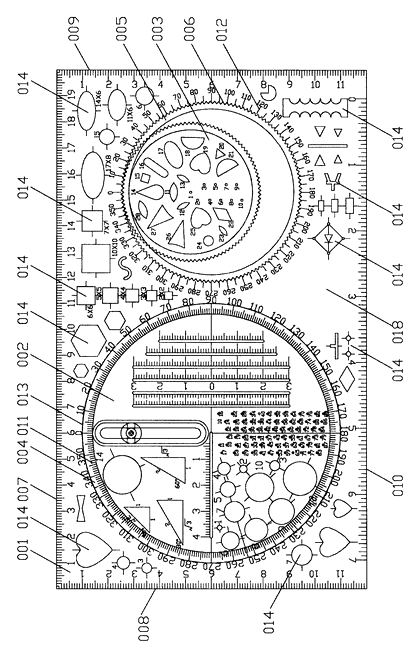
This patent describes a single flat template that replaces the compass, protractor and basic rulers.
- A fixed form (001) serves as the rectangular base, with scale rulers on all four edges.
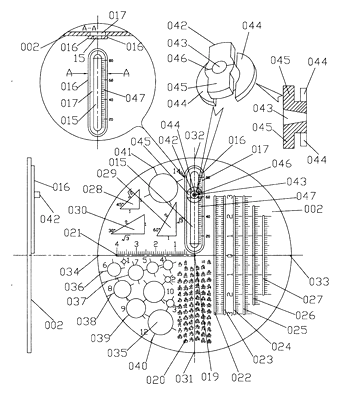
- A rotating circular template (002) sits inside a stepped circular hole in the fixed form, resting on an inner boss ridge (004).
- Multiple small circle holes are distributed at different distances from the center of the circular template, each indicating a specific diameter size.
- Inserting a pencil into a chosen hole and rotating the circular template draws a complete circle without a metal needle.
- Straight line holes (021–027) and angled slots on the template allow the user to trace triangles, rectangles and pentagons.
- Pattern cutouts provide outlines for schematic symbols such as diodes, triodes and inductance coils.
Who it is for
- Educational stationery brands looking for a geometry tool that eliminates the safety risk of needle compasses in classrooms while combining multiple drafting functions.
- Office and art supply wholesalers adding a compact, multi-function drafting aid to their catalog for engineers, architects and hobbyists who sketch quick diagrams.
- Promotional product distributors sourcing flat, printable templates for corporate branding, since the design includes a marked brand name area (018) on the surface.
- Toy and puzzle makers developing hands-on learning kits that encourage children to explore shapes and spatial reasoning through guided tracing.
How it works
The main parts
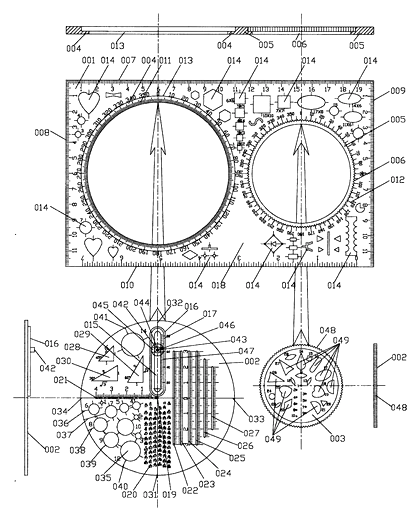
| No. | Part | What it does |
|---|---|---|
| 001 | Fixed form | Rectangular base frame holding the scale rulers and the central circular hole. |
| 002 | Rotating circular template | Rotating disc containing circle holes, straight slots and pattern cutouts. |
| 003 | Flower-pattern insert | Gear-toothed disc for drawing decorative flower patterns. |
| 004 | Inner side boss ridge | Raised ring inside the circular hole that supports the rotating template. |
| 006 | Inside knuckle-tooth | Teeth on the frame that mesh with the gear teeth of the flower form. |
| 007–010 | Scale rulers | High, left-hand, right side and lower part graduated rulers on the fixed form edges. |
| 011, 012 | 360 degree scales | Degree markings around the circular holes for angle measurement. |
| 021–027 | Straight line holes | Parallel slots used as guides for drawing polygon sides. |
| 050 | Right-angle corner insert | Square-hole insert for right-angle constructions. |
Operating steps
- Place the fixed form flat on the paper. All scales, text and marks are engraved on the back surface so the face remains flush.
- To draw a circle, select a small circle hole on the rotating template corresponding to the desired diameter. Insert a pencil and rotate the template one full turn. The inner side boss ridge prevents the disc from tilting.
- To draw a rectangle, align a pencil in one of the straight line holes, draw a side, rotate the template 90 degrees using the 360-degree scale, and repeat four times.
- To draw a triangle, use the first straight line hole and the center line arrows to set the required angles, then trace the sides through the parallel slots.
- For decorative patterns, replace the circular template with the flower-pattern insert. Its gear teeth mesh with the knuckle-teeth on the frame; rotating it traces multi-petal shapes.
Applications
Classroom geometry lessons
Students use the template to construct circles, triangles and rectangles without handling a sharp compass point. The integrated scales and angle markings keep all necessary references on one board, reducing desk clutter during math periods.
Engineering and electronics sketching
Drafters and technicians trace standard schematic symbols, including diode, triode and inductance coil figures, directly from the pattern cutouts. This speeds up hand-drawn circuit diagrams when CAD software is not immediately available.
Art and craft projects
Crafters swap in the flower-shaped collapsible form to generate repeating petal patterns for greeting cards or scrapbooking. The gear-teeth mechanism ensures the petals remain evenly spaced around the center.
Corporate promotional items
Stationery suppliers print company logos in the designated brand name marked area and distribute the templates at trade shows. The flat profile fits easily into envelopes or presentation folders.
Where it is less suitable
- High-precision architectural drafting - professional CAD or metal drafting compasses offer finer tolerances than a plastic rotating template.
- Large-format poster drawing - the template size limits the maximum circle diameter to the dimensions of the disc itself.
- Heavy-duty workshop marking - metal scribes and industrial trammel points are required for marking steel or wood surfaces.
Frequently asked questions
How does it draw circles without a metal compass?
The rotating disc contains several small holes positioned at set distances from the center. You insert a pencil into the hole that matches the diameter you need, press it against the paper, and spin the disc. An inner boss ridge keeps the disc level so it does not tilt while drawing.
What shapes can be drawn besides circles?
The template includes parallel straight line slots and angled guides. By tracing through these slots and rotating the disc 90 degrees at a time, you can construct triangles, rectangles and pentagons. Specific cutouts also provide outlines for electronic schematic symbols like diodes and inductance coils.
Are the scales printed on the front?
No. The patent specifies that all scales, text and marks are engraved on the back surface of the template. This keeps the working face completely flat against the paper for accurate tracing.
What is the flower-shaped accessory?
It is a separate collapsible disc with external gear teeth. When placed in the second circular hole on the frame, its gears mesh with knuckle-teeth on the frame. Rotating it while tracing through its functional holes produces multi-petal decorative patterns.
What material is it made from?
The patent does not specify a material. Rigid transparent or opaque plastics such as acrylic or polystyrene are typical for drafting templates; the exact material is set in design and confirmed on prototypes.
Is it safe for young students?
Because it uses a pencil instead of a sharp metal compass point, it removes the puncture risk. However, any product marketed for children in the US must still pass applicable physical and chemical safety tests.
Can we add our company logo?
Yes. The design includes a specific brand name marked area (018) on the template surface intended for logos or text.
Can this design be made and sold in the US?
The patent was filed only in China and is currently in force there (until at most 2037-03-24, if annual fees are paid), meaning production in China requires the owner’s permission. There is no US counterpart to this specific patent. However, a later US patent (US11279167B2) held by Naser Moghadampour cites this document, so we recommend a freedom-to-operate check before volume production in the US market.
Are you affiliated with the patent owner?
No. IP2M is an independent design and manufacturing service working from the public patent document.
Request a quote
Click Request a Quote below to see our email address - copy it, or open your email app with a ready-made message. Please mention patent CN106827894B in the subject.
Helpful details to include:
- Your company and channel (stationery brand, school supplier, promotional distributor, toy maker)
- Overall dimensions and required circle diameters
- Shapes and symbols needed in the cutouts
- Material preference and color
- Logo artwork for the brand name area
- Estimated quantity and target price
- Timeline - when you would like samples and the first shipment
You can also reach us at (332) 203-9997.
Explore this product
Interested in building this?
Tell us your target market, quantity and timeline. We reply with options for prototyping, small-batch runs or volume production.
Send your inquiry to
Please put CN106827894B in the subject line and tell us your company, country, estimated quantity and timeline.
Prefer to talk? Call (332) 203-9997.
More product-ready patents
All School, Office & Art patents →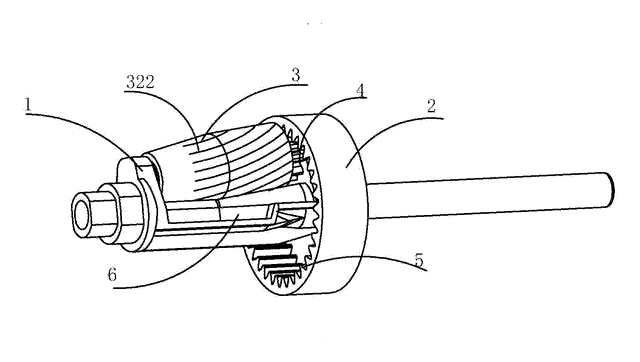
School, Office & Art
Long-Point Sketch Pencil Sharpener
Crank sharpener that cuts only the wood of sketch pencils, leaving a long, round lead about 30 mm long.
Patent CN207241257U
School, Office & Art
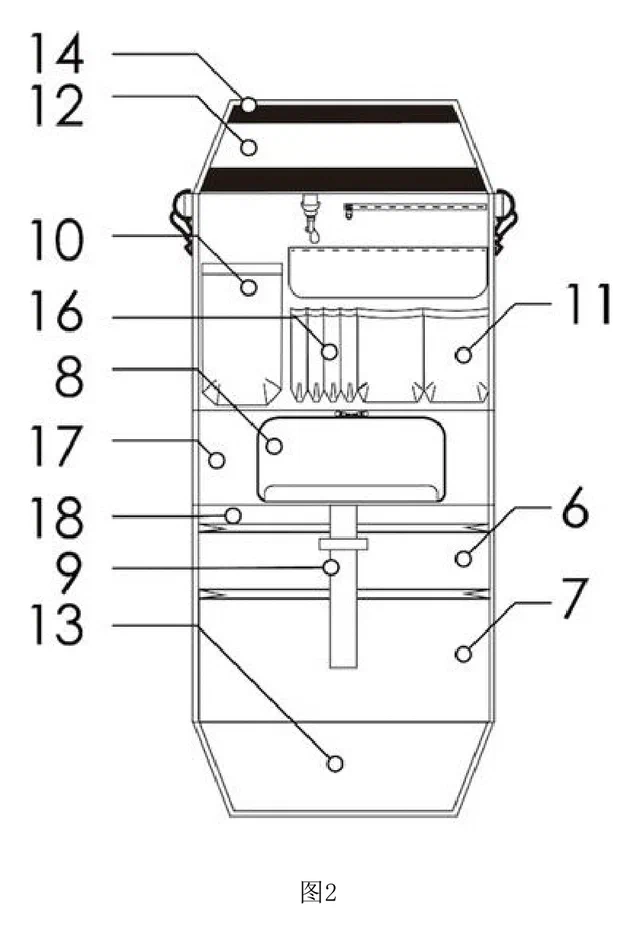
Fold-Out Desk Organizer Insert for School Backpacks
Backpack insert that unfolds into a hanging desk organizer for workbooks, stationery and a water bottle.
Patent CN209436546U
School, Office & Art
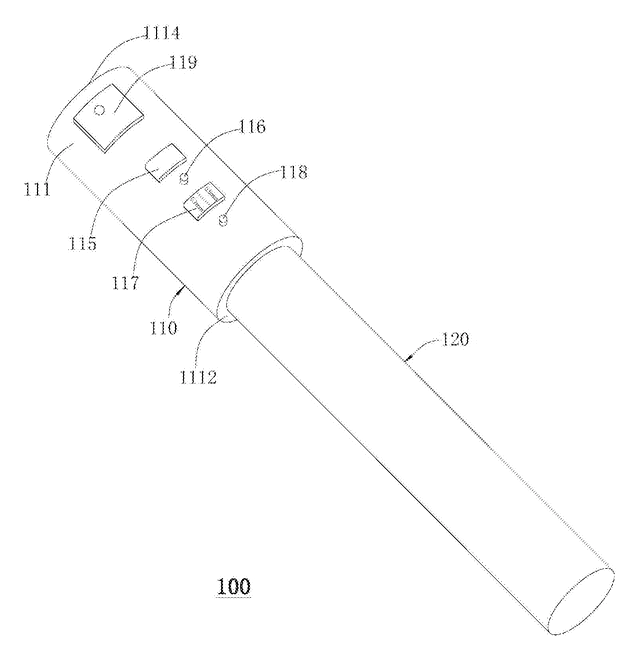
Smart Pencil Cap That Checks the Point with a Camera
Electronic pencil cap that photographs the point, measures it and reminds you to sharpen.
Patent CN106427302B
School, Office & Art
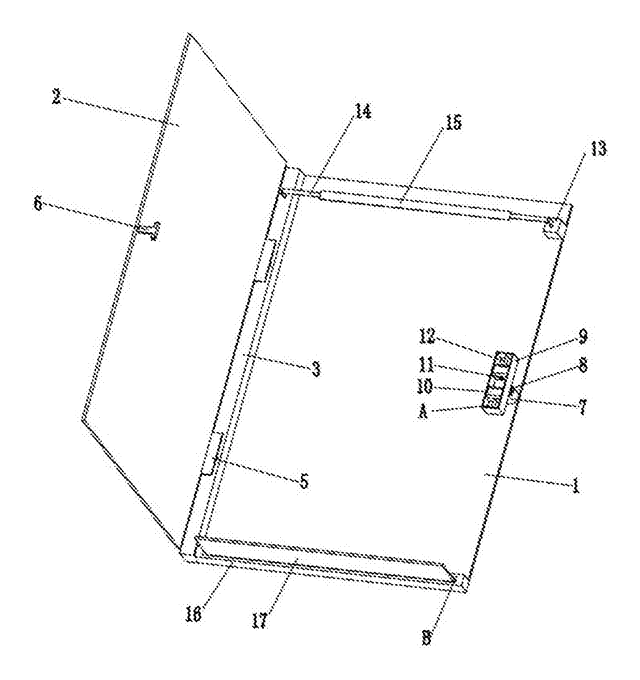
Expanding Clipboard Folder with Spring-Mounted Hinge and Catch
Hard folder whose spring-mounted hinge and catch let the cover clamp any thickness of paper.
Patent CN105667120B
School, Office & Art
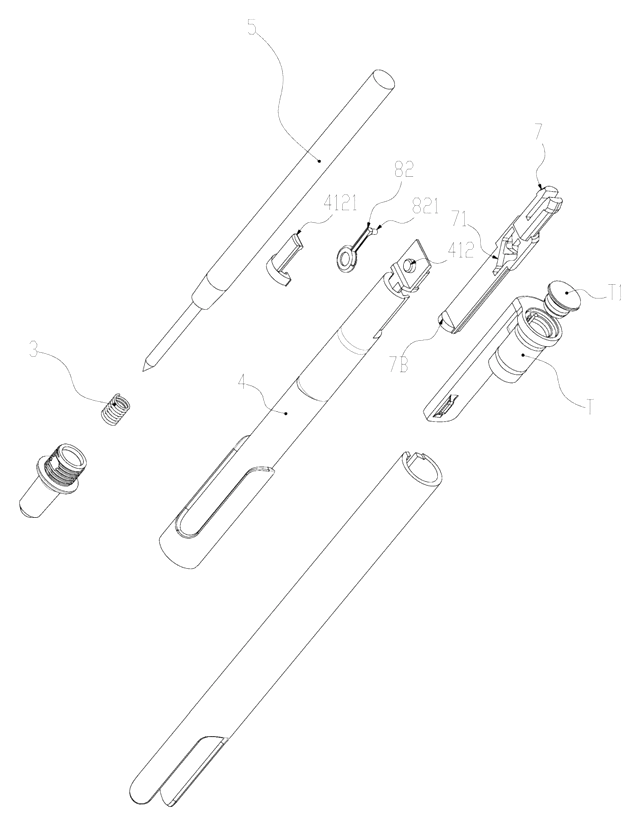
Slide-Action Retractable Pen with a Friction-Loaded Cam That Ignores Gravity
Slide-action retractable pen whose spring-pressed cam latch stays put whichever way the pen is held.
Patent CN217671900U
School, Office & Art
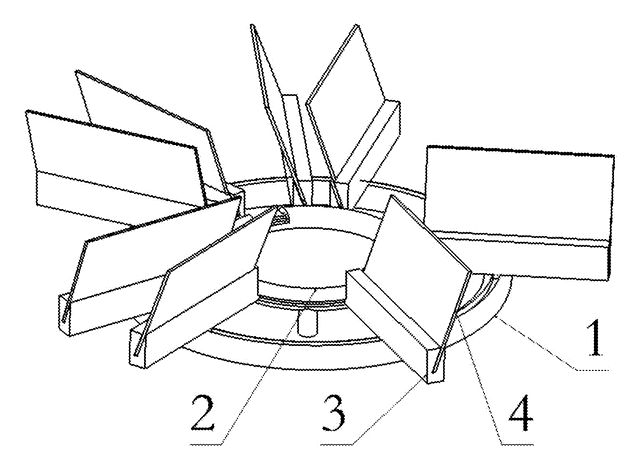
Carousel Business Card Holder with Rolling Card Trays on Twin Ring Tracks
Desk card holder: angled card trays roll on wheels around two concentric ring tracks and lift out.
Patent CN105774300B
Browse by category
- Apparel & Accessories (22)
- Baby & Kids (16)
- Bags & Luggage (9)
- Bath & Personal Care (16)
- Car Accessories (10)
- Furniture, Bedding & Storage (12)
- Garden & Outdoor (18)
- Health & Wellness (8)
- Home, Kitchen & Cleaning (24)
- Lighting (12)
- Packaging & Containers (6)
- Pet Products (6)
- Phone & Camera Accessories (4)
- Retail Display (13)
- School, Office & Art (19)
- Sports & Recreation (25)
- Tools & Workshop (27)
- Toys & Games (12)
This page is based on the public patent document CN106827894B, assigned to Cai Fuhan. IP2M is an independent manufacturing service and is not affiliated with, endorsed by or licensed by the patent owner. Images marked as concept renderings are illustrations, not photos of an existing product. Patent status information is provided for reference only and is not legal advice; confirm freedom to operate for your market before production. Full disclaimer.