At a glance
| Patent number | CN106827894B (application CN201710204666) |
| Type | China invention patent (发明专利) - protects product shape, structure and method |
| Original title | Universal compass intelligence drawing template (万能圆规智力绘图模板) |
| Patent owner | Cai Fuhan |
| Inventors | Jie Guoan, Jie Jie, Wu Dingyuan, Wu Hui |
| Filing date | 2017-03-24 |
| Grant date | 2019-04-16 |
| Status (China) | In force in China until at most 2037-03-24 (if annual fees are paid) |
| Patent family | Chinese filings only - no US, European, Japanese, PCT or other filings listed |
| Cited by | 2 later documents |
| Source | Google Patents (search for CN106827894B) |
What the claims cover, in plain language
Claim 1 describes a drawing template made of a fixed form, a rotating circular template, a right-angle corner insert and a flower-pattern insert. The fixed form is rectangular, surrounded by four scale rulers (top, left, right and bottom). It has two circular holes: the first with a 360-degree scale engraved on an inner boss ridge, and the second with a 360-degree scale on inside knuckle-teeth. The rotating circular template sits inside the first circular hole’s inner step circle; its diameter and thickness are slightly smaller than the step so it rotates freely. A first straight line hole starts at the center of the circular template, and six additional straight line holes run parallel to each other at different distances from the center. These holes combine with center line arrows and the 360-degree scale to determine angles for drawing triangles. Rectangles are drawn by tracing a side through a straight line hole, rotating the template 90 degrees, and repeating four times. Right-angled triangles use the first straight line hole for one side, a 90-degree rotation for the adjacent side, and the top scale ruler for the hypotenuse. Isosceles triangles are formed by drawing a bottom edge first, then two equal bevel edges. All scales, text and marks on the entire template are engraved on the back surface. A penholder inserted into a selected small circle hole and rotated draws a circle of the needed diameter. The inner boss ridge prevents the template from tilting during drawing. The flower-pattern insert uses gear teeth that mesh with the knuckle-teeth of the second circular hole to draw decorative patterns.
This is a simplified reading for orientation only. The legal scope is defined by the exact claim wording in the official Chinese document.
What this means for US production
This patent was filed only in China and is currently in force there (until at most 2037-03-24, provided annual fees are paid). Making or selling this exact template design in China needs the owner’s permission. There is no US or other foreign counterpart, so the design itself is not restricted by this specific patent outside China.
Two points to settle early:
- Other patents may exist. Naser Moghadampour holds a later US patent (US11279167B2) that cites this Chinese document, indicating related drafting-tool intellectual property in the US market. A freedom-to-operate (FTO) review covering rotating drawing templates and educational geometry tools is recommended before committing to tooling.
- Material safety. School supplies sold in the US must meet strict chemical and physical safety standards; material selection for the plastic template and any printed inks must be verified early.
Customization and manufacturing
What can be customized
| Area | Options |
|---|---|
| Overall dimensions | Length and width of the fixed form to be confirmed in design |
| Circle hole sizes | Diameters and spacing of the small circle holes set in design |
| Scale markings | Metric, imperial or custom graduations on the four edge rulers |
| Pattern cutouts | Specific geometric shapes or electronic symbols added per buyer request |
| Color and finish | Transparent, solid colors, frosted surface; brand logo printing |
| Material | Acrylic, polystyrene or other rigid plastics to be confirmed on prototypes |
| Accessories | Inclusion of the flower collapsible form or right-angle corner form |
Things to plan for (US market)
- 16 CFR 1500.48 and 1500.49 - sharp point and sharp edge tests if the template is marketed for children under 8.
- ASTM F963 - standard consumer safety specification for toy safety, applicable if marketed as a children’s educational toy.
- CPSIA Section 101 - lead content limits in substrates for children’s products.
- California Prop 65 - screening of plastics, colorants and printing inks for listed chemicals.
How a project runs
- Inquiry - target audience, required shapes, dimensions and quantity.
- Design - CAD layout of the fixed form, rotating disc, hole positions, scale engravings and pattern cutouts.
- Prototype - CNC-cut or 3D-printed samples to verify rotation smoothness, hole alignment and scale accuracy.
- Pilot run - injection-molded batch for physical testing, including drop tests and chemical screening.
- Production - mold fabrication, injection molding, pad printing or engraving, assembly and packaging.
Quantities & timeline
The fixed form and rotating templates require precision injection molds; the gear teeth on the flower collapsible form need tight mold tolerances to mesh correctly. Scale engravings are typically molded directly or applied via pad printing. Certification tests for children’s products add time before shipment. Send us your target dimensions, hole configurations, material preferences, quantity and target price and we will reply with options.
Patent drawings
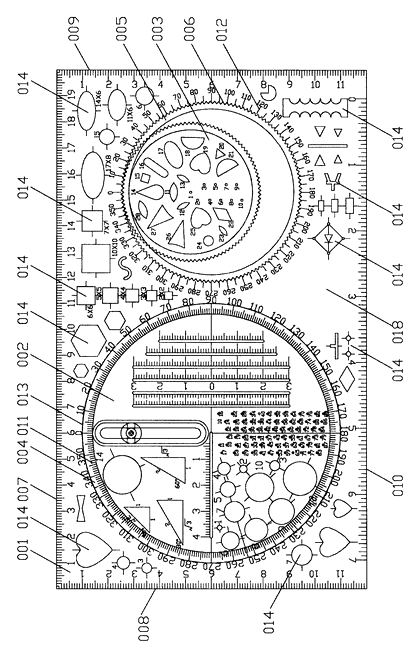
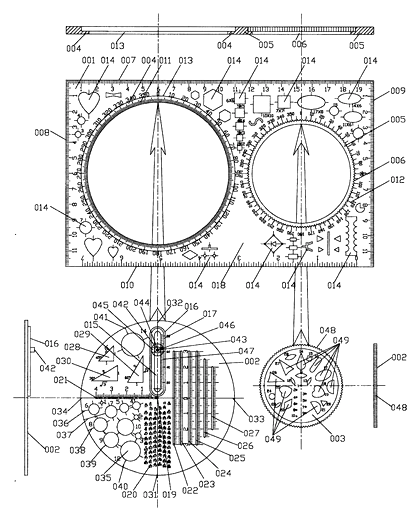
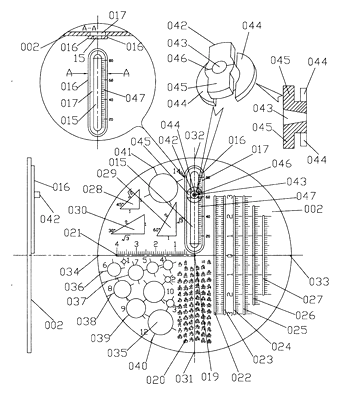
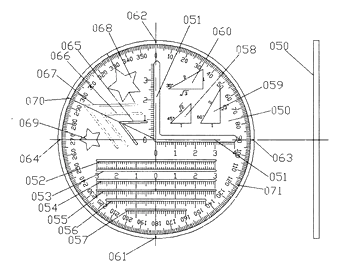
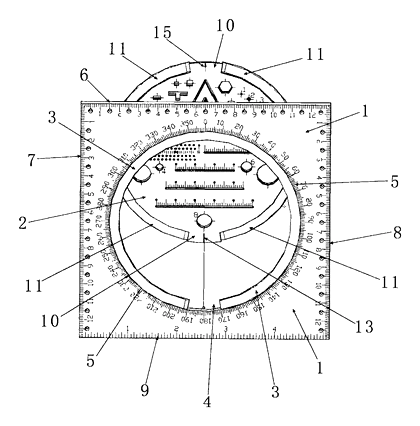
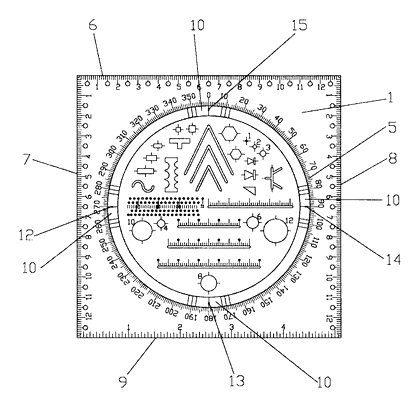
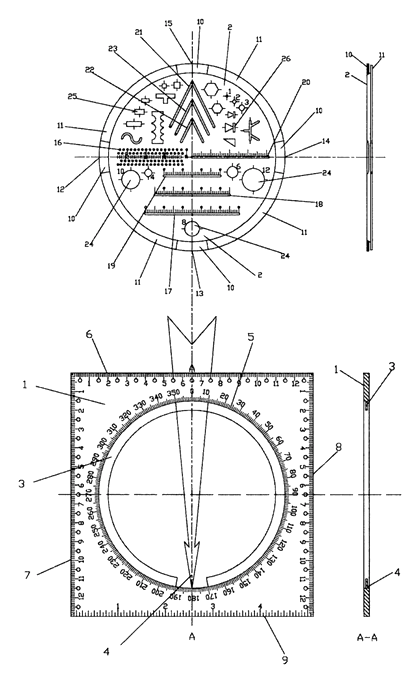
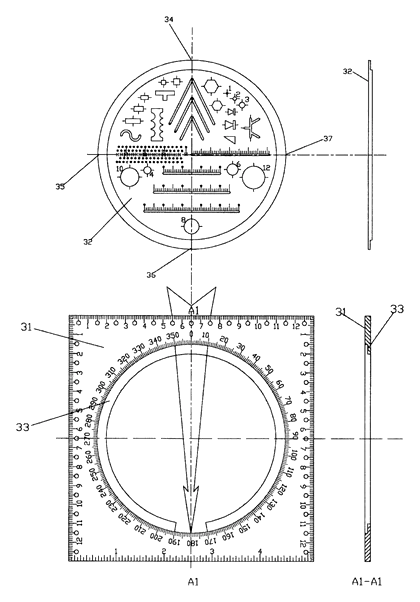
Drawings reproduced from the public patent document for reference.