At a glance
| Patent number | CN106937773B (application CN201710320710) |
| Type | China invention patent (发明专利) - protects product shape, structure, and method |
| Original title | An adjustable height-increasing insole (一种可调式增高鞋垫) |
| Patent owner | Dongguan Shanchuan Technology Co.,Ltd. |
| Inventors | Li Jintao |
| Filing date | 2017-05-09 |
| Grant date | 2019-03-29 |
| Status (China) | In force - valid until at most 2037-05-09, subject to payment of annual fees |
| Patent family | Chinese filings only - no US, European, Japanese, PCT or other filings listed |
| Cited by | 0 later documents |
| Source | Google Patents (search for CN106937773B) |
What the claims cover, in plain language
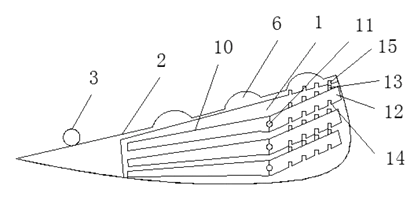
Claim 1 defines an adjustable height-increasing insole comprising an upper insole and a lower insole. Key features include:
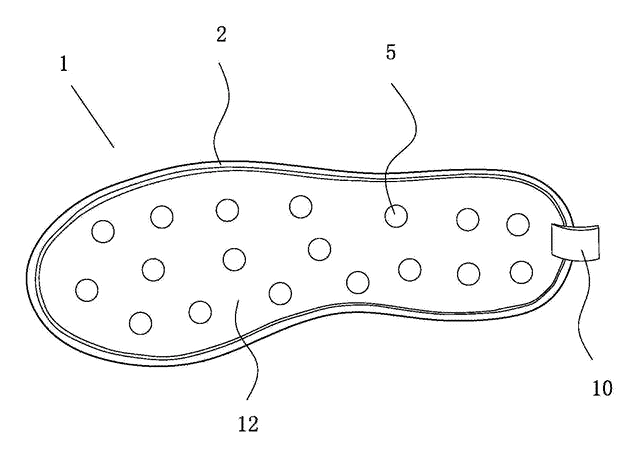
- The upper insole has ventilation holes on the left side.
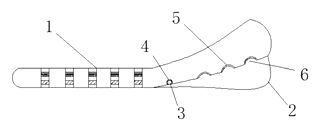
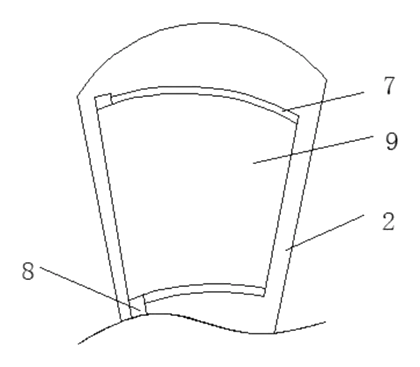
- A sliding groove (arc-shaped, opening downward) is located at the middle of the lower end of the upper insole.
- Card slots are arranged equidistantly on the right side of the lower end of the upper insole.
- A fixed slider slides within the groove and connects to the lower insole.
- The lower insole has card blocks matching the card slots.
- The lower insole contains an inner groove housing multiple pad combinations.
- Each pad combination includes a long backing plate and a short backing plate connected by a pin shaft.
- The short plate has insert blocks and slots to interlock with slots in the groove top and bottom.
- A movable door pad is attached to a shaft body at the groove notch to cover the opening.
Claim 2 specifies that both insoles are made of rubber, and the inner groove is filled with a bamboo charcoal fiber sweat-absorbing layer.
Claim 3 notes that the cross-sectional distance at the opening of the sliding groove is smaller than the diameter of the fixed slider to prevent disengagement.
Claim 4 details that the ventilation holes contain two layers of filter screens: a coarse layer and a fine layer below it.
This is a simplified reading for orientation only. The legal scope is defined by the exact claim wording in the official Chinese document.
What this means for US production
This patent was filed only in China and is currently in force. Making or selling this specific design in China requires the patent owner’s permission. However, since there are no US patents in this family, the design itself is not restricted by this specific patent in the United States.
Two points to settle early:
- Other patents may exist. Footwear inserts and height-increasing devices are a crowded field. While this specific mechanical arrangement (pin-linked plates with a hinged door) appears novel in this document, similar modular lift concepts may be protected by other US utility or design patents. A freedom-to-operate (FTO) review is strongly recommended before launching in the US market.
- Material Safety. The use of bamboo charcoal and rubber requires verification of material sourcing and safety data sheets (SDS) to ensure compliance with consumer product safety regulations regarding toxic substances.
Customization and manufacturing
What can be customized
| Area | Options |
|---|---|
| Height Range | Number of shim plates per stack to define min/max lift (range to be confirmed in design). |
| Material Hardness | Shore A hardness of rubber for upper/lower insoles (soft vs. firm support). |
| Ventilation Pattern | Size and spacing of holes; mesh density (coarse/fine). |
| Lining Material | Bamboo charcoal fiber, memory foam, or cork alternatives. |
| Color | Black, white, beige, or custom Pantone matches for rubber parts. |
| Packaging | Retail blister packs or bulk industrial packaging. |
Things to plan for (US market)
- CPSC Regulations: General Consumer Product Safety Commission rules apply. Specifically, check for lead and phthalates restrictions in plastics/rubber under CPSIA if marketed near children, though this is primarily an adult product.
- FDA Guidelines: If marketed with health claims (e.g., “orthopedic,” “pain relief”), the product may fall under medical device regulations. Stick to cosmetic/convenience claims (e.g., “height increase,” “comfort”) to avoid FDA 510(k) requirements.
- Proposition 65 (California): Rubber compounds and certain additives may contain chemicals requiring warning labels. Ensure material suppliers provide Prop 65 compliance data.
- Textile Labels: If the bamboo charcoal layer is considered a textile component, FTC Textile Act labeling rules may apply regarding fiber content.
How a project runs
- Inquiry - Define target height range, material preferences, and quantity.
- Design Adaptation - CAD modeling of the shim stack dimensions and molding tooling for the curved groove/slider interface.
- Prototype - 3D printed or silicone mold samples to test fit, sliding mechanism smoothness, and door durability.
- Tooling - Molds for the upper and lower insoles and tooling for the shim plates.
- Production - Mass injection molding, assembly of pin-linked shims, insertion of lining, and quality control checks.
Quantities & timeline
Tooling for footwear components and assembly of the multi-part shim system add time compared with a single-piece insole, so plan the schedule early. Minimum order quantity depends on the mold and rubber compounding setup. Send us your target height range, material specs, quantity, and delivery schedule and we will reply with options.
Patent drawings
Drawings reproduced from the public patent document for reference.