At a glance
| Patent number | CN106945426B (application CN201710288694) |
| Type | China invention patent (发明专利) - protects method and product structure |
| Original title | Portable Smart File Folder (一种便携式智能文件夹) |
| Patent owner | Beijing Tianchu Technology Co ltd |
| Inventors | Fan Zihui |
| Filing date | 2017-04-27 |
| Grant date | 2018-08-28 |
| Status (China) | In force - valid until at most 2037-04-27 (subject to payment of annual fees) |
| Patent family | Chinese filings only - no US, European, Japanese, PCT or other filings listed |
| Cited by | 0 later documents |
| Source | Google Patents (search for CN106945426B) |
What the claims cover, in plain language
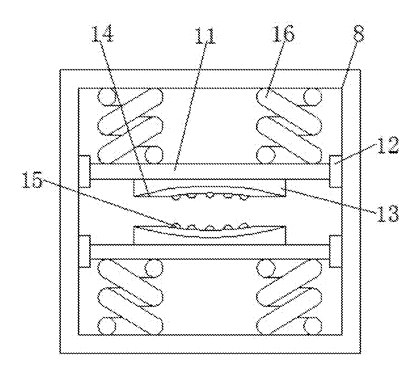
Claim 1 defines a portable smart file folder comprising a rubber strip (1) connecting a first plate body (2) and a second plate body (3). Key features include a fixed block (17) with a through hole (4) and two clamping rods (5) on the first plate. The second plate has a handle (6), a card block (7), and two housings (8) with openings (9). Inside each housing are two slide plates (11) guided by sliders (12). Buffer blocks (13) and rubber blocks (14) with ten protruding blocks (15) are mounted on the slide plates. Return springs (16) connect the slide plates to the housing walls. The protruding blocks engage the clamping rods to lock the folder.
Claim 2 adds anti-slip blocks (19) fixed to the upper surfaces of both plate bodies. Claim 3 specifies a rubber sleeve (18) with anti-slip patterns covering the handle (6). Claim 4 clarifies there are two clamping rods (5) distributed on one side of the first plate’s upper surface. Claim 5 details the ten protruding blocks (15) distributed on the opposite sides of the two rubber blocks (14). Claim 6 states the slider (12) contacts the inner wall of the housing (8).
This is a simplified reading for orientation only. The legal scope is defined by the exact claim wording in the official Chinese document.
What this means for US production
This patent was filed only in China and is currently in force. Making or selling this specific design in China requires the owner’s permission. It has no US or other foreign counterpart.
Two points to settle early:
- Other patents may exist. While no foreign citations were found for this specific patent, the field of office supplies and mechanical fasteners is dense with IP. A freedom-to-operate (FTO) review is recommended to ensure the spring-loaded clamping mechanism and handle integration do not infringe on existing US utility or design patents for similar folder structures.
- Material Compliance. The use of rubber and plastics in products handled frequently by children or adults requires adherence to material safety standards regarding phthalates and heavy metals.
Customization and manufacturing
What can be customized
| Area | Options |
|---|---|
| Plate Material | ABS, PP, or PC injection molded plates; varying thicknesses for rigidity. |
| Spine/Hinge | Silicone or TPE rubber strips for flexibility and color matching. |
| Spring Type | Compression coil springs; rate and length adjustable for lock strength. |
| Handle Design | Integrated mold-on handles or separate attachable units; different grip textures. |
| Color/Finish | Pantone-matched plastic colors; matte or glossy finishes. |
| Branding | Pad printing, laser etching, or embossed logos on plates or handle. |
Things to plan for (US market)
- ASTM D-4236 - Labeling requirements for art materials; applies if sold to schools or artists containing certain chemicals.
- California Prop 65 - Screening of rubber compounds and plasticizers for carcinogens and reproductive toxins.
- CPSC General Use Toy Safety - If marketed to children under 12, small parts regulations apply to the spring mechanisms and protruding blocks.
- FDA 21 CFR - Not applicable unless marketed specifically for food storage; standard office use does not trigger food contact rules.
How a project runs
- Inquiry - Define plate size, color, spring load preference, and quantity.
- Design - Finalize mold designs for housings, plates, and slide components.
- Prototype - 3D-printed samples for fit check; off-the-shelf springs for initial function test.
- Pilot Run - Injection molding trial; assembly verification; cycle testing of the lock mechanism.
- Production - Mass injection molding, spring insertion, rubber bonding, final assembly.
Quantities & timeline
The tooling cost is driven by the number of molds required for the plates, housings, and internal slides. Spring quality consistency is critical for reliable locking. Assembly steps involve inserting springs, mounting slide plates, and attaching the rubber spine. Send us your specifications, quantity, and target price and we will reply with options.
Production notes
Tooling and process
ABS or PP injection molding is likely used for the plate bodies and housings to ensure structural integrity. Aluminum extrusion is typically not used here given the complex internal cavities, favoring molded plastics instead. Stamping may be required for any metal reinforcement within the handle area, though the patent suggests plastic/metal hybrid or all-plastic construction.
Cost drivers
The number of molds is a primary cost driver due to the multiple distinct plastic parts (plates, housings, slides, buffers). Spring and clip quality significantly impacts reliability; inconsistent spring rates can lead to failure. Print setup costs apply if branding is added via pad printing. Assembly steps, particularly the manual insertion of small springs and alignment of slide plates, contribute to labor costs.
Prototyping path
A 3D-printed sample is typically created first to verify the geometric fit of the slide plates within the housings. Off-the-shelf springs are used in early prototypes to test the clamping force before custom spring tooling is committed. Function and cycle tests are performed to ensure the protruding blocks consistently engage the clamping rods.
What we would change before tooling
We would likely refine the tolerance fits for the sliders (12) to prevent jamming, depending on the final plastic shrinkage rates. The rubber compound for the spine might be adjusted for better fatigue resistance. We would also evaluate if the protruding blocks (15) need a slight angle modification to facilitate easier unlocking by the user.
Common failure points
Hinge fatigue is a concern for the rubber strip (1) after repeated folding. Clip spring loss could occur if the return springs (16) detach from their anchor points. Sharp edges on molded plastic parts must be deburred to avoid injury. Ink compatibility is relevant if labels are applied to the rubber or plastic surfaces. Cover cracking may happen if the plate material is too brittle or if the spring force exceeds the plastic’s yield strength.
Patent drawings
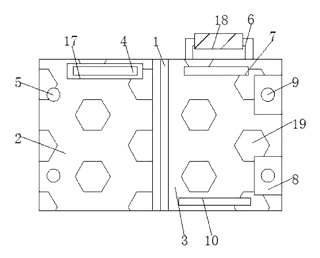
Drawings reproduced from the public patent document for reference.