At a glance
| Patent number | CN106974520B (application CN201710325788) |
| Type | China invention patent (发明专利) - protects product shape, structure and method |
| Original title | Burn-proof safety children’s spoon (防烫安全儿童勺) |
| Patent owner | ZHEJIANG EMC PLASTIC Co Ltd |
| Inventors | Peng Congwen |
| Filing date | 2017-05-10 |
| Grant date | 2018-08-31 |
| Status (China) | Lapsed - terminated for non-payment of annual fees (recorded 2022-04-15) |
| Patent family | Chinese filings only - CN106974520B |
| Cited by | 0 later documents |
| Source | Google Patents (search for CN106974520B) |
What the claims cover, in plain language
Claim 1 - a burn-proof safety children’s spoon comprising a spoon head, a kettleholder and a connecting rod. The connecting rod has a rear bar and a front bar. The front bar’s rod end has a slot, and the rear bar’s rod end has an inserted sheet matched to the slot. They are pivotally connected by a rotation axis. The spoon head internally has a middle air chamber, and the front bar internally has a slide cartridge in airtight communication with the air chamber. A sliding block is inside the slide cartridge, capable of airtight sliding. The inserted sheet’s end has a limit buckle, and the slot’s bottom has a limit hole connected to the slide cartridge’s end. Under natural conditions, the limit buckle is fastened in the limit hole.
Claim 2 - the middle air chamber is filled with an evaporation liquid.
Claim 3 - the slot’s side wall contains a permanent magnetic strip whose two magnetic poles are parallel to the front bar’s axis. The inserted sheet internally contains a permanent magnetism column whose two magnetic poles are parallel to the rear bar’s axis. Adjacent permanent magnetism column and permanent magnetic strip attract each other with opposite poles.
This is a simplified reading for orientation only. The legal scope is defined by the exact claim wording in the official Chinese document.
What this means for US production
This patent was filed only in China and is lapsed due to non-payment of annual fees, so it no longer restricts anyone in China either. It has no US or other foreign counterpart.
Two points to settle early:
- Other patents may exist. Temperature-indicating baby spoons and thermochromic feeding products are covered by various US and international patents held by different companies in the infant care field. Even though this specific mechanical design is lapsed, a freedom-to-operate (FTO) review covering the air-chamber expansion mechanism and magnetic reset is recommended before tooling.
- Evaporation liquid selection. The type of liquid used inside the sealed chamber determines the activation temperature. The exact compound and volume must be confirmed on prototypes to ensure consistent bending at the intended threshold.
Customization and manufacturing
What can be customized
| Area | Options |
|---|---|
| Activation temperature | Set in design by choosing the evaporation liquid and chamber volume |
| Spoon bowl size | Infant or toddler dimensions, to be confirmed in design |
| Handle length and grip | Kettleholder shape, texture and overall length |
| Colors | Injection-molded plastic colors for outer shell parts |
| Magnet strength | Adjusted to change the force required for the handle to reset |
| Packaging | Retail blister, box or bulk tray configurations |
Things to plan for (US market)
- FDA 21 CFR - all materials contacting food (spoon head plastics, sealants, internal chamber walls) must comply with FDA food-contact regulations for infant use.
- CPSC / CPSIA - children’s products sold in the US require third-party testing for lead, phthalates and small parts; a Children’s Product Certificate (CPC) is mandatory.
- ASTM F963 - while primarily a toy standard, its mechanical hazard tests (small parts cylinder, sharp edges) are often applied by retailers to infant feeding items.
- California Prop 65 - plastics, magnets and coatings must be screened for listed substances.
How a project runs
- Inquiry - target age range, activation temperature, quantities and packaging needs.
- Design - 3D modeling of the spoon head, air chamber, slide cartridge, bars, magnets and buckle spring.
- Prototype - CNC or printed samples to verify the sealing, sliding friction and magnetic reset force.
- Pilot run - injection molds opened; sample batch tested for repeated heating/cooling cycles and food-contact compliance.
- Production - molding, magnet insertion, assembly, airtight sealing of the chamber, quality inspection and packing.
Quantities & timeline
The spoon requires precision injection molds for the front bar, rear bar, spoon head and sliding block, plus tooling for the compression spring and magnet placement fixtures. Achieving a reliable airtight seal between the chamber and the slide cartridge during mass assembly takes process development. Certification tests for food contact and children’s product safety run concurrently with pilot batches. Send us your target age, activation temperature, quantity and packaging requirements and we will reply with options.
Patent drawings
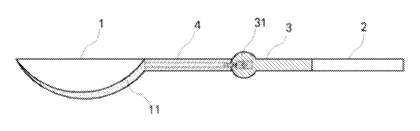
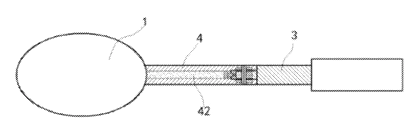
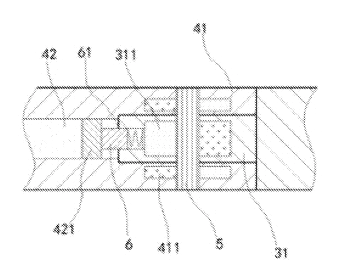
Drawings reproduced from the public patent document for reference.