
Patent CN107117365B
Updated October 24, 2026Child-Resistant Paperboard Medicine Box with Three-Point Opening
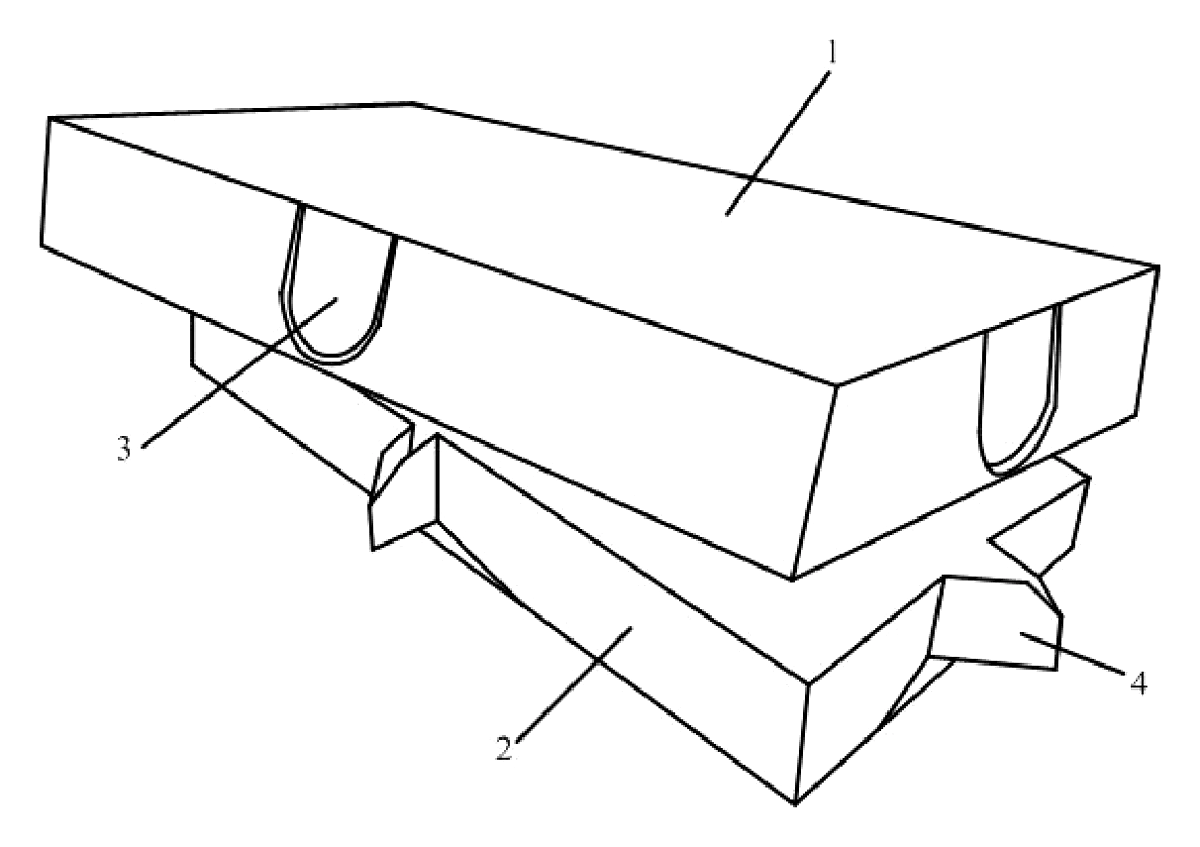
Most child-resistant packaging relies on plastic: push-and-turn caps, blister packs, plastic clips glued into cartons. This box does it with paperboard alone. The base box has double walls on three sides, and folded into each double wall is a small spring lock - four pentagon-shaped panels that spring outward and catch the lid. The lid has a matching press point on the same three sides. Press all three at once and the locks fold back, letting the lid lift off; press only one or two and the remaining lock still holds. Both boxes fold from single die-cut sheets.
- China invention patent - lapsed
- No filings outside China
- Child-resistant packaging
- Folding carton board, no plastic parts
Splat! What let you down?
🔒
Three locks at once
Spring locks on the left, front and back walls must all be released together.
📦
All paperboard
The locks are folded from the carton itself - no plastic clips or inserts.
👐
Easy for adults
Two hands press three points together; small hands and immature coordination cannot.
✂️
Two die-cut sheets
The lid box and base box each fold from one flat blank.
Bring this product to market
- ✓ Patent vetted China-only family and legal status checked
- 2 Product brief · now How it works, uses and options written up
- 3 Prototype First samples for buyers to review
- 4 Pilot run Small first batch for launch customers
- 5 Volume production Repeat orders at scale
Buyer interest
– of 100 buyers needed to start prototyping
One click, no sign-up. Each vote is one real visitor, and products with the most interest go to prototyping first.
Build team: no members yet. Need a partner, co-funding or skills to build this? Join and we introduce the team once it forms.
The problem
Young children getting into medicines, vitamins and household chemicals is a long-standing safety problem, which is why many of these products must be sold in child-resistant packaging. The common solutions - push-and-turn caps, blister packs and cartons with plastic locking inserts - work, but they add plastic, extra parts and assembly, and some are hard for older adults to open. Brands moving to paper-based packaging want a carton that is child-resistant on its own. The patent, from a university packaging design team, is one such carton.
The solution
The patent builds the locks into the board:
- The box is a lid box (1) that slides down over a base box (2), like a shoebox.
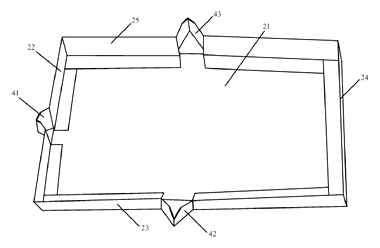
- The base box has double walls on the left (22), front (23) and back (25).
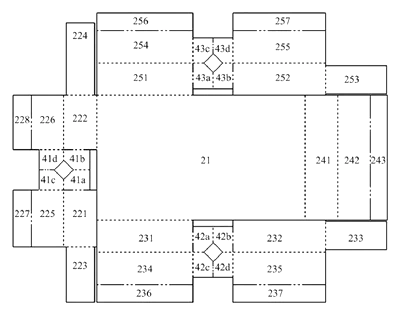
- Inside each double wall, a spring lock - left (41), front (42), back (43) - is folded from four pentagon-shaped panels joined by fold lines. Folded in, they act like a small spring that pushes outward and catches the lid.
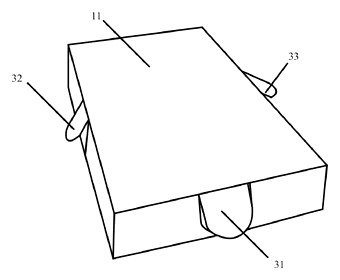
- The lid has a matching press point (unlocking mechanism) on each of the same three sides: left (31), front (32) and back (33), made from U-shaped folded flaps.
- Pressing a press point pushes its spring lock back and frees that side. The lid comes off only when all three are pressed at once.
- According to the patent, pressing three points with one hand while using the other hand to lift is easy for adults, but children’s smaller palms and immature coordination make it hard for them.
Who it is for
- OTC drug, vitamin and supplement brands looking for paper-based child-resistant packaging that cuts plastic.
- Cannabis and CBD brands in states that require child-resistant packaging for edibles and other products.
- Folding-carton converters wanting a structural design to offer clients alongside their standard cartons.
- Household chemical and e-commerce brands whose products need a secure, recyclable outer box.
How it works
The main parts
| No. | Part | What it does |
|---|---|---|
| 1 | Lid box | Slides over the base; carries the three press points. |
| 31, 32, 33 | Press points | U-shaped folded flaps on the left, front and back walls of the lid. |
| 2 | Base box | Holds the product; double walls on three sides. |
| 22, 23, 25 | Double walls | Left, front and back walls of the base, folded double. |
| 41, 42, 43 | Spring locks | Pentagon panels folded inside the double walls that catch the lid. |
Opening and closing
- Hold the box with both hands.
- Press the left, front and back points at the same time. Each pushes its spring lock in.
- Lift the lid while the three points are held.
- To close, slide the lid down; the spring locks snap out and catch it again.
Made from flat sheets
Each box is cut from one sheet of board and folded. The patent gives every panel and fold line, so a carton converter can make a cutting die directly from the drawings.
Applications
Over-the-counter medicines
Outer cartons for pain relievers, cold remedies and iron supplements that must be child-resistant.
Vitamins and gummies
Gummy vitamins look like candy; a child-resistant paper box adds protection without a plastic tub.
Cannabis and CBD edibles
State rules often require child-resistant packaging that is also resealable - this box closes again after each use.
Laundry and cleaning pods
Paperboard boxes for detergent pods, where child-resistant closures are expected.
Button batteries and small hazardous items
Small items that are dangerous if swallowed, packed in a paper outer box that a toddler cannot open.
Where it is less suitable
- Very humid storage - paperboard springs weaken when damp; coatings or board grade must be chosen for the use.
- Products needing tamper evidence or moisture barriers - add a seal or inner pouch; the box itself is a child-resistant closure, not a barrier.
Frequently asked questions
How does a paperboard box lock without plastic?
The base box has double walls on three sides. Folded inside each is a spring lock made of four small pentagon panels; folded together they push outward and catch the lid. Pressing the matching point on the lid pushes the lock back.
Why three points?
One or two locks released still leaves the lid held. All three - left, front and back - must be pressed at the same time, which needs two coordinated hands. According to the patent, this is easy for adults but hard for young children.
Is it certified child-resistant?
Not by itself. Child resistance in the US is proven by testing the final box with panels of children and seniors under 16 CFR 1700.20. We build samples in the production board and arrange the test.
Can older adults open it?
The protocol also tests seniors, and the box must pass both. Press force depends on board grade and fold design, which we tune and test.
Does it close again after opening?
Yes. Sliding the lid back down lets the spring locks snap out and catch it again, so the box stays child-resistant between uses.
How many times can it be opened?
Paperboard springs soften with use and humidity. The number of reliable cycles is checked on samples for the product’s typical use, and board grade or coating is chosen to match.
Can this design be made and sold in the US?
The patent was filed only in China and has lapsed, so it does not restrict the design in the US or in China. Child-resistant cartons are covered by many US patents - see Patent & Production - so we recommend a freedom-to-operate check before volume production.
Are you affiliated with the patent owner?
No. IP2M is an independent design and manufacturing service working from the public patent document.
Request a quote
Click Request a Quote below to see our email address - copy it, or open your email app with a ready-made message. Please mention patent CN107117365B in the subject.
Helpful details to include:
- Your company and product (OTC drug, supplement, cannabis, household chemical)
- What goes inside - blister cards, bottle, pouch, pods - and its size
- Board and print preferences
- Testing needs - 16 CFR 1700.20 or state requirements
- Estimated quantity and target price
- Timeline - when you would like samples and the first shipment
You can also reach us at (332) 203-9997.
Explore this product
Interested in building this?
Tell us your target market, quantity and timeline. We reply with options for prototyping, small-batch runs or volume production.
Send your inquiry to
Please put CN107117365B in the subject line and tell us your company, country, estimated quantity and timeline.
Prefer to talk? Call (332) 203-9997.
More product-ready patents
All Packaging & Containers patents →
Packaging & Containers
Rigid Shell Container with Removable Silicone Liner
Cup or food box with a rigid outer shell and a removable, leak-tight silicone liner.
Patent CN212638395U
Packaging & Containers
Tape-Free Reusable Shipping Box with Zigzag Interlocking Flaps
Reusable carton closed without tape: zigzag flaps interlock, tabs tuck in, a U-clip locks the lid.
Patent CN207242262U
Packaging & Containers
Hinge Device for Folding Containers with Integrated Twistlock Hole
Folding container hinge with a built-in twistlock hole and observation port.
Patent CN113460518B
Packaging & Containers
Cylindrical Plastic Bottle Cap with Built-In Soup Ladle
Plastic bottle cap storing a soup ladle inside, with a flip-top lid and inner sealing closure.
Patent CN106144192B
Packaging & Containers
Insulated Food Packaging Box with Detachable Liner and Self-Heating Cavity
Detachable insulated food box with a sealed cavity for a self-heating sheet and a temperature sticker.
Patent CN108372980B
Home, Kitchen & Cleaning
Soap-Dispensing Dish Brush That Refills in Its Stand
Dish brush whose soap chamber refills from a detergent tank in its stand; press to dose.
Patent CN212368563U
Browse by category
- Apparel & Accessories (22)
- Baby & Kids (16)
- Bags & Luggage (9)
- Bath & Personal Care (16)
- Car Accessories (10)
- Furniture, Bedding & Storage (12)
- Garden & Outdoor (18)
- Health & Wellness (8)
- Home, Kitchen & Cleaning (24)
- Lighting (12)
- Packaging & Containers (6)
- Pet Products (6)
- Phone & Camera Accessories (4)
- Retail Display (13)
- School, Office & Art (19)
- Sports & Recreation (25)
- Tools & Workshop (27)
- Toys & Games (12)
This page is based on the public patent document CN107117365B, assigned to Suzhou Vocational University. IP2M is an independent manufacturing service and is not affiliated with, endorsed by or licensed by the patent owner. Images marked as concept renderings are illustrations, not photos of an existing product. Patent status information is provided for reference only and is not legal advice; confirm freedom to operate for your market before production. Full disclaimer.