At a glance
| Patent number | CN107348764B (application CN201710757574) |
| Type | China invention patent (发明专利) - protects technical solutions |
| Original title | Automatic adjusting frame for household intelligent watering flower stand (一种家居智能浇水花架用自动调节架体) |
| Patent owner | Yangzhou Ankang Industrial Investment Co ltd |
| Inventors | Ye Kan |
| Filing date | 2017-08-29 |
| Grant date | 2019-04-26 |
| Status (China) | In force - valid until at most 2037-08-29, provided annual fees are paid |
| Patent family | Chinese filings only - no US, European, Japanese, PCT or other filings listed |
| Cited by | 0 later documents |
| Source | Google Patents (search for CN107348764B) |
What the claims cover, in plain language
Claim 1 defines an automatic adjustment frame comprising a frame body with two vertical gripper shoes. A bottom support plate sits between them. A side connecting plate at the top holds a promotion motor, whose output shaft connects to a lifting screw rod. This screw rod engages a tube fixed to the support plate, allowing the plate to move up and down. The plate has bolt apertures with downward through-holes. Flowerpot placement groove bodies sit on the plate, featuring lower spiro union portions that screw into the apertures. These portions have through-holes communicating with the pot and the plate’s drainage. A water-accepting basin rack is fixed to the bottom of the frame, holding a basin beneath all drainage paths. Self-lubricating blocks on the plate sides press against the vertical shoes. Limit elastics on a limit support board below the basin rack prevent over-movement.
Claim 2 adds that the limit support board has a middle part through slot.
This is a simplified reading for orientation only. The legal scope is defined by the exact claim wording in the official Chinese document.
What this means for US production
This patent was filed only in China and is currently in force. Making or selling products incorporating this specific mechanical arrangement in China requires the owner’s permission. However, since there are no US patents in this family, the technology itself is not protected by patent rights in the United States.
Two points to settle early:
- Other patents may exist. Smart home devices and motorized furniture are heavily patented fields in the US. While this specific combination of a screw-lift and integrated drainage might not be claimed elsewhere, related technologies like app-controlled motors or specific sensor integrations could be covered by other US patents. A freedom-to-operate (FTO) review is recommended before mass production for the US market.
- Component sourcing. The patent mentions a “control host” and “WIFI wireless module” in the description but not the claims. If you choose to include these electronic features, ensure they comply with FCC regulations and do not infringe on standard wireless communication patents.
Customization and manufacturing
What can be customized
| Area | Options |
|---|---|
| Dimensions | Height range, plate diameter, and number of pot positions per tier |
| Materials | Steel, aluminum, or high-grade plastics for the frame and supports |
| Motor Type | DC gear motor or stepper motor depending on speed and torque needs |
| Drainage Capacity | Size of the water-accepting basin based on expected watering volume |
| Finish | Powder coating, wood veneer, or matte black for modern interiors |
| Control Interface | Basic button panel, remote control, or Wi-Fi enabled app connectivity |
Things to plan for (US market)
- UL/ETL Listing: If the product includes mains-powered electric motors, it must meet safety standards for electrical appliances. UL 153 or similar standards apply to portable lamps and decorative lighting, but motorized furniture falls under general electrical safety.
- FCC Part 15: Required if the device uses Bluetooth or Wi-Fi modules for wireless control.
- Proposition 65: California requires warnings for certain chemicals in plastics and metals used in consumer products.
- Consumer Product Safety Commission (CPSC): General stability and pinch-point safety rules apply to furniture with moving parts.
How a project runs
- Inquiry - Define size, load capacity, and desired features (e.g., app control vs. manual switch).
- Design - Select motor specs, determine screw pitch for smooth lifting, and design mold cavities for plastic parts.
- Prototype - Build functional samples to test lifting force, noise levels, and drainage efficiency.
- Certification Prep - Submit prototypes for electrical safety testing if applicable.
- Production - Injection molding for plastic components, CNC machining or stamping for metal frames, and final assembly.
Quantities & timeline
Motor integration and separation of water from electrical components need prototype evaluation. Tooling and testing schedules depend on the selected pot supports, controller and intended load; confirm these before agreeing a delivery date. Send us your target dimensions, weight capacity, material preferences, and estimated order volume and we will reply with options.
Patent drawings
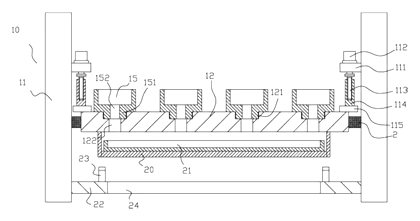
Drawings reproduced from the public patent document for reference.