
Patent CN107672339B
Updated October 26, 2026Spring-Loaded Retractable File Storage Folder with T-Shaped Sliders
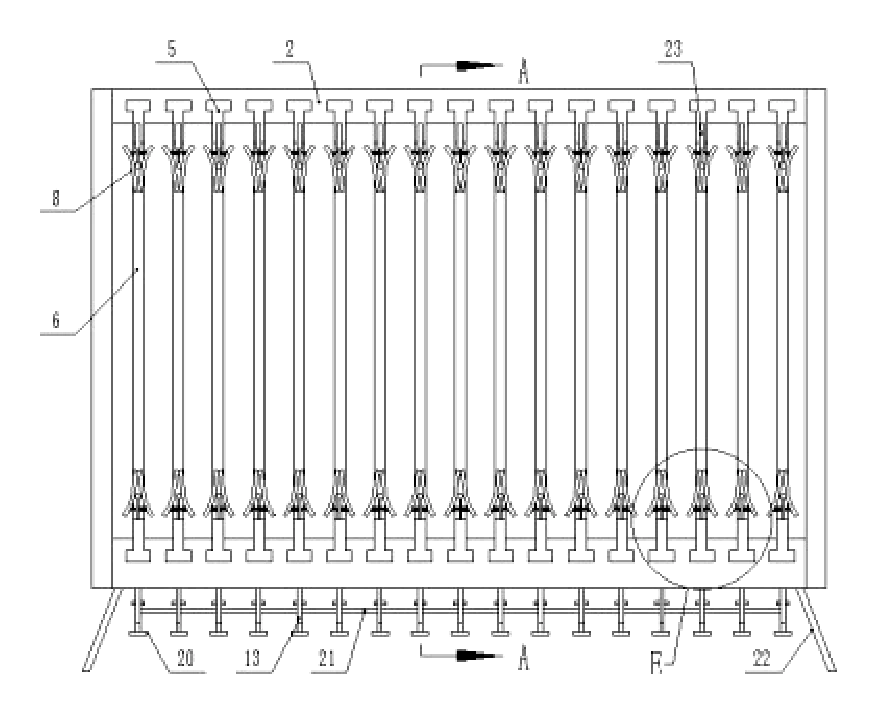
Standard file folders stack flat but force you to flip through pages one by one. This design uses sliding T-shaped blocks that pull outward to expose individual document positions. When you need to file or retrieve several records at once, you pull out the relevant blocks, clip the papers in, and let them sit open. When you are done, pulling a single fixed rod underneath releases the locking mechanism, and retracting springs draw every extended block back into the folder body simultaneously. The plates are molded from plastic, and the spacing between the upper and lower ends of each T-shaped block is set to about 35 cm in the patent drawings, leaving room for standard documents.
- China invention patent - in force
- No filings outside China
- Office & filing supplies
- Plastic plates, metal springs and rods
Splat! What let you down?
📂
T-shaped sliding blocks
Blocks ride in matching grooves on the top and bottom plates, pulling outward to expose each filing position.
🔄
One-pull retract
A linkage under the bottom plate lets you retract all extended blocks at once by pulling a single fixed rod.
🔒
Clamping block locks
Each slot uses a clamping block that slides in a through hole to hold the T-shaped block in its working position.
🧱
Plastic construction
The bottom and top plates are specified as plastic materials, keeping the folder light for desk use.
Bring this product to market
- ✓ Patent vetted China-only family and legal status checked
- 2 Product brief · now How it works, uses and options written up
- 3 Prototype First samples for buyers to review
- 4 Pilot run Small first batch for launch customers
- 5 Volume production Repeat orders at scale
Buyer interest
– of 100 buyers needed to start prototyping
One click, no sign-up. Each vote is one real visitor, and products with the most interest go to prototyping first.
Build team: no members yet. Need a partner, co-funding or skills to build this? Join and we introduce the team once it forms.
The problem
When office workers manage large volumes of paper records, they often need to locate several files at the same time. With a conventional binder or box, pulling one file out makes it hard to access the others without shuffling the whole stack. If multiple documents are removed, putting them back in order takes extra time. A system that lets each file position slide out independently, yet returns everything together in one motion, would reduce handling time in busy filing environments.
The solution
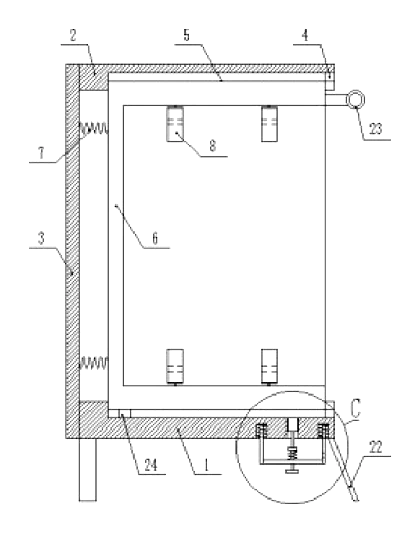
- A bottom plate (1) and a top plate (2) made of plastic are joined at their edges by a rear baffle (3).
- Symmetrical T-shaped grooves (4) are evenly arranged on the upper face of the bottom plate and the lower face of the top plate.
- T-shaped blocks (5) slide inside these grooves. Upper and lower blocks at each position are connected by a connecting rod (6).
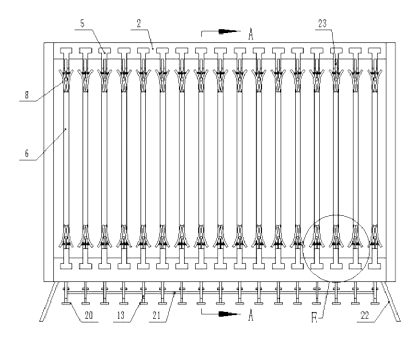
- A retracting spring (7) is fixed between the rear baffle (3) and each connecting rod (6), constantly pulling the assembly inward.
- A clip (8) is mounted symmetrically between the paired T-shaped blocks to hold documents.
- Underneath, a linkage of sliding blocks (11), vertical rods A (13), springs A (14), a connecting plate (15) and vertical rods B (16) with clamping blocks (17) locks the sliders in place when pulled out and releases them all together when a fixing rod (21) is pulled down.
Who it is for
- Office supply brands looking for a mechanical filing folder to add to their catalog of desk organizers.
- Wholesalers serving government and corporate offices where staff handle batches of personnel or administrative records daily.
- Amazon sellers in the stationery niche who want a differentiated product that demonstrates a clear mechanical action in video listings.
- Medical and legal record managers who sort physical documents frequently and need quick access to multiple files without losing sequence.
How it works
The main parts
| No. | Part | What it does |
|---|---|---|
| 1 | Bottom plate | Plastic base carrying the lower T-shaped grooves (4) and through holes A (9). |
| 2 | Top plate | Plastic cover carrying the upper T-shaped grooves (4). |
| 3 | Rear baffle | Connects the back edges of the plates; anchors the retracting springs (7). |
| 4 | T-shaped groove | Track for the sliding blocks, evenly spaced on both plates. |
| 5 | T-shaped block | Slides in the groove; carries the clip (8); spaced about 35 cm vertically. |
| 6 | Connecting rod | Joins the upper and lower T-shaped blocks at each position. |
| 7 | Retracting spring | Pulls the connecting rod back toward the rear baffle. |
| 8 | Clip | Holds the document between the T-shaped blocks. |
| 9 | Through hole A | Opening in the bottom plate aligned with each groove. |
| 10 | Blind hole | Houses the sliding block (11) at each end of through hole A. |
| 11 | Sliding block | Moves inside the blind hole to actuate the locking linkage. |
| 12 | Blocking ring | Fixed at the edge of the blind hole to limit travel. |
| 13 | Vertical rod A | Extends downward from the sliding block. |
| 14 | Spring A | Sits between the sliding block and the blocking ring. |
| 15 | Connecting plate | Links all vertical rods A together. |
| 16 | Vertical rod B | Passes through the connecting plate and up through through hole A. |
| 17 | Clamping block | Fixed to the top of vertical rod B; engages through hole B (24) on the T-shaped block to lock it. |
| 18 | Disc A | Fixed on the side of vertical rod B. |
| 19 | Spring B | Installed between disc A and the connecting plate. |
| 20 | Disc B | Fixed at the bottom of vertical rod B. |
| 21 | Fixing rod | Connects the connecting plates; pulled down to release all locks. |
| 22 | Leg | Supports the bottom plate on a desk. |
| 23 | Pull ring | Attached to the edge of the T-shaped block for manual extraction. |
| 24 | Through hole B | On the T-shaped block, matching the clamping block. |
Operating steps
- Pull a T-shaped block outward using the pull ring (23). The connecting rod (6) stretches the retracting spring (7). As the block reaches its working position, the clamping block (17) rises through through hole B (24) to lock it in place.
- Attach documents using the clip (8) between the upper and lower T-shaped blocks. Repeat for as many positions as needed.
- Retract all blocks by pulling the fixing rod (21) downward. This lowers the connecting plate (15), which pulls the vertical rods B (16) and clamping blocks (17) out of the through holes B (24). The retracting springs (7) then pull every extended block back into the folder body at once.
Applications
Corporate HR departments
Personnel teams often review several employee files in one session. This folder allows them to slide out the exact records needed, read them side by side, and snap everything closed with one pull of the fixing rod.
Law firms and notary offices
Legal staff handling physical case documents can separate active files within a single unit. The clips keep papers secure while the retracting mechanism ensures nothing is left protruding when the folder is shelved.
Government archives
Clerks managing public records benefit from the uniform spacing of the T-shaped grooves. The mechanical action reduces the time spent flipping through bound registers when cross-referencing multiple entries.
School administration offices
Registrars sorting student transcripts or enrollment forms can isolate specific records quickly. The plastic construction keeps the unit light enough to move between desks or carry to meetings.
Where it is less suitable
- Digital-first offices - organizations that have fully migrated to electronic records will not need a mechanical paper folder.
- Heavy-duty archival storage - long-term vault storage typically requires acid-free boxes rather than plastic folders with moving metal parts.
- Single-document carriers - if a user only ever transports one file, a standard manila folder is simpler and lighter.
Frequently asked questions
How do the T-shaped blocks stay out when I pull them?
When you slide a block forward, a clamping block attached to a vertical rod rises into a matching hole on the T-shaped block. This mechanical lock holds the block in its extended position against the pull of the retracting spring until you release the linkage.
How do I close all the open slots at once?
Underneath the bottom plate, a connecting plate links all the vertical rods together via a fixing rod. Pulling this fixing rod downward lowers every clamping block out of its locking hole simultaneously. Once unlocked, the retracting springs behind each connecting rod pull all the extended T-shaped blocks back into the folder body in one motion.
What material is the folder made of?
The patent specifies that the bottom plate and top plate are made of plastic materials. The exact resin type is not named in the document and would be set in design based on stiffness, friction and cost requirements. Internal components like rods, springs and blocking rings are metal.
What size documents does it hold?
The patent describes the distance between the upper and lower ends of the T-shaped block as about 35 cm. The overall plate dimensions to accommodate letter, A4 or legal paper sizes are to be confirmed in design.
How many files can it hold?
The patent mentions a plurality of evenly arranged T-shaped grooves but does not specify an exact number. The slot count is set in design and confirmed on prototypes based on the desired width of the folder.
Is the spacing between slots adjustable?
The grooves are molded into the plastic plates, so their spacing is fixed during manufacturing. Different versions can be tooled with wider or narrower spacing depending on the intended document thickness.
Can this design be made and sold in the US?
The patent was filed only in China and is in force in China until at most 2037-11-14 (if annual fees are paid). It has no US counterpart, so the Chinese patent itself does not restrict making or selling the design in the US. However, other patents covering mechanical filing devices may exist - see Patent & Production - so we recommend a freedom-to-operate check before volume production.
Are you affiliated with the patent owner?
No. IP2M is an independent design and manufacturing service working from the public patent document.
Request a quote
Click Request a Quote below to see our email address - copy it, or open your email app with a ready-made message. Please mention patent CN107672339B in the subject.
Helpful details to include:
- Your company and channel (office supply brand, Amazon seller, wholesale distributor, institutional buyer)
- Target paper size (letter, A4, legal or custom)
- Number of slots required per folder
- Material preferences for the plastic plates and any color requirements
- Clip style preferred for holding documents
- Estimated quantity and target price
- Timeline - when you would like samples and the first shipment
You can also reach us at (332) 203-9997.
Explore this product
Interested in building this?
Tell us your target market, quantity and timeline. We reply with options for prototyping, small-batch runs or volume production.
Send your inquiry to
Please put CN107672339B in the subject line and tell us your company, country, estimated quantity and timeline.
Prefer to talk? Call (332) 203-9997.
More product-ready patents
All School, Office & Art patents →
School, Office & Art
Long-Point Sketch Pencil Sharpener
Crank sharpener that cuts only the wood of sketch pencils, leaving a long, round lead about 30 mm long.
Patent CN207241257U
School, Office & Art
Fold-Out Desk Organizer Insert for School Backpacks
Backpack insert that unfolds into a hanging desk organizer for workbooks, stationery and a water bottle.
Patent CN209436546U
School, Office & Art
Smart Pencil Cap That Checks the Point with a Camera
Electronic pencil cap that photographs the point, measures it and reminds you to sharpen.
Patent CN106427302B
School, Office & Art
Expanding Clipboard Folder with Spring-Mounted Hinge and Catch
Hard folder whose spring-mounted hinge and catch let the cover clamp any thickness of paper.
Patent CN105667120B
School, Office & Art
Slide-Action Retractable Pen with a Friction-Loaded Cam That Ignores Gravity
Slide-action retractable pen whose spring-pressed cam latch stays put whichever way the pen is held.
Patent CN217671900U
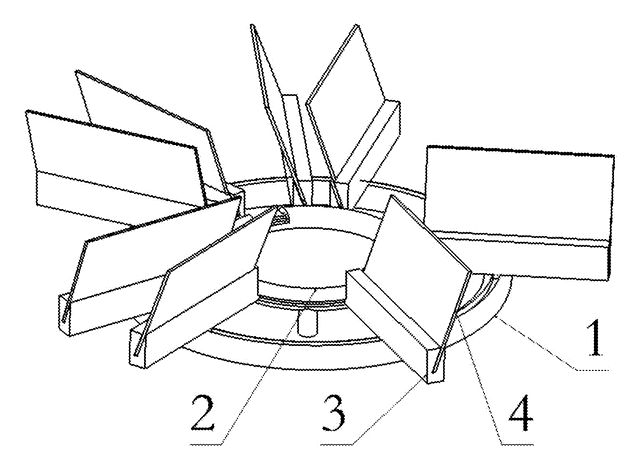
School, Office & Art
Carousel Business Card Holder with Rolling Card Trays on Twin Ring Tracks
Desk card holder: angled card trays roll on wheels around two concentric ring tracks and lift out.
Patent CN105774300B
Browse by category
- Apparel & Accessories (22)
- Baby & Kids (16)
- Bags & Luggage (9)
- Bath & Personal Care (16)
- Car Accessories (10)
- Furniture, Bedding & Storage (12)
- Garden & Outdoor (18)
- Health & Wellness (8)
- Home, Kitchen & Cleaning (24)
- Lighting (12)
- Packaging & Containers (6)
- Pet Products (6)
- Phone & Camera Accessories (4)
- Retail Display (13)
- School, Office & Art (19)
- Sports & Recreation (25)
- Tools & Workshop (27)
- Toys & Games (12)
This page is based on the public patent document CN107672339B, assigned to Jiaxing Erhui Human Resources Co.,Ltd.. IP2M is an independent manufacturing service and is not affiliated with, endorsed by or licensed by the patent owner. Images marked as concept renderings are illustrations, not photos of an existing product. Patent status information is provided for reference only and is not legal advice; confirm freedom to operate for your market before production. Full disclaimer.