
Patent CN107930093B
Updated November 2, 2026Multi-Functional Adjustable Roller Skate Knife Rest
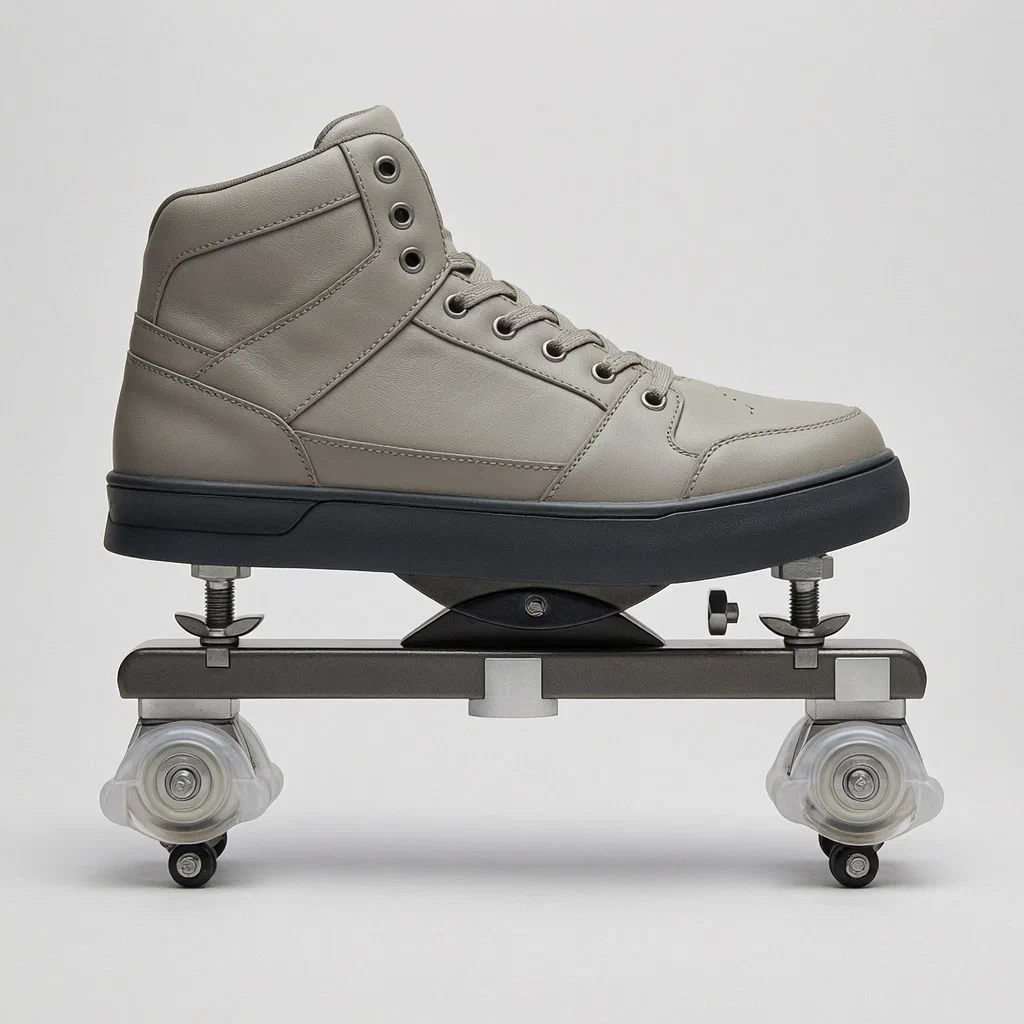
Standard roller skates lock you into one style. Switching from aggressive inline-style maneuvers to casual cruising usually requires swapping entire skate bodies or complex tool work. This design integrates a multi-mode chassis directly onto the shoe bottom. By adjusting the height of two rear wheels and tilting the frame angle via wing nuts, users can manually convert the skate setup to suit sneaker-style skating, leisure cruising, or specific trick patterns. All adjustments are hand-operated, requiring no screwdrivers or wrenches during use.
- China invention patent - lapsed
- No filings outside China
- Skates & Snow Sports
- Manual adjustment, multi-mode chassis
Splat! What let you down?
🔄
Three Skating Modes
Switch between sneaker, leisure, and flat floral configurations by adjusting wheel heights.
🔧
Tool-Free Operation
Wing nuts and rotating wheels allow manual adjustment without external tools.
⚖️
Tilt Control
Screw rods at both ends adjust the frame's forward or backward lean for stability.
📐
Height Adjustment
Hex-nut based devices raise or lower specific wheels to change ground contact points.
Bring this product to market
- ✓ Patent vetted China-only family and legal status checked
- 2 Product brief · now How it works, uses and options written up
- 3 Prototype First samples for buyers to review
- 4 Pilot run Small first batch for launch customers
- 5 Volume production Repeat orders at scale
Buyer interest
– of 100 buyers needed to start prototyping
One click, no sign-up. Each vote is one real visitor, and products with the most interest go to prototyping first.
Build team: no members yet. Need a partner, co-funding or skills to build this? Join and we introduce the team once it forms.
The problem
Most roller skates are built for a single purpose. A user who wants to practice aggressive tricks cannot easily switch to casual cruising without changing skates entirely. Existing adjustable frames often require tools like Allen keys or screwdrivers to modify wheel positions, making quick changes difficult during a session. Furthermore, standard frames do not allow for the subtle angular adjustments needed to shift weight distribution between different skating styles, leading to discomfort or poor performance when trying to adapt one skate for multiple uses.
The solution
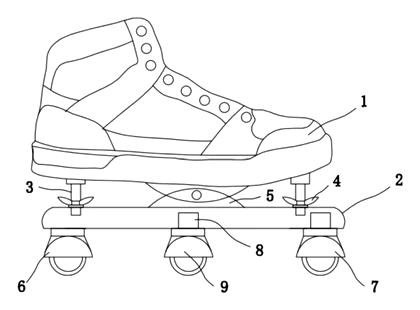
- A shoe body (1) is mounted to a tool holder body (2) located at the bottom.
- The connection is managed by a central mounting assembly (5) consisting of arc-shaped ears pinned together, allowing the frame to pivot.
- Adjusting screw rods (3) run through the left and right ends of the tool holder body, secured by wing nuts (4). Turning these nuts manually adjusts the tilt angle of the entire frame.
- The bottom of the tool holder body holds a fixed fast pulley (6) at the front.
- Behind it, a first regulating wheel (9) and a second regulating wheel (7) are positioned. Their vertical position is controlled by a height adjustment device (8).
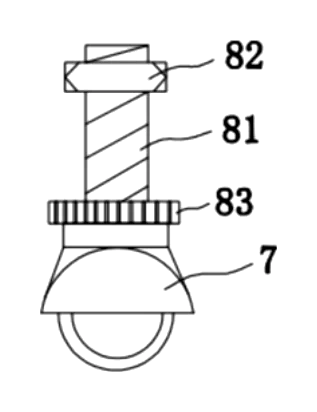
- This device uses a drift bolt screw rod (81) with a hexagonal socket nut (82) and a rotating wheel (83) at the bottom, allowing users to raise or lower each rear wheel independently by hand.
Who it is for
- Inline skate brands looking to offer versatile entry-level models that appeal to beginners wanting to try different styles.
- Rental fleet operators who need durable skates that can be quickly adjusted between users with varying skill levels and preferences.
- Recreational sports retailers selling all-in-one skates for families where members have different skating interests.
- Custom skate builders seeking modular chassis designs that simplify the creation of multi-purpose skates.
How it works
The main parts
| No. | Part | What it does |
|---|---|---|
| 1 | Shoe Body | The boot or base to which the frame attaches. |
| 2 | Tool Holder Body | The main chassis structure holding the wheels. |
| 3, 4 | Screw Rods & Wing Nuts | Adjust the tilt angle of the chassis (forward/backward lean). |
| 5 | Mounting Assembly | Pinned arc ears that allow the chassis to pivot on the shoe. |
| 6 | Fast Pulley | Fixed front wheel providing primary ground contact. |
| 7, 9 | Regulating Wheels | Rear wheels whose height determines the active wheel set. |
| 8 | Height Adjustment Device | Mechanism to raise/lower rear wheels manually. |
| 81, 82, 83 | Screw, Nut, Wheel | Components inside the height device for tool-free tuning. |
Operating steps
- Select Mode: Decide whether to use Sneaker, Leisure, or Flat Floral configuration.
- Adjust Height: Rotate the rotating wheel (83) on the height adjustment device (8). This moves the drift bolt screw rod (81) up or down, raising or lowering the first (9) or second (7) regulating wheel.
- Adjust Tilt: Turn the wing nuts (4) on the adjusting screw rods (3). Tightening one side while loosening the other pivots the tool holder body (2) on the mounting assembly (5), changing the frame’s lean.
- Lock Position: The threads and friction in the screw mechanisms hold the settings in place without additional locking hardware.
Applications
Sneaker Style Skating
For users who prefer an inline-skate feel with boots, the first and second regulating wheels are raised so they align horizontally with the fast pulley. The wing nuts are adjusted to tilt the frame slightly forward, mimicking the stance of athletic sneakers for better balance during active movement.
Leisure Cruising
When switching to casual riding, the rear wheels are lowered to sit on the same plane as the front wheel, creating a stable four-point contact. The adjusting screws are tightened to level the tool holder body completely horizontal, ensuring smooth rolling on flat surfaces without the forward lean used in active skating.
Flat Floral Trick Patterns
For specific trick maneuvers, the second regulating wheel is raised off the ground entirely, while the first wheel remains aligned with the front pulley. The frame is then tilted to the left using the wing nuts, shifting the center of gravity to support lateral movements and spins common in artistic or street skating routines.
Where it is less suitable
- High-speed racing: The mechanical complexity and potential play in the adjustment threads may introduce instability at very high velocities compared to rigid, fixed-frame speed skates.
- Extreme impact jumps: The reliance on threaded connections for structural integrity suggests this design is optimized for recreational versatility rather than heavy-duty downhill or vert ramp impacts.
- Children’s learning skates: The multiple adjustment points might be too complex for young children to manage independently, potentially leading to improper setup if unsupervised.
Frequently asked questions
Do I need tools to change skating modes?
No. The design uses wing nuts for tilt adjustment and a rotating wheel for height adjustment. Both are meant to be operated by hand, allowing users to switch between sneaker, leisure, and trick modes quickly without screwdrivers or wrenches.
How many skating modes does it support?
The patent describes three distinct configurations: Sneaker mode (wheels aligned, forward tilt), Leisure mode (all wheels on ground, horizontal frame), and Flat Floral mode (one rear wheel raised, left tilt). Each is achieved by combining height and tilt adjustments.
Is the adjustment mechanism secure?
The system relies on threaded connections (screw rods and drift bolts). While effective for recreational use, regular checks are recommended to ensure nuts remain tight after intense skating sessions. The design does not include secondary locking pins mentioned in the patent text.
Can this frame fit any skate boot?
It mounts to the bottom of a shoe body via a central pin-and-ear assembly. Compatibility depends on the boot’s sole structure and the spacing of the mounting points. Custom adapters may be needed for boots with non-standard bottoms.
What materials are used for the frame?
The patent specifies a tool holder body with screw holes and metallic threads. For production, nylon composites or aluminum alloys are typical choices to balance weight and strength. The final material depends on the specific manufacturing contract.
Are there safety certifications for this design?
The patent itself does not list certifications. However, products made from this design for the US market should comply with ASTM F1351 standards for recreational inline skates, covering truck strength and wheel stability.
Can this design be made and sold in the US?
The patent was filed only in China and has lapsed due to non-payment of fees, so it does not restrict the design in the US. However, other active patents in the skate equipment industry may cover similar adjustable mechanisms. We recommend a freedom-to-operate check before volume production.
Are you affiliated with the patent owner?
No. IP2M is an independent design and manufacturing service working from the public patent document.
Request a quote
Click Request a Quote below to see our email address - copy it, or open your email app with a ready-made message. Please mention patent CN107930093B in the subject.
Helpful details to include:
- Your company and channel (skate brand, rental operator, sports retailer)
- Target user (beginner, intermediate, or specific niche)
- Wheel sizes you want the frame to accommodate
- Material preference (plastic, aluminum, etc.)
- Estimated quantity and target price
- Timeline - when you would like prototypes and the first shipment
You can also reach us at (332) 203-9997.
Explore this product
Interested in building this?
Tell us your target market, quantity and timeline. We reply with options for prototyping, small-batch runs or volume production.
Send your inquiry to
Please put CN107930093B in the subject line and tell us your company, country, estimated quantity and timeline.
Prefer to talk? Call (332) 203-9997.
More product-ready patents
All Sports & Recreation patents →
Sports & Recreation
Compact Torsion-Spring Bike Bell
Mini bike bell with a standard torsion spring and a rubber-floated dome - small size, clear tone, quick strap mount.
Patent CN205819384U
Sports & Recreation
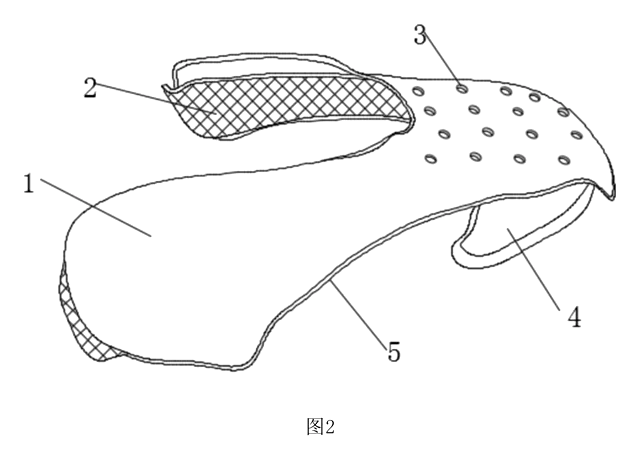
Padded Toe-Box Shield for Sneakers
Ventilated, silicone-lined toe-box insert that supports the front of a sneaker and cushions the toes.
Patent CN209473731U
Sports & Recreation
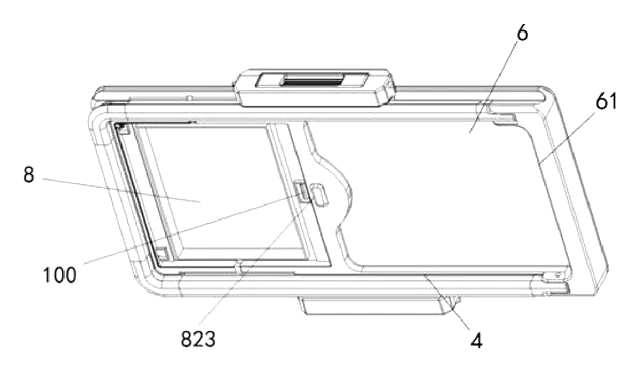
Reversible Fishing Seat-Box Lid with Backrest
Fishing seat-box lid that flips on removable hinge pins: cushion, backrest and storage on one face.
Patent CN208624426U
Sports & Recreation
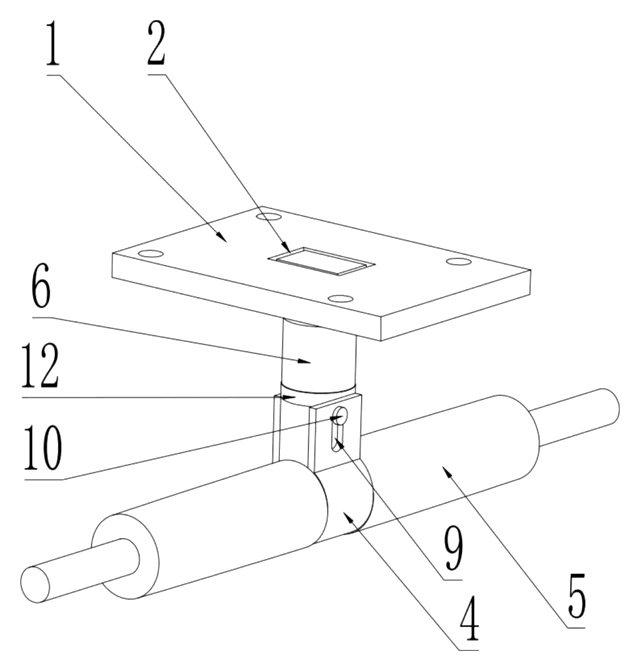
Swivel-Pin Skateboard Truck with Rubber Sleeve
Skateboard truck with a turning center pin, a tilting axle clamp and a rubber sleeve that centers it.
Patent CN216777880U
Sports & Recreation
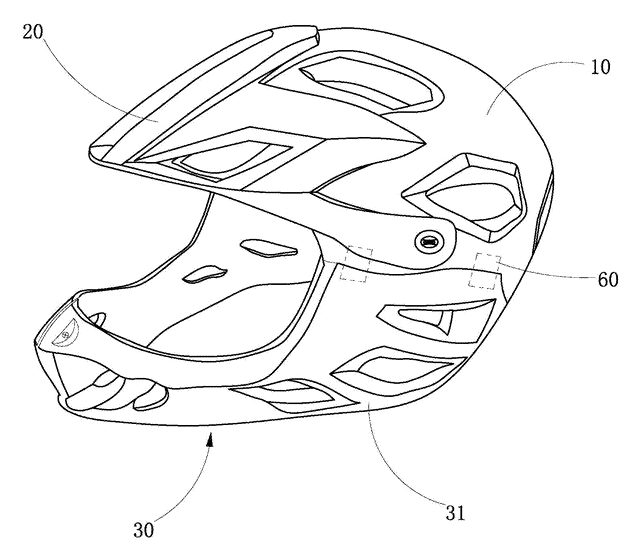
Full-Face Bike Helmet with Magnetic Detachable Chin Bar
Full-face cycling helmet whose chin bar clips on and off with magnetic, latching side connectors.
Patent CN206630067U
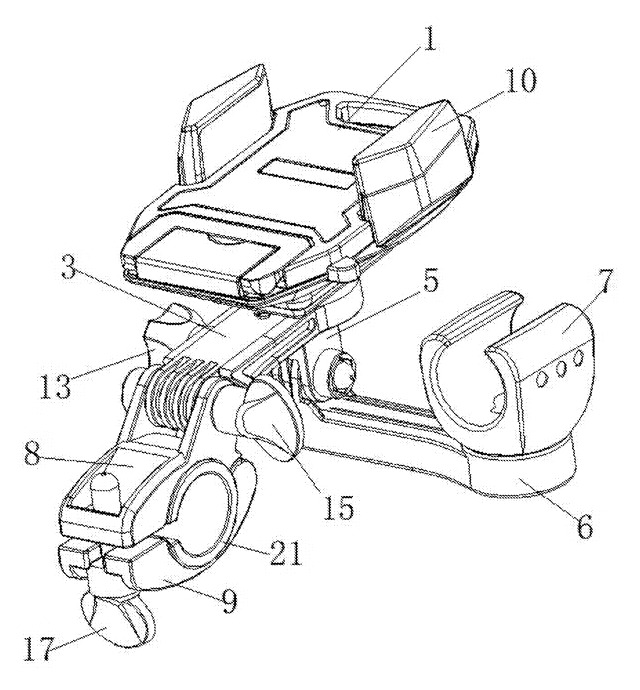
Sports & Recreation
Bike Phone Holder with Built-In Flashlight Clamp
Handlebar mount with a phone cradle on top and a flashlight clamp below, on one arm.
Patent CN206077485U
Browse by category
- Apparel & Accessories (30)
- Baby & Kids (20)
- Bags & Luggage (13)
- Bath & Personal Care (21)
- Car Accessories (16)
- Furniture, Bedding & Storage (15)
- Garden & Outdoor (21)
- Health & Wellness (10)
- Home, Kitchen & Cleaning (32)
- Lighting (16)
- Packaging & Containers (8)
- Pet Products (7)
- Phone & Camera Accessories (6)
- Retail Display (17)
- School, Office & Art (24)
- Sports & Recreation (31)
- Tools & Workshop (36)
- Toys & Games (16)
This page is based on the public patent document CN107930093B, assigned to Henan University of Technology, Anhui Xinhua University. IP2M is an independent manufacturing service and is not affiliated with, endorsed by or licensed by the patent owner. Images marked as concept renderings are illustrations, not photos of an existing product. Patent status information is provided for reference only and is not legal advice; confirm freedom to operate for your market before production. Full disclaimer.