At a glance
| Patent number | CN107930093B (application CN201711403408) |
| Type | China invention patent (发明专利) - protects product structure and function |
| Original title | A kind of multi-functional adjustable roller shoes knife rest (一种多功能可调节轮滑刀架) |
| Patent owner | Henan University of Technology, Anhui Xinhua University |
| Inventors | Hu Jianping, Yuan Yandong, Zhang Aichen, Wang Yuzhen |
| Filing date | 2017-12-22 |
| Grant date | 2019-04-12 |
| Status (China) | Lapsed - terminated for non-payment of annual fees (recorded 2024-12-13) |
| Patent family | Chinese filings only - no US, European, Japanese, PCT or other filings listed |
| Cited by | 0 later documents |
| Source | Google Patents (search for CN107930093B) |
What the claims cover, in plain language
Claim 1 - a roller skate frame comprising a shoe body and a tool holder body. The holder connects to the shoe via adjusting screw rods with wing nuts at both ends. A central mounting assembly pins the holder to the shoe. The holder has a fixed fast pulley and two regulating wheels behind it. These rear wheels connect to the holder via height adjustment devices to change their vertical position.
Claim 2 - the mounting assembly consists of two sets of arc mounting ears, one on the shoe and one on the holder, connected by pins to allow pivoting. Claim 3 - the top of the tool holder body has through-holes with internal threads matching the external threads of the adjusting screw rods. Claim 4 - the height adjustment device includes a drift bolt screw rod in a bottom hole, a hexagonal socket nut on its outer wall, and a rotating wheel socketed at the bottom for manual turning.
This is a simplified reading for orientation only. The legal scope is defined by the exact claim wording in the official Chinese document.
What this means for US production
This patent was filed only in China and has lapsed, meaning the exclusive rights have ended due to non-payment of maintenance fees. It has no US or other foreign counterpart.
Two points to settle early:
- Other patents may exist. While this specific design is free to use, the broader field of adjustable skate frames and multi-mode chassis systems may still be covered by active US patents held by major sporting goods manufacturers. A freedom-to-operate (FTO) review is recommended before mass production to ensure no infringement of existing IP regarding similar adjustment mechanisms.
- Material durability. The design relies heavily on plastic or metal threads for structural load. In US markets, consumer safety expectations for skates are high; material selection must account for fatigue resistance under repeated adjustment cycles.
Customization and manufacturing
What can be customized
| Area | Options |
|---|---|
| Frame Material | Nylon composite, aluminum alloy, or steel depending on weight targets. |
| Wheel Sizes | Compatible with standard 60mm-80mm inline skate wheels. |
| Adjustment Range | Thread pitch can be modified to fine-tune the sensitivity of height/tilt changes. |
| Ergonomics | Shape of wing nuts and rotating wheels can be enlarged for gloved hands. |
| Finish | Anodized, powder-coated, or raw metal finishes. |
Things to plan for (US market)
- ASTM F1351 - Standard Specification for Recreational Inline Skates. This covers requirements for trucks, wheels, and bearings, including strength and stability tests.
- CPSC Safety Standards - General consumer product safety rules apply, particularly regarding pinch points in the adjustment mechanisms.
- California Prop 65 - If metal plating or certain plastics are used, chemical warnings may be required.
How a project runs
- Inquiry - Define target user (beginner vs. advanced), wheel size compatibility, and desired adjustment range.
- Design - Finalize thread specs for screw rods, shape of arc ears, and material thickness for the holder body.
- Prototype - Print or CNC machine samples to test the smoothness of the height adjustment and tilt locking.
- Pilot Run - Conduct ASTM cycle testing and static load tests on the adjustment joints.
- Production - Injection molding for plastic parts, machining for metal threads, assembly of wheels and bearings.
Quantities & timeline
The core chassis requires precision molds for the integrated screw holes and arc ear shapes. Metal inserts for the threads add assembly steps. Testing for adjustment durability takes significant time. Send us your material preference, wheel compatibility, quantity and target price and we will reply with options.
Patent drawings
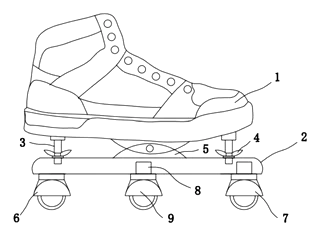
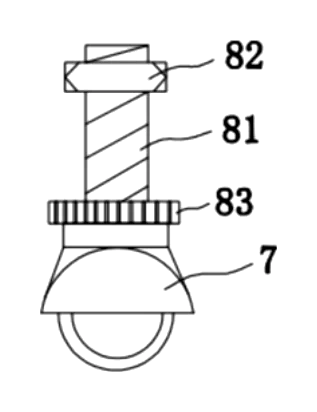
Drawings reproduced from the public patent document for reference.