At a glance
| Patent number | CN107981504B (application CN201711232893) |
| Type | China invention patent (发明专利) - protects product method and structure |
| Original title | Split type suitcase with table and chairs (一种自带桌椅的分体式行李箱) |
| Patent owner | ZHEJIANG HUAYANG LUGGAGE LEATHER Co.,Ltd. |
| Inventors | Pang Wencong |
| Filing date | 2017-11-30 |
| Grant date | 2021-05-04 |
| Status (China) | Active - In force in China until at most 2037-11-30 (if annual fees are paid) |
| Patent family | Chinese filings only - no US, European, Japanese, PCT or other filings listed |
| Cited by | 0 later documents |
| Source | Google Patents (search for CN107981504B) |
What the claims cover, in plain language
Claim 1 - A split-type suitcase comprising an upper branch box and a lower branch box arranged vertically. They are connected by a telescopic structure on one side, which has a fixed section and a telescopic section. Between the boxes sits a chair plate rotatably connected to the fixed section. The chair plate has chair legs that extend downward to meet the ground when the plate rotates out. A connecting plate slides relative to the chair plate, and a table plate is rotatably connected to the connecting plate. The mechanism allows the chair and table to be hidden between the boxes when closed and deployed when open.
This is a simplified reading for orientation only. The legal scope is defined by the exact claim wording in the official Chinese document.
What this means for US production
This patent was filed only in China and is currently active. It has no US or other foreign counterpart. Therefore, making or selling this specific design in the United States does not infringe this particular Chinese patent. However, because the patent is still in force in China, manufacturing the goods in China requires permission from the patent owner or proof that the design falls outside the claimed scope.
Two points to settle early:
- Other patents may exist. Luggage designs with integrated features are a competitive field. While this specific split-case mechanism appears unique in its current claim set, broader patents covering folding furniture integrated into suitcases or telescopic handles with attachments may exist in the US. A freedom-to-operate (FTO) review is recommended before mass production.
- Structural Integrity. The reliance on a single side-mounted telescopic pole to bear the weight of both boxes and the user’s interaction with the furniture requires robust material selection to prevent bending or failure under load.
Customization and manufacturing
What can be customized
| Area | Options |
|---|---|
| Dimensions | Case height, width, and depth to match standard airline carry-on or checked baggage sizes. |
| Materials | ABS, PC, or Aluminum alloy for the shell; Steel or reinforced Nylon for the internal frame and legs. |
| Furniture Size | Diameter of the chair plate and surface area of the table plate can be adjusted based on target user demographics. |
| Locking Mechanism | Additive TSA locks or combination dials for the zippers/clasps between the upper and lower boxes. |
| Handle Type | Single-side telescopic pole (as patented) vs. dual-pole systems if structural redesign permits. |
| Finish | Matte, glossy, textured, or branded printing on the outer shells. |
Things to plan for (US market)
- CPSC Safety Standards: Ensure no pinch points exist in the sliding/rotating mechanisms that could injure fingers, particularly relevant for general consumer goods.
- TSA Compliance: If locks are added, they must be recognized by Transportation Security Administration standards.
- Material Restrictions: Avoid restricted chemicals (e.g., certain phthalates in plastics) per California Prop 65 and federal regulations.
- Load Testing: Verify the telescopic pole and chair legs can support average adult weight without deformation, as this is a primary safety concern for seating.
How a project runs
- Inquiry - Define case size, material preferences, and quantity.
- Design Review - Adapt the telescopic and rotating mechanisms to chosen materials and molds.
- Prototype - Build functional samples to test deployment smoothness and structural strength.
- Testing - Conduct drop tests, cycle tests on the hinge/sliding parts, and load tests on the chair.
- Production - Injection molding for shells and plates, assembly of telescopic poles, and final packaging.
Quantities & timeline
Tooling for injection-molded plastic parts and metal stamping for the telescopic poles will dictate lead times. Assembly requires precise alignment of the rotating shafts to ensure the furniture fits flush between the cases. Send us your desired dimensions, material choices, and estimated volume and we will reply with options.
Patent drawings
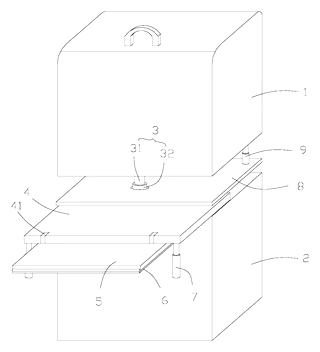
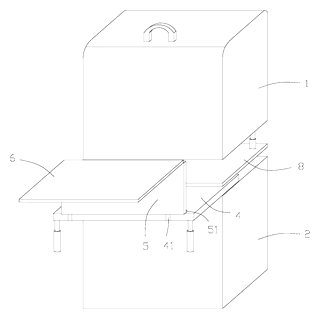
Drawings reproduced from the public patent document for reference.