
Patent CN108043012B
Updated November 5, 2026Children's Roller Skates with Step-Switching Mechanism
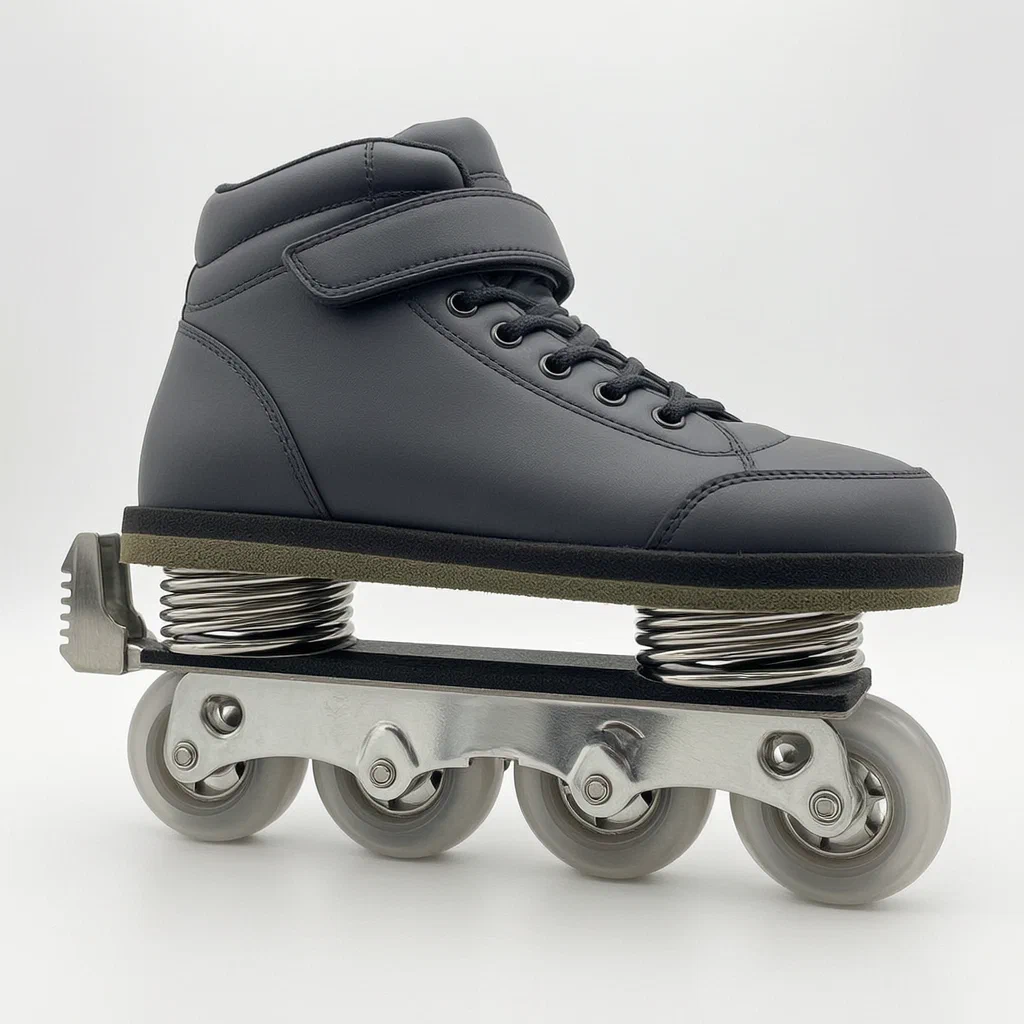
Traditional kids' skates require manual adjustment of buckles or levers to switch between wheels and ground contact, which can be difficult for small hands and time-consuming for parents. This patent describes a 'step-switching' mechanism where the act of stepping down engages the skating mode automatically. The sole compresses against a spring, rotating an internal lever arm that locks the pulley system into place. Lifting the foot releases the lock, returning the skate to a walking configuration. This simplifies operation for children and reduces the risk of loose settings during play.
- China invention patent - in force
- No filings outside China
- Children's sports equipment
- Spring-loaded step switching mechanism
Splat! What let you down?
👟
Step-to-switch
Pressing the foot down engages the skating mode; lifting it returns to walking mode.
🔩
Multi-layer sole
Rubber substrate, steel plate, and EVA bottom provide impact protection and flexibility.
⚙️
Internal lever lock
A rotating bull stick and connecting rod lock the pulley system without external buckles.
🛡️
Impact absorption
Springs dampen landing shock, reducing stress on ankles and joints.
Bring this product to market
- ✓ Patent review Patent family and legal status reviewed in the relevant jurisdictions.
- 2 Product brief · now How it works, uses and options written up
- 3 Prototype First samples for buyers to review
- 4 Pilot run Small first batch for launch customers
- 5 Volume production Repeat orders at scale
Buyer interest
– of 100 buyers needed to start prototyping
One click, no sign-up. Each vote is one real visitor, and products with the most interest go to prototyping first.
Build team: no members yet. Need a partner, co-funding or skills to build this? Join and we introduce the team once it forms.
Patent Rights & Team Participation
Before joining a development team, participants should ensure they have the necessary rights or authorization to participate in the project.
Participation is generally appropriate where:
- You own the relevant patent rights or have obtained permission or a license from the rights holder.
- The relevant patent rights have expired or have been legally invalidated in the jurisdictions where the planned activities will take place.
- The planned development, manufacturing, and commercialization activities have been independently assessed and do not infringe applicable patent rights in the relevant jurisdictions.
Important: Being located outside a country where a patent is protected does not automatically exempt you from patent infringement risks. Patent rights may apply based on where development, manufacturing, use, sale, or import activities take place.
IP2M does not grant any patent license or authorization through team participation. Joining a project does not provide permission to use, manufacture, or commercialize patented technology.
The problem
Children often struggle with complex buckle systems on traditional adjustable skates. Switching between inline skating and regular shoe functionality typically requires stopping, bending down, and manipulating latches or buttons. This process is slow, frustrating for young users, and prone to error if the mechanism isn’t fully engaged. Additionally, standard soles may lack sufficient impact protection for jumping or rough surfaces, leading to discomfort or injury. There is a need for a simpler, intuitive way to toggle between modes that integrates safety features directly into the sole structure.
The solution
The patent introduces a roller skate with a mechanical switching system activated by weight and movement.
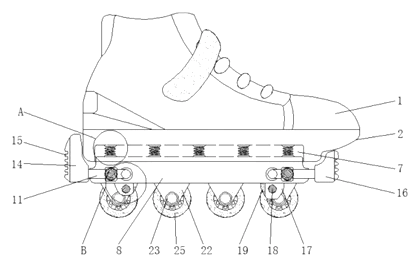
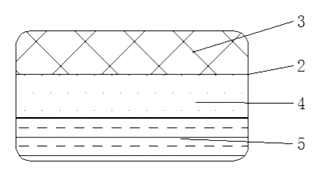
- Sole Assembly: The bottom consists of three layers—rubber substrate, steel plate, and MD (EVA) bottom—bonded together. This stack provides rigidity and cushioning.
- Spring Mechanism: A spring connects the sole to a pedestal below. When the user steps, the sole compresses this spring.
- Switching Lever: Inside the pedestal, a shaft holds a rotating “bull stick” (lever). The bull stick is attached to a connecting rod.
- Engagement: As the sole moves downward, it pushes the connecting rod, causing the bull stick to rotate. This rotation aligns locking components (fixed block and screw) to secure the pulley/wheel assembly in skating mode.
- Disengagement: Lifting the foot allows the spring to expand, reversing the lever motion and releasing the lock, returning the skate to walking mode.
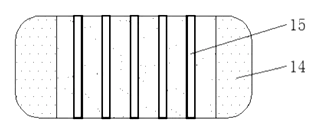
- Guidance Blocks: Convex blocks and stalls on the back seat guide the movement of the sole and ensure proper alignment during the transition.
Who it is for
- Toy and Sports Brands: Companies looking for differentiated products in the children’s footwear market with easy-use mechanics.
- Amazon Sellers: Retailers seeking high-conversion items that solve the “complicated buckles” pain point for parents.
- Wholesalers: Distributors supplying general merchandise stores that want versatile, dual-function kids’ shoes.
- OEM Manufacturers: Factories capable of precision injection molding and metal stamping who can produce custom variations of this mechanism.
How it works
The main parts
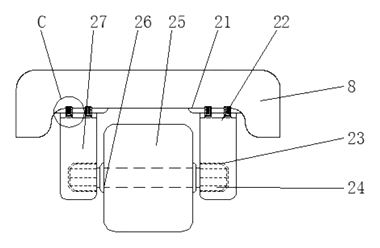
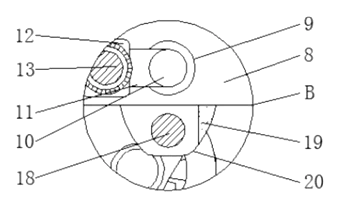
| No. | Part | What it does |
|---|---|---|
| 1 | Shoe Body | Upper part holding the foot. |
| 2, 3, 4, 5 | Sole Layers | Rubber substrate, steel plate, and MD/EVA bottom for structure and comfort. |
| 6 | Spring | Absorbs impact and resets the switching mechanism. |
| 8 | Pedestal | Housing for the internal switching gears and levers. |
| 9, 10 | Shaft and Bull Stick | Rotating lever that translates vertical step pressure into horizontal locking motion. |
| 11, 12, 13 | Connecting Rod & Fixed Block | Links the lever to the locking screw that secures the wheel assembly. |
| 14, 15, 16 | Back Seat Components | Convex blocks and stalls that guide the sole’s movement. |
| 17, 19, 20 | Receiving Blocks & Detent | Secure the position when the mode is switched. |
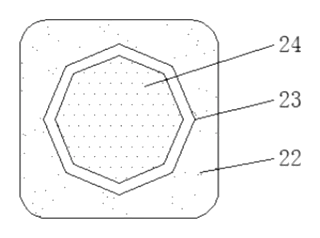
| 22, 23, 24 | Main Fixing Seat & Sliding Slot | Houses the rotor and pulley for the wheel attachment. |
| 25, 26 | Pulley & Bearing | Allows the wheel assembly to move or lock as needed. |
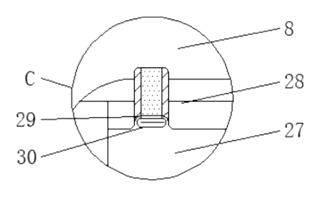
| 27, 28, 29, 30 | Secondary Fixing & Screws | Attaches the final wheel unit to the base. |
Operating Steps
- Walking Mode: The foot is lifted. The spring expands, pulling the sole up. The bull stick rotates away from the locking position, leaving the wheel assembly free or retracted.
- Stepping Down: The child places their foot firmly on the ground. The weight compresses the spring, pushing the sole downward.
- Mechanical Engagement: The downward movement drives the connecting rod, which rotates the bull stick around its shaft.
- Locking: The rotating lever pushes the fixed block and screw into engagement with the receiving blocks, locking the pulley system into the “skate” position.
- Release: Lifting the foot reverses the process. The spring pushes the sole up, the lever rotates back, and the lock disengages.
Applications
Playground and Park Use
Children can walk normally to the skating area and switch instantly by stepping, removing the need to sit down and adjust buckles before starting to roll.
Indoor Family Activities
Parents appreciate the simplicity for younger children who cannot manage complex latch mechanisms, encouraging more frequent use at home or in indoor courts.
School Physical Education
PE programs benefit from quick transitions between walking drills and skating exercises, maximizing active time during limited class periods.
Retail Display Demos
Brands can demonstrate the ease of use in-store, showing customers how a simple step changes the function, which serves as a strong selling point over competitors.
Where it is less suitable
- Professional Inline Racing: High-performance skates require rigid, direct-contact boots and precise wheel adjustments not provided by this flexible sole mechanism.
- Adult Sizes: The patent specifies “children’s” skates; the load-bearing capacity of the plastic/metal hybrid sole may not support adult weights safely.
- Rough Terrain Hiking: While durable, the exposed mechanical parts could jam with heavy mud or debris compared to sealed industrial footwear.
Patent & Production
At a glance
| Patent number | CN108043012B (application CN201711290581) |
| Type | China invention patent (发明专利) - protects technical solutions and methods |
| Original title | Children’s roller-skates of the sliding free switching of step (一种步滑自由切换的儿童用滑轮鞋) |
| Patent owner | Fujian Qibu Children Products Co ltd |
| Inventors | Zhou Jianyong, Tang Minghui, Ren Zhongjun, Jian Zhongming, Guo Bin, Yao Jiabing, Zeng Qingcong |
| Filing date | 2017-12-08 |
| Grant date | 2019-04-05 |
| Status (China) | In force - valid until at most 2037-12-08, subject to annual fee payments |
| Patent family | Public record shows Chinese filings only - no US, European, Japanese, PCT or other filings listed |
| Cited by | 0 later documents |
| Source | Google Patents (search for CN108043012B) |
What the claims cover, in plain language
Claim 1 defines a children’s roller skate comprising a shoe body and a specific sole assembly. The sole includes a rubber substrate, a steel plate bottom, and an MD (ethylene-vinyl acetate copolymer) bottom. A spring connects the sole to a pedestal. The key feature is a switching mechanism inside the pedestal: a shaft holds a “bull stick” (lever) that rotates 0-360 degrees. This lever is connected to a connecting rod and a fixed block with a screw. As the sole moves vertically (due to stepping), the lever rotates to engage or disengage locking components (front/rear receiving blocks and detent blocks), thereby switching between walking and skating modes. The wheel assembly is mounted via a main fixing seat containing a sliding slot and rotor, secured by a secondary fixing seat and screws.
Claims 2-9 specify materials (EVA/MD), dimensions (pedestal taper), rotational limits, symmetrical arrangement of receiving blocks, octagonal sliding slots for the rotor, and detachable structures using screws with invagination slots.
This is a simplified reading for orientation only. The legal scope is defined by the exact claim wording in the official Chinese document.
What this means for US production
This patent was filed in China and is currently in force there. The public record shows no US or other foreign counterpart. Therefore, making or selling this specific design in China requires permission from the patent owner. However, because there is no US patent, this Chinese patent alone does not restrict manufacturing or sales in the United States.
Two points to settle early:
- Other patents may exist. Children’s convertible skates are a competitive field. While this specific “step-switching” mechanism appears novel based on the current record, broader concepts of convertible footwear may be covered by other US patents held by major brands like Heelys, Nike, or Adidas. A freedom-to-operate (FTO) review is strongly recommended before tooling.
- Safety Compliance. As a children’s product, strict adherence to US safety standards is mandatory regardless of patent status.
Customization and manufacturing
What can be customized
| Area | Options |
|---|---|
| Size Range | Child sizes (e.g., EU 28-38); scaling of the lever mechanism required for different foot lengths. |
| Materials | Sole compounds (hardness of EVA/Rubber), metal grade for the steel plate, plastic resin for the pedestal. |
| Colors | Shoe upper colors, sole accent colors, wheel color. |
| Wheel Type | Standard polyurethane inline wheels; hardness durometer selection. |
| Upper Design | Mesh, synthetic leather, or textile uppers compatible with the sole structure. |
| Logo Placement | Mold-in logos on the pedestal or side plates; printed labels on the shoe body. |
Things to plan for (US market)
- ASTM F1492 / CPSC Standards: General requirements for recreational footwear and toys.
- CPSIA (Consumer Product Safety Improvement Act): Mandatory testing for lead and phthalates in plastics and coatings; tracking labels required.
- Small Parts Regulations: Ensure the mechanism does not release small parts that pose choking hazards if broken.
- California Prop 65: Screening for chemicals in plastics and adhesives.
How a project runs
- Inquiry - Define size range, target cost, and quantity.
- Design Validation - CAD modeling of the lever mechanism to ensure smooth switching under child-weight loads.
- Prototype - 3D-printed functional samples to test the step-switching action and durability.
- Tooling - Create molds for the pedestal, sole layers, and secondary fixing seats; stamp dies for the steel plate.
- Production - Injection molding, stamping, sewing (uppers), and assembly.
Quantities & timeline
The complexity lies in the precision fit of the rotating lever and locking blocks. Molds must maintain tight tolerances to prevent jamming. Lead times depend on mold fabrication and certification testing. Send us your size range, material preferences, estimated quantity and target price and we will reply with options.
Production notes
Tooling and process
Glass-filled nylon injection molding is likely used for the pedestal and fixing seats to withstand repeated mechanical stress. Stamping processes form the steel plate bottom. Sewing joins the upper to the sole assembly.
Cost drivers
The number of molds is typically a primary driver due to the multi-part sole and complex internal mechanism. Impact grade material costs for the nylon and rubber substrates also influence pricing. Fastener count adds assembly labor costs.
Prototyping path
Start with 3D-printed parts to verify the lever geometry and spring rate. Machined frames are typically used for initial strength tests. Functional samples should undergo impact testing to validate the switching mechanism under simulated jumps.
What we would change before tooling
Depends on the final design, but tightening the tolerance on the shaft-bull stick interface is critical to reduce play. Ensuring the spring rate matches typical child weights prevents premature wear or failure to engage.
Common failure points
Cracking under impact is a risk for the plastic housing. Bolts loosening due to vibration could compromise the wheel attachment. Spring fatigue and rate consistency issues may cause the switching mechanism to fail over time. Thread engagement in the plastic inserts must be robust to handle fastener torque.
Patent drawings
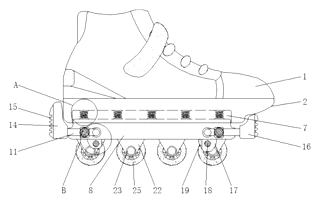
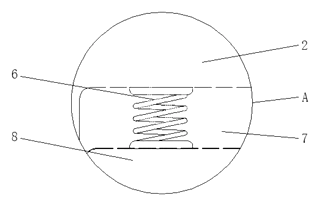
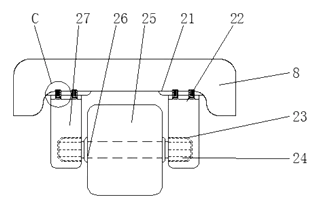
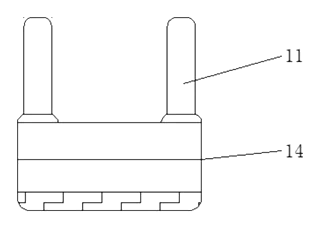
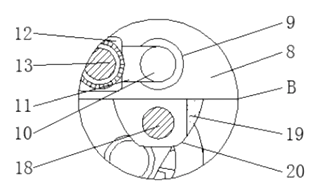
Drawings reproduced from the public patent document for reference.
Frequently asked questions
How does the step-switching work?
The sole is connected to a spring and an internal lever system. When you step down, the sole compresses the spring and rotates a “bull stick” lever. This rotation engages a locking block that secures the wheels in skating mode. Lifting your foot releases the lock, returning the skate to walking mode.
Is the mechanism durable for daily use?
The patent specifies glass-filled nylon for structural parts and a steel plate for impact protection. Durability depends on the quality of materials and manufacturing tolerances. Regular inspection of the moving parts is recommended to ensure smooth operation.
Can adults use these skates?
The patent explicitly describes “children’s” roller skates. The spring tension and lever geometry are designed for lower body weights. Using them for adults could lead to mechanism failure or insufficient engagement.
What materials are used in the sole?
The sole has three layers: a rubber substrate for grip, a steel plate for protection and rigidity, and an MD (ethylene-vinyl acetate) bottom for cushioning. This combination aims to balance comfort with mechanical stability.
How do I clean or maintain the switching mechanism?
Keep the pedestal area free of dirt and debris that could jam the lever. Check the spring for signs of fatigue. Do not submerge the shoe; wipe the exterior with a damp cloth. Lubrication of the shaft may be needed depending on usage intensity.
Are the wheels replaceable?
Yes, the wheel assembly is attached via a secondary fixing seat and screws. This allows for replacement if the wheels wear out or break. The design uses a sliding slot and rotor system for attachment.
Can this design be made and sold in the US?
The patent is filed in China and is in force there. The public record shows no US counterpart, so this specific Chinese patent does not restrict manufacturing or sales in the US. However, other US patents may cover similar convertible skate technologies. We recommend a freedom-to-operate check before mass production.
Are you affiliated with the patent owner?
No. IP2M is an independent design and manufacturing service working from the public patent document.
Request a quote
Click Request a Quote below to see our email address - copy it, or open your email app with a ready-made message. Please mention patent CN108043012B in the subject.
Helpful details to include:
- Your company and channel (toy brand, sports retailer, Amazon seller)
- Size range (EU/US sizes)
- Target retail price and estimated quantity
- Material preferences (plastic grades, sole composition)
- Certification needs (CPSIA, ASTM)
- Timeline - when you would like samples and the first shipment
You can also reach us at (332) 203-9997.
Page editor: Emily Zhang, Product Editor · IP2M
Last updated November 5, 2026. If something on this page looks wrong, email [email protected] and we will check it against the patent.
Interested in building this?
Tell us your target market, quantity and timeline. We reply with options for prototyping, small-batch runs or volume production.
Send your inquiry to
Please put CN108043012B in the subject line and tell us your company, country, estimated quantity and timeline.
Prefer to talk? Call (332) 203-9997.
More product-ready patents
All Sports & Recreation patents →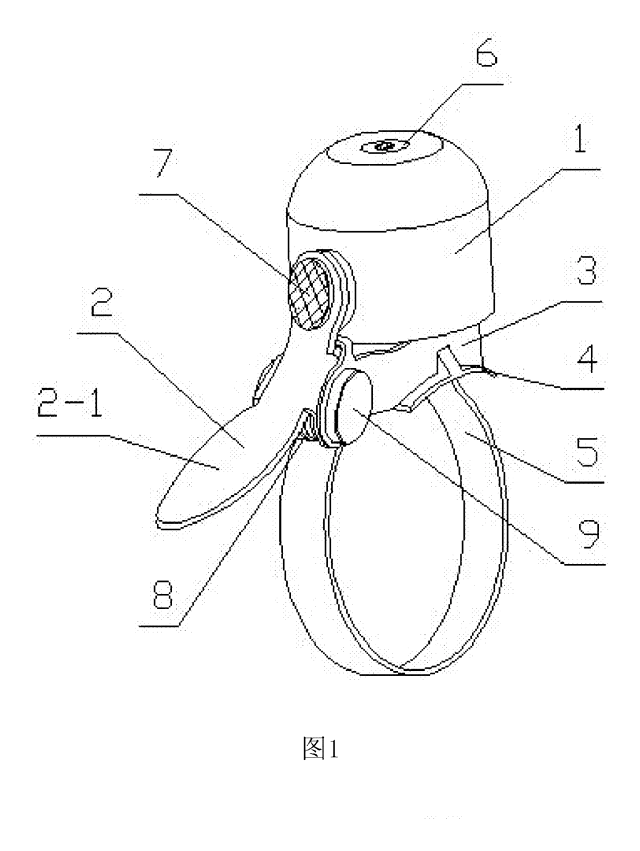
Sports & Recreation
Compact Torsion-Spring Bike Bell
Mini bike bell with a standard torsion spring and a rubber-floated dome - small size, clear tone, quick strap mount.
Patent CN205819384U
Sports & Recreation
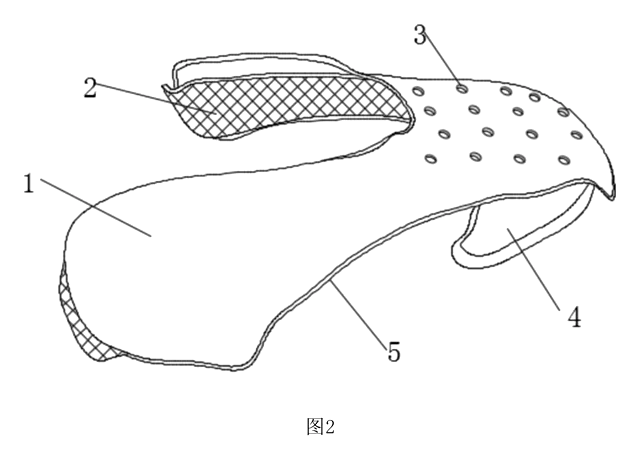
Padded Toe-Box Shield for Sneakers
Ventilated, silicone-lined toe-box insert that supports the front of a sneaker and cushions the toes.
Patent CN209473731U
Sports & Recreation
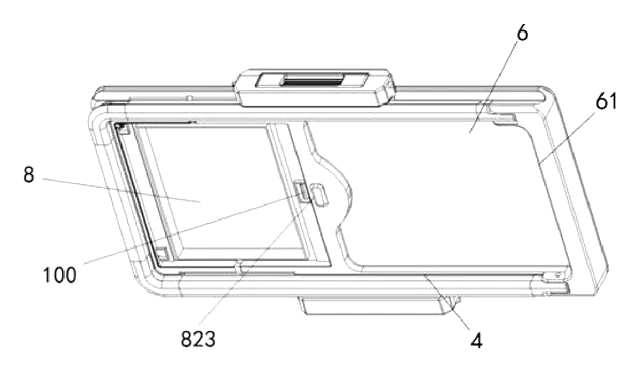
Reversible Fishing Seat-Box Lid with Backrest
Fishing seat-box lid that flips on removable hinge pins: cushion, backrest and storage on one face.
Patent CN208624426U
Sports & Recreation
Swivel-Pin Skateboard Truck with Rubber Sleeve
Skateboard truck with a turning center pin, a tilting axle clamp and a rubber sleeve that centers it.
Patent CN216777880U
Sports & Recreation
Full-Face Bike Helmet with Magnetic Detachable Chin Bar
Full-face cycling helmet whose chin bar clips on and off with magnetic, latching side connectors.
Patent CN206630067U
Sports & Recreation
Bike Phone Holder with Built-In Flashlight Clamp
Handlebar mount with a phone cradle on top and a flashlight clamp below, on one arm.
Patent CN206077485U
Browse by category
- Apparel & Accessories (41)
- Baby & Kids (27)
- Bags & Luggage (15)
- Bath & Personal Care (28)
- Car Accessories (23)
- Furniture, Bedding & Storage (21)
- Garden & Outdoor (29)
- Health & Wellness (13)
- Home, Kitchen & Cleaning (44)
- Lighting (22)
- Packaging & Containers (11)
- Pet Products (10)
- Phone & Camera Accessories (8)
- Retail Display (23)
- School, Office & Art (32)
- Sports & Recreation (41)
- Tools & Workshop (50)
- Toys & Games (21)
This page is based on the public patent document CN108043012B, assigned to Fujian Qibu Children Products Co ltd. IP2M is an independent manufacturing service and is not affiliated with, endorsed by or licensed by the patent owner. Images marked as concept renderings are illustrations, not photos of an existing product. Patent status information is provided for reference only and is not legal advice; confirm freedom to operate for your market before production. Full disclaimer.