At a glance
| Patent number | CN108095292B (application CN201711029458) |
| Type | China invention patent (发明专利) - protects technical solutions |
| Original title | Pot brush with adjustable brush length (一种可调毛刷长度的锅刷) |
| Patent owner | Individual |
| Inventors | Wang Shuangshuang |
| Filing date | 2017-10-27 |
| Grant date | 2020-09-01 |
| Status (China) | Lapsed - terminated for non-payment of annual fees (recorded 2021-10-12) |
| Patent family | Chinese filings only - no US, European, Japanese, PCT or other filings listed |
| Cited by | 0 later documents |
| Source | Google Patents (search for CN108095292B) |
What the claims cover, in plain language
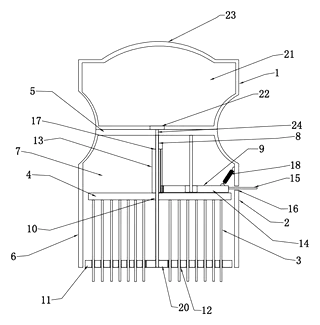
Claim 1 defines a pot brush with a handheld part and a brush head assembly. The head includes a mounting seat, brushes, and a mounting plate. A lifting assembly inside the seat uses a screw rod and a driving assembly with two gears (first and second) to rotate the mounting plate. The plate threads onto the screw rod so that rotation moves it up or down, adjusting bristle length. The second gear is larger than the first and has a poke rod that slides in a groove. An extension spring returns the rod to its initial position.
Claim 2 specifies that the lower end of the screw rod connects to a bottom plate via a bearing, ensuring smooth rotation and alignment.
Claim 3 adds a sanitizer chamber in the handle with a valve opening and squeeze button to dispense liquid directly into the brush area.
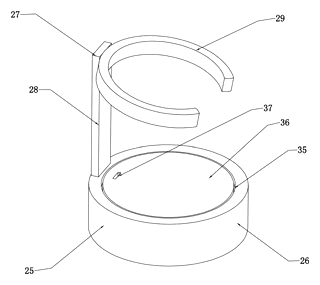
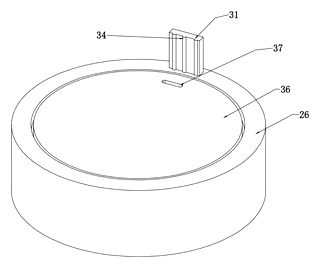
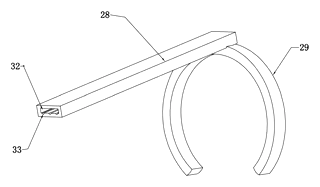
Claim 4 mentions a placement frame (details truncated in source text).
This is a simplified reading for orientation only. The legal scope is defined by the exact claim wording in the official Chinese document.
What this means for US production
This patent was filed only in China and has lapsed due to unpaid fees. It currently offers no exclusive rights in China or elsewhere.
Two points to settle early:
- Other patents may exist. Kitchen tools are a crowded field. While this specific gear-screw combination appears unique in this document, similar adjustable brush mechanisms or ergonomic handles may be covered by active US utility patents held by major consumer goods companies. A freedom-to-operate (FTO) review is essential before mass production.
- Material safety. Since this is a food-contact item, the plastics used for the gears, screw, and housing must meet FDA requirements for repeated contact with water and detergents.
Customization and manufacturing
What can be customized
| Area | Options |
|---|---|
| Bristle Material | Nylon, polypropylene, silicone, or natural fibers depending on pot type. |
| Handle Color/Finish | Soft-touch rubber coating, glossy plastic, or matte finish. |
| Gear Ratio | Adjust tooth counts to change the amount of bristle extension per push. |
| Sanitizer Module | Include or exclude the built-in soap dispenser feature (Claim 3). |
| Head Diameter | Scale the internal mechanism to fit different pot widths. |
Things to plan for (US market)
- FDA 21 CFR 177 - Regulations for indirect food additives (plastics) in articles intended for producing, manufacturing, processing, preparing, treating, packing, transporting, dispensing, or holding food. All wetted parts must comply.
- Proposition 65 - If using certain colorants or stabilizers in plastics, ensure they do not contain restricted chemicals like lead or cadmium above safe harbor levels.
- Consumer Product Safety Improvement Act (CPSIA) - If marketed as a toy or children’s item (unlikely but possible), testing for lead and phthalates is required. For general household use, standard safety applies.
How a project runs
- Inquiry - Define target market, quantity, and desired features (e.g., with or without soap dispenser).
- Design - Finalize gear dimensions, screw pitch, and material selection for durability and food safety.
- Prototype - 3D print or CNC machine functional samples to test the poke-rod action and bristle adjustment range.
- Tooling - Create injection molds for the handle, seat, gears, and plates.
- Production - Injection molding, bristle tufting, assembly of mechanical parts, and quality control checks.
Quantities & timeline
Injection molds for complex interlocking gears and threaded components require precise engineering to prevent binding. Assembly involves fitting springs and rods into tight cavities. Testing focuses on the longevity of the screw threads and the return strength of the spring. Send us your target quantities, material preferences, and feature set and we will reply with options.
Patent drawings
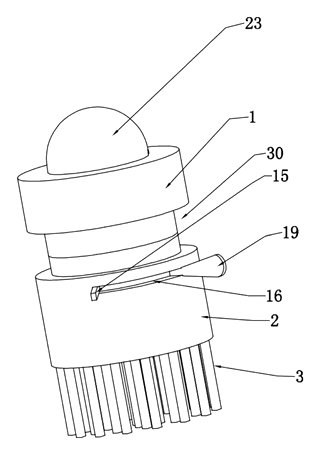
Drawings reproduced from the public patent document for reference.