
Patent CN108185895B
Updated October 27, 2026Motorized Toilet Auxiliary Standing Device with Dual Branched Chains
Standing up from a standard toilet requires effort that many older adults or people with limited mobility find difficult. This device adds a motorized cushion assembly over the bowl. When the user needs to stand, an electric motor drives two symmetrical branched chains. Each chain converts rotary motion into linear lift through bevel gears, cross shafts, threaded transmission shafts and threaded sleeves. Lower and upper connecting rods pivot to raise the cushion evenly. Because both chains operate together, the cushion stays level and avoids hitting the toilet bowl. A weight sensor on the cushion sends data to a control unit, which tracks whether the seat is empty, occupied, or if the user is shifting weight to stand. The system selects a motor speed matched to the user's average sitting weight, so the lift feels steady rather than sudden.
- China invention patent - in force
- No filings outside China
- Bathroom accessibility hardware
- Motorized lift, bevel gears, threaded shafts, weight sensor
Splat! What let you down?
⚙️
Dual branched chains
Two symmetrical transmission chains keep the cushion level and prevent interference with the toilet bowl during the lift.
⚖️
Weight-sensor control
A sensor on the cushion detects load in real time, switching the device between idle, use and assist-in-standing states automatically.
🎛️
Customized lift speed
The controller matches the motor speed to the user's average sitting weight via a stored lookup table for a tailored experience.
🔌
Bevel gear drive
The motor turns a first transmission rod linked to the chains through bevel gears, cross shafts and threaded screw-drive sleeves.
Bring this product to market
- ✓ Patent vetted China-only family and legal status checked
- 2 Product brief · now How it works, uses and options written up
- 3 Prototype First samples for buyers to review
- 4 Pilot run Small first batch for launch customers
- 5 Volume production Repeat orders at scale
Buyer interest
– of 100 buyers needed to start prototyping
One click, no sign-up. Each vote is one real visitor, and products with the most interest go to prototyping first.
Build team: no members yet. Need a partner, co-funding or skills to build this? Join and we introduce the team once it forms.
The problem
Standard toilets sit low to the floor, requiring significant leg strength to rise from a seated position. For older adults or individuals recovering from injury, this daily movement presents a fall risk and physical strain. Fixed grab bars help but require the user to pull their own weight, while bulky powered lift chairs often replace the toilet entirely, taking up space and altering the bathroom layout. A solution that fits over an existing bowl and assists the standing motion mechanically is needed.
The solution
This device places a motorized cushion assembly above the toilet bowl. It solves the lifting problem through several coordinated mechanical and electronic steps:
- A base supports the entire structure around or above the toilet bowl.
- A cushion rests on the base in a closed, horizontal position for normal sitting.
- A motor body provides the driving force, controlled by an electrical control device.
- A first transmission rod rotates when driven by the motor body.
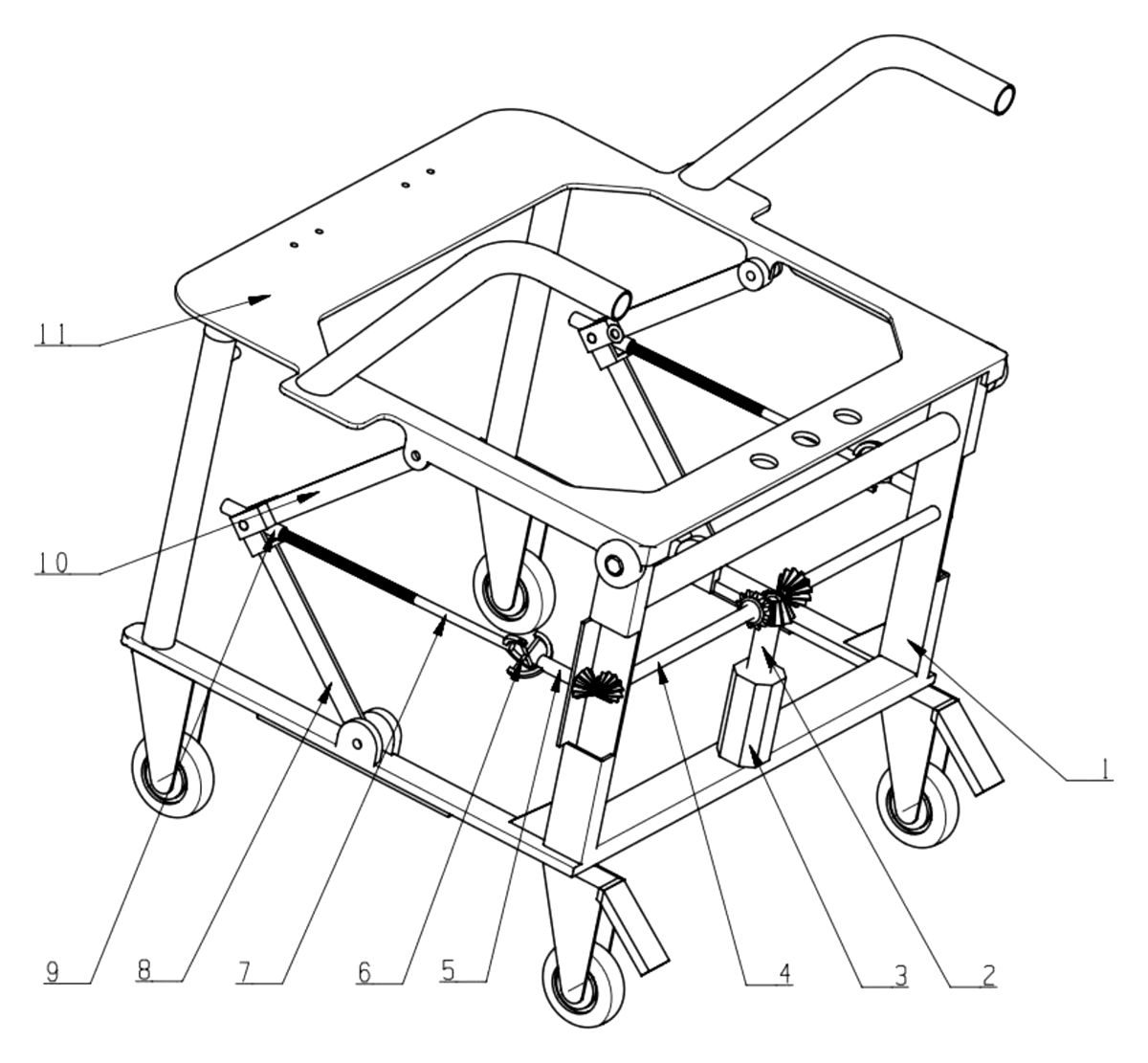
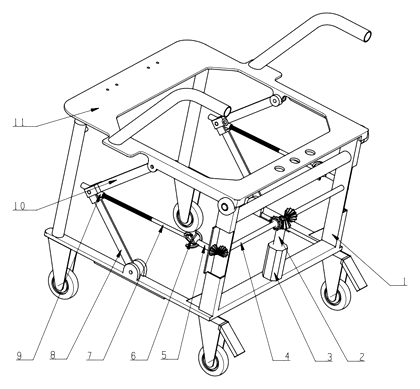
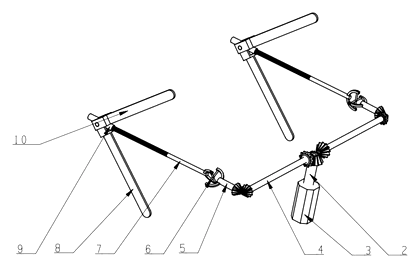
- Two parallel, symmetrically distributed branched chains transfer this rotation into a lifting motion. Each chain contains a second transmission rod, a third transmission rod, a cross shaft, a threaded transmission shaft, a lower connecting rod, a threaded sleeve and an upper connecting rod.
- Bevel gear connections link the first transmission rod to the second, and the second to the third, redirecting the rotational force.
- The third transmission rod connects to the threaded transmission shaft via a cross shaft forming a universal joint.
- The threaded transmission shaft screws into the threaded sleeve, converting rotation into vertical travel.
- The lower connecting rod pivots between the threaded sleeve and the base, while the upper connecting rod pivots between the threaded sleeve and the cushion.
- A weight sensor on the cushion reads the applied load continuously, allowing the control device to switch between idle, use and assist-in-standing states, and to select a motor speed based on the user’s average sitting weight.
Who it is for
- Medical equipment distributors supplying aging-in-place products to home care networks who need a mechanical alternative to full toilet replacement.
- Accessible bathroom fixture brands looking to add a powered standing aid to their catalog without redesigning standard plumbing.
- Senior living facility operators seeking retrofittable devices that reduce caregiver strain during bathroom transfers.
- E-commerce sellers in the home health category offering functional bathroom aids where the weight-sensor automation serves as a distinct feature.
How it works
The main parts
| No. | Part | What it does |
|---|---|---|
| 1 | Base | Supports the mechanism and mounts around the toilet area; includes vertical beams for rod connections. |
| 11 | Cushion | Provides the seating surface; tilts open to assist standing and closes flat for sitting. |
| 3 | Motor body | Drives the first transmission rod. |
| 2 | First transmission rod | Rotates under motor control to initiate the drive sequence. |
| 4 | Second transmission rod | Connects to the first rod via bevel gears; redirects rotation toward the chains. |
| 5 | Third transmission rod | Connects to the second rod via bevel gears; drives the cross shaft. |
| 6 | Cross shaft | Forms a universal joint between the third rod and the threaded transmission shaft. |
| 7 | Threaded transmission shaft | Screws into the threaded sleeve to create linear motion. |
| 9 | Threaded sleeve | Travels along the threaded shaft; acts as the pivot point for the connecting rods. |
| 8 | Lower connecting rod | Pivots between the threaded sleeve and the base. |
| 10 | Upper connecting rod | Pivots between the threaded sleeve and the cushion. |
| - | Control device | Processes sensor data and commands the motor body. |
| - | Weight sensor | Mounted on the cushion to detect load in real time. |
Operating steps
- Idle state: The cushion is horizontal. The weight sensor reads below a first weight threshold for longer than a first time threshold, keeping the system off.
- Use state: A person sits down. The sensor reading meets or exceeds the first weight threshold. The control device records the sitting weight over a sampling period to calculate an average sitting posture weight.
- Assist in standing up: The user shifts forward to stand. The control device detects that the absolute difference between the current weight and the average sitting weight exceeds a first difference weight. The state changes to assist-in-standing.
- Lifting: The control device queries an internal correspondence table using the average sitting weight to find a matching motor working speed. The motor body rotates forward. The bevel gears turn the transmission rods, spinning the threaded shafts inside the sleeves. The upper and lower connecting rods push the cushion upward into an open state. Both branched chains move simultaneously, keeping the cushion level and clear of the toilet bowl.
- Reset: Once the weight drops below the first threshold (or a touch sensor detects skin separation), the standing assist is complete. The motor reverses, lowering the cushion back to the horizontal reset position, and the system returns to idle.
Applications
Home bathrooms for older adults
Older adults living independently often struggle to rise from a standard-height toilet. According to the patent, the device sits over the existing bowl and a weight sensor on the cushion triggers the lift when the user shifts forward, rather than relying on a hand-operated switch.
Assisted living facilities
Caregivers in residential facilities help residents with many bathroom transfers each day. According to the patent, the two branched chains raise the cushion together, so the seat lifts evenly instead of tipping; facility buyers would evaluate on prototypes how much this changes the hands-on help a resident needs.
Post-surgery recovery
People coming home after a hospital stay may find rising from the toilet harder than before, and families often look for equipment that reduces the effort of each transfer. The patent describes a lift speed chosen from a stored table according to the user’s average sitting weight, so the cushion rises at a set pace rather than a single fixed speed. Any use in a recovery setting should follow the advice of the user’s own clinician; this page is not medical advice.
Accessible public restrooms
Commercial buildings upgrading restrooms for accessibility usually install grab bars, which still demand upper-body strength. Integrating a powered standing aid offers a mechanical option for users who cannot support their own weight, expanding the facility’s usability.
Where it is less suitable
- Wet-room environments without waterproofing - the motor body, control device and weight sensor require protection from direct water exposure not detailed in the patent.
- Pediatric use - the weight thresholds and correspondence tables described are oriented toward adult weights and standing mechanics.
- Non-standard or wall-hung toilets - the base mounting geometry must align with the specific bowl shape to avoid the interference the dual chains are designed to prevent.
Frequently asked questions
How does the device lift the user?
An electric motor turns a first transmission rod. Through bevel gears, this rotation drives two symmetrical branched chains. Inside each chain, a threaded transmission shaft spins within a threaded sleeve. As the sleeve travels, upper and lower connecting rods pivot, pushing the cushion from a flat sitting position into an angled standing position.
Why are there two branched chains?
The patent describes two parallel, symmetrically distributed chains to ensure both sides exert force simultaneously. This keeps the working states of the two chains synchronous, prevents the cushion from deforming during the lift, and avoids mechanical interference with the toilet bowl itself.
How does it know when to start lifting?
A weight sensor on the cushion detects the load in real time. The control device monitors this data. When the user shifts forward to stand, the detected weight changes compared to their average sitting weight. Once this difference crosses a set threshold, the system enters the “assist in standing up” state and activates the motor.
Can the lifting speed be adjusted?
Yes. The control device calculates the user’s average sitting weight during use. It then queries an internal correspondence table to find a motor working speed matched to that specific weight. If no exact match is found, it defaults to a preset speed. The table can be set by the user or configured by the control device based on the user’s age.
Does it require a button to operate?
The primary operation described relies on the weight sensor detecting the shift in posture automatically. The patent also mentions a touch sensing device that detects skin contact and separation, which the control device can use alongside weight data to trigger or confirm the standing assist without manual buttons.
What happens after the user stands up?
When the weight sensor reads below the first weight threshold, or the touch sensor registers separation, the control device determines the standing assist is complete. It then reverses the motor body, gradually closing the cushion back to its horizontal reset position and returning the system to the idle state.
Will it fit any toilet?
The patent shows the device working with a toilet bowl, but exact dimensional compatibility depends on the base design. The base size, mounting points and the travel arc of the upper connecting rods are set in design and confirmed on prototypes to match specific round or elongated bowl profiles.
Can this design be made and sold in the US?
The patent was filed only in China and is currently in force there, meaning making or selling this exact device in China requires the owner’s permission. There is no US counterpart identified. However, powered bathroom lifts are a heavily patented category globally, so we recommend a freedom-to-operate check before volume production.
Are you affiliated with the patent owner?
No. IP2M is an independent design and manufacturing service working from the public patent document.
Request a quote
Click Request a Quote below to see our email address - copy it, or open your email app with a ready-made message. Please mention patent CN108185895B in the subject.
Helpful details to include:
- Your company and channel (medical distributor, accessible fixture brand, senior living operator, e-commerce seller)
- Target toilet bowl types (standard round, elongated, commercial)
- User weight range and desired lift speed options
- Power source (mains plug-in, battery backup) and wireless/wired sensor preference
- Estimated quantity and target price
- Timeline - when you would like prototypes and the first shipment
You can also reach us at (332) 203-9997.
Explore this product
Interested in building this?
Tell us your target market, quantity and timeline. We reply with options for prototyping, small-batch runs or volume production.
Send your inquiry to
Please put CN108185895B in the subject line and tell us your company, country, estimated quantity and timeline.
Prefer to talk? Call (332) 203-9997.
More product-ready patents
All Bath & Personal Care patents →
Bath & Personal Care
Foot-Pedal Soap & Sanitizer Dispenser Stand
Hands-free, battery-free dispenser stand - step on a pedal to press the pump of any soap or sanitizer bottle.
Patent CN207461995U
Bath & Personal Care
Ear-Shaped Mask Strap Guard with Tension Adjuster
Ear-shaped silicone guard and strap-length adjuster that make ear-loop masks comfortable to wear for long hours.
Patent CN205456233U
Bath & Personal Care
Adjustable-Length Back Scrubber Strap with Push-Button Handles
Back-scrubber strap with push-button handles that set its length and a spring that keeps it taut.
Patent CN207041452U
Bath & Personal Care
Angled-Plate Hair Straightener
Flat iron with plates twisted 45-75° to the handle, a curling groove and rubber-capped tips.
Patent CN206137462U
Bath & Personal Care
Refillable Lipstick Case with Sealed Snap-In Refill Pods
Reusable twist-up lipstick case; sealed refill pods unlock at the top of the stroke for shade swaps.
Patent CN206909979U
Bath & Personal Care
Quick-Release Toilet Seat Hinge with a Push-Button Two-Strip Latch
Toilet seat hinge: drop the shaft onto a grooved post to lock; one push parks the latch open to lift it off.
Patent CN210370292U
Browse by category
- Apparel & Accessories (22)
- Baby & Kids (16)
- Bags & Luggage (9)
- Bath & Personal Care (16)
- Car Accessories (10)
- Furniture, Bedding & Storage (12)
- Garden & Outdoor (18)
- Health & Wellness (8)
- Home, Kitchen & Cleaning (24)
- Lighting (12)
- Packaging & Containers (6)
- Pet Products (6)
- Phone & Camera Accessories (4)
- Retail Display (13)
- School, Office & Art (19)
- Sports & Recreation (25)
- Tools & Workshop (27)
- Toys & Games (12)
This page is based on the public patent document CN108185895B, assigned to Hefei Hagong Cijian Intelligent Technology Co ltd. IP2M is an independent manufacturing service and is not affiliated with, endorsed by or licensed by the patent owner. Images marked as concept renderings are illustrations, not photos of an existing product. Patent status information is provided for reference only and is not legal advice; confirm freedom to operate for your market before production. Full disclaimer.