At a glance
| Patent number | CN108185895B (application CN201810212617) |
| Type | China invention patent (发明专利) - protects product shape, structure and method |
| Original title | Auxiliary standing device for toilet (一种卫生间辅助起立装置) |
| Patent owner | Hefei Hagong Cijian Intelligent Technology Co ltd |
| Inventors | Wang Fei, Zhang Yanling, Qian Chao, Cheng Chao, Shao Dongsheng, Cui Wen, Dai Wei, Yu Zhenzhong, Li Wenxing |
| Filing date | 2018-03-15 |
| Grant date | 2023-04-18 |
| Status (China) | In force - In force in China until at most 2038-03-15 (if annual fees are paid) |
| Patent family | Chinese filings only - no US, European, Japanese, PCT or other filings listed |
| Cited by | 0 later documents |
| Source | Google Patents (search for CN108185895B) |
What the claims cover, in plain language
Claim 1 covers a toilet standing aid device with a base, a cushion, a transmission mechanism, a first transmission rod and a motor body. The transmission mechanism has two parallel, symmetrically distributed branched chains. Each chain includes a second transmission rod, a third transmission rod, a cross shaft, a threaded transmission shaft, a lower connecting rod, a threaded sleeve and an upper connecting rod. The first transmission rod is rotated by the motor. Bevel gears connect the first rod to the second, and the second to the third. The third rod forms a universal joint with the threaded transmission shaft via the cross shaft. The threaded shaft screws into the threaded sleeve. The lower connecting rod pivots between the sleeve and the base; the upper connecting rod pivots between the sleeve and the cushion. A control device is wired or wirelessly connected to a weight sensor on the cushion to control the motor based on real-time weight information.
Claim 2 defines three equipment states managed by the control device: idle, use and assist in standing up. Claim 3 places the control device below the motor body. Claim 4 details the logic: the state becomes idle when weight is below a first threshold for a set time; it switches to use when weight meets or exceeds the threshold; it switches to assist-in-standing when the difference between current weight and average sitting weight exceeds a set value. After standing, the motor resets the cushion and returns to idle. Claim 5 describes calculating the average sitting weight over a sampling period and using a stored correspondence table to select a motor working speed matched to that average weight, providing a customized speed for different users.
This is a simplified reading for orientation only. The legal scope is defined by the exact claim wording in the official Chinese document.
What this means for US production
This patent was filed only in China and is currently in force. Making or selling this exact device in China needs the owner’s permission. There is no US or other foreign counterpart identified.
Two points to settle early:
- Other patents may exist. The patent facts list one Korean filing citing this document (KR102062486B1, held by 송순영 / Song Sun-young). Powered toilet lifts and patient transfer seats are actively patented fields in the US and globally, so a freedom-to-operate (FTO) review covering the dual-chain linkage, weight-based state machine and speed lookup table is necessary before tooling.
- Electrical safety and moisture. The device combines a motor, control electronics and a weight sensor in a bathroom environment. Component selection must account for humidity, and the power supply design dictates the certification path.
Customization and manufacturing
What can be customized
| Area | Options |
|---|---|
| Base dimensions | Sized to fit standard round or elongated toilet bowls, or custom fixtures |
| Cushion material | Waterproof foam, antimicrobial upholstery covers, rigid polymer shells |
| Motor specifications | Voltage, torque and RPM to match target user weight ranges |
| Control logic | Threshold values, sampling periods and speed lookup tables programmed per market |
| Sensor types | Weight sensor only, or adding the touch sensing device mentioned in the description |
| Finish | Powder-coated metal parts, corrosion-resistant fasteners, chrome or white plastic housings |
Things to plan for (US market)
- FDA device classification - powered standing and lifting aids for people with limited mobility can fall under FDA physical medicine devices (21 CFR Part 890); the exact class and whether a 510(k) is needed depend on the intended-use claims, and the factory and US importer handle establishment registration and device listing (21 CFR Part 807).
- UL or ETL listing - if the unit is mains-powered, motorized bathroom appliances generally require safety certification to UL standards for household or medical electrical equipment.
- FCC Part 15 - if the control device and weight sensor communicate wirelessly, the radio module must comply with FCC rules.
- CPSC - general consumer product safety rules apply to mechanical pinch points and structural stability.
How a project runs
- Inquiry - target bowl sizes, user weight range, power source and quantity.
- Design - engineering the base geometry, sizing the bevel gears and threaded shafts, programming the control device logic.
- Prototype - machining sample chains and testing the lift synchronization, sensor accuracy and motor speed mapping.
- Pilot run - cycle testing the cushion reset, verifying waterproofing of the electronics, and conducting safety evaluations.
- Production - die casting or stamping the base, machining the transmission rods and shafts, injection molding the cushion frame, assembling and programming the control units.
Quantities & timeline
The base and cushion frames require dedicated molds or dies. The transmission rods, bevel gears and threaded shafts need precision machining tooling. Certification tests for electrical safety and wireless modules add time before volume shipment. Send us your target bowl dimensions, user weight range, power requirements, estimated quantities and timeline and we will reply with options.
Patent drawings
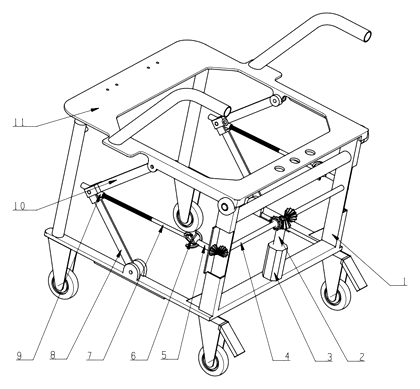
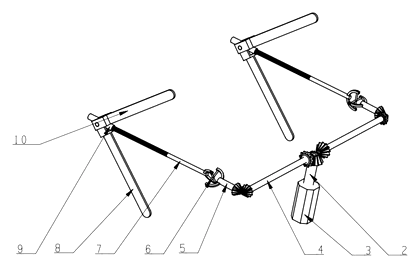
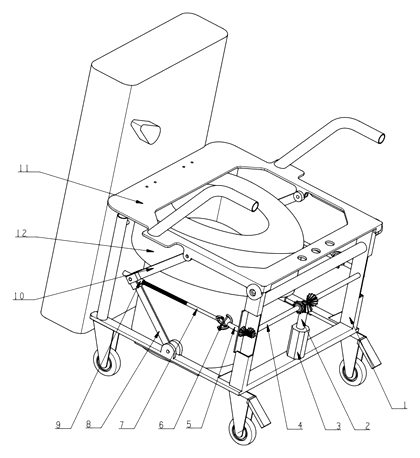
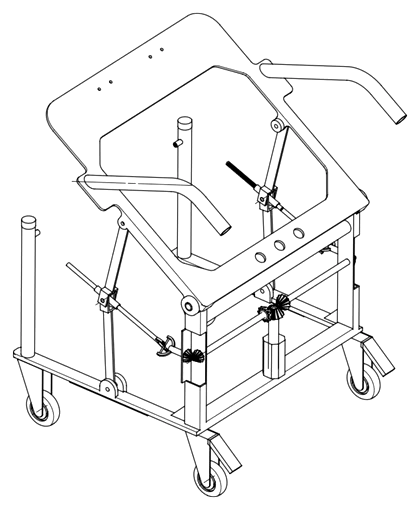
Drawings reproduced from the public patent document for reference.