
Patent CN108237507B
Updated November 8, 2026Blow-Molded Tool Handle with Integrated Blade Mounting
Traditional tool handles often rely on screws or glue to attach blades, which can loosen over time or fail under stress. This patent describes a tool combination device where the handle and its connecting portion are formed together via blow molding. A key feature is the integration of a blade mounting system directly into this molded structure. The blade, equipped with a toothed section, is inserted into radial cuts in the connecting portion. During production, an auxiliary jig holds the parts together while the plastic cools, causing the material to deform slightly around the teeth and locking holes, creating a firm mechanical bond without additional fasteners. Variations include ultrasonic welding or snap-fit mechanisms for different assembly needs.
- China invention patent - lapsed
- No filings outside China
- Hand tools & cutting implements
- Blow molding & injection molding processes
Splat! What let you down?
💨
Blow-Molded Construction
Handle and connector formed in one step, saving material and cost.
🔗
Jig-Assisted Assembly
Auxiliary jig ensures tight fit between blade teeth and molded cuts.
🛡️
Enhanced Connection Strength
Mechanical interlock prevents separation under heavy use.
⚙️
Multiple Embodiments
Includes variations with snap-fits, barb locks, and ultrasonic welding.
Bring this product to market
- ✓ Patent review Patent family and legal status reviewed in the relevant jurisdictions.
- 2 Product brief · now How it works, uses and options written up
- 3 Prototype First samples for buyers to review
- 4 Pilot run Small first batch for launch customers
- 5 Volume production Repeat orders at scale
Buyer interest
– of 100 buyers needed to start prototyping
One click, no sign-up. Each vote is one real visitor, and products with the most interest go to prototyping first.
Build team: no members yet. Need a partner, co-funding or skills to build this? Join and we introduce the team once it forms.
Patent Rights & Team Participation
Before joining a development team, participants should ensure they have the necessary rights or authorization to participate in the project.
Participation is generally appropriate where:
- You own the relevant patent rights or have obtained permission or a license from the rights holder.
- The relevant patent rights have expired or have been legally invalidated in the jurisdictions where the planned activities will take place.
- The planned development, manufacturing, and commercialization activities have been independently assessed and do not infringe applicable patent rights in the relevant jurisdictions.
Important: Being located outside a country where a patent is protected does not automatically exempt you from patent infringement risks. Patent rights may apply based on where development, manufacturing, use, sale, or import activities take place.
IP2M does not grant any patent license or authorization through team participation. Joining a project does not provide permission to use, manufacture, or commercialize patented technology.
The problem
Many hand tools, such as utility knives or scrapers, suffer from weak connections between the handle and the blade. Traditional methods often involve screwing or gluing a separate metal or plastic housing to the handle. These joints can loosen due to vibration, temperature changes, or physical impact, leading to tool failure. Furthermore, assembling multiple separate parts increases labor costs and complexity. There is a need for a simpler, stronger method to integrate the blade mounting mechanism directly into the handle structure during manufacturing.
The solution
The patent describes a tool combination device where the handle and its connecting portion are manufactured together using blow molding. This creates a single-piece structural base. The blade features a specific toothed section designed to interact with radial cuts formed at the open end of the connecting portion.
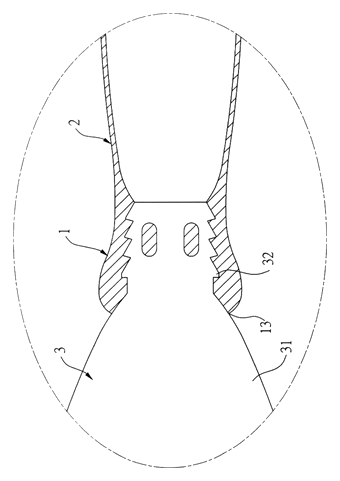
During the manufacturing process, the blade’s toothed section is inserted into these radial cuts while the plastic is still warm or being shaped. An auxiliary jig is used to clamp the connecting portion and the blade teeth together. As the blow-molded plastic cools, it deforms slightly around the teeth and enters the blade’s combining holes, creating a secure mechanical lock. Once cooled, the jig is removed, leaving the blade firmly fixed to the handle without the need for additional fasteners like screws or adhesives.
Who it is for
- Hand Tool Manufacturers: Companies looking to reduce assembly steps and part count for utility knives, box cutters, or scraping tools.
- OEM Buyers: Brands seeking cost-effective, durable tool structures for high-volume consumer goods.
- DIY Product Designers: Innovators needing a reliable method to integrate blades into molded handles without complex secondary operations.
- Industrial Supply Distributors: Wholesalers offering robust, simple-to-use tools for construction or workshop environments.
How it works
The main parts
| No. | Part | What it does |
|---|---|---|
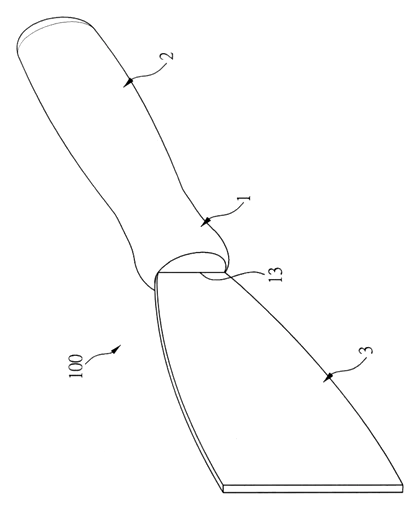
| 1 | Connecting Portion | Injection-molded or integral part with radial cuts/notches. |
| 2 | Handle | Blow-molded grip attached to the connecting portion. |
| 3 | Blade | Cutting element with a toothed section (32) and combining holes. |
| 13 | Radial Cuts/Notches | Openings in the connecting portion for blade insertion. |
| 14 | Barb Blocks | Features in some embodiments for snap-fit locking. |
| 21 | Convex Part | Handle feature for ultrasonic welding variants. |
| 32 | Tooth Section | Engages with radial cuts and combining holes. |
Operating steps
- Molding: The handle (2) and connecting portion (1) are formed. In the primary embodiment, both are created via blow molding.
- Insertion: The blade (3)’s toothed section (32) is aligned with the radial cut (13) of the connecting portion.
- Clamping: An auxiliary jig holds the connecting portion and blade teeth together.
- Cooling/Locking: The plastic cools, shrinking or deforming around the teeth and entering the blade’s combining holes, securing the blade.
- Release: The jig is removed, completing the assembly.
Applications
Utility Knives
Ideal for standard box cutters where the blade must be securely held but replaceable or permanently fixed depending on the model variant. The integrated design prevents the blade from popping out during deep cuts.
Scraping Tools
Useful for window cleaners or floor scrapers. The strong mechanical bond withstands the lateral pressure applied when scraping surfaces, reducing the risk of handle-blade separation.
Industrial Hand Tools
Suitable for basic workshop tools like putty knives or spatulas. The simplified assembly lowers production costs for high-volume industrial consumables.
Consumer DIY Kits
Great for home improvement kits where ease of use and durability are paramount. The lack of small loose screws makes the tool safer and easier for general consumers to handle.
Where it is less suitable
- Heavy-Duty Power Tools: Not designed for tools subjected to extreme torque or impact forces beyond typical hand-tool loads.
- High-Temperature Environments: Blow-molded plastics may deform if exposed to sustained high heat, unlike all-metal tools.
- Complex Multi-Part Blades: Designs requiring intricate blade geometries not compatible with the simple radial cut interface.
Patent & Production
At a glance
| Patent number | CN108237507B (application CN201611224650) |
| Type | China invention patent (发明专利) - protects product structure and method |
| Original title | Tool Combination Device (工具组合装置) |
| Patent owner | Individual |
| Inventors | Chen Shouhong |
| Filing date | 2016-12-27 |
| Grant date | 2021-08-24 |
| Status (China) | Lapsed - terminated for non-payment of annual fees (recorded 2024-01-05) |
| Patent family | Public record shows Chinese filings only - no US, European, Japanese, PCT or other filings listed |
| Cited by | 0 later documents |
| Source | Google Patents (search for CN108237507B) |
What the claims cover, in plain language
Claim 1 defines a tool combination device comprising a handle and a connecting portion, both formed by blow molding. The connecting portion has an open end with a radial cut. A blade includes a knife part, two combining holes, and a tooth part. The method involves inserting the blade’s tooth part into the radial cut during the blow molding phase. An auxiliary jig clamps the connecting portion and the tooth part, causing the plastic to deform into the spaces between the teeth and into the combining holes. Upon cooling, the jig is removed, resulting in a fixed connection.
Claim 2 specifies that the tooth part is inclined outward toward the direction of the knife part.
This is a simplified reading for orientation only. The legal scope is defined by the exact claim wording in the official Chinese document.
What this means for US production
This patent was filed in China and is now lapsed, so it no longer restricts anyone in China either. The public record shows no US or other foreign counterpart.
Two points to settle early:
- Other patents may exist. The field of hand tool ergonomics and blade retention mechanisms is dense with intellectual property. While this specific blow-molding technique appears unique in the public record, related snap-fit or welded handle technologies may be covered by other active patents. A freedom-to-operate (FTO) review is recommended before mass production.
- Material Safety. Ensure the blow-molded polymer meets relevant safety standards for consumer contact and potential chemical exposure.
Customization and manufacturing
What can be customized
| Area | Options |
|---|---|
| Handle Shape | Ergonomic contours, grip textures, color pigments |
| Blade Interface | Tooth geometry, radial cut dimensions, combining hole layout |
| Assembly Method | Jig-assisted molding, ultrasonic welding, snap-fit barbs |
| Materials | Various blow-moldable polymers (e.g., HDPE, PP), blade steel grades |
| Features | Lanyard holes, hanging tabs, protective caps |
Things to plan for (US market)
- CPSC Regulations: General safety requirements for consumer products.
- ASTM Standards: Specific tests for sharp objects or tool durability if applicable to the final product category.
- Proposition 65: California warning requirements for certain chemicals in plastics.
- FDA Compliance: If the tool is intended for food-related tasks (e.g., kitchen scrapers), materials must meet food-contact regulations.
How a project runs
- Inquiry - Define tool type, blade specifications, and desired handle aesthetics.
- Design - CAD modeling of the radial cuts, tooth interface, and jig fixtures.
- Prototype - Create initial samples using temporary molds or 3D-printed components to test fit.
- Testing - Verify pull-out strength, cycle life, and ergonomic comfort.
- Production - Finalize blow-molding dies and injection molds for connectors; set up assembly lines.
Quantities & timeline
Lead times depend on mold complexity and order volume. Tooling and pilot production are scheduled after the design is fixed. Send us your blade specs, handle preferences, quantity and target price and we will reply with options.
Production notes
Tooling and process
The core process typically relies on glass-filled nylon injection molding for the handle and the connector. Precision in the radial cut dimensions is critical. Auxiliary jigs are required during the cooling phase to maintain alignment.
Cost drivers
Main costs typically come from mold fabrication for the handle and the connector. The complexity of the jig system also impacts setup costs. Material waste is minimized by the integrated design.
Prototyping path
We typically start with 3D-printed handles to validate the ergonomic shape. Use machined or off-the-shelf blades to test the tooth interface. Progress to functional samples with soft tooling before committing to hard steel molds.
What we would change before tooling
We would likely review the tolerance stack-up between the blade teeth and the plastic cuts. Ensure the cooling rate allows sufficient deformation for a tight lock without warping the handle. Optimize the jig release mechanism for speed.
Common failure points
Potential issues include incomplete filling of the combining holes by the plastic, leading to weak bonds. Thermal clearance errors could cause the handle to warp. Edge hardness of the blade must match the plastic interface to prevent premature wear.
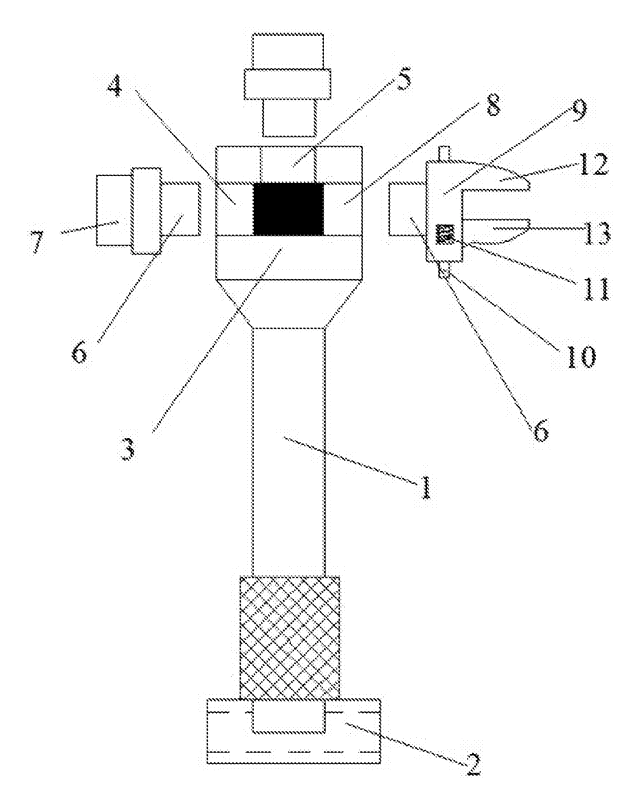
Patent drawings
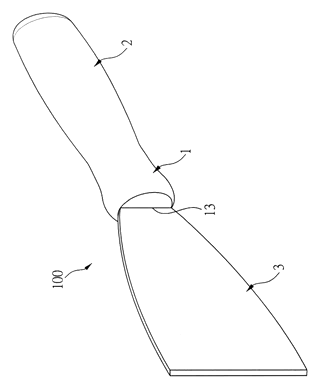
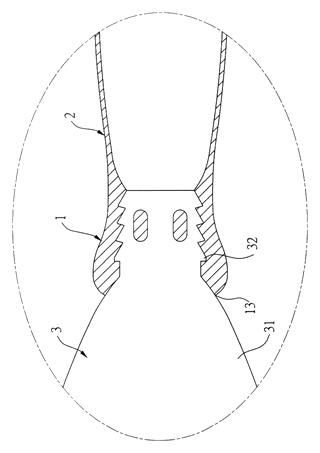
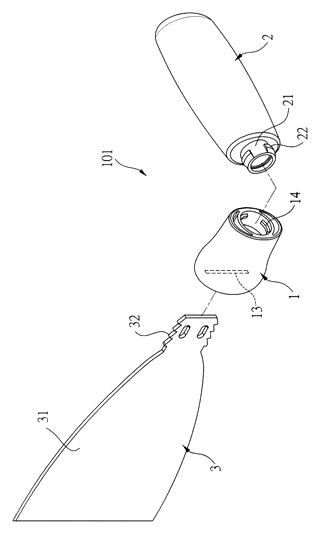
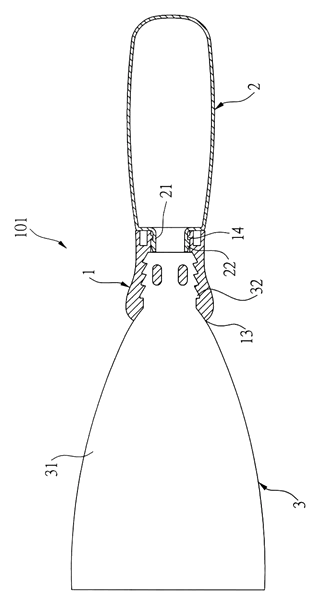
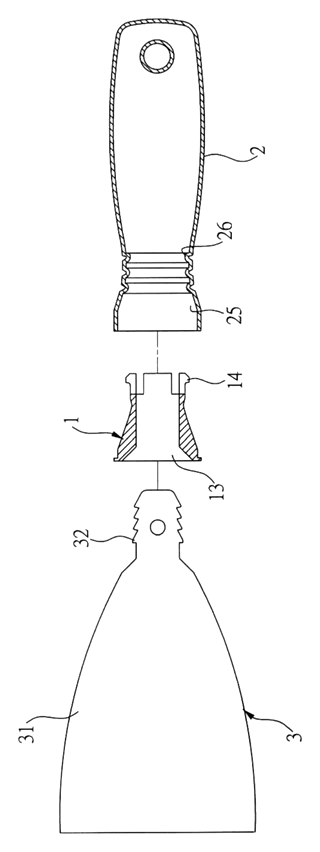
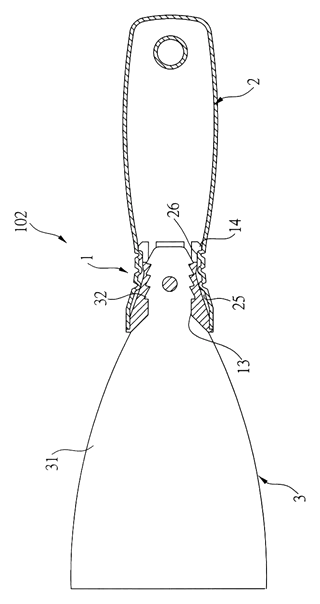
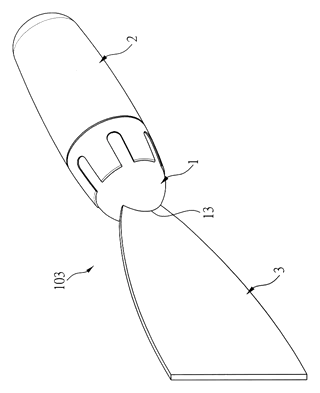
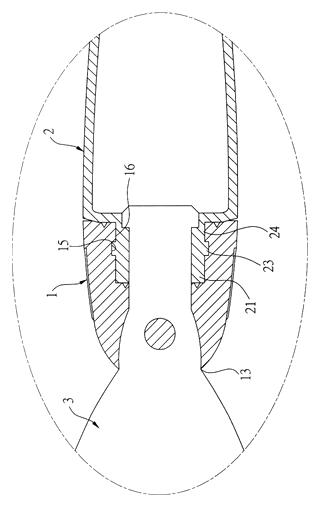
Drawings reproduced from the public patent document for reference.
Frequently asked questions
How does the blade stay in the handle?
The blade has a toothed section that fits into radial cuts on the handle’s connecting portion. During manufacturing, a jig holds them together while the plastic cools, causing the material to shrink around the teeth and lock into place.
Do I need screws or glue for assembly?
No. The primary embodiment described uses a mechanical interlock created during the blow-molding cooling process. Other variations in the patent use snap-fits or ultrasonic welding, eliminating the need for adhesives or fasteners.
Is this design strong enough for heavy use?
The patent states that the connection strength is enhanced compared to separate parts. However, actual load capacity depends on the specific plastic material and blade geometry chosen in design. It is suitable for standard hand tools like utility knives.
Can I customize the handle shape?
Yes. Since the handle is blow-molded, the outer contour, grip texture, and colors can be customized. The internal connecting portion requires precise tolerances to match the blade teeth.
What materials are used?
The handle and connector are typically made from blow-moldable thermoplastics. The blade is usually steel. Specific material grades should be selected based on the intended application and environmental conditions.
Can this design be made and sold in the US?
The patent was filed in China and is currently lapsed. The public record shows no US counterpart, so it does not restrict the design in the US. However, other patents in the hand tool field may apply, so a freedom-to-operate check is advised.
Are you affiliated with the patent owner?
No. IP2M is an independent design and manufacturing service working from the public patent document.
Request a quote
Click Request a Quote below to see our email address - copy it, or open your email app with a ready-made message. Please mention patent CN108237507B in the subject.
Helpful details to include:
- Your company and channel (tool brand, hardware distributor, OEM buyer)
- Blade type and dimensions
- Handle preferences (size, shape, color)
- Estimated quantity and target price
- Timeline - when you would like samples and the first shipment
You can also reach us at (332) 203-9997.
Page editor: Emily Zhang, Product Editor · IP2M
Last updated November 8, 2026. If something on this page looks wrong, email [email protected] and we will check it against the patent.
Interested in building this?
Tell us your target market, quantity and timeline. We reply with options for prototyping, small-batch runs or volume production.
Send your inquiry to
Please put CN108237507B in the subject line and tell us your company, country, estimated quantity and timeline.
Prefer to talk? Call (332) 203-9997.
More product-ready patents
All Tools & Workshop patents →
Tools & Workshop
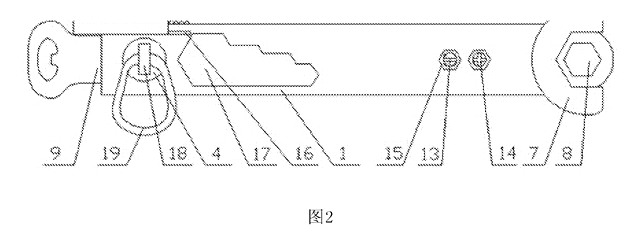
Rolling Tool Box with Telescoping Step Ladder
Telescoping A-frame ladder with an attached rolling tool box that slides to your working height.
Patent CN206290197U
Tools & Workshop
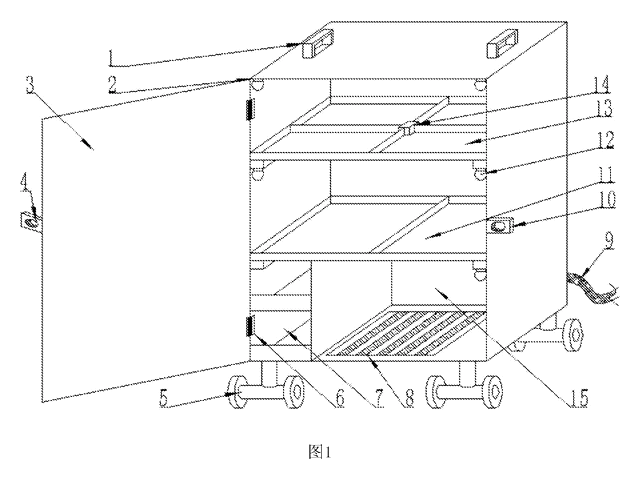
Folding 3-Handle Wrench Multi-Tool
Folding three-handle wrench multi-tool with magnetic screwdriver bits, saw, file and bottle opener.
Patent CN205290875U
Tools & Workshop
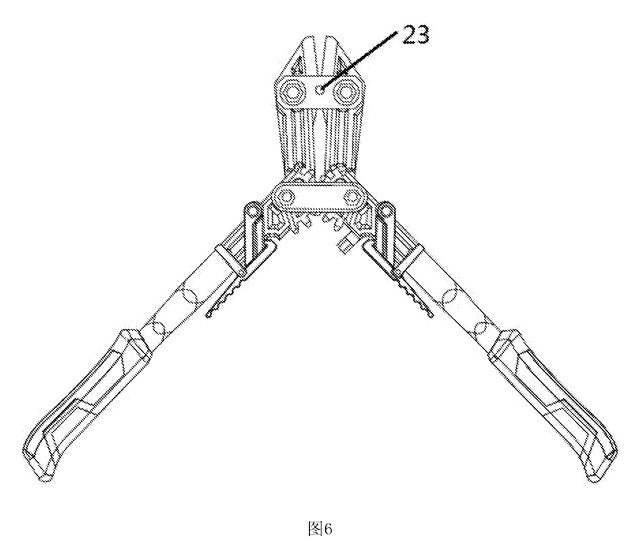
Rolling Auto-Repair Tool Cabinet with Built-In Lights
Lockable rolling tool cabinet for car repair with interior lights, a lubricant tray, parts drawers and a tool bay.
Patent CN205989314U
Tools & Workshop
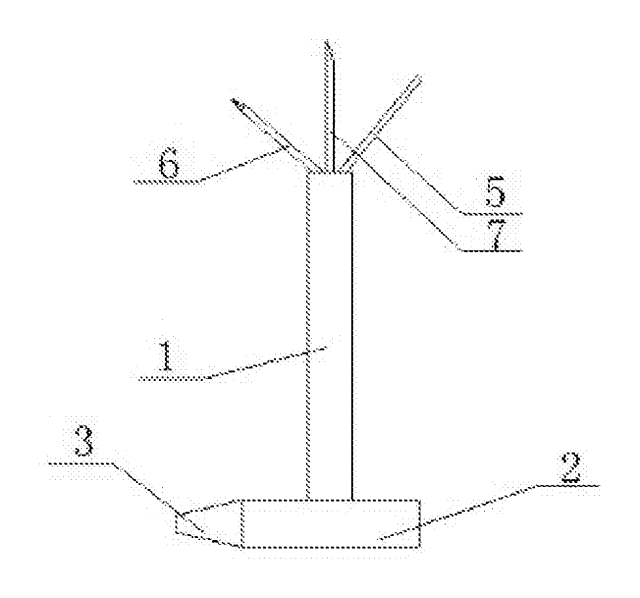
Wide-Opening Folding Bolt Cutter
Bolt cutter with linked, gear-meshing handles that open up to 190° and fold in half for storage.
Patent CN207206226U
Tools & Workshop
Nail-Holding Hammer with Fold-Out Drivers
Hammer with a nail-holding T-slot in the head and fold-out drivers stored in the handle.
Patent CN205254927U
Tools & Workshop
Modular Wrench with Screw-On Heads
Wrench handle with a three-way threaded hub for screw-on adjustable and hex heads, plus a pipe sleeve.
Patent CN206216564U
Browse by category
- Apparel & Accessories (51)
- Baby & Kids (30)
- Bags & Luggage (17)
- Bath & Personal Care (33)
- Car Accessories (27)
- Furniture, Bedding & Storage (25)
- Garden & Outdoor (34)
- Health & Wellness (15)
- Home, Kitchen & Cleaning (52)
- Lighting (25)
- Packaging & Containers (13)
- Pet Products (12)
- Phone & Camera Accessories (10)
- Retail Display (27)
- School, Office & Art (38)
- Sports & Recreation (49)
- Tools & Workshop (57)
- Toys & Games (24)
This page is based on the public patent document CN108237507B, assigned to Individual. IP2M is an independent manufacturing service and is not affiliated with, endorsed by or licensed by the patent owner. Images marked as concept renderings are illustrations, not photos of an existing product. Patent status information is provided for reference only and is not legal advice; confirm freedom to operate for your market before production. Full disclaimer.