At a glance
| Patent number | CN108392020B (application CN201810103776) |
| Type | China invention patent (发明专利) - protects technical solutions |
| Original title | Foldable lamp showing stand (一种可折叠灯具展示架) |
| Patent owner | Zhongshan Wanglai Display Product Co ltd |
| Inventors | Wang Fei |
| Filing date | 2018-02-01 |
| Grant date | 2020-08-21 |
| Status (China) | Active - In force in China until at most 2038-02-01 (if annual fees are paid) |
| Patent family | Chinese filings only - no US, European, Japanese, PCT or other filings listed |
| Cited by | 0 later documents |
| Source | Google Patents (search for CN108392020B) |
What the claims cover, in plain language
Claim 1 - A collapsible light fixture display stand comprising a fixed rod and a sliding rod. The sliding rod fits inside the fixed rod. A rack is fixed to the sliding rod and protrudes through a sliding groove in the fixed rod. A handle with a gear is mounted on a support seat; the gear meshes with the rack to drive the sliding rod up or down. At least three support rods are hinged at the bottom of the fixed rod for folding. At the top of the sliding rod, supporting arms are hinged circumferentially. Sliding blocks move along these arms and hold lamp supporting and lifting rods. A backing ring for the lamp rotates 180 degrees to lock into a concave hole on the lifting rod via a convex block.
Claim 2 - The side walls of the stationary bar have half-circle shaped handles, likely for carrying or stabilization.
Claim 3 - The exposed ends of the support rods (base legs) are fitted with rollers, allowing the stand to be tilted and rolled rather than carried entirely.
This is a simplified reading for orientation only. The legal scope is defined by the exact claim wording in the official Chinese document.
What this means for US production
This patent was filed only in China and is currently active in China. Making, selling, or importing this specific mechanical configuration into the United States is generally permissible under this patent alone, as it has no US counterpart. However, the patent owner retains rights within China.
Two points to settle early:
- Other patents may exist. Display stands and mechanical lifting systems are broad fields. While this specific combination of rack-and-pinion lift with folding bases is patented in China, similar mechanisms might be covered by older or newer US patents held by major display equipment manufacturers. A freedom-to-operate (FTO) review focusing on the rack-and-pinion integration and the specific locking mechanism of the lamp rings is recommended before mass production.
- Safety Standards. Mechanical lifting devices in public spaces must meet stability requirements. The addition of rollers (Claim 3) changes the center of gravity dynamics compared to static feet, which impacts tipping tests.
Customization and manufacturing
What can be customized
| Area | Options |
|---|---|
| Height Range | Adjust stroke length of the sliding rod and rack size. |
| Capacity | Number of supporting arms and lamp holders per arm. |
| Material | Aluminum alloy or steel tubing for the rods; plastic or metal for gears/handles. |
| Finish | Powder coating colors, anodizing, or wood accents for the base. |
| Base Type | Rollers (as claimed), fixed feet, or casters with brakes. |
| Locking Mechanism | Variation in the concave/convex interface for different lamp bases. |
Things to plan for (US market)
- OSHA / ANSI Stability Guidelines: While not a specific federal regulation for all display stands, commercial furniture and display equipment sold in the US often follow voluntary standards like BIFMA for tip-over resistance, especially if used in public areas.
- UL Listing (Electrical): If the stand includes integrated wiring or power outlets for the lamps, the electrical components must be UL listed. The mechanical stand itself does not typically require UL unless it is part of a powered system.
- California Prop 65: Materials used in coatings and plastics must be screened for restricted substances.
How a project runs
- Inquiry - Define load capacity, number of lamps, and desired height range.
- Design - Engineer the rack pitch, gear ratio, and hinge points for smooth operation.
- Prototype - Build functional models to test the lifting mechanism and folding stability.
- Pilot Run - Manufacture small batches for durability testing (cycle life of the rack).
- Production - Tube cutting, welding, machining of gears/racks, injection molding of handles/blocks, and final assembly.
Quantities & timeline
The rack and pinion system requires precise machining or mold-making for consistency. Injection molds for the sliding blocks and handles add lead time. Send us your target height, lamp count, material preference, quantity and target price and we will reply with options.
Patent drawings
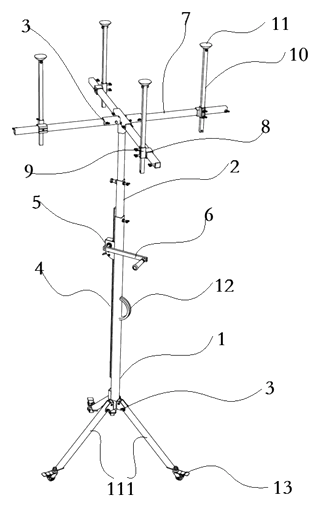
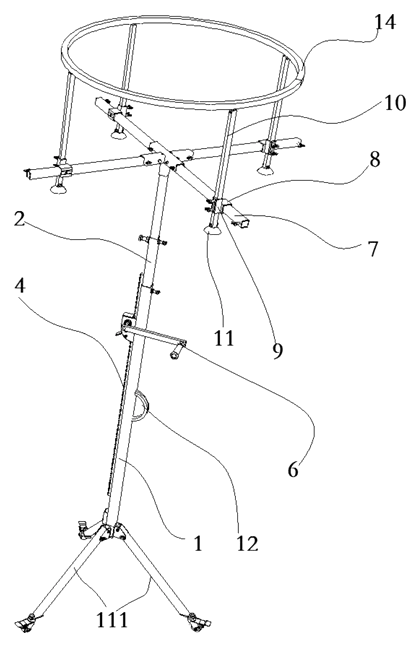
Drawings reproduced from the public patent document for reference.