
Patent CN108392818B
Updated October 26, 2026Multi-Blade Array Ice Skating Shoe with Ventilated Sole
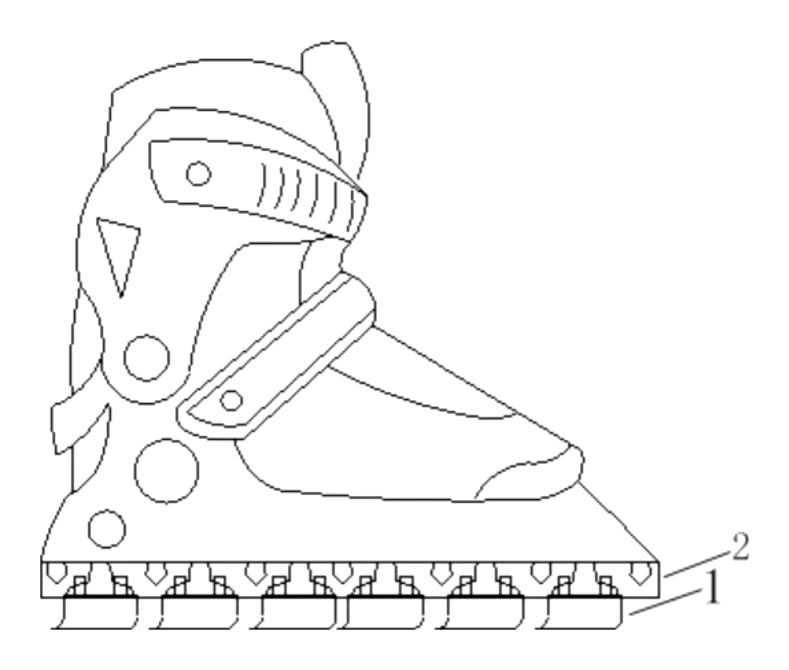
Standard ice skates use a single tall blade, which makes balancing difficult for beginners and often leads to twisted ankles. This design solves that problem by inserting multiple blade groups into the sole, arranging them side-by-side across the width of the foot. Each group holds several short ice blades lined up from toe to heel, creating a wide, flat array that contacts the ice. Because the blades are shorter and spread out, the user's center of gravity stays lower and more stable. The sole is preferably made of rubber, giving it a feel closer to a regular shoe while wrapping the blades securely. Inside the sole, a network of air passages built from alternating bulges vents moisture outward, and metal particles are embedded in those bulges.
- China invention patent - in force
- No filings outside China
- Sports & recreation equipment
- Rubber sole, metal blades, breathable layers
Splat! What let you down?
⛸️
Array blade layout
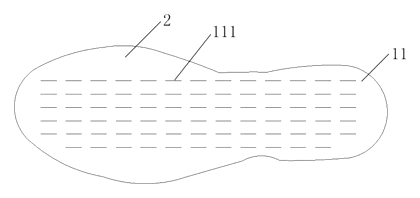
Multiple blade groups run left-to-right, each holding several blades front-to-back for a wide, stable footprint.
🔩
Shoulder-mounted blades
Each blade has a top shoulder with a planar structure and connection piece inserted into the sole to spread the load.
💨
Internal ventilation
Alternating bulges form air passages through the sole to let moisture escape from the shoe cavity.
🧱
Metal particle layer
Metal particles are uniformly arranged on the internal bulges within the sole structure.
Bring this product to market
- ✓ Patent vetted China-only family and legal status checked
- 2 Product brief · now How it works, uses and options written up
- 3 Prototype First samples for buyers to review
- 4 Pilot run Small first batch for launch customers
- 5 Volume production Repeat orders at scale
Buyer interest
– of 100 buyers needed to start prototyping
One click, no sign-up. Each vote is one real visitor, and products with the most interest go to prototyping first.
Build team: no members yet. Need a partner, co-funding or skills to build this? Join and we introduce the team once it forms.
The problem
Traditional ice skates rely on a single, relatively tall blade running the length of the boot. For beginners and casual users, this narrow contact point makes balancing difficult. The height of the blade raises the user’s center of gravity, increasing the risk of the foot rolling sideways and causing ankle sprains. Beyond balance, physical activity on the ice generates sweat that becomes trapped inside the boot. Conventional skate boots lack effective ways to vent this moisture during use. Additionally, friction and movement can cause static electricity to build up on the body. These issues limit ice skating to experienced users and make the experience uncomfortable for others.
The solution
This patent describes a skating shoe that replaces the single runner with a distributed array of blades.
- Multiple blade groups are inserted directly into the sole, arranged sequentially along the left-right direction of the foot.
- Several ice blades make up each group, lined up along the front-back direction so they extend parallel to the direction of movement.
- The blades are kept short, reducing the overall height of the skate and lowering the center of gravity.
- A shoulder at the top of each blade includes a planar structure and a connection structure that anchors into the sole, increasing the contact area between the metal and the rubber.
- Internal channels are molded into the sole using alternating first and second bulges, creating air passages that connect the inside of the shoe to the outside.
- Metal particles are placed uniformly on these bulges within the sole structure.
Who it is for
- Recreational skate brands looking to offer beginner-friendly ice skates that reduce the learning curve and fear of falling.
- Rental rink operators who need durable, easy-to-use skates for patrons with no prior ice skating experience.
- Footwear manufacturers exploring crossover products that combine standard shoe comfort with ice-gliding capability.
- Winter sports equipment wholesalers adding accessible, entry-level ice gear to their seasonal catalogs.
How it works
The main parts
| No. | Part | What it does |
|---|---|---|
| 1 | Blade groups | Multiple sets of blades arranged left-to-right across the sole. |
| 11 | Ice blades | Individual short blades within a group, arranged front-to-back. |
| 2 | Sole | Preferably rubber; wraps the blades and houses the ventilation system. |
| 112 | Shoulder | Top end of each blade; includes a planar structure and connection structure. |
| 22 / 23 | First and second bulges | Alternating structures inside the sole that form air passages. |
| 24 | Metal particles | Embedded uniformly on the bulges inside the sole. |
| 25 | Waterproof breathable layer | Placed over the metal particles. |
| 26 | Protective layer | A three-dimensional grid above the breathable layer. |
| 27 | Multi-layer gauze | Reduces hole size, increases support, ensures ventilation. |
| 28 | Barb fitting structure | On the shoe sidewall to fix the gauze, protective layer, and breathable layer. |
Operating steps
- Stepping onto the ice - the user stands on the array of blades. Because the blades are distributed across the width and length of the sole, the weight spreads over a larger area than a single runner.
- Gliding - the short blades extend in the direction of movement, allowing forward and backward sliding while the low profile prevents the foot from rolling sideways.
- Flexing - the rubber sole provides elasticity when the blades contact the ice, allowing the user to bounce or push off similarly to walking in a regular shoe.
- Ventilating - as the user moves, air travels from the shoe cavity down through the first upper branches, into the first air passage between the bulges, through the second air passage, and out the side of the sole.
Applications
Beginner ice skating lessons
New skaters often struggle to stand on a single blade. The array layout gives instructors a tool that lets students focus on gliding mechanics rather than fighting to stay upright. Rental rinks benefit because fewer falls mean faster turnover and less time spent assisting patrons at the boards.
Casual winter recreation
Families visiting outdoor rinks or frozen ponds want a comfortable experience without heavy, rigid boots. The rubber sole mimics the feel of a normal shoe, making it easier for casual users to walk from the bench to the ice. The reduced blade height lowers the intimidation factor for occasional skaters.
Indoor ice entertainment centers
Entertainment venues that feature ice paths or small rinks need equipment suited for people wearing everyday clothing. These skates can be designed with various shoe patterns for different ages, functioning as an amusement attraction. The ventilation system helps manage moisture during active play sessions.
Rehabilitation and balance training
Physical therapy programs sometimes use ice-like surfaces for balance exercises. The wide stance provided by the blade array offers a controlled environment for practicing weight shifts. Therapists can use the stable platform to guide patients through low-impact movements.
Where it is less suitable
- Competitive figure skating or speed skating - athletes require specific single-blade profiles for deep edges, jumps, and maximum glide efficiency.
- Ice hockey - players need specialized steel runners for sharp turns, rapid stops, and aggressive maneuvering that an array cannot provide.
- Uneven natural ice - very rough or cracked outdoor ice may catch the multiple short blades more easily than a single long runner.
Frequently asked questions
How does having multiple blades change the skating experience?
Instead of balancing on one narrow runner, the user stands on an array of short blades spread across the width and length of the sole. The patent states this arrangement strengthens the user’s balance, reduces the risk of twisting the foot, and lowers the panic feeling often experienced by beginners.
Are the blades removable?
The patent describes the blade groups as being inserted into the sole, with each blade featuring a connection structure fixed inside the rubber. Whether they are designed to be replaceable by the user or permanently molded in place is set in design / confirmed on prototypes.
How does the ventilation system work?
The sole contains internal channels formed by alternating first and second bulges. Air moves from the inside of the shoe down through upper branches, passes through the passages between the bulges, and exits through a second air passage that penetrates the side of the sole.
What materials are inside the sole besides rubber?
According to the patent, the sole incorporates metal particles arranged uniformly on the internal bulges. Above the metal particles sits a waterproof breathable layer, followed by a three-dimensional grid protective layer, and topped with multi-layer gauze to increase the supporting area while maintaining airflow.
What sizes are available?
The patent mentions that different shoe patterns can be designed for people of all ages, but specific size ranges are set in design / confirmed on prototypes based on the manufacturer’s last.
How thick are the blades?
The patent specifies that the thickness of the ice blade is 0.5-1.0 mm. The exact steel grade and edge geometry are determined during the manufacturing setup.
Can the upper part look like a normal sneaker?
Yes. The patent explicitly notes that the shoe body part of the skating shoe can be various types of shoes, and different patterns can be applied, meaning the exterior appearance is not restricted to traditional stiff skate boots.
Can this design be made and sold in the US?
The patent was filed only in China and is currently in force there. It has no US counterpart, so it does not restrict making or selling the design in the United States. However, manufacturing this exact design in China would require the patent owner’s permission. Other patents covering ice skate structures may exist, so we recommend a freedom-to-operate check before volume production.
Are you affiliated with the patent owner?
No. IP2M is an independent design and manufacturing service working from the public patent document.
Request a quote
Click Request a Quote below to see our email address - copy it, or open your email app with a ready-made message. Please mention patent CN108392818B in the subject.
Helpful details to include:
- Your company and channel (recreational skate brand, rental rink operator, footwear manufacturer, wholesaler)
- Target age group and shoe styles
- Size range needed
- Blade layout preference (number of groups and blades per group)
- Estimated quantity and target price
- Timeline - when you would like samples and the first shipment
You can also reach us at (332) 203-9997.
Explore this product
Interested in building this?
Tell us your target market, quantity and timeline. We reply with options for prototyping, small-batch runs or volume production.
Send your inquiry to
Please put CN108392818B in the subject line and tell us your company, country, estimated quantity and timeline.
Prefer to talk? Call (332) 203-9997.
More product-ready patents
All Sports & Recreation patents →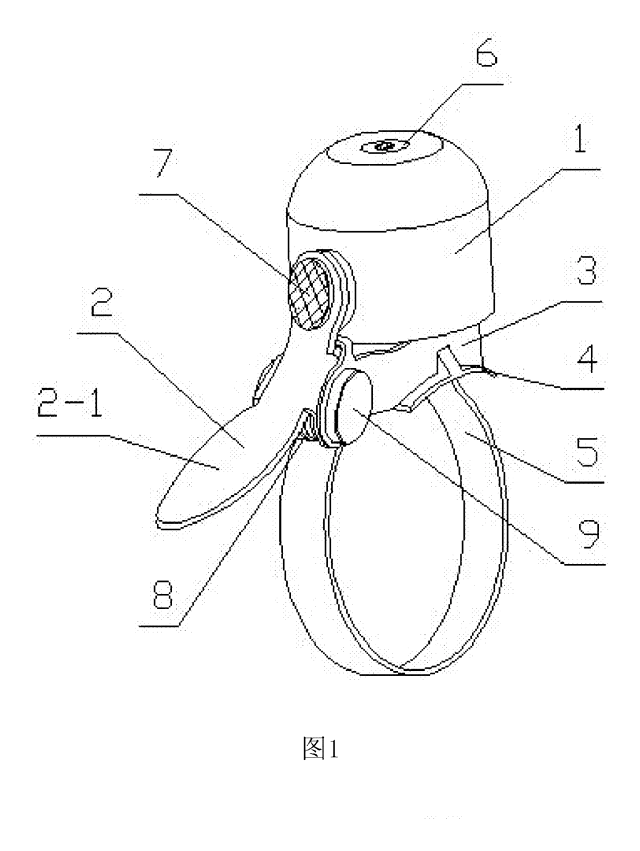
Sports & Recreation
Compact Torsion-Spring Bike Bell
Mini bike bell with a standard torsion spring and a rubber-floated dome - small size, clear tone, quick strap mount.
Patent CN205819384U
Sports & Recreation
Padded Toe-Box Shield for Sneakers
Ventilated, silicone-lined toe-box insert that supports the front of a sneaker and cushions the toes.
Patent CN209473731U
Sports & Recreation
Reversible Fishing Seat-Box Lid with Backrest
Fishing seat-box lid that flips on removable hinge pins: cushion, backrest and storage on one face.
Patent CN208624426U
Sports & Recreation
Swivel-Pin Skateboard Truck with Rubber Sleeve
Skateboard truck with a turning center pin, a tilting axle clamp and a rubber sleeve that centers it.
Patent CN216777880U
Sports & Recreation
Full-Face Bike Helmet with Magnetic Detachable Chin Bar
Full-face cycling helmet whose chin bar clips on and off with magnetic, latching side connectors.
Patent CN206630067U
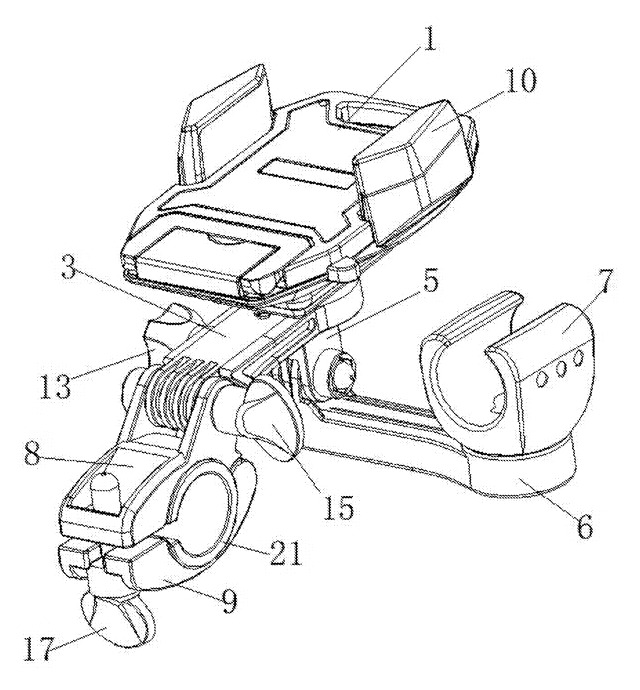
Sports & Recreation
Bike Phone Holder with Built-In Flashlight Clamp
Handlebar mount with a phone cradle on top and a flashlight clamp below, on one arm.
Patent CN206077485U
Browse by category
- Apparel & Accessories (22)
- Baby & Kids (16)
- Bags & Luggage (9)
- Bath & Personal Care (16)
- Car Accessories (10)
- Furniture, Bedding & Storage (12)
- Garden & Outdoor (18)
- Health & Wellness (8)
- Home, Kitchen & Cleaning (24)
- Lighting (12)
- Packaging & Containers (6)
- Pet Products (6)
- Phone & Camera Accessories (4)
- Retail Display (13)
- School, Office & Art (19)
- Sports & Recreation (25)
- Tools & Workshop (27)
- Toys & Games (12)
This page is based on the public patent document CN108392818B, assigned to Individual. IP2M is an independent manufacturing service and is not affiliated with, endorsed by or licensed by the patent owner. Images marked as concept renderings are illustrations, not photos of an existing product. Patent status information is provided for reference only and is not legal advice; confirm freedom to operate for your market before production. Full disclaimer.