
Patent CN108453685B
Updated November 7, 2026Toolbox with Bench Vise Jaws Converting to Table Saw Fence
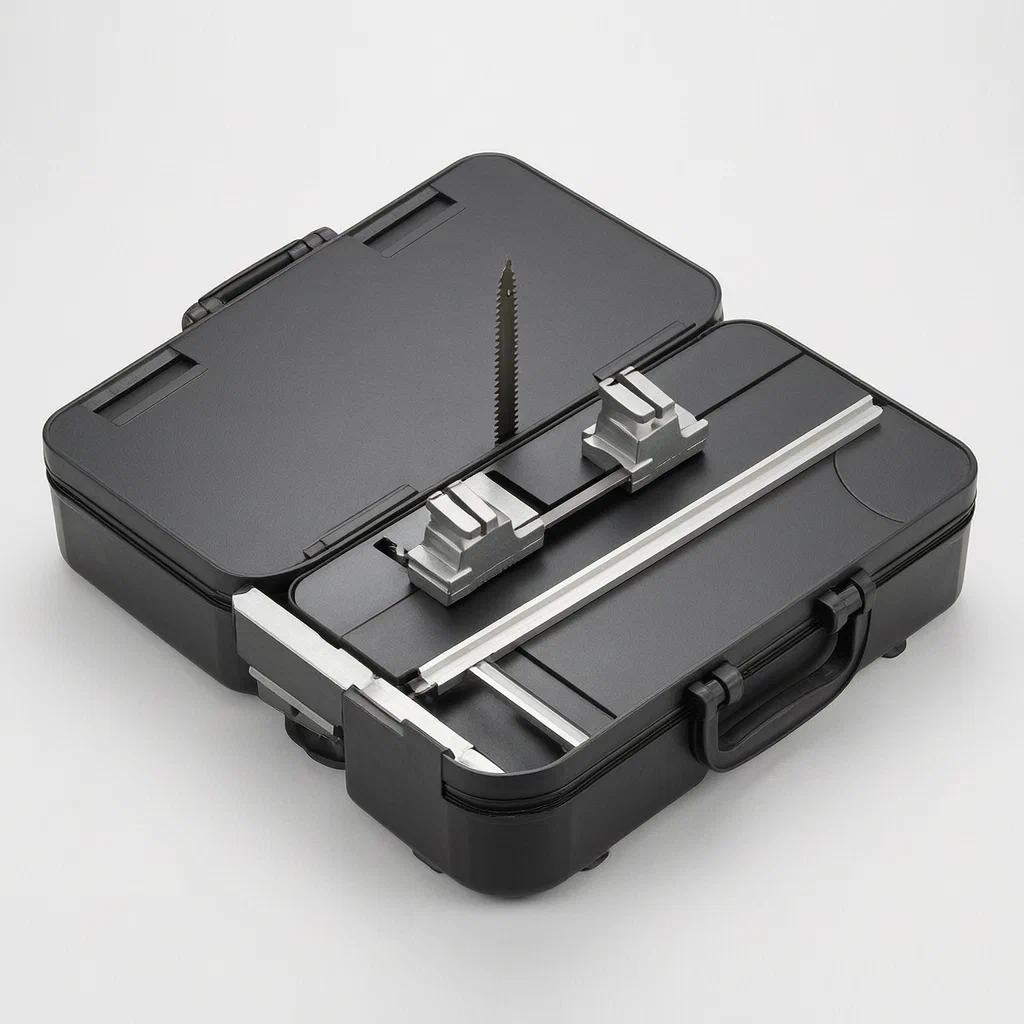
Small workshops lack space for separate machines. A bench vise takes room when idle; a table saw needs a stable fence. This design merges them: the vise’s jaws become the saw’s guide rail, stored inside the same box that carries the tools. No extra hardware, no setup time—just detach, align, and cut.
- China invention patent - lapsed
- No filings outside China
- Workshop storage & multi-function bench
- Detachable vise jaws, integrated table saw, adjustable baffle
Splat! What let you down?
🔧
Dual-purpose vise
Clamp claws serve as vise jaws and convert into a saw fence.
📏
Flush alignment
Vise bodies slide vertically to keep tops level with the workbench.
🪚
Integrated saw
Cutting blade protrudes through table slot to form a table saw.
🎯
Angle guide
Adjustable baffle fits into a front-to-back groove for angled cuts.
Bring this product to market
- ✓ Patent review Patent family and legal status reviewed in the relevant jurisdictions.
- 2 Product brief · now How it works, uses and options written up
- 3 Prototype First samples for buyers to review
- 4 Pilot run Small first batch for launch customers
- 5 Volume production Repeat orders at scale
Buyer interest
– of 100 buyers needed to start prototyping
One click, no sign-up. Each vote is one real visitor, and products with the most interest go to prototyping first.
Build team: no members yet. Need a partner, co-funding or skills to build this? Join and we introduce the team once it forms.
Patent Rights & Team Participation
Before joining a development team, participants should ensure they have the necessary rights or authorization to participate in the project.
Participation is generally appropriate where:
- You own the relevant patent rights or have obtained permission or a license from the rights holder.
- The relevant patent rights have expired or have been legally invalidated in the jurisdictions where the planned activities will take place.
- The planned development, manufacturing, and commercialization activities have been independently assessed and do not infringe applicable patent rights in the relevant jurisdictions.
Important: Being located outside a country where a patent is protected does not automatically exempt you from patent infringement risks. Patent rights may apply based on where development, manufacturing, use, sale, or import activities take place.
IP2M does not grant any patent license or authorization through team participation. Joining a project does not provide permission to use, manufacture, or commercialize patented technology.
The problem
In compact workshops, storing both a bench vise and a table saw requires significant floor space and setup time. Users often face cluttered benches where tools compete for room, and switching between clamping tasks and cutting operations means moving heavy equipment or losing stability. Traditional setups force buyers to choose between portability and functionality: a standard toolbox lacks structural features for precise work, while dedicated machines cannot be stored together without complex mounting systems.
The solution
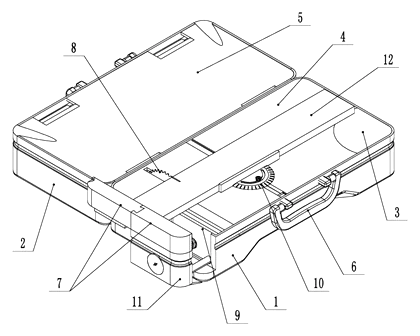
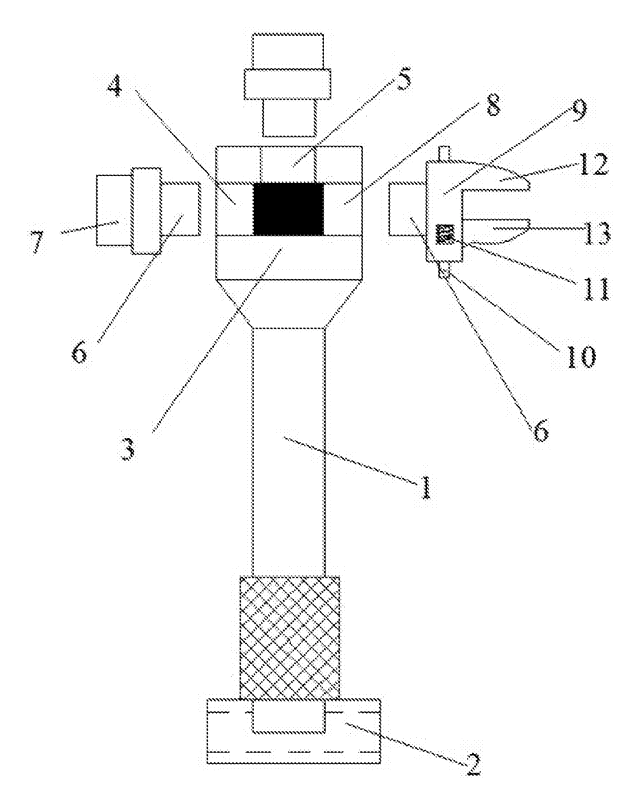
The device integrates three functions into one case. The work table top (4) provides a flat surface with a slot through which a cutting blade (8) extends, creating a table saw. At one corner, a fixed clamp body (9) and movable clamp body (11) form a bench vise. Each body has an upper part carrying a detachable clamp claw (7). These claws extend above the table surface. To convert the vise into a saw fence, the user removes the claw from the fixed body and mates it with the movable body’s claw. Both bodies are connected via vertical sliding grooves and slide rails, ensuring their top surfaces remain equal in height to the workbench. An angle-adjustable baffle (10) inserts into a shallow groove running front-to-back across the table, allowing users to position workpieces at specific angles for cutting.
Who it is for
- Home workshop owners needing a compact, all-in-one solution for small spaces.
- Mobile repair technicians who require a portable bench with cutting and clamping capabilities.
- Educational institutions looking for safe, integrated toolsets for basic woodworking lessons.
- DIY hobbyists wanting to reduce clutter by combining storage, vise, and saw functions.
How it works
The main parts
| No. | Part | What it does |
|---|---|---|
| 1 | Box body | Main housing containing the tool layer. |
| 2 | Case lid | Top cover with optional secondary work surface. |
| 4 | Work table top | Detachable surface with blade hole and baffle groove. |
| 7 | Clamp claws | Detachable jaws that form vise grips or saw fence. |
| 8 | Cutting blade | Protrudes through table to act as table saw. |
| 9 | Fixed clamp body | Stationary vise component with sliding mechanism. |
| 10 | Angle baffle | Adjustable guide inserted into table groove. |
| 11 | Movable clamp body | Slides vertically to adjust jaw position. |
Operating steps
- Unfold the table: Place the work table top (4) onto the box body (1), securing the cutting tool below so the blade (8) passes through the slot.
- Configure the vise: Use the fixed (9) and movable (11) clamp bodies with attached claws (7) to hold workpieces directly on the bench.
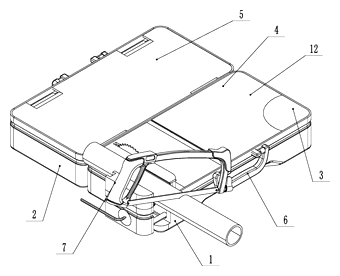
- Convert to fence: Remove the claw (7) from the fixed body (9). Attach it to the movable body (11) to create a continuous backer/fence aligned with the saw blade.
- Set angle: Insert the angle-adjustable baffle (10) into the front-to-back groove on the table top to guide cuts at desired angles.
- Stow away: Disconnect claws and store tools in the accommodating layer below the table surface.
Applications
Home DIY projects
Users can clamp wood pieces for drilling or sanding using the vise function, then switch to the saw mode for trimming without moving materials to another station. The integrated fence ensures straight cuts even for beginners.
Mobile service vans
Technicians use this unit as a temporary workbench during field repairs. The compact footprint fits in vehicle racks, providing immediate access to cutting and clamping tools for electrical conduit or plumbing pipes.
School workshops
Students learn basic joinery and safety protocols using a single controlled environment. The detachable nature allows instructors to demonstrate how one set of parts serves multiple mechanical purposes.
Apartment living
Residents with limited balcony or closet space utilize the box as both storage and functional bench. The ability to hide sharp blades inside the case when not in use enhances safety in shared living areas.
Where it is less suitable
- Heavy industrial lumber: The structure is designed for light-to-medium duty tasks typical of consumer and educational use, not large timber processing.
- High-precision metal cutting: While it includes a hammering surface, the primary focus is general workshop utility rather than specialized metalworking accuracy.
Patent & Production
At a glance
| Patent number | CN108453685B (application CN201810614632) |
| Type | China invention patent (发明专利) - protects product shape, structure, and method |
| Original title | Toolbox that converts bench clamp blocks into table saw back cushion (一种可将台钳夹块变为台锯靠山的工具箱) |
| Patent owner | Ningbo Platinum Quercus Crafts Co ltd |
| Inventors | Zhuo Geyaoquan, Kong Xinjie |
| Filing date | 2018-06-14 |
| Grant date | 2023-10-03 |
| Status (China) | Lapsed - terminated for non-payment of annual fees (recorded 2025-06-06) |
| Patent family | Public record shows Chinese filings only - no US, European, Japanese, PCT or other filings listed |
| Cited by | 1 later document |
| Source | Google Patents (search for CN108453685B) |
What the claims cover, in plain language
Claim 1 - a toolbox comprising a box body (1) and case lid (2). The top has a detachable work table top (4) with a tool layer below holding a cutting tool. The cutting blade (8) penetrates a hole in the table to form a table saw. One corner has a bench clamp with fixed (9) and movable (11) bodies, each with a detachable clamp claw (7) higher than the table surface. Removing the fixed body’s claw allows it to mate with the movable body’s claw to form a backer for saw cutting. The bodies connect via vertical sliding grooves and rails, keeping top surfaces flush with the table.
Claim 2 - the sliding connections use dovetail grooves and rails. Claim 3 - horizontal chutes allow lateral movement of claws. Claim 4 - an angle-adjustable baffle (10) fits into the table for angled cutting. Claim 5 - a shallow groove runs front-to-back for the baffle. Claims 6-8 - details on lid structure, handles, and an iron felt surface for hammering.
This is a simplified reading for orientation only. The legal scope is defined by the exact claim wording in the official Chinese document.
What this means for US production
This patent was filed in China and has lapsed due to non-payment of annual fees, so it no longer restricts anyone in China either. The public record shows no US or other foreign counterpart.
Two points to settle early:
- Other patents may exist. Robert Bosch GmbH holds later US/foreign patents citing this field, including US12708996B2 and US20260061588A1. A freedom-to-operate (FTO) review is needed before tooling to ensure no conflict with active Bosch patents or other existing IP in multi-function workshop tools.
- Safety standards. Table saw mechanisms trigger strict regulatory scrutiny; design must prioritize blade guarding and kickback prevention beyond the patent description.
Customization and manufacturing
What can be customized
| Area | Options |
|---|---|
| Material | Die-cast aluminum for frame; stamped steel for rails; glass-filled nylon for knobs/handles |
| Blade Type | Standard circular saw blade compatible with common arbor sizes |
| Surface Finish | Powder-coated steel table; rubberized grip on handles |
| Dimensions | Box size scaled to fit standard backpack or van rack widths |
| Features | Integrated dust collection port; magnetic base for baffle retention |
Things to plan for (US market)
- CPSC 16 CFR 1203 / ANSI Z133.1 - While not a handheld power tool, if sold as a kit with a motorized saw, it falls under power tool safety standards regarding guards and emergency stops.
- UL Listing - If the box includes electrical components for the saw, UL certification is required.
- California Prop 65 - Screening for lead, cadmium, or phthalates in plastics and coatings.
How a project runs
- Inquiry - Define target load capacity, blade compatibility, and folding mechanism requirements.
- Design - CAD modeling of dovetail sliders and claw mating interfaces; stress analysis on table top.
- Prototype - Machined or off-the-shelf blade samples; 3D-printed handle prototypes; heat-treatment trial coupons for steel parts.
- Pilot run - Assembly tests for smooth sliding action; durability testing of snap-fit claws.
- Production - Stamping dies for rails; injection molds for nylon parts; final assembly with rivets and screws.
Quantities & timeline
Tooling costs depend heavily on the number of stamping dies for the steel rails and the complexity of the dovetail machining. Injection molding for the nylon claws and handles requires precision molds. Surface finish application adds cycle time. Send us your material preferences, blade specs, quantity, and target price and we will reply with options.
Production notes
Tooling and process
Likely involves stamped steel for the sliding rails and fixed bodies, requiring multiple progressive dies. Glass-filled nylon injection molding is typically used for the detachable claws and handles to balance strength and weight. Machining may be necessary for the dovetail interfaces if tolerances are tight.
Cost drivers
Number of stamping dies significantly impacts upfront cost. Material and heat treatment for the steel components add expense, especially if edge hardness is critical for wear resistance. Assembly steps involving snap-fits and rivets increase labor time. Actual costs typically depend on final materials, order volume, and supplier quotes.
Prototyping path
Start with a 3D-printed handle to verify ergonomics. Use machined or off-the-shelf blades for initial fit checks. Produce heat-treatment trial coupons to validate steel hardness before committing to full tooling. Build a functional sample to test the claw-to-fence conversion mechanism. The exact sequence depends on the final design and supplier feedback.
What we would change before tooling
We would likely simplify the vertical sliding mechanism if friction becomes an issue, perhaps using a bushing system instead of direct metal-on-metal contact. Ensuring the iron felt surface is securely bonded to the table top is also a priority to prevent delamination.
Common failure points
Edge hardness below spec could cause rapid wear on the sliding rails. Pivot pin wear might loosen the movable clamp over time. Handle creep under load is a risk if plastic thickness is insufficient. Spring-back or kickback issues must be addressed in the saw configuration design.
Patent drawings
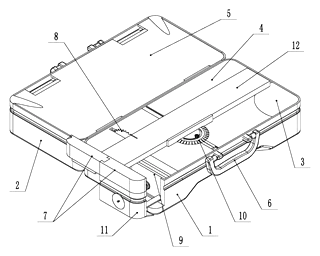
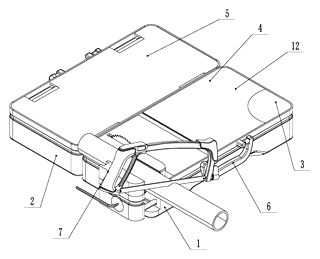
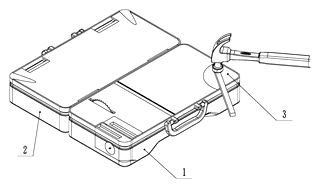
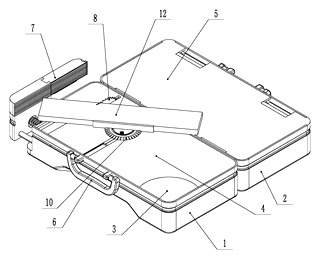
Drawings reproduced from the public patent document for reference.
Frequently asked questions
How does the vise turn into a saw fence?
The bench vise has two clamp bodies with detachable claws. You remove the claw from the fixed body and attach it to the movable body. Together, they form a long, straight backer that guides material against the table saw blade.
Is the table saw motor included?
The patent describes the mechanical structure and the blade hole. It does not specify the motor. In practice, you would need to confirm if the design supports a specific motor mount or if it uses an external handheld saw inserted into the slot.
Can I use it for heavy lumber?
The patent focuses on a compact, multi-function design. Load capacities are not specified. For heavy industrial lumber, dedicated stationary saws with larger fences are more suitable. This design is likely intended for light-to-medium DIY tasks.
What materials are used?
The patent mentions steel for the clamp bodies and rails. Handles and claws could be made from durable plastics like glass-filled nylon. Final material choices depend on the production design and safety requirements.
Is it safe to use as a table saw?
Any table saw configuration requires strict safety measures. The patent describes a mechanical fence but does not detail electronic guards or emergency stops. You must add appropriate blade guards and follow local safety regulations for power tools.
Does it fold up for storage?
Yes, the work table top is detachable, and the tools fit into a layer below it. The box acts as a container for the entire setup, making it portable.
Can this design be made and sold in the US?
The patent was filed in China and has lapsed due to non-payment of annual fees. The public record shows no US counterpart, so it does not restrict the design in the US. However, other patents (such as those held by Robert Bosch GmbH) may apply, so a freedom-to-operate check is recommended.
Are you affiliated with the patent owner?
No. IP2M is an independent design and manufacturing service working from the public patent document.
Request a quote
Click Request a Quote below to see our email address - copy it, or open your email app with a ready-made message. Please mention patent CN108453685B in the subject.
Helpful details to include:
- Your company and channel (tool brand, workshop supplier, educational distributor)
- Target load class and dimensions
- Material preferences (steel, aluminum, plastic types)
- Motor compatibility needs (if applicable)
- Estimated quantity and target price
- Timeline - when you would like samples and the first shipment
You can also reach us at (332) 203-9997.
Page editor: Emily Zhang, Product Editor · IP2M
Last updated November 7, 2026. If something on this page looks wrong, email [email protected] and we will check it against the patent.
Interested in building this?
Tell us your target market, quantity and timeline. We reply with options for prototyping, small-batch runs or volume production.
Send your inquiry to
Please put CN108453685B in the subject line and tell us your company, country, estimated quantity and timeline.
Prefer to talk? Call (332) 203-9997.
More product-ready patents
All Tools & Workshop patents →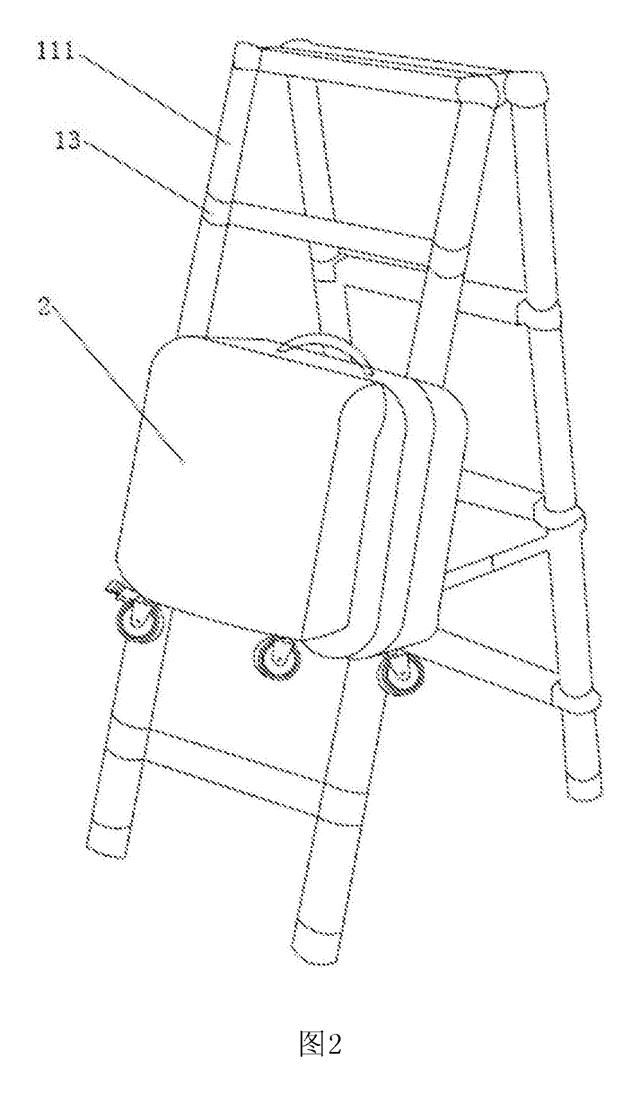
Tools & Workshop
Rolling Tool Box with Telescoping Step Ladder
Telescoping A-frame ladder with an attached rolling tool box that slides to your working height.
Patent CN206290197U
Tools & Workshop
Folding 3-Handle Wrench Multi-Tool
Folding three-handle wrench multi-tool with magnetic screwdriver bits, saw, file and bottle opener.
Patent CN205290875U
Tools & Workshop
Rolling Auto-Repair Tool Cabinet with Built-In Lights
Lockable rolling tool cabinet for car repair with interior lights, a lubricant tray, parts drawers and a tool bay.
Patent CN205989314U
Tools & Workshop
Wide-Opening Folding Bolt Cutter
Bolt cutter with linked, gear-meshing handles that open up to 190° and fold in half for storage.
Patent CN207206226U
Tools & Workshop
Nail-Holding Hammer with Fold-Out Drivers
Hammer with a nail-holding T-slot in the head and fold-out drivers stored in the handle.
Patent CN205254927U
Tools & Workshop
Modular Wrench with Screw-On Heads
Wrench handle with a three-way threaded hub for screw-on adjustable and hex heads, plus a pipe sleeve.
Patent CN206216564U
Browse by category
- Apparel & Accessories (46)
- Baby & Kids (28)
- Bags & Luggage (17)
- Bath & Personal Care (30)
- Car Accessories (25)
- Furniture, Bedding & Storage (23)
- Garden & Outdoor (32)
- Health & Wellness (14)
- Home, Kitchen & Cleaning (48)
- Lighting (23)
- Packaging & Containers (12)
- Pet Products (11)
- Phone & Camera Accessories (9)
- Retail Display (25)
- School, Office & Art (35)
- Sports & Recreation (45)
- Tools & Workshop (54)
- Toys & Games (22)
This page is based on the public patent document CN108453685B, assigned to Ningbo Platinum Quercus Crafts Co ltd. IP2M is an independent manufacturing service and is not affiliated with, endorsed by or licensed by the patent owner. Images marked as concept renderings are illustrations, not photos of an existing product. Patent status information is provided for reference only and is not legal advice; confirm freedom to operate for your market before production. Full disclaimer.