
Patent CN108514507B
Updated October 29, 2026Wall-Mounted Massager with Motorized Lifting and Auto-Folding Armrest
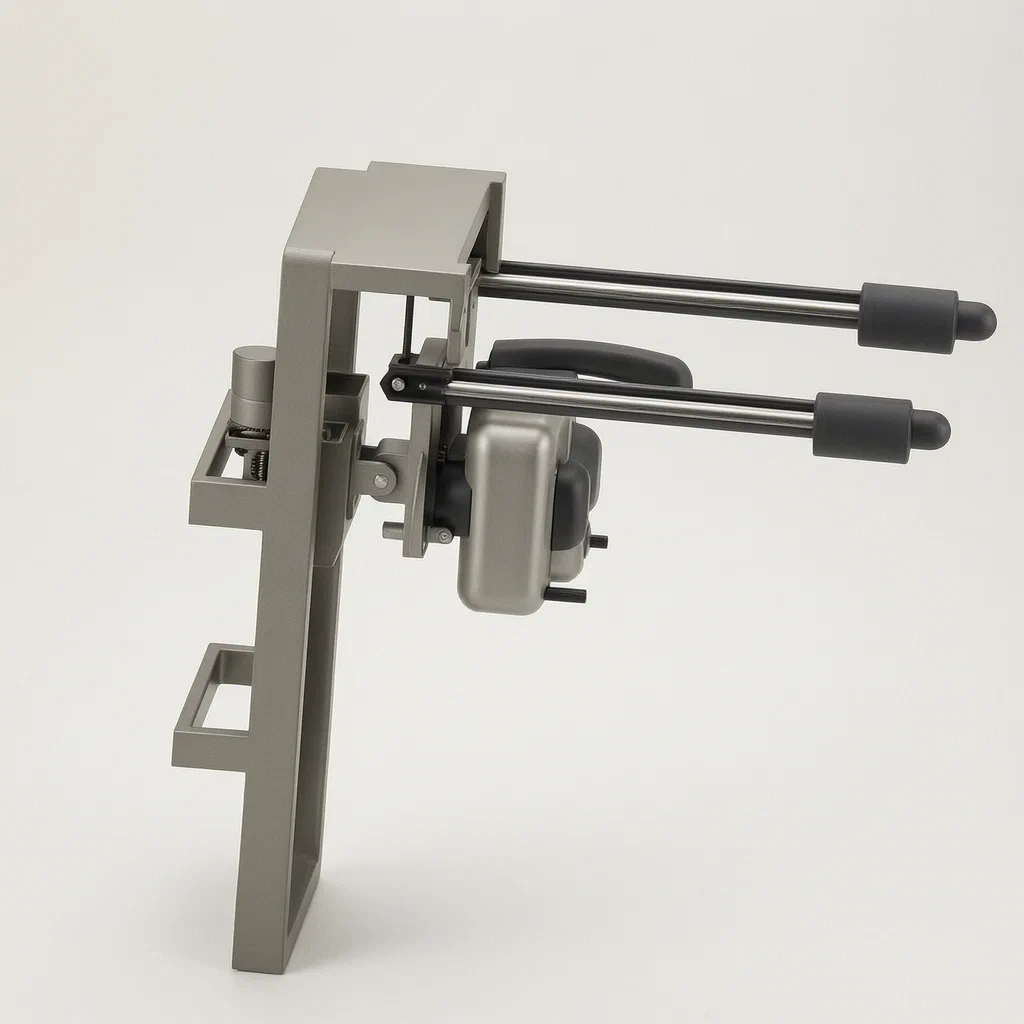
Floor-standing massage chairs take up space even when not in use. This design mounts the entire mechanism on a wall bracket and adds an armrest that folds away by itself. A lifting drive mechanism raises and lowers the connecting frame and massage heads along a vertical chute. At the top of the travel, a fixed insertion bar trips a wedge-shaped plug piece, unlocking the armrest from its working position. As the frame keeps rising, an abutting part on the bracket pushes the armrest flat against the frame, overcoming the torsion spring that normally holds it open. To use the device again, lowering the frame reverses the sequence: the torsion spring swings the armrest back out, and the reset spring drives the plug piece into matching holes to lock it. A control module and a position detection module, such as laser ranging, track the frame's height to coordinate the lift, the massage mechanism, and the pivot motor that tilts the second connecting frame.
- China invention patent - in force
- No filings outside China
- Massage & wellness hardware
- Motorized lift, auto-folding armrest, wall-mounted
Splat! What let you down?
🧱
Wall-mounted chassis
The support bracket hangs on a wall with a vertical chute, keeping the floor clear.
⬆️
Motorized vertical lift
A driving motor, gear assembly, and pulleys raise and lower the massage frame.
🔄
Auto-folding armrest
An insertion bar releases the lock and an abutting part folds the armrest at the top of travel.
📡
Position detection
A detection module tracks the frame height so the control module coordinates all motors.
Bring this product to market
- ✓ Patent vetted China-only family and legal status checked
- 2 Product brief · now How it works, uses and options written up
- 3 Prototype First samples for buyers to review
- 4 Pilot run Small first batch for launch customers
- 5 Volume production Repeat orders at scale
Buyer interest
– of 100 buyers needed to start prototyping
One click, no sign-up. Each vote is one real visitor, and products with the most interest go to prototyping first.
Build team: no members yet. Need a partner, co-funding or skills to build this? Join and we introduce the team once it forms.
The problem
Freestanding massage chairs occupy a large footprint, which limits placement options in small rooms, apartments, or commercial spaces where floor area is needed for other uses. Moving them for cleaning is difficult because of their weight. According to the patent, mounting the massage components on a wall bracket removes the base from the floor entirely. However, a wall-mounted unit still needs side supports for the user’s arms during a session, and leaving those armrests extended when the machine is parked at the top of the wall makes the stored profile bulky and prone to bumping. Manually folding them each time adds steps the user may skip.
The solution
According to the patent, this wall-mounted massager solves the storage problem by linking the armrest lock to the vertical travel of the lifting frame.
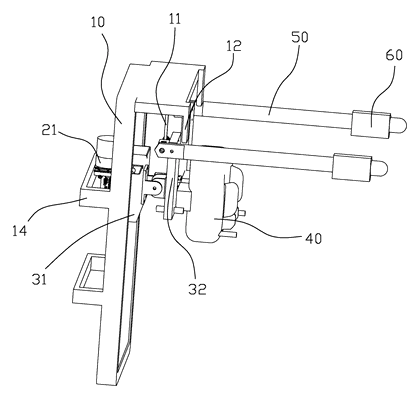
- A wall-hanging bracket (10) is fixed to a wall and carries a vertical chute (13).
- A lifting drive mechanism, consisting of a driving motor (21), a gear transmission assembly, and pulleys (22), moves a connecting frame up and down inside the chute.
- The connecting frame has a first connecting frame (31) driven by the lift and a second connecting frame (32) pivoted to it by a driving motor (33) acting on a pivot shaft (34) to tilt the massage mechanism (40).
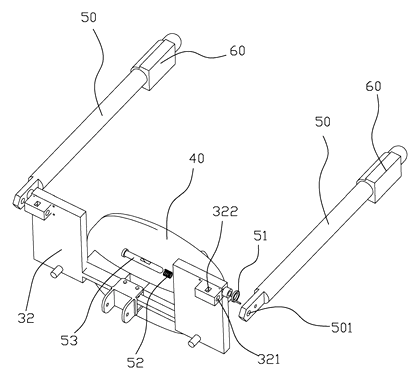
- An armrest (50) is pivoted to the second connecting frame. A torsion spring (51) acts as a first resetting piece to hold it in the unfolded, parallel working state.
- A plug piece (53) driven by a reset spring (52) passes through a first jack (321) on the frame and a second jack (501) on the armrest to lock it.
- At the top of the bracket, an insertion bar (11) enters a relief hole (322) and presses a wedge surface (532) on the plug piece, pulling it out of the jacks. Continued upward movement lets an abutting part push the armrest closed against the torsion spring.
Who it is for
- Wellness equipment brands seeking a space-saving massage unit for urban retail catalogs.
- Amazon sellers and e-commerce operators looking for home relaxation products that mount on a load-bearing wall instead of taking up floor space.
- Day spas and massage studios that need an extra massage station in shared rooms without dedicating permanent floor space.
- Hotel and serviced-apartment buyers wanting to offer in-room massage amenities that tuck away when guests are not using them.
How it works
The main parts
| No. | Part | What it does |
|---|---|---|
| 10 | Wall-hanging bracket | Mounts to the wall; holds the chute and top trigger parts. |
| 13 | Chute | Vertical guide slot for the pulleys. |
| 21 | Driving motor | Powers the lifting mechanism through a gear assembly. |
| 22 | Pulleys | Ride in the chute to carry the frame up and down. |
| 31 | First connecting frame | Driven directly by the lift mechanism. |
| 32 | Second connecting frame | Pivots on the first frame; carries the massage mechanism. |
| 33 | Driving motor | Tilts the second frame via the pivot shaft. |
| 34 | Pivot shaft | Connects the two frames for angle adjustment. |
| 40 | Massage mechanism | The rollers or nodes that contact the user. |
| 50 | Armrest | Pivots on the second frame for user support. |
| 51 | Torsion spring | First resetting piece; biases the armrest toward the unfolded state. |
| 52 | Reset spring | Second resetting piece; pushes the plug piece into the locking jacks. |
| 53 | Plug piece | Bolt-like lock with a wedge surface; secures the armrest. |
| 321, 501 | First and second jacks | Holes in the frame and armrest aligned when unfolded. |
| 11 | Insertion bar | Driving part at the top of the bracket that trips the wedge. |
| 60 | Control module | Coordinates the lift, tilt, and massage motors based on sensor input. |
Operating steps
- Unfolding for use: When the frame lowers from storage, the insertion bar clears the plug piece. The reset spring pushes the plug piece through both jacks, locking the armrest open. The torsion spring assists in swinging it to the parallel position.
- Adjusting height and angle: The control module receives signals from the position detection module. It runs the driving motor to place the frame at the desired height and operates the pivot motor to tilt the second connecting frame.
- Folding for storage: The lifting motor raises the frame. Near the top, the insertion bar slides into the relief hole and contacts the wedge surface of the plug piece, converting vertical motion into horizontal withdrawal of the plug from the jacks.
- Automatic stowage: With the lock released, the abutting part on the bracket presses against the armrest. The armrest pivots inward, compressing the torsion spring, until the frame parks flush against the wall.
Applications
Compact home gyms and apartments
Residents who lack room for a freestanding chair can mount this unit on a load-bearing wall. According to the patent, the automatic folding sequence means the armrest tucks away without manual effort after each session, keeping the walkway clear.
Day spas and massage studios
Studio owners can install the unit in rooms that also serve other services. The patent describes a position detection module, such as laser ranging, allowing the control module to locate the user precisely before starting the massage mechanism.
Hotel guest rooms and suites
Hospitality buyers can offer a premium amenity that does not clutter the room layout. Housekeeping staff simply raise the frame to the top position, where the mechanical trigger folds the armrest automatically.
Corporate wellness lounges
Offices setting up relaxation zones benefit from the reduced footprint. Multiple units can be placed along a single wall, each parking neatly when employees return to their desks.
Where it is less suitable
- Outdoor or wet environments - the electrical motors and exposed chute require dry, indoor installation.
- Walls unable to bear dynamic loads - the bracket must be anchored to structural framing capable of supporting the moving weight; hollow partitions without reinforcement are unsuitable.
- Users requiring full-body horizontal tables - this design provides seated or reclined back massage with armrests, not a flat table format.
Frequently asked questions
How does the armrest fold by itself?
According to the patent, when the lifting motor raises the frame near the top of the wall bracket, a fixed insertion bar presses against a wedge surface on a plug piece. This pulls the plug out of the holes that lock the armrest open. As the frame continues upward, an abutting part on the bracket physically pushes the armrest inward, compressing the torsion spring until it lies flat.
What powers the up-and-down movement?
A driving motor turns a gear transmission assembly connected to pulleys. These pulleys ride inside a vertical chute formed in the wall-hanging bracket, carrying the entire connecting frame and massage mechanism smoothly up and down.
How does the machine know where to stop?
The patent describes a position detection module mounted on the connecting frame, which can be a laser ranging sensor. It continuously measures the frame’s height and sends this data to a control module that manages the lifting motor, the pivot motor, and the massage mechanism.
Can the massage angle be adjusted?
Yes. The connecting frame is split into a first frame attached to the lift and a second frame that carries the massage heads. A separate driving motor rotates a pivot shaft between them, allowing the second frame to tilt forward or backward to change the contact angle.
What kind of wall is needed for installation?
The patent mentions fixing the bracket to a wall using methods such as fixing nails, but does not specify load ratings. In practice, the wall must support the static weight of the unit plus the dynamic forces of a user leaning on the armrests. Solid wood studs, concrete, or reinforced masonry are typical requirements to be confirmed in design.
Does it hold the armrest securely during use?
When the frame is lowered below the top trigger zone, a reset spring pushes a plug piece through aligned holes in the connecting frame and the armrest. Combined with the outward force of the torsion spring, this mechanical lock keeps the armrest rigidly in the unfolded position.
Can this design be made and sold in the US?
This patent was filed only in China and is currently in force there. It has no US counterpart, so it does not restrict manufacturing or sales in the United States. However, the massage equipment field contains many other active patents. We recommend a freedom-to-operate review before volume production. See Patent & Production for details.
Are you affiliated with the patent owner?
No. IP2M is an independent design and manufacturing service working from the public patent document.
Request a quote
Click Request a Quote below to see our email address - copy it, or open your email app with a ready-made message. Please mention patent CN108514507B in the subject.
Helpful details to include:
- Your company and channel (wellness brand, Amazon seller, spa supplier, hospitality buyer)
- Target dimensions and user weight capacity
- Massage mechanism preferences (roller type, heating)
- Electrical specs (voltage, plug type for the destination market)
- Upholstery material and color choices
- Estimated quantity and target price
- Certification needs (UL, FCC, etc.)
- Timeline - when you would like prototypes and the first shipment
You can also reach us at (332) 203-9997.
Explore this product
Interested in building this?
Tell us your target market, quantity and timeline. We reply with options for prototyping, small-batch runs or volume production.
Send your inquiry to
Please put CN108514507B in the subject line and tell us your company, country, estimated quantity and timeline.
Prefer to talk? Call (332) 203-9997.
More product-ready patents
All Health & Wellness patents →
Health & Wellness
Wrist-Mounted Umbrella Stabilizer
Wrist-worn umbrella holder with an anti-shake link; the patent designs it for people with tremor.
Patent CN212545964U
Health & Wellness
Spring-Valve Breath Trainer for Singers
Pocket breath trainer: blow against a spring-loaded valve to practice breath support for singing.
Patent CN207833725U
Health & Wellness
Closed-Loop Nasal Rinse Kit with Collection Bottle
Nasal rinse set: syringe-fed nose plug inside a sealed hood, with used solution drawn into a bottle.
Patent CN208017763U
Health & Wellness
Inflatable Cervical Traction Collar Shaped for a Child's Neck
Child-size three-ring air collar on telescoping shoulder struts, inflated with a hand bulb.
Patent CN208958444U
Massage & Wellness
Pneumatic Multi-Directional Neck Traction Collar
Three-airbag cervical collar that inflates in sequence to guide the head in multiple directions.
Patent CN207202980U
Health & Wellness
Shoulder-Detecting Massage Chair Mechanism with Forked Swing Arms
Massage chair core uses forked swing arms and sensors to detect shoulders and adjust the routine.
Patent CN106618998B
Browse by category
- Apparel & Accessories (22)
- Baby & Kids (16)
- Bags & Luggage (9)
- Bath & Personal Care (16)
- Car Accessories (10)
- Furniture, Bedding & Storage (12)
- Garden & Outdoor (18)
- Health & Wellness (8)
- Home, Kitchen & Cleaning (24)
- Lighting (12)
- Packaging & Containers (6)
- Pet Products (6)
- Phone & Camera Accessories (4)
- Retail Display (13)
- School, Office & Art (19)
- Sports & Recreation (25)
- Tools & Workshop (27)
- Toys & Games (12)
This page is based on the public patent document CN108514507B, assigned to Xiamen Comfort Science and Technology Group Co Ltd. IP2M is an independent manufacturing service and is not affiliated with, endorsed by or licensed by the patent owner. Images marked as concept renderings are illustrations, not photos of an existing product. Patent status information is provided for reference only and is not legal advice; confirm freedom to operate for your market before production. Full disclaimer.