
Patent CN108851454B
Updated November 5, 2026Intelligent Backpack with Motorized Strap Fastening and Anti-Theft Compartment
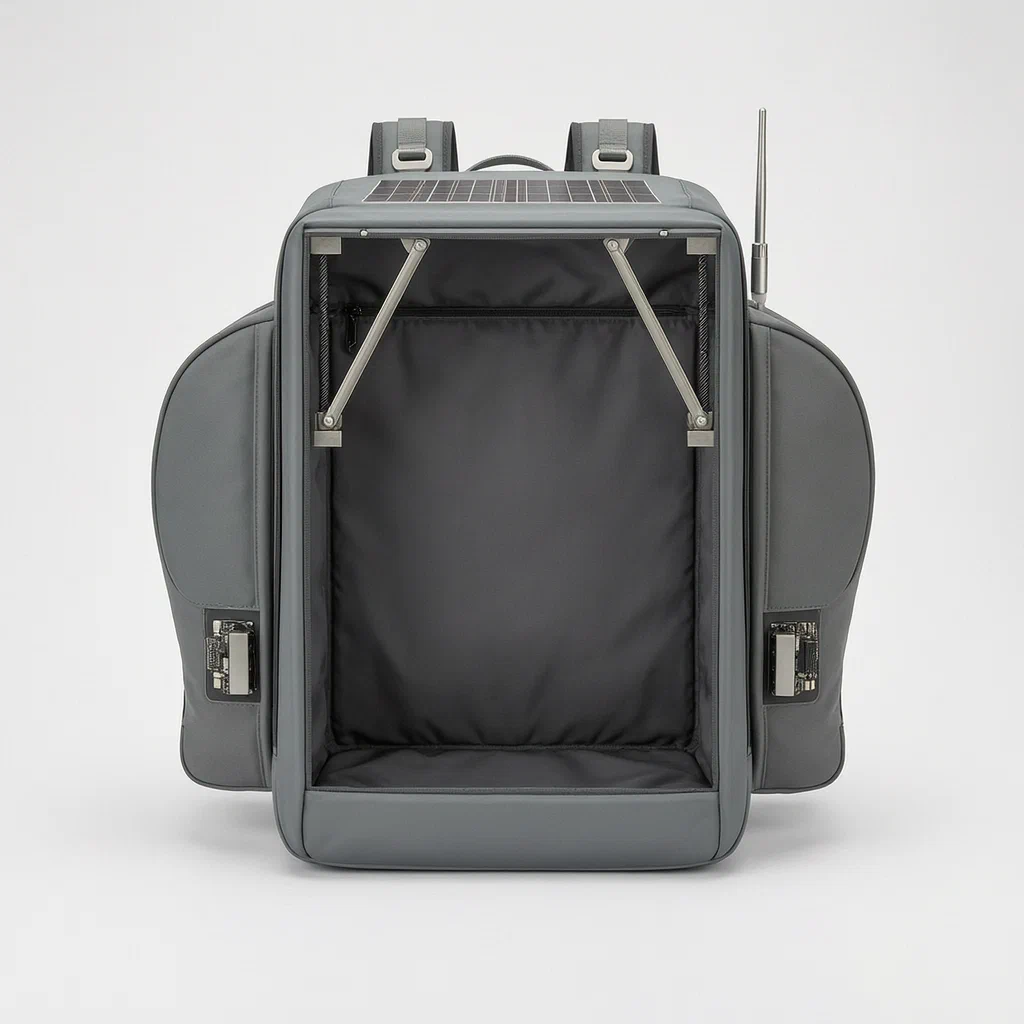
Standard backpacks rely on zippers and buckles that can be picked or undone accidentally. This patent describes a system where the storage compartment is physically sealed by motor-driven plates, and the shoulder straps are locked into the body by retractable pins controlled by a central processor. A solar panel adjusts its angle automatically to charge the internal systems, while an antenna allows users to trigger these safety features remotely.
- China invention patent - in force
- No filings outside China
- Smart luggage & bags
- PLC control, motorized locks, solar adjustment
Splat! What let you down?
🔒
Motorized Sealing
A screw-driven mechanism closes internal plates to seal the storage chamber against picking.
🎒
Auto-Lock Straps
Shoulder straps lock into the body via ball-and-groove assemblies driven by motors.
☀️
Solar Adjustment
An external solar panel tilts automatically to maximize charging efficiency.
📱
Remote Control
Built-in antenna connects to mobile devices for remote operation of safety features.
Bring this product to market
- ✓ Patent review Patent family and legal status reviewed in the relevant jurisdictions.
- 2 Product brief · now How it works, uses and options written up
- 3 Prototype First samples for buyers to review
- 4 Pilot run Small first batch for launch customers
- 5 Volume production Repeat orders at scale
Buyer interest
– of 100 buyers needed to start prototyping
One click, no sign-up. Each vote is one real visitor, and products with the most interest go to prototyping first.
Build team: no members yet. Need a partner, co-funding or skills to build this? Join and we introduce the team once it forms.
Patent Rights & Team Participation
Before joining a development team, participants should ensure they have the necessary rights or authorization to participate in the project.
Participation is generally appropriate where:
- You own the relevant patent rights or have obtained permission or a license from the rights holder.
- The relevant patent rights have expired or have been legally invalidated in the jurisdictions where the planned activities will take place.
- The planned development, manufacturing, and commercialization activities have been independently assessed and do not infringe applicable patent rights in the relevant jurisdictions.
Important: Being located outside a country where a patent is protected does not automatically exempt you from patent infringement risks. Patent rights may apply based on where development, manufacturing, use, sale, or import activities take place.
IP2M does not grant any patent license or authorization through team participation. Joining a project does not provide permission to use, manufacture, or commercialize patented technology.
The problem
Traditional backpacks depend on zippers and plastic buckles for security and retention. Zippers can be opened from the outside with simple tools, leaving contents vulnerable to theft in crowded areas. Shoulder straps often use friction-based clips or manual buckles that can slip off during movement or if not fully engaged, causing the bag to drop unexpectedly. Furthermore, electronic accessories within bags require frequent charging, and standard designs lack integrated power generation or automated management systems. There is a need for a bag that physically prevents unauthorized access to the main compartment and ensures straps remain securely attached without user intervention.
The solution
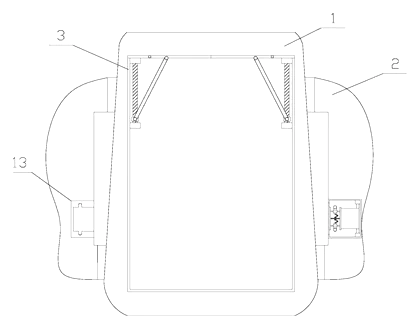
This patent describes an intelligent backpack managed by a Programmable Logic Controller (PLC). The solution integrates two primary mechanical systems: an anti-theft sealing mechanism for the storage chamber and a fastening mechanism for the shoulder straps.
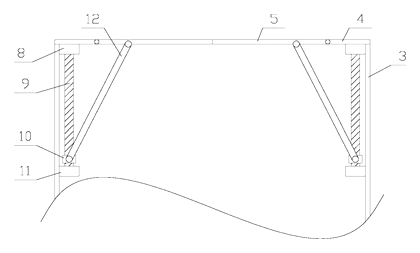
- Anti-Theft Mechanism: Inside the main body’s storage chamber, fixed plates are connected to turnover plates via hinges. A first motor drives a screw rod, which moves a sliding block. This motion pushes connecting rods that rotate the turnover plates inward. When activated, the plates support each other to physically block the opening of the storage chamber, preventing access through zipper manipulation.
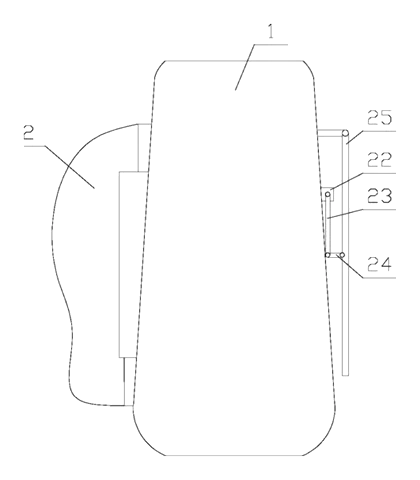
- Strap Fastening Mechanism: Each shoulder strap contains a fastening chamber and a connecting chamber. A sleeve inside the strap aligns with an opening in the backpack body. Two balls mounted on support rods fit into arc-shaped clamping grooves at the opening. A second motor controls a roller and connecting belt to adjust the length of the assembly, allowing insertion. Once inserted, a third motor extends telescopic rods to push the support rods outward, embedding the balls firmly into the grooves. Limiting rings guide the rods to ensure stable engagement.
- Power and Control: The main body includes a solar panel mounted on a supporting shaft. A fourth motor adjusts the panel’s angle via rotating and adjusting rods to face the sun directly, improving energy capture. An antenna within the body connects the PLC to mobile devices, allowing users to trigger the locking and unlocking sequences remotely.
Who it is for
- Tech-focused luggage brands looking to differentiate their product lines with active security features beyond passive locks.
- Commuters in high-theft urban environments who need a bag that cannot be easily opened by pickpockets using slim tools.
- Outdoor enthusiasts who benefit from the integrated solar charging capability for powering small electronics while hiking or traveling.
- Security-conscious professionals carrying sensitive documents or equipment who require a verified lock state before moving between locations.
How it works
The main parts
| No. | Part | What it does |
|---|---|---|
| 1 | Main Body | Houses the PLC, storage chamber, and control electronics. Made of nylon. |
| 2 | Straps | Contain the fastening chambers and connecting chambers for attachment. |
| 3 | Storage Chamber | The area protected by the turnover plate sealing mechanism. |
| 4, 5 | Fixed/Turnover Plates | Hinged plates that close together to seal the chamber when driven by the motor. |
| 8 | First Motor | Drives the screw rod to activate the anti-theft sealing plates. |
| 9, 10, 12 | Screw/Slider/Rod | Mechanical linkage converting motor rotation into linear plate movement. |
| 15 | Sleeve | Inserted into the main body opening; holds the locking balls. |
| 16 | Balls | Engage with clamping grooves to lock the strap to the body. |
| 17, 18, 28 | Support Rods/Plate | Push the balls into the grooves when extended by the telescopic unit. |
| 19 | Second Motor | Controls the roller and belt to adjust strap insertion depth/length. |
| 26 | Third Motor | Drives the telescopic rods to extend the locking balls. |
| 25 | Solar Panel | Adjustable panel for charging the system. |
| 22 | Fourth Motor | Adjusts the angle of the solar panel. |
Operating steps
- Sealing the Bag: To secure contents, the user triggers the PLC (via button or app). The First Motor rotates the Screw Rod. the Slider moves along the rod, pushing the Connecting Rods. This causes the Turnover Plates to rotate inward until they lean against each other, blocking the storage chamber entry.
- Locking the Straps: When attaching straps, the Second Motor adjusts the Belt to position the Sleeve correctly. The Third Motor activates the Telescopic Unit, extending the Support Rods. This pushes the Balls into the Arc-Shaped Clamping Grooves on the main body. Limiting Rings keep the rods aligned.
- Charging Management: The Fourth Motor periodically adjusts the Solar Panel’s angle to face the sun, optimizing energy collection for the motors and PLC.
- Release: Reversing the motor directions retracts the balls from the grooves and opens the turnover plates, allowing removal of straps and access to the bag.
Applications
Urban Commuting
In crowded subways or buses, the sealed compartment prevents pickpockets from unzipping the bag unnoticed. The auto-locking straps ensure the bag stays attached even if bumped heavily.
Outdoor Travel
Hikers and travelers benefit from the solar panel maintaining battery levels for GPS trackers or phones stored inside, reducing the need for separate power banks.
Student Campuses
Students carrying laptops and tablets gain peace of mind knowing the physical barrier prevents casual theft in libraries or cafeterias, while the app control offers convenience.
Corporate Security
Employees transporting confidential documents can verify the lock status remotely via the mobile app connection, ensuring chain-of-custody integrity during transit.
Where it is less suitable
- Ultra-lightweight minimalist packs - The addition of four motors, gears, and metal linkages adds significant weight compared to standard fabric-only backpacks.
- Extreme cold weather environments - Electronic components and lubricants in the screw mechanisms may fail or stiffen in sub-zero temperatures unless specifically rated.
- Low-cost commodity markets - The complexity of the PLC and motorized systems makes this design unsuitable for budget products competing on price alone.
Patent & Production
At a glance
| Patent number | CN108851454B (application CN201810669822) |
| Type | China invention patent (发明专利) - protects product shape, structure, and method |
| Original title | Intelligent backpack with good anti-theft effect and fastening strap function (一种具有紧固背带功能的防盗效果好的智能背包) |
| Patent owner | YIWU SPRING LUGGAGE Co.,Ltd. |
| Inventors | Cao Yanhong |
| Filing date | 2018-06-26 |
| Grant date | 2020-05-19 |
| Status (China) | In force - valid until at most 2038-06-26, provided annual fees are paid |
| Patent family | Public record shows Chinese filings only - no US, European, Japanese, PCT or other filings listed |
| Cited by | 0 later documents |
| Source | Google Patents (search for CN108851454B) |
What the claims cover, in plain language
Claim 1 defines an intelligent backpack comprising a main body, storage chamber, and two straps. It specifies a fastening mechanism in the straps and an anti-theft mechanism in the chamber, both controlled by a PLC. The anti-theft mechanism uses a first motor driving a screw rod and slider to move connecting rods, which rotate turnover plates to seal the chamber. The fastening mechanism involves a sleeve with balls on support rods that engage with clamping grooves in the main body. A second motor adjusts a belt for insertion, and a third motor extends telescopic rods to lock the balls.
Claim 2 details the hinge unit with a connecting shaft and collars. Claim 3 adds a bearing seat for the screw rod. Claim 4 specifies the third motor driving a rotating rod and telescopic rod for the support rods. Claim 5 introduces limiting units with rings and rods to guide the support rods. Claim 6 adds a charging mechanism with a solar panel on a supporting shaft. Claim 7 details the fourth motor adjusting the solar panel’s angle via adjusting rods. Claim 8 states the main body is made of nylon. Claim 9 includes an antenna connected to the PLC for remote control.
This is a simplified reading for orientation only. The legal scope is defined by the exact claim wording in the official Chinese document.
What this means for US production
This patent was filed in China and is currently in force there. Making or selling this specific design in China requires the owner’s permission. However, the public record shows no US counterpart or foreign family members. Therefore, this patent does not restrict making or selling this design in the United States based on this specific document.
Two points to settle early:
- Other patents may exist. Smart luggage and motorized locking mechanisms are competitive fields. While this specific combination of screw-driven sealing and ball-locking straps appears unique in this filing, broader concepts like “smart backpack,” “remote locking,” or “solar-charged bags” may be covered by other US patents. A freedom-to-operate (FTO) review is strongly recommended before tooling.
- Electronic Component Safety. Integrating multiple DC motors, a PLC, and lithium-ion batteries (implied by the solar charging context) into a wearable item raises significant electrical safety concerns regarding heat, short circuits, and battery stability under impact.
Customization and manufacturing
What can be customized
| Area | Options |
|---|---|
| Control System | PLC vs. Microcontroller (Arduino/ESP32); App connectivity (BLE/Wi-Fi) |
| Motors | Torque ratings, voltage (3.7V Li-ion vs. USB powered), noise dampening |
| Materials | Nylon variants (ballistic, ripstop), water-resistant coatings |
| Locking Geometry | Number of balls/grooves, screw pitch, plate thickness |
| Solar Integration | Panel size, flexibility, angle adjustment range |
| User Interface | Physical buttons, touch pads, voice command modules |
Things to plan for (US market)
- FCC Part 15 - If the device uses Bluetooth or Wi-Fi for the “mobile device connection” mentioned in Claim 9, it must comply with radio frequency emission limits.
- UL 2054 / UN 38.3 - Battery safety standards. Lithium-ion batteries in bags must meet transport and performance safety criteria.
- CPSC Guidelines - General consumer product safety rules apply to sharp edges, pinch points, and overheating risks from motors.
- RoHS - Restriction of Hazardous Substances for electronic components (lead-free solder, etc.).
How a project runs
- Inquiry - Define target capacity, electronic specs, and quantity.
- Design - CAD modeling of gear trains, motor mounts, and PCB layout.
- Prototype - 3D-printed housings, functional motor tests, code integration.
- Pilot Run - Stress testing locking mechanisms, thermal monitoring, waterproofing checks.
- Production - Injection molding for hard parts, sewing for soft goods, final assembly and QC.
Quantities & timeline
Complexity lies in the synchronization of four motors and the precision required for the ball-and-groove locking. Tooling for custom gear sets and motor mounts will take longer than standard bag hardware. Electronics sourcing and FCC certification add lead time. Send us your technical requirements, quantity estimates, and target launch date and we will reply with options.
Production notes
Tooling and process
The structural frame likely relies on aluminum extrusion for rigidity around the motor mounts, combined with glass-filled nylon injection molding for the durable locking sleeves and gears. Soft goods like the main body and straps involve sewing with reinforced stitching patterns. Motor assembly requires precise alignment of shafts to bearings to minimize wear.
Cost drivers
High costs typically stem from the number of molds needed for the intricate internal locking components and the impact grade material required to protect electronics from daily drops. Weight is also a driver, as heavier gauge materials and motors increase shipping costs. Fastener count is elevated due to securing motors and plates internally.
Prototyping path
We would typically start with 3D-printed parts to validate the geometry of the turnover plates and ball engagements. Use a machined frame for initial motor torque testing. Create a functional sample integrating the PLC and sensors before moving to tooling. Conduct impact test samples to verify housing durability.
What we would change before tooling
We would simplify the hinge unit to reduce part count and potential failure points. The solar panel adjustment mechanism might be replaced with a fixed tilt or manual fold to save cost and weight, unless automated tracking is a key selling point. We would also integrate the battery pack more centrally to improve balance.
Common failure points
Primary risks include shaft and bearing alignment issues causing motor burnout, and motor mount cracking under repeated vibration. Battery compartment security is critical to prevent shifting that could damage wiring. Strap or buckle failure may occur if the ball engagement wears down over time. UV degradation of the nylon exterior could weaken the fabric holding the heavy mechanisms.
Patent drawings
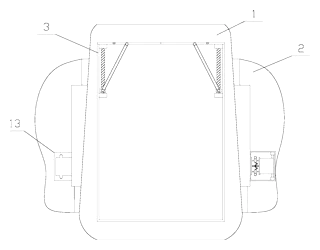
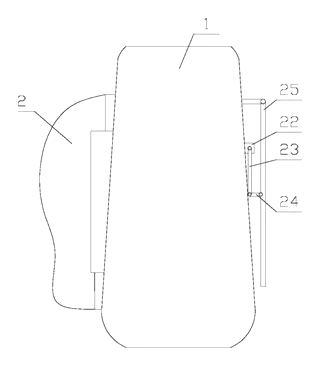
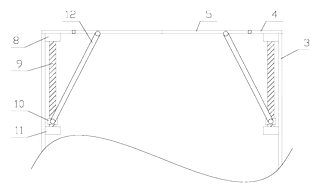
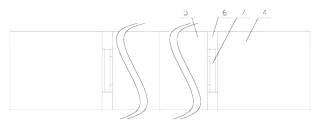
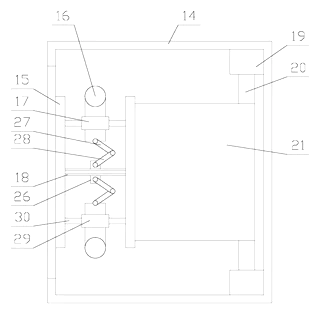
Drawings reproduced from the public patent document for reference.
Frequently asked questions
How does the anti-theft feature actually work?
Unlike a standard zipper, this design uses internal mechanical plates. When you lock the bag, a motor drives a screw mechanism that swings two hinged plates together inside the storage chamber. These plates physically block the opening, so even if someone manipulates the zipper, they cannot reach the contents because the chamber is sealed from the inside.
Can the straps fall off accidentally?
No. The straps are locked into the main body using a ball-and-groove system. Motors extend pins that push steel balls into recesses on the backpack frame. This creates a positive mechanical lock. The straps cannot detach unless the motor reverses the action, which is controlled by the user via the button or app.
Does it have a battery?
Yes. The patent describes a charging mechanism involving a solar panel and motors, implying an internal power source. While the specific battery chemistry isn’t detailed in the claims, such systems typically use rechargeable lithium-ion cells to power the PLC and motors. The solar panel helps maintain charge levels during outdoor use.
Is there an app?
The patent mentions an antenna connected to the PLC that allows control via a mobile device. This suggests the backpack can connect to a smartphone (likely via Bluetooth or similar protocol) to let users check the lock status or trigger the unlocking sequence remotely.
How heavy is it?
The patent does not specify a total weight. Because it contains four electric motors, gears, metal linkages, and electronics, it will be significantly heavier than a standard empty backpack. Final weight depends on the capacity chosen and the density of the materials used in the casing.
What happens if the battery dies?
If the power fails, the mechanical locks may remain in their current position. Some designs include a manual override or emergency release, but the patent focuses on the automated motorized system. Users should ensure regular charging, especially given the solar assistance feature described.
Can this design be made and sold in the US?
The patent was filed in China and is in force there. The public record shows no US counterpart or family member. Therefore, this specific patent does not restrict making or selling this design in the US. However, smart luggage is a complex field; we recommend a freedom-to-operate (FTO) review to check for other US patents covering general smart bag concepts or specific electronic implementations.
Are you affiliated with the patent owner?
No. IP2M is an independent design and manufacturing service working from the public patent document.
Request a quote
Click Request a Quote below to see our email address - copy it, or open your email app with a ready-made message. Please mention patent CN108851454B in the subject.
Helpful details to include:
- Your company and channel (tech brand, luggage retailer, security firm)
- Target capacity (liters) and dimensions
- Electronic preferences (battery type, app platform iOS/Android)
- Material choices (water resistance level, fabric type)
- Estimated quantity and target price
- Timeline - when you would like prototypes and mass production
You can also reach us at (332) 203-9997.
Page editor: Emily Zhang, Product Editor · IP2M
Last updated November 5, 2026. If something on this page looks wrong, email [email protected] and we will check it against the patent.
Interested in building this?
Tell us your target market, quantity and timeline. We reply with options for prototyping, small-batch runs or volume production.
Send your inquiry to
Please put CN108851454B in the subject line and tell us your company, country, estimated quantity and timeline.
Prefer to talk? Call (332) 203-9997.
More product-ready patents
All Sports & Recreation patents →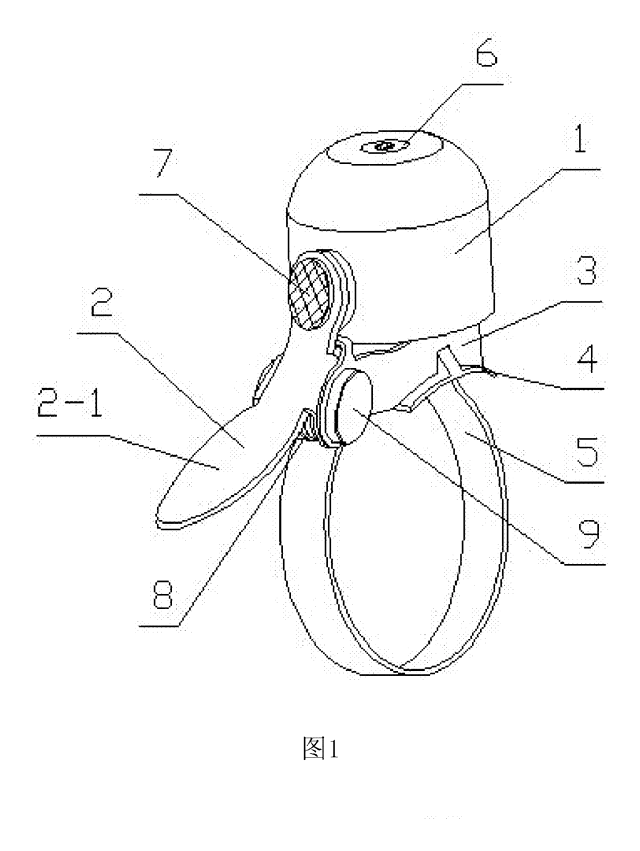
Sports & Recreation
Compact Torsion-Spring Bike Bell
Mini bike bell with a standard torsion spring and a rubber-floated dome - small size, clear tone, quick strap mount.
Patent CN205819384U
Sports & Recreation
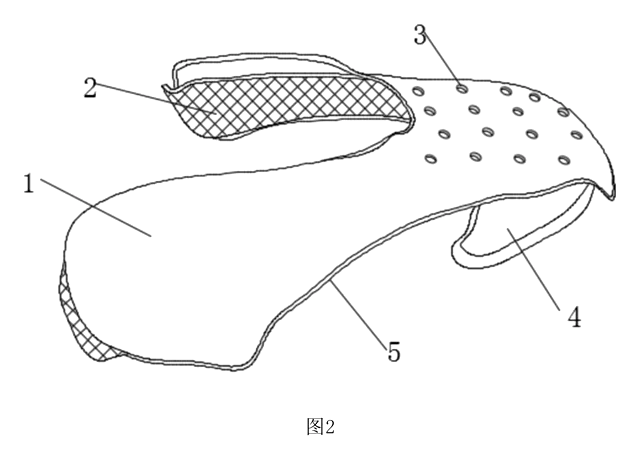
Padded Toe-Box Shield for Sneakers
Ventilated, silicone-lined toe-box insert that supports the front of a sneaker and cushions the toes.
Patent CN209473731U
Sports & Recreation
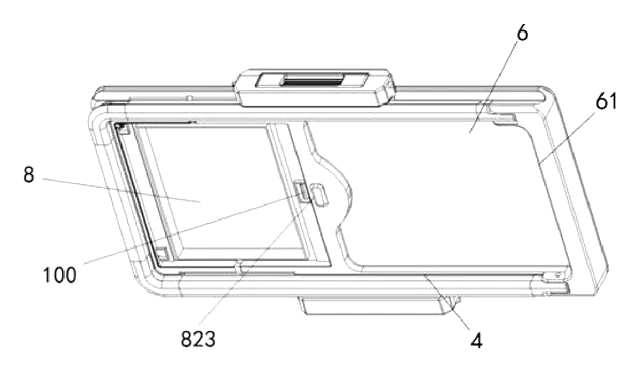
Reversible Fishing Seat-Box Lid with Backrest
Fishing seat-box lid that flips on removable hinge pins: cushion, backrest and storage on one face.
Patent CN208624426U
Sports & Recreation
Swivel-Pin Skateboard Truck with Rubber Sleeve
Skateboard truck with a turning center pin, a tilting axle clamp and a rubber sleeve that centers it.
Patent CN216777880U
Sports & Recreation
Full-Face Bike Helmet with Magnetic Detachable Chin Bar
Full-face cycling helmet whose chin bar clips on and off with magnetic, latching side connectors.
Patent CN206630067U
Sports & Recreation
Bike Phone Holder with Built-In Flashlight Clamp
Handlebar mount with a phone cradle on top and a flashlight clamp below, on one arm.
Patent CN206077485U
Browse by category
- Apparel & Accessories (41)
- Baby & Kids (26)
- Bags & Luggage (15)
- Bath & Personal Care (27)
- Car Accessories (22)
- Furniture, Bedding & Storage (21)
- Garden & Outdoor (29)
- Health & Wellness (12)
- Home, Kitchen & Cleaning (44)
- Lighting (21)
- Packaging & Containers (11)
- Pet Products (10)
- Phone & Camera Accessories (8)
- Retail Display (22)
- School, Office & Art (31)
- Sports & Recreation (40)
- Tools & Workshop (49)
- Toys & Games (20)
This page is based on the public patent document CN108851454B, assigned to YIWU SPRING LUGGAGE Co.,Ltd.. IP2M is an independent manufacturing service and is not affiliated with, endorsed by or licensed by the patent owner. Images marked as concept renderings are illustrations, not photos of an existing product. Patent status information is provided for reference only and is not legal advice; confirm freedom to operate for your market before production. Full disclaimer.