At a glance
| Patent number | CN108851491B (application CN201810822903) |
| Type | China invention patent (发明专利) - protects technical solutions relating to a product or process |
| Original title | Integral cup for brushing teeth with rapidly dewatering toothbrush hair in large quantity after use (一种牙刷使用后刷毛可迅速大量脱水的刷牙一体杯) |
| Patent owner | Ruian Kelai Electronic Co ltd |
| Inventors | Zhang Libin |
| Filing date | 2018-07-25 |
| Grant date | 2019-12-10 |
| Status (China) | Lapsed - terminated for non-payment of annual fees (recorded 2023-08-04) |
| Patent family | Chinese filings only - CN108851491B |
| Cited by | 2 later documents |
| Source | Google Patents (search for CN108851491B) |
What the claims cover, in plain language
Claim 1 - An integral cup for brushing teeth comprising a brush cup body (1), a toothbrush (2), a drinking cup region (3), and a cup (4). It utilizes a brush holder clamping mechanism, a bristle poking mechanism, and a ventilation placing structure so that moisture in the bristles can be separated during the normal toothbrush placing process.
Claim 2 - The dewatering room (6) contains a large plastic bottom plate (701) shaped as an arc matching the brush cup body. Two long connecting plastic strips (702) are fixed at front and back positions. Two clamping arm columns (703) are adhered to the right side, featuring smooth arc surfaces (704) on their top and right sides. A clamping roller (705) is connected to the columns, carrying ten anti-skid rubber strips (706) on its outer surface. A tensile plate (707) is movably provided behind the clamping roller.
Claim 3 - The clamping arm columns have a penetrating groove (12). The clamping roller has a clamping groove (13) communicating with the penetrating groove. The tensile plate extends into the penetrating groove and ends in a limiting plate (14) situated inside the clamping groove. The limiting plate is wider than the penetrating groove so it can only move within the clamping groove. A backrest plate (15) is fixed at the bottom of the dewatering room between the roller and the tensile plate, featuring a pushing convex point (16) facing the clamping roller.
Claim 4 - An elastic rubber band (17) is fixed to the top of a plastic supporting sheet (8), and a replaceable imitation deer-skin water-absorbing towel (18) is movably sleeved over the supporting sheet.
This is a simplified reading for orientation only. The legal scope is defined by the exact claim wording in the official Chinese document.
What this means for US production
This patent was filed only in China and is lapsed (terminated for non-payment of annual fees recorded on 2023-08-04), so it no longer restricts anyone in China either. It has no US or other foreign counterpart.
Two points to settle early:
- Other patents may exist. Bathroom organizers, toothbrush holders, and mechanical drying devices for personal care items are active areas of patent filing in the US. A freedom-to-operate (FTO) review focusing on the specific combination of clamping rollers, poking mechanisms, and absorbent towel integration is recommended before committing to injection molds.
- Material safety for oral contact. Because the toothbrush bristles physically touch the internal plastic plates, rubber strips, and the imitation deer-skin towel, all materials in the dewatering room must be evaluated for oral care safety and chemical migration.
Customization and manufacturing
What can be customized
| Area | Options |
|---|---|
| Housing color and finish | Solid colors, matte or gloss plastics, custom brand Pantone matches |
| Internal plastics | ABS, PP, or Tritan for the bottom plate, connecting strips, and arm columns |
| Rubber strips | TPE or silicone instead of rubber for the ten anti-skid strips on the roller |
| Absorbing towel | Different microfiber or PVA materials replacing the imitation deer-skin towel |
| Cup capacity | Volume of the drinking cup region to be confirmed in design |
| Packaging | Blister packs, printed boxes, or bulk trays for wholesale |
Things to plan for (US market)
- FDA 21 CFR - Components that routinely contact the toothbrush bristles (which go into the mouth) may be evaluated under food-contact or oral-device material guidelines depending on the buyer’s classification.
- California Proposition 65 - Plastics, rubber strips, and dyes must be screened for listed chemicals if sold in California.
- CPSC / CPSIA - If the product is marketed for children under 12, it must meet lead and phthalate limits and carry tracking labels.
- ASTM D6866 - If marketing the plastic parts as bio-based, testing is required to verify the claim.
How a project runs
- Inquiry - Target audience, material preferences, towel type, and estimated quantities.
- Design - 3D modeling of the brush cup body, dewatering room clearances, roller diameter, and groove widths based on the chosen toothbrush handle size.
- Prototype - 3D-printed or CNC-machined samples to test the interaction between the clamping roller, tensile plate, limiting plate, and pushing convex point.
- Pilot run - Injection molding of the plastic parts, assembly of the rubber strips and towel, and functional testing of the dewatering action.
- Production - Full-scale molding, pad printing, assembly, and packing.
Quantities & timeline
The brush cup body, large plastic bottom plate, clamping arm columns, and plastic supporting sheet require individual injection molds. The clamping roller needs a mold capable of holding the ten anti-skid rubber strips, which may be co-molded or assembled post-molding. The imitation deer-skin towel requires die-cutting tooling. Functional testing of the poking mechanism and ventilation structure takes place during the prototype phase. Send us your target materials, toothbrush handle dimensions, towel preference, quantity and target price and we will reply with options.
Patent drawings
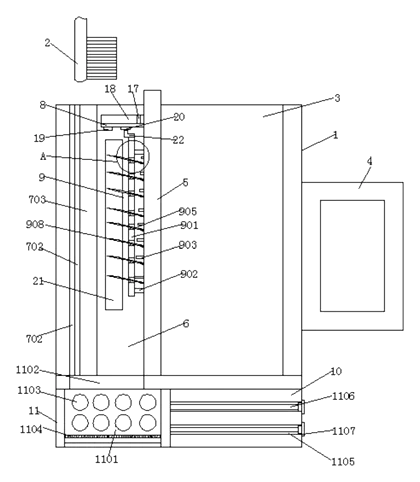
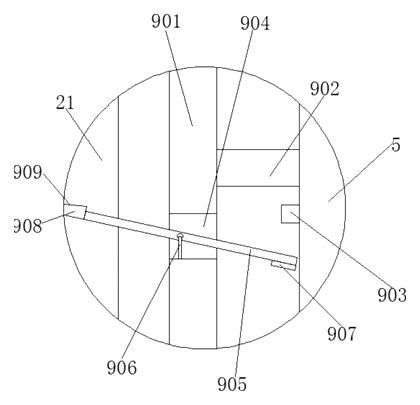
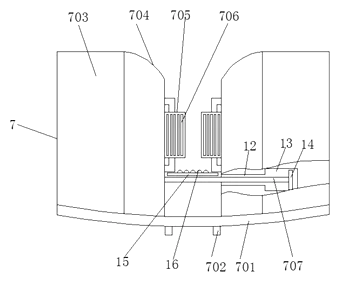
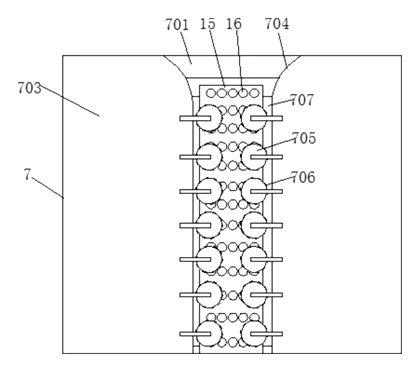
Drawings reproduced from the public patent document for reference.