
Patent CN108858291B
Updated November 3, 2026Back Lock Folding Knife with Safety Locking Function
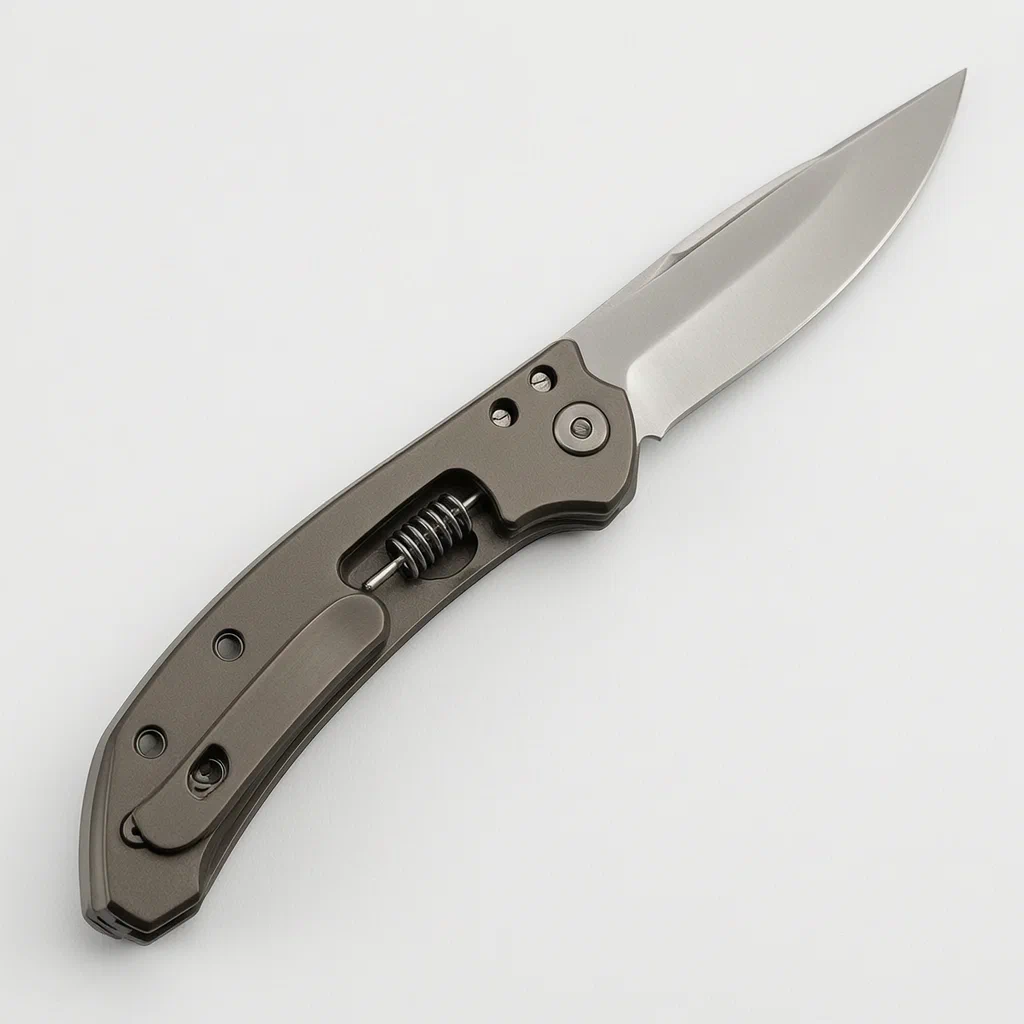
Standard back-lock knives rely on the friction of the spring arm against the blade tang to keep the blade open. If the lock fails or the user accidentally presses the release tab while gripping the spine, the blade can snap shut. This design adds a mechanical safety layer: a removable pin passes through the handle and the back spring's locking hook. Once inserted, it physically prevents the spring from moving, keeping the blade rigidly locked in the open position. The pin itself is never lost; it clips into a storage hole inside the handle when not engaged.
- China invention patent - active
- No filings outside China
- Safety pin for back-lock mechanism
- Integrated pin storage in handle
Splat! What let you down?
🔒
Mechanical Safety Lock
A pin passes through the handle and spring to physically block the back-lock mechanism.
📦
Pin Storage System
The safety pin clips into a dedicated hole in the handle when not in use, preventing loss.
⚙️
Spring Wire Retention
An internal spring wire holds the pin securely in both the lock and storage positions.
🛡️
Prevents Accidental Closure
Eliminates the risk of the blade snapping shut due to lock failure or accidental release.
Bring this product to market
- ✓ Patent vetted China-only family and legal status checked
- 2 Product brief · now How it works, uses and options written up
- 3 Prototype First samples for buyers to review
- 4 Pilot run Small first batch for launch customers
- 5 Volume production Repeat orders at scale
Buyer interest
– of 100 buyers needed to start prototyping
One click, no sign-up. Each vote is one real visitor, and products with the most interest go to prototyping first.
Build team: no members yet. Need a partner, co-funding or skills to build this? Join and we introduce the team once it forms.
The problem
In traditional back-lock folding knives, the blade is held open by a spring-loaded arm that engages with a notch in the blade tang. While effective for general use, this mechanism has inherent risks. If the lock face wears down, if debris interferes with the engagement, or if the user inadvertently presses the thumb stud or release tab while gripping the spine, the blade can suddenly close. For tasks requiring sustained pressure or precision cutting, unexpected closure poses a significant safety hazard to the user’s fingers. Additionally, many external safety accessories are bulky, easily lost, or require separate storage, making them impractical for everyday carry.
The solution
This patent describes a folding knife where the standard back-lock mechanism is augmented with a removable safety pin. The pin serves two functions: it acts as a physical barrier to stop the back spring from moving, thereby locking the blade open, and it features an integrated storage system within the handle so it is always available when needed.
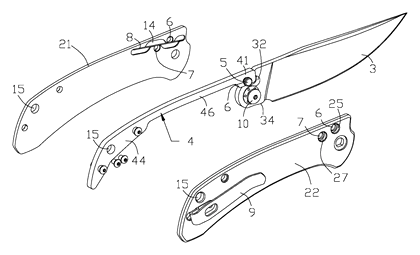
- Handle Assembly: Composed of two opposing flat handle parts connected to form a cavity.
- Blade and Spring: A rotatable blade sits between the handles, paired with a back spring that includes a locking hook.
- Aligned Holes: Pin holes are spaced through the back spring’s hook and the handle parts. A separate lock-pin placement hole is also provided in the handle.
- Internal Spring Wire: A spring wire is mounted inside the handle. It extends into both the pin holes and the storage hole.
- Clamping Mechanism: The safety pin has a clamping groove. The internal spring wire forms clamping portions that grip this groove, holding the pin firmly in place whether it is engaged in the lock position or stored in the handle.
Who it is for
- Outdoor and Survival Brands: Companies looking to differentiate their fixed-blade alternatives with a folding knife that offers secure lock-up.
- Professional Tool Manufacturers: Makers of utility knives for construction or carpentry where accidental closure could cause injury during heavy-duty tasks.
- High-End EDC (Everyday Carry) Brands: Niche manufacturers targeting users who prioritize maximum safety features over minimal weight.
- Military and Law Enforcement Suppliers: Agencies requiring fail-safe mechanisms for tactical folding knives used in critical situations.
How it works
The main parts
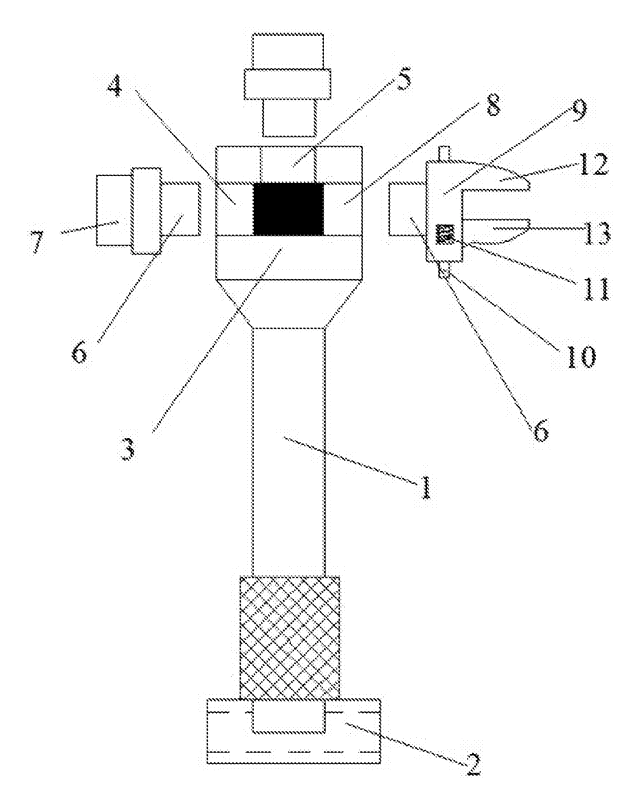
| No. | Part | What it does |
|---|---|---|
| 2 | Handle Parts | Two opposing plates forming the body; contain internal mounting grooves. |
| 3 | Knife Body | Rotatable blade with a locking groove and surface. |
| 4 | Back Spring | Includes a body, locking arm, and hook; moves to release/lock the blade. |
| 5 | Lock Pin | Removable cylindrical pin with a clamping groove; inserts into holes to block motion. |
| 6 | Pin Holes | Aligned holes through the spring hook and handle for the safety pin. |
| 7 | Placement Hole | Dedicated hole in the handle for storing the pin when not in use. |
| 8 | Spring Wire | Internal wire that elastically deforms to clamp the pin’s groove in both positions. |
Operating Steps
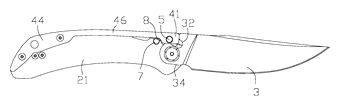
- Open the Blade: Rotate the knife body out of the handle. The back spring’s hook engages the blade’s locking groove.
- Engage Safety Lock: Insert the lock pin through the aligned pin holes in the handle and the back spring’s hook. The internal spring wire clamps the pin’s groove, holding it in place.
- Locked State: With the pin inserted, the back spring cannot move. The blade is mechanically prevented from closing, regardless of pressure on the release tab.
- Release Safety: Pull the lock pin out. The spring wire releases its grip.
- Store the Pin: Insert the pin into the lock-pin placement hole in the handle. The spring wire clamps it here, keeping it attached to the knife.
- Close the Blade: Press the back spring’s release tab to disengage the hook from the blade and fold the knife closed.
Applications
Heavy-Duty Cutting Tasks
When using a folding knife for batoning wood or prying materials, lateral forces can stress the lock. The safety pin ensures the blade remains rigidly open, protecting the user from sudden collapse.
Precision Work
For carving, whittling, or detailed craft work, consistent blade stability is crucial. The pin eliminates micro-movements or potential slip-offs caused by wear on the standard back-lock surfaces.
Child-Safe Handling
Parents or educators teaching knife skills can insert the pin to create a “training mode” where the blade cannot accidentally close, reducing pinch hazards while learning proper grip and angle.
Maintenance and Cleaning
During deep cleaning or lubrication of the pivot and lock area, the pin can be removed and stored directly in the handle, ensuring the small part is not misplaced among tools or rags.
Where it is less suitable
- Ultra-Minimalist EDC: Users seeking the lightest possible pocket knife may find the added metal pin and internal spring wire slightly heavier than standard designs.
- One-Handed Operation: Deploying and stowing the safety pin requires two hands, making it unsuitable for scenarios demanding immediate one-handed deployment.
- High-Vibration Environments: While the pin is clamped, extreme vibration might theoretically loosen the fit over time without additional thread-locking or retention features not specified in the patent.
Frequently asked questions
How does the safety pin actually work?
The pin is a solid rod that passes through pre-drilled holes in the handle and the back spring’s locking hook. Once inserted, it physically blocks the spring from moving. Since the blade stays open only because the spring is engaged, blocking the spring effectively freezes the blade in the open position, preventing any accidental closure.
Is the pin likely to get lost?
No. The design includes a dedicated “placement hole” inside the handle. When you pull the pin out to unlock the knife, you simply push it into this storage hole. An internal spring wire clamps onto a groove in the pin, holding it securely against the handle so it doesn’t fall out during normal carry.
Does it affect the knife’s balance?
The pin is small and made of metal, adding negligible weight. Because it is stored internally in the handle rather than externally on the spine, it does not significantly alter the center of gravity compared to a standard back-lock knife.
Can I use this knife for one-handed opening?
Yes, the blade opens manually like a standard folding knife. However, engaging or disengaging the safety pin typically requires two hands—one to hold the knife and one to insert/remove the pin. It is designed for tasks where you want to set up the tool and leave it locked open.
How durable is the internal spring wire?
The patent specifies a spring wire that elastically deforms within a mounting groove. In production, this would likely be made from stainless steel or high-carbon spring steel. Durability depends on the heat treatment and fatigue resistance of the specific alloy chosen during manufacturing.
Why not just use a liner lock?
Liner locks are prone to “blade stab” issues if the liner slips. This back-lock design is generally stronger against axial loads, and the added safety pin adds a mechanical stop that keeps the back spring from moving, which is useful for heavy-duty tasks where hand position near the spine is risky.
Can this design be made and sold in the US?
The patent is filed only in China and is currently in force there. It does not restrict sales in the US directly. However, folding knife mechanisms are heavily patented globally. You must conduct a freedom-to-operate search to ensure this specific pin-and-wire configuration does not infringe on existing US patents before mass production.
Are you affiliated with the patent owner?
No. IP2M is an independent design and manufacturing service working from the public patent document.
Request a quote
Click Request a Quote below to see our email address - copy it, or open your email app with a ready-made message. Please mention patent CN108858291B in the subject.
Helpful details to include:
- Your company and channel (outdoor brand, tool manufacturer, EDC distributor)
- Target dimensions (blade length, overall length)
- Materials (handle scale, blade steel, pin finish)
- Quantity and expected launch date
- Specific concerns regarding the internal spring wire mechanism
You can also reach us at (332) 203-9997.
Explore this product
Interested in building this?
Tell us your target market, quantity and timeline. We reply with options for prototyping, small-batch runs or volume production.
Send your inquiry to
Please put CN108858291B in the subject line and tell us your company, country, estimated quantity and timeline.
Prefer to talk? Call (332) 203-9997.
More product-ready patents
All Tools & Workshop patents →
Tools & Workshop
Rolling Tool Box with Telescoping Step Ladder
Telescoping A-frame ladder with an attached rolling tool box that slides to your working height.
Patent CN206290197U
Tools & Workshop
Folding 3-Handle Wrench Multi-Tool
Folding three-handle wrench multi-tool with magnetic screwdriver bits, saw, file and bottle opener.
Patent CN205290875U
Tools & Workshop
Rolling Auto-Repair Tool Cabinet with Built-In Lights
Lockable rolling tool cabinet for car repair with interior lights, a lubricant tray, parts drawers and a tool bay.
Patent CN205989314U
Tools & Workshop
Wide-Opening Folding Bolt Cutter
Bolt cutter with linked, gear-meshing handles that open up to 190° and fold in half for storage.
Patent CN207206226U
Tools & Workshop
Nail-Holding Hammer with Fold-Out Drivers
Hammer with a nail-holding T-slot in the head and fold-out drivers stored in the handle.
Patent CN205254927U
Tools & Workshop
Modular Wrench with Screw-On Heads
Wrench handle with a three-way threaded hub for screw-on adjustable and hex heads, plus a pipe sleeve.
Patent CN206216564U
Browse by category
- Apparel & Accessories (31)
- Baby & Kids (23)
- Bags & Luggage (13)
- Bath & Personal Care (22)
- Car Accessories (19)
- Furniture, Bedding & Storage (17)
- Garden & Outdoor (25)
- Health & Wellness (10)
- Home, Kitchen & Cleaning (36)
- Lighting (17)
- Packaging & Containers (9)
- Pet Products (8)
- Phone & Camera Accessories (6)
- Retail Display (18)
- School, Office & Art (25)
- Sports & Recreation (32)
- Tools & Workshop (41)
- Toys & Games (17)
This page is based on the public patent document CN108858291B, assigned to Individual. IP2M is an independent manufacturing service and is not affiliated with, endorsed by or licensed by the patent owner. Images marked as concept renderings are illustrations, not photos of an existing product. Patent status information is provided for reference only and is not legal advice; confirm freedom to operate for your market before production. Full disclaimer.