At a glance
| Patent number | CN108858291B (application CN201810778795) |
| Type | China invention patent (发明专利) - protects product structure and method |
| Original title | Back lock folding knife with safety locking function (具有保险锁定功能的背锁折刀) |
| Patent owner | Individual |
| Inventors | Liang Xiaoxuan |
| Filing date | 2018-07-16 |
| Grant date | 2023-10-20 |
| Status (China) | In force - valid until at most 2038-07-16 (if annual fees are paid) |
| Patent family | Chinese filings only - no US, European, Japanese, PCT or other filings listed |
| Cited by | 0 later documents |
| Source | Google Patents (search for CN108858291B) |
What the claims cover, in plain language
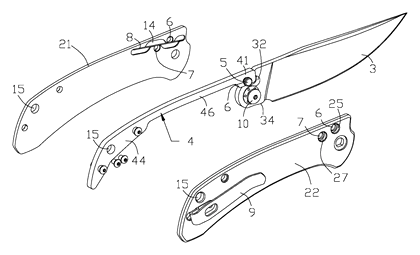
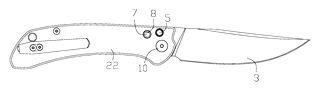
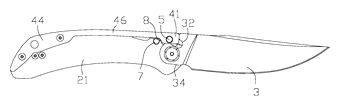
Claim 1 defines a back lock folding knife comprising two opposing handle parts, a knife body, and a back spring. Key features include:
- Aligned Holes: Pin holes penetrate the back spring and handle parts. A separate lock-pin placement hole penetrates the handle.
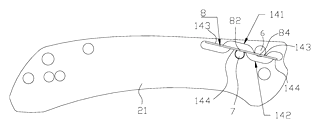
- Internal Retention: A spring wire is installed inside the handle, extending into both the pin holes and the placement hole.
- Clamping Action: The spring wire forms clamping portions that engage a groove on the removable lock pin. This holds the pin securely when inserted into the lock position (blocking the spring) or when stored in the placement hole.
- Mounting Structure: The handle contains a concave mounting groove with specific limiting parts (first and second walls) that secure the spring wire and allow elastic deformation.
Claims 2-6 specify details such as holes penetrating both handle sides, chamfered grooves and counterbores for smooth insertion, and the annular shape of the pin’s clamping groove. Claims 7-9 describe the back spring’s composition (body, arm, hook), the pin passing through the hook, and optional hanging holes.
This is a simplified reading for orientation only. The legal scope is defined by the exact claim wording in the official Chinese document.
What this means for US production
This patent was filed only in China and is currently in force. Making, selling, or importing products covered by these claims in China requires permission from the patent owner. There is no direct US patent counterpart.
Two points to settle early:
- Other patents may exist. Folding knife locking mechanisms are a dense field of intellectual property. Major manufacturers hold numerous US patents on various lock types (liner, frame, axis, compression). A freedom-to-operate (FTO) review is essential to ensure this specific “safety pin blocking the back spring” configuration does not infringe on existing US utility patents regarding secondary locks or pin-retention systems.
- Design nuances. The specific geometry of the internal spring wire and the handle’s limiting parts described in Claim 1 is complex to mold or machine. Replicating the exact clamping action without triggering prior art on simple push-button safeties requires careful engineering.
Customization and manufacturing
What can be customized
| Area | Options |
|---|---|
| Materials | Handle scales (G10, Micarta, Aluminum, Titanium); Blade steel (D2, S35VN, etc.); Pin material (Stainless, Brass) |
| Dimensions | Overall length, blade length, handle thickness |
| Finish | Stonewash, satin, black oxide, DLC coating |
| Lock Pin Design | Color-coded pins for visibility; textured grips for easier removal |
| Storage Hole | Position adjusted for balance or aesthetic preference |
| Spring Wire | Material gauge and temper for optimal retention force vs. ease of insertion |
Things to plan for (US market)
- State Laws: Check local regulations regarding folding knives, specifically those with “automatic” or assisted opening features (though this is manual, some states scrutinize lock-back designs).
- CPSC Guidelines: While not a toy, sharp objects must have appropriate warning labels regarding safe handling and lock engagement.
- Quality Control: The internal spring wire mechanism relies on precise tolerances. Molds for the handle interior must account for the elastic deformation space required by the wire.
How a project runs
- Inquiry - Define target dimensions, materials, and quantity.
- Engineering Review - Analyze the internal spring wire geometry for manufacturability (MIM vs. machining).
- Prototype - Create handle molds and test the pin retention force and durability.
- Testing - Verify the lock prevents closure under lateral load and the pin stays secure during shake tests.
- Production - Injection molding/casting handles, CNC machining blades, assembly.
Quantities & timeline
Complex internal cavities for the spring wire may require multi-slide injection molds or precision casting. The lock pin and spring wire need tight tolerance control to ensure they don’t fall out but are easy to remove. Send us your target specs, material preferences, and estimated volume and we will reply with options.
Patent drawings
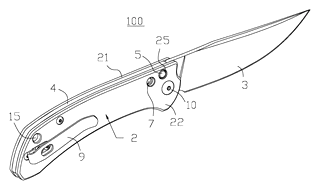
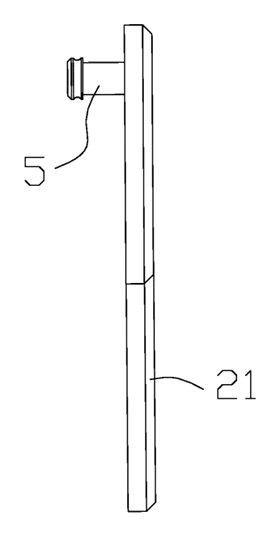
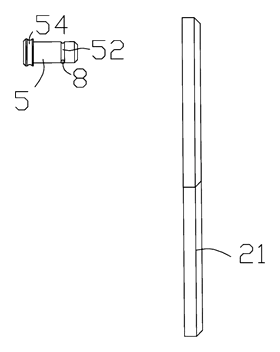
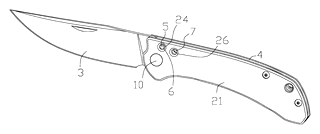
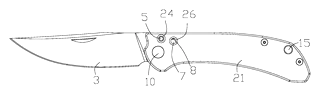
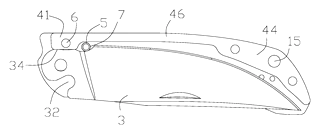
Drawings reproduced from the public patent document for reference.