
Patent CN108908225B
Updated October 27, 2026Manual Multi-Tool Integrating Saw, File, Hammer, Pick and Drill
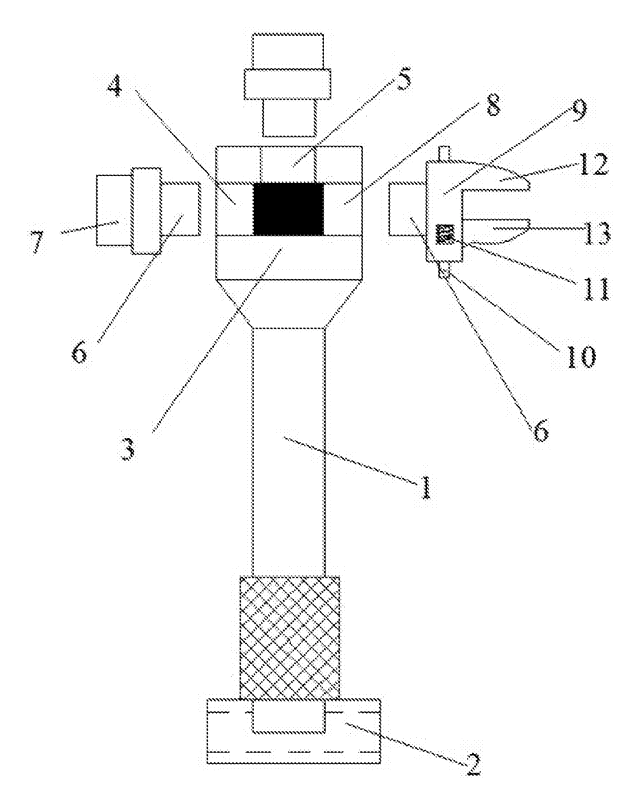
Carrying separate tools for every small job adds weight and takes up space. This design puts a saw, file, hammer, pick and drill into a single cuboid body. The core is a tool mounting body with a vertical assembly groove. Inside, a sliding block moves along side-wall slide grooves and locks in place with a threaded rod turned by a hexagonal wrench. The block carries a drill rod in a square hole at its top, a screwdriver in a square hole at its bottom, and a saw blade fitted between the screwdriver and the hammer-pick on the left connector. The outer wall of the body itself serves as a file. For light repair, field work or emergency kits, one piece covers the most common manual tasks without switching handles or searching through a toolbox.
- China invention patent - lapsed
- No filings outside China
- Multi-tools
- Metal body, sliding block, threaded lock
Splat! What let you down?
🔨
Five tools in one body
Saw, file, hammer, pick and drill are integrated into a single cuboid mounting body.
🔩
Sliding block lock
A sliding block inside the assembly groove holds the attachments and locks via a threaded rod.
📐
Built-in file surface
The outer wall of the tool mounting body is machined directly into a file structure.
🔧
Hex wrench included
A regular hexagonal wrench on the locking rod lets users tighten or release the block.
Bring this product to market
- ✓ Patent vetted China-only family and legal status checked
- 2 Product brief · now How it works, uses and options written up
- 3 Prototype First samples for buyers to review
- 4 Pilot run Small first batch for launch customers
- 5 Volume production Repeat orders at scale
Buyer interest
– of 100 buyers needed to start prototyping
One click, no sign-up. Each vote is one real visitor, and products with the most interest go to prototyping first.
Build team: no members yet. Need a partner, co-funding or skills to build this? Join and we introduce the team once it forms.
The problem
Workers, campers and maintenance staff often need several basic hand tools for a single task. Carrying a separate saw, file, hammer, pick and drill means extra weight, more items to lose, and time spent switching between them. Small toolboxes get cluttered quickly, and when a quick fix is needed away from a workshop, the right tool is often missing. A compact unit that holds these functions together reduces the load and keeps everything ready in one piece.
The solution
This design solves the problem by building all five functions into a single cuboid tool mounting body.
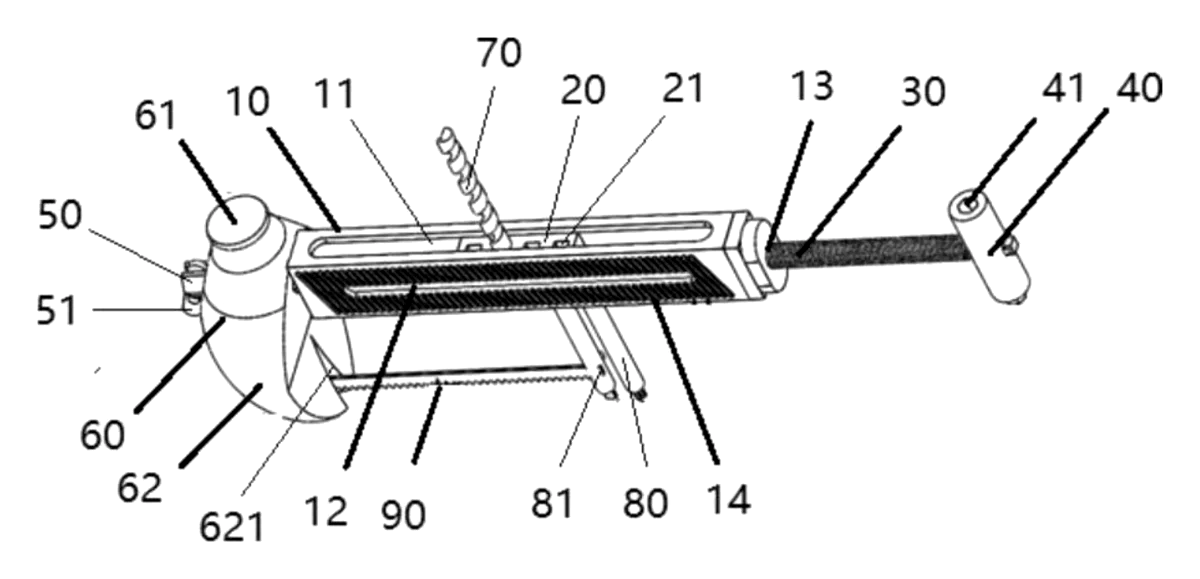
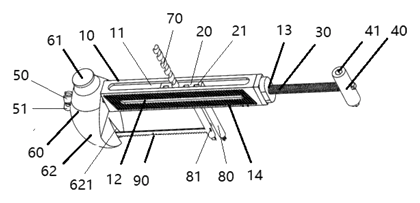
- The tool mounting body (10) has a vertical assembly groove (11) running through it, with slide grooves (12) on both side walls.
- A sliding block (20) sits inside the assembly groove. It has square holes (21) at its top and bottom ends.
- A drill rod (70) fits into the top square hole, and a screwdriver (80) fits into the bottom square hole.
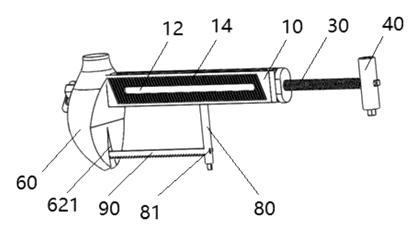
- A saw blade (90) is mounted between the screwdriver and the hammer-pick at the left end.
- The left end of the body carries a connecting piece (50) with a hammer pick (60) and a clamping piece (51).
- A threaded locking rod (30) passes through a threaded hole (13) at the right end to secure the sliding block, turned by a wrench (40).
- The outer wall of the tool mounting body is machined into a file (14) structure.
Who it is for
- Outdoor gear brands adding a compact repair tool to camping or hiking kits, where carrying fewer items matters.
- Hardware wholesalers supplying maintenance crews who need a backup tool for quick fixes in the field.
- Promotional product buyers looking for a practical, multi-function item for trade shows or corporate gifts.
- Amazon sellers targeting the multi-tool category with a design that combines five distinct functions in one metal body.
How it works
The main parts
| No. | Part | What it does |
|---|---|---|
| 10 | Tool mounting body | Cuboid frame holding all components; outer wall forms the file. |
| 11 | Assembly groove | Vertical slot inside the body for the sliding block. |
| 12 | Slide grooves | Channels on the side walls guiding the sliding block. |
| 20 | Sliding block | Moves inside the groove; holds the drill rod, screwdriver and saw blade. |
| 21 | Square holes | Openings at the top and bottom of the sliding block for tool inserts. |
| 30 | Threaded locking rod | Screws into the body to lock the sliding block in position. |
| 40 | Wrench | Hexagonal cylinder used to turn the locking rod. |
| 50 | Connecting piece | Mount at the left end holding the hammer pick. |
| 60 | Hammer pick | Combined hammer face and pick point. |
| 70 | Drill rod | Fits into the top square hole for drilling. |
| 80 | Screwdriver | Fits into the bottom square hole; flat or cross type. |
| 90 | Saw blade | Mounted between the screwdriver and the hammer pick. |
Operating steps
- Unlock the block - use the hexagonal wrench (40) to turn the threaded locking rod (30) counter-clockwise, releasing the sliding block (20).
- Select the tool - slide the block to expose the needed attachment: the drill rod (70) at the top, the screwdriver (80) at the bottom, or the saw blade (90).
- Lock the block - tighten the threaded locking rod clockwise so the connecting portion (32) presses against the sliding block through the slide grooves (12).
- Use the hammer or pick - grip the body and strike with the hammer face (61) or pry with the pick (62) on the connecting piece (50).
- Use the file - rub the outer wall (14) of the tool mounting body directly against the workpiece.
Applications
Camping and hiking repairs
Hikers often need to cut cord, file a burr off a stove part, or tap a tent peg. Instead of packing separate tools, they carry this single body. The saw cuts branches, the hammer drives pegs, and the file smooths rough edges on gear.
Facility maintenance walk-throughs
Maintenance technicians walking a building may encounter loose screws, jammed latches or small burrs. The screwdriver tightens fasteners while the pick clears debris from tracks. The compact shape fits in a pocket or belt pouch.
Emergency roadside kits
Drivers facing a minor breakdown can use the hammer to tap a hubcap back on or the file to clean battery terminals. The drill rod helps clear blocked holes in brackets. Keeping one unit in the glove box saves space over a full toolkit.
Farm and garden upkeep
Fence repairs require driving staples, cutting wire and filing sharp ends. The hammer pick handles driving and prying. The saw blade trims small wooden stakes without needing a separate handsaw.
Trade show giveaways
Brands handing out promotional items want something recipients will actually keep. A metal multi-tool with five functions stays in a desk drawer or toolbox. The flat body surfaces allow laser engraving of logos.
Where it is less suitable
- Heavy construction framing - the hammer and saw are sized for light manual tasks, not structural carpentry.
- Precision machining - the drill rod is manually operated and intended for basic holes, not millimeter-tolerant work.
- Electrical live work - the metal body and lack of insulated grips mean it should not be used on energized circuits.
Frequently asked questions
How do the five tools fit into one body?
The tool mounting body is a cuboid block with a vertical assembly groove inside. A sliding block rides in this groove and holds the drill rod at the top, the screwdriver at the bottom, and the saw blade alongside. The hammer pick mounts on a connector at one end, and the outer wall of the body is machined into a file surface.
How does the sliding block stay in place?
A threaded locking rod screws through a hole at the right end of the body. Its connecting portion passes through the sliding block. Turning the hexagonal wrench on the free end tightens the rod, pressing the block against the slide grooves so it cannot move during use.
Can the saw blade be replaced?
The patent describes the saw blade mounted between a connecting shaft on the pick’s V-notch and a connecting hole on the screwdriver bottom. In production, this joint can be designed as a removable pin or screw so worn blades can be swapped. Exact fastener type is set in design.
What is the file surface made of?
The file is not a separate piece glued on. The outer side wall of the tool mounting body itself is machined into a file structure. The tooth pattern depends on the metal chosen and the machining process applied during manufacturing.
Does the wrench serve any other purpose?
The wrench is a regular hexagonal cylinder with an inner hexagonal hole. Its primary function is to turn the threaded locking rod. The patent does not describe it doubling as a socket driver, but the hex shape could mate with standard bolts if sized accordingly.
Is the screwdriver fixed or interchangeable?
The patent mentions the screwdriver includes both a flat-nosed and a cross-nosed type and sits in a square hole at the bottom of the sliding block. Whether both are provided as separate inserts or as a reversible bit is confirmed on prototypes during development.
Can this design be made and sold in the US?
The patent was filed only in China and is lapsed due to non-payment of annual fees, so it does not restrict the design in the US or in China. Multi-tools may be covered by other US patents - see Patent & Production - so we recommend a freedom-to-operate check before volume production.
Are you affiliated with the patent owner?
No. IP2M is an independent design and manufacturing service working from the public patent document.
Request a quote
Click Request a Quote below to see our email address - copy it, or open your email app with a ready-made message. Please mention patent CN108908225B in the subject.
Helpful details to include:
- Your company and channel (outdoor brand, hardware wholesaler, Amazon seller, promotional buyer)
- Target material for the body (carbon steel, stainless steel, aluminum)
- Overall dimensions or preferred hand size
- Surface finish and grip style (bare metal, rubber over-mold, knurled)
- File coarseness preference
- Estimated quantity and packaging type
- Timeline - when you would like samples and the first shipment
You can also reach us at (332) 203-9997.
Explore this product
Interested in building this?
Tell us your target market, quantity and timeline. We reply with options for prototyping, small-batch runs or volume production.
Send your inquiry to
Please put CN108908225B in the subject line and tell us your company, country, estimated quantity and timeline.
Prefer to talk? Call (332) 203-9997.
More product-ready patents
All Tools & Workshop patents →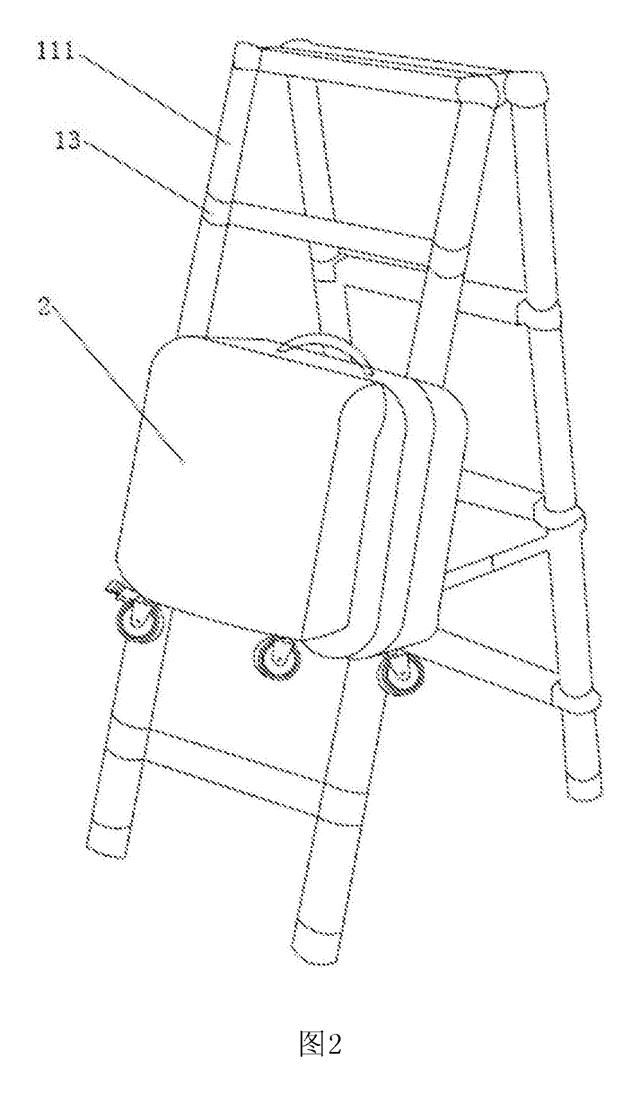
Tools & Workshop
Rolling Tool Box with Telescoping Step Ladder
Telescoping A-frame ladder with an attached rolling tool box that slides to your working height.
Patent CN206290197U
Tools & Workshop
Folding 3-Handle Wrench Multi-Tool
Folding three-handle wrench multi-tool with magnetic screwdriver bits, saw, file and bottle opener.
Patent CN205290875U
Tools & Workshop
Rolling Auto-Repair Tool Cabinet with Built-In Lights
Lockable rolling tool cabinet for car repair with interior lights, a lubricant tray, parts drawers and a tool bay.
Patent CN205989314U
Tools & Workshop
Wide-Opening Folding Bolt Cutter
Bolt cutter with linked, gear-meshing handles that open up to 190° and fold in half for storage.
Patent CN207206226U
Tools & Workshop
Nail-Holding Hammer with Fold-Out Drivers
Hammer with a nail-holding T-slot in the head and fold-out drivers stored in the handle.
Patent CN205254927U
Tools & Workshop
Modular Wrench with Screw-On Heads
Wrench handle with a three-way threaded hub for screw-on adjustable and hex heads, plus a pipe sleeve.
Patent CN206216564U
Browse by category
- Apparel & Accessories (22)
- Baby & Kids (16)
- Bags & Luggage (9)
- Bath & Personal Care (16)
- Car Accessories (10)
- Furniture, Bedding & Storage (12)
- Garden & Outdoor (18)
- Health & Wellness (8)
- Home, Kitchen & Cleaning (24)
- Lighting (12)
- Packaging & Containers (6)
- Pet Products (6)
- Phone & Camera Accessories (4)
- Retail Display (13)
- School, Office & Art (19)
- Sports & Recreation (25)
- Tools & Workshop (27)
- Toys & Games (12)
This page is based on the public patent document CN108908225B, assigned to Yangzhou Polytechnic Institute. IP2M is an independent manufacturing service and is not affiliated with, endorsed by or licensed by the patent owner. Images marked as concept renderings are illustrations, not photos of an existing product. Patent status information is provided for reference only and is not legal advice; confirm freedom to operate for your market before production. Full disclaimer.