
Patent CN109036175B
Updated October 28, 2026Four-Sided Rotating Advertisement Display Board with Elastic Linkage
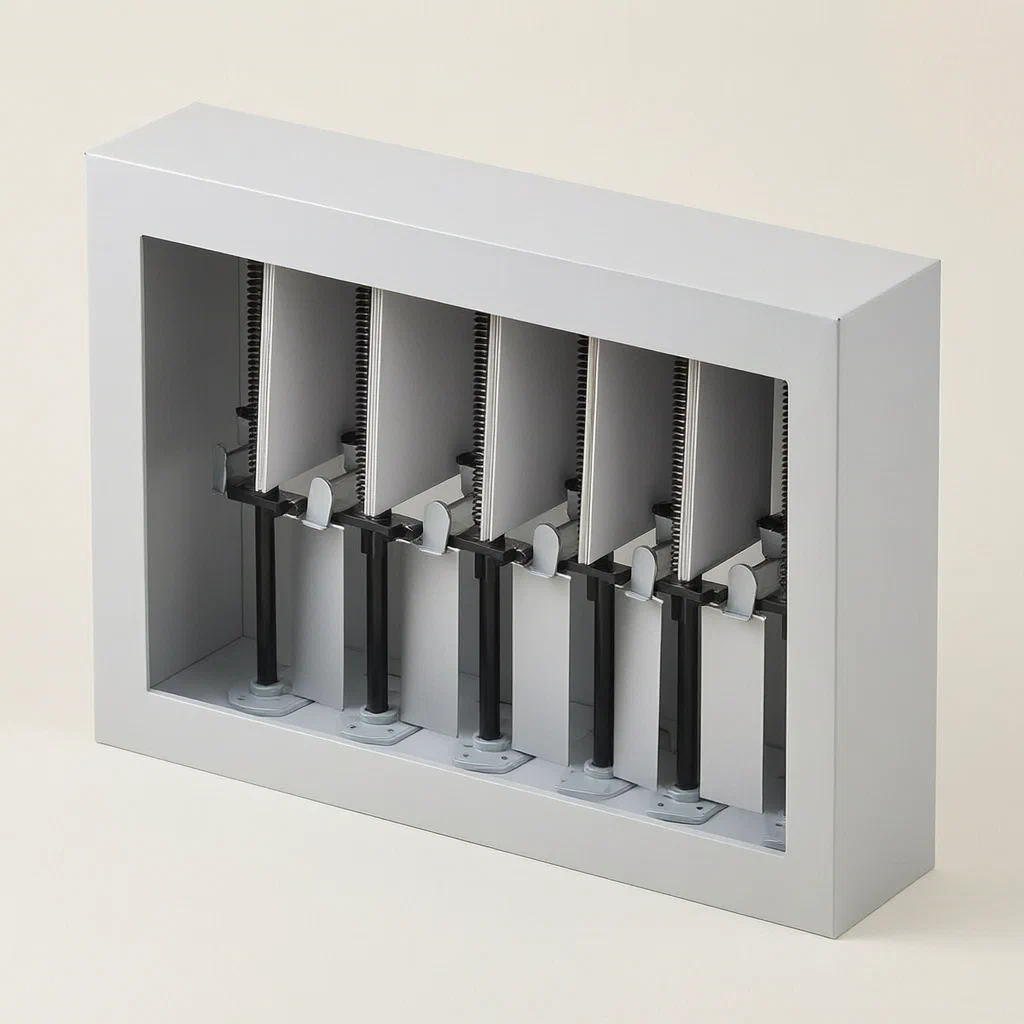
Standard three-sided rotating signs leave one face hidden at any time. This design uses a quadrangular prism structure—four display boards hinged together—to present four different advertisement contents within the same overall width. Each vertical column contains a central shaft fitted with an elastic connecting piece combination. Collars rotate on the shaft with torsion springs, and telescopic rods push against movable plates that slide along the inner sides of the boards. When a motor turns a shared worm gear, the worm wheels on every shaft rotate together, flipping the entire array from one complete picture to the next. The result is a rolling type display board combination that makes further use of the available space without increasing the footprint of the sign.
- China invention patent - in force
- No filings outside China
- Retail & outdoor signage
- Metal frame, worm-gear drive, elastic linkage
Splat! What let you down?
🔲
Four-sided prism columns
Each vertical column has four hinged display boards, presenting four different pictures in the original width.
⚙️
Worm-gear synchronization
A shared worm meshes with a worm wheel on every central shaft so all columns turn together.
🔗
Elastic connecting pieces
Collars, torsion springs, telescopic rods and sliding plates link the boards to the shaft.
🖼️
Seamless picture array
Columns are arranged in a horizontal array; their individual faces combine into one full image.
Bring this product to market
- ✓ Patent vetted China-only family and legal status checked
- 2 Product brief · now How it works, uses and options written up
- 3 Prototype First samples for buyers to review
- 4 Pilot run Small first batch for launch customers
- 5 Volume production Repeat orders at scale
Buyer interest
– of 100 buyers needed to start prototyping
One click, no sign-up. Each vote is one real visitor, and products with the most interest go to prototyping first.
Build team: no members yet. Need a partner, co-funding or skills to build this? Join and we introduce the team once it forms.
The problem
Traditional rotating advertisement signs typically use triangular prisms. At any moment, one of the three faces points backward inside the housing, which limits the sign to three messages for a given width. Retailers and advertisers who need to cycle more content must either install a wider unit or accept fewer rotations per hour. Wider units take up more sidewalk or wall space, and adding a second sign doubles the hardware cost. Furthermore, driving many separate triangular columns requires a mechanism that keeps them aligned so the combined picture does not appear broken during the flip.
The solution
This patent describes a rolling type display board combination that replaces the triangular prism with a variable quadrangular prism structure.
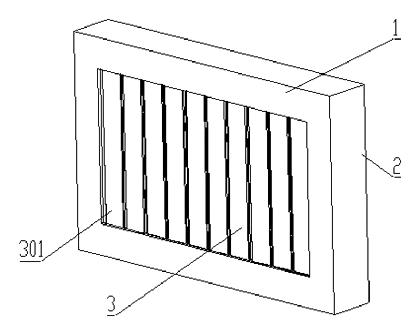
- A frame panel (1) covers a box body (2), leaving a central opening that serves as the movable display board area.
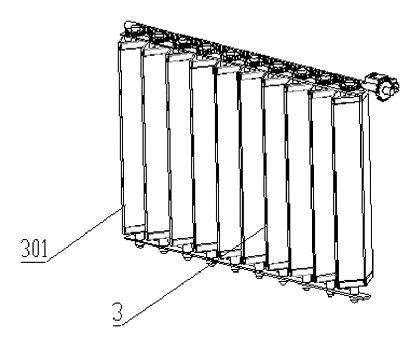
- Inside this opening, multiple display columns (301) stand vertically in a horizontal array. Each column is a quadrangular prism formed by four adjacent display boards (310) hinged to one another.
- A central shaft (302) passes through the middle of every column. Its upper and lower ends insert into through holes on two horizontal fixing boards (4) mounted inside the box body.
- An elastic connecting piece combination (320) sits on the shaft. It includes collars (322) with torsion springs, telescopic rods (323) fixed to the collars, and movable plates (324) hinged symmetrically at the rod ends. The plates slide against the inner side faces of the display boards.
- At one end of each shaft, a worm wheel (8) is mounted coaxially. A single horizontal worm (9) engages all the worm wheels, turned by a worm motor (10).
- When the motor runs, the worm rotates every shaft simultaneously. The elastic linkage folds the hinged boards smoothly from one flat face to the next, showing four different advertisement contents without changing the overall width of the sign.
Who it is for
- Outdoor advertising operators who manage street-level billboards and want to sell four rotation slots per sign instead of three, maximizing revenue per square meter.
- Retail store chains that use storefront signage to cycle daily promotions, seasonal offers and brand messaging on a single unit.
- Trade show booth builders who need dynamic backdrops that change graphics mechanically without digital screens or manual banner swaps.
- Transit hub concessionaires placing directional or promotional signs in airports and bus stations where floor space is strictly limited.
How it works
The main parts
| No. | Part | What it does |
|---|---|---|
| 1 | Frame panel | Outermost cover with a central opening for the display area. |
| 2 | Box body | Housing that holds the internal mechanism. |
| 3 | Display board combination | The full array of vertical columns forming the visible picture. |
| 301 | Display column | One quadrangular prism made of four hinged boards. |
| 310 | Display board | Individual face carrying the printed advertisement. |
| 302 | Central shaft | Rod passing through the column axis, supported by fixing boards. |
| 320 | Connecting piece combination | Elastic linkage transferring rotation to the boards. |
| 321 | Connecting piece | Assembly of collar, rod and plates on the shaft. |
| 322 | Collar | Sleeve rotatably mounted on the shaft with a torsion spring. |
| 323 | Telescopic rod | Arm fixed to the collar, pushing toward the board hinge. |
| 324 | Movable plate | Hinged plate sliding along the inner face of the display board. |
| 4 | Fixing board | Horizontal plate with through holes holding the shaft ends. |
| 5 | Boss | Rounded protrusion on the board edge for guided movement. |
| 8 | Worm wheel | Gear on the shaft end meshing with the worm. |
| 9 | Worm | Shared horizontal screw gear engaging all worm wheels. |
| 10 | Worm motor | Electric motor driving the worm. |
Operating steps
- Power on - the worm motor (10) starts turning the horizontal worm (9).
- Synchronized rotation - the worm drives every worm wheel (8), spinning all central shafts (302) at the same speed.
- Elastic folding - as the shaft turns, the collars (322) rotate. The torsion springs and telescopic rods (323) push the movable plates (324) along the inner faces of the display boards (310).
- Face change - the hinged boards fold inward and flatten outward, shifting the column from one flat quadrangular face to the next.
- Full picture - because every column moves together, the individual board faces align to form a complete, seamless advertisement across the entire array.
- Stop and hold - the motor stops when the next face is fully flat; the elastic linkage maintains tension to keep the boards flush.
Applications
Storefront retail windows
Shops facing foot traffic often run morning, afternoon and evening promotions. A four-sided rotating board lets a retailer schedule four distinct graphic sets on one fixture. The mechanical flip draws attention without the glare or power draw of an LED screen.
Bus shelters and transit stops
Advertising space at transit stops is measured in inches. Replacing a three-sided prism with a quadrangular prism adds a fourth advertiser slot in the exact same housing width. Commuters see a new message each time the motor cycles.
Trade show and exhibition booths
Exhibitors frequently change messaging between keynote sessions. Instead of reprinting banners or rewiring video walls, staff program the motor to flip to the next pre-printed face. The physical movement also attracts attendees walking the aisles.
Mall directory and wayfinding areas
Shopping centers use large overhead or pillar-mounted signs to highlight tenant sales. A synchronized column array can display a mall map on one face and promotional artwork on the other three. The worm-gear drive ensures every section flips uniformly so the map remains readable.
Restaurant menu boards
Drive-through or counter-menu boards can rotate between breakfast, lunch, dinner and late-night menus. The elastic linkage handles the repeated folding action throughout the day. Printed graphics avoid the pixel failure issues common in outdoor digital menus.
Where it is less suitable
- High-resolution video content - the display relies on static printed boards; it cannot play motion graphics or update remotely like digital signage.
- Extreme weather exposure - the hinged joints and elastic linkage require protection from heavy rain, ice or sand ingress, meaning fully open roadside poles may need additional sealing beyond the box body.
- Very narrow single-column signs - the mechanism relies on a horizontal array combining into one picture; a standalone single column loses the visual impact of the array effect.
Frequently asked questions
How does a four-sided column differ from a standard three-sided rotating sign?
A standard rotating sign uses triangular prisms, limiting the display to three faces per column. This design uses a quadrangular prism structure, meaning each column has four hinged display boards. It presents four different advertisement contents within the same overall width, improving space utilization compared to a three-sided unit.
What keeps the four boards flat when they stop?
According to the patent, an elastic connecting piece combination sits on the central shaft inside each column. It uses collars with torsion springs, telescopic rods and movable plates that slide along the inner side faces of the boards. This linkage applies tension to hold the selected face flat and guides the folding action during rotation.
How do all the columns turn at the same time?
A worm wheel is mounted on the same end of every central shaft. A single horizontal worm meshes with all these worm wheels, and a worm motor drives the worm. When the motor runs, the worm turns every shaft simultaneously, keeping the horizontal array synchronized so the individual pictures combine into one full image.
What materials are used for the display boards?
The patent text does not specify the exact material for the display boards, only describing them as hinged panels forming a quadrangular prism with advertisement display areas. Material selection—such as aluminum composite, polycarbonate or coated steel—is set in design and confirmed on prototypes based on whether the sign is used indoors or outdoors.
Can the graphics be changed easily?
The patent focuses on the mechanical flipping structure rather than the graphic mounting method. In practice, the display areas on the boards can be fitted with printed vinyl, snap-in frames or direct prints. The method of attaching the graphics is set in design and confirmed on prototypes to suit the buyer’s workflow.
Is this sign suitable for outdoor use?
The patent describes a frame panel covered on a box body, which provides a basic housing. For permanent outdoor installation in the US, the box body, motor enclosure and wiring must be engineered to meet local wind loads and electrical codes, which is handled during the customization phase.
How large can the display board be made?
The patent does not state maximum dimensions. The overall width and height depend on the number of display columns in the horizontal array and the length of the central shafts. These parameters are set in design and confirmed on prototypes to match the required viewing distance and mounting location.
Can this design be made and sold in the US?
The patent was filed only in China and is currently in force there (until at most 2038-09-13, if annual fees are paid). It has no US or other foreign counterpart, so it does not restrict making or selling the design in the United States. However, rotating signs are a heavily patented field globally, so we recommend a freedom-to-operate check before volume production.
Are you affiliated with the patent owner?
No. IP2M is an independent design and manufacturing service working from the public patent document.
Request a quote
Click Request a Quote below to see our email address - copy it, or open your email app with a ready-made message. Please mention patent CN109036175B in the subject.
Helpful details to include:
- Your company and channel (advertising operator, retail chain, trade show builder, transit concessionaire)
- Overall dimensions (width and height) and number of columns
- Installation environment (indoor, outdoor, sheltered)
- Graphic change method preferred (vinyl wrap, snap-in frames, direct print)
- Motor and control requirements (voltage, timer, remote trigger)
- Estimated quantity and target price
- Timeline - when you would like samples and the first shipment
You can also reach us at (332) 203-9997.
Explore this product
Interested in building this?
Tell us your target market, quantity and timeline. We reply with options for prototyping, small-batch runs or volume production.
Send your inquiry to
Please put CN109036175B in the subject line and tell us your company, country, estimated quantity and timeline.
Prefer to talk? Call (332) 203-9997.
More product-ready patents
All Retail Display patents →
Retail Display
Motorized Shelf Display That Presents a Product to Shoppers
Shelf unit that lifts a product over the price rail toward shoppers when a sensor detects them.
Patent CN215077184U
Retail Display
Portable Advertising Light Box with Spinning LED Display
Portable ad box whose spinning LED bars draw images and text; content changes by wireless or USB.
Patent CN207425291U
Retail Display
Automated Folding Store Shelf That Pushes Products Up to the Customer
Double-sided shelf for unmanned stores: folding tiers, screw pushers and lift cylinders present stock.
Patent CN109645754B
Retail Display
Motorized Rotating Display Pedestal with Lift Column, Info Screen and Clip-On Display Racks
Mobile pedestal: motorized rotating cube with lit faces and racks, electric lift column and info screen.
Patent CN208875862U
Retail Display
Thin Outdoor LED Video Wall Cabinet with Magnetic Modules and Tool-Free Locks
Thin outdoor LED wall cabinet: magnetic modules and rear body, rotary locks, finned rear cooling.
Patent CN205354557U
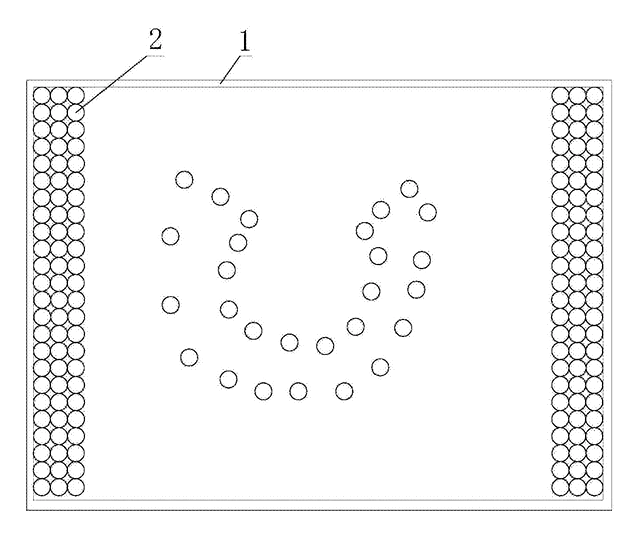
Store & Display
Magnetically Repositionable LED Advertising Panel
LED panel whose lamp beads slide to new positions via an external electromagnet.
Patent CN205487209U
Browse by category
- Apparel & Accessories (22)
- Baby & Kids (16)
- Bags & Luggage (9)
- Bath & Personal Care (16)
- Car Accessories (10)
- Furniture, Bedding & Storage (12)
- Garden & Outdoor (18)
- Health & Wellness (8)
- Home, Kitchen & Cleaning (24)
- Lighting (12)
- Packaging & Containers (6)
- Pet Products (6)
- Phone & Camera Accessories (4)
- Retail Display (13)
- School, Office & Art (19)
- Sports & Recreation (25)
- Tools & Workshop (27)
- Toys & Games (12)
This page is based on the public patent document CN109036175B, assigned to Henan Lianhang Industrial Co ltd. IP2M is an independent manufacturing service and is not affiliated with, endorsed by or licensed by the patent owner. Images marked as concept renderings are illustrations, not photos of an existing product. Patent status information is provided for reference only and is not legal advice; confirm freedom to operate for your market before production. Full disclaimer.