At a glance
| Patent number | CN109130626B (application CN201811261161) |
| Type | China invention patent (发明专利) - protects product shape, structure and method |
| Original title | A compass ruler for teaching (一种教学用圆规尺) |
| Patent owner | Hangzhou Sea Spy Measuring Tool Co Ltd |
| Inventors | Liu Xiaoliang |
| Filing date | 2018-10-26 |
| Grant date | 2020-05-05 |
| Status (China) | In force in China until at most 2038-10-26 (if annual fees are paid) |
| Patent family | Chinese filings only - no US, European, Japanese, PCT or other filings listed |
| Cited by | 2 later documents |
| Source | Google Patents (search for CN109130626B) |
What the claims cover, in plain language
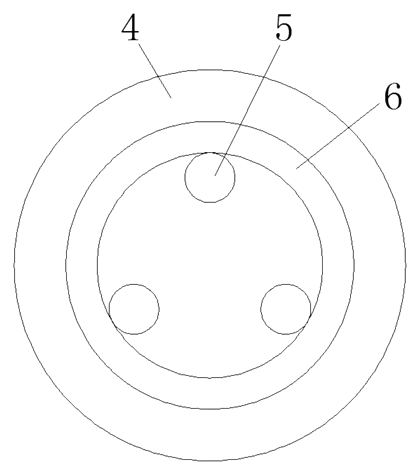
Claim 1 describes a teaching compass ruler comprising a first ruler (1), a second ruler (2) and a circle center positioning mechanism (3). One end of the first ruler is hinged to the second ruler. The far end of the second ruler connects to a circular first connecting block (4), which holds three circumferentially distributed clamping rods (5) secured by a sliding fixing ring (6); chalk is clamped between the rods. The far end of the first ruler connects to a circular second connecting block (7) holding a positioning end (8) with an embedded spherical first magnetic bead (9) at its center. Both rulers feature scales, are made of wood, and have arc-shaped hinge ends.
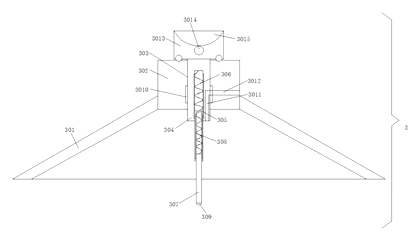
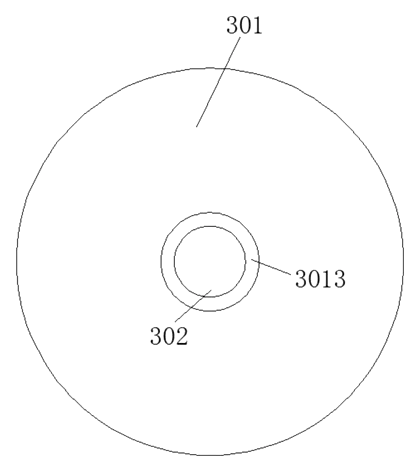
The positioning mechanism includes a transparent rubber suction cup (301) bonded to a circle center positioning block (302) with a central positioning hole (303). Inside the hole, a first telescopic tube (304) slides over a second telescopic tube (305) connected by a first spring (306) and guided by limit slots. A telescopic positioning rod (307) slides inside the second tube via a second spring (308) and limit slots, ending in an arc-shaped rubber pad (309). A sealing gasket (3010) lines the hole. A first vent hole (3011) on the first tube communicates with the suction cup interior, while a second vent hole (3012) on the block and gasket communicates with the outside. A docking end (3013) fixed to the first tube rotates to align or separate the vent holes. Its upper surface has an arc-shaped groove containing a spherical second magnetic bead (3014) with polarity opposite to the first bead, and its lower surface holds a ball that slides against the positioning block.
This is a simplified reading for orientation only. The legal scope is defined by the exact claim wording in the official Chinese document.
What this means for US production
This patent was filed only in China and is currently in force there. It has no US or other foreign counterpart. Because it is active in China until at most 2038-10-26 (provided annual fees are maintained), manufacturing or selling this specific design within China requires permission from the patent owner. However, since no corresponding patent exists in the United States or other jurisdictions, producing the item outside of China for sale in those markets is not restricted by this particular document.
Two points to settle early:
- Freedom to operate (FTO). While this specific Chinese patent does not apply in the US, educational drawing instruments and magnetic mounting devices are broad categories. A freedom-to-operate review focusing on magnetic pivots and suction-based board mounts should be conducted before investing in tooling for the American market.
- Other patents may exist. Classroom geometry tools and whiteboard accessories are patented by various educational supply companies, particularly regarding magnetic attachment mechanisms and adjustable drafting arms. Verifying that the combination of a telescopic vent-valve suction cup and a magnetic pivot does not infringe existing US utility patents is essential.
Customization and manufacturing
What can be customized
| Area | Options |
|---|---|
| Ruler material | Beechwood, pine, bamboo, or high-impact ABS plastic |
| Ruler length | Various lengths to determine the maximum drawable radius, to be confirmed in design |
| Scale markings | Metric, imperial, or dual-scale printing; custom brand logos |
| Suction cup | Silicone or TPR instead of natural rubber; varying durometers for different board textures |
| Chalk clamp | Adapted diameter to hold dry-erase markers or whiteboard pens instead of chalk |
| Magnet strength | Neodymium bead grade selection based on the weight of the chosen arm material |
| Color and finish | Non-toxic paints, clear lacquers, or anodized aluminum accents for premium versions |
Things to plan for (US market)
- ASTM F963 - if marketed for children under 14, the toy safety standard applies. The embedded magnetic beads must pass the flux index test to ensure they are not hazardous loose magnets, and the wooden parts must meet heavy metals limits.
- CPSIA (16 CFR 1303 / 1501) - lead content in surface coatings and substrate materials must comply. Small parts testing is required if the target age group includes children under 3 years.
- California Proposition 65 - wood finishes, rubber compounds, and plastics must be screened for listed chemicals to avoid mandatory warning labels.
- Labeling requirements - educational tools sold in the US typically require country-of-origin marking and responsible party information on the packaging.
How a project runs
- Inquiry - define target user (chalkboard vs. whiteboard), preferred materials, ruler lengths, and estimated volumes.
- Design - engineer the telescopic tube tolerances, spring rates for the positioning rod, vent hole alignment geometry, and magnetic bead seating.
- Prototype - machine sample arms and mold a test suction cup to verify vacuum retention on standard board surfaces.
- Pilot run - produce a small batch for drop testing, cycle testing of the vent valve, and third-party lab submission for CPSIA/ASTM compliance.
- Production - scale up woodworking or injection molding, assemble the telescopic mechanisms, embed magnets, print scales, and package.
Quantities & timeline
Manufacturing this compass requires precision machining or molding for the nested telescopic tubes to ensure the vent holes align perfectly when twisted. The suction cup demands dedicated compression or injection molding tooling, and embedding the magnetic beads requires secondary assembly jigs to guarantee correct polarity orientation. Third-party safety testing adds lead time before shipment. Send us your material preferences, ruler dimensions, marker compatibility needs, quantity and target price and we will reply with options.
Patent drawings
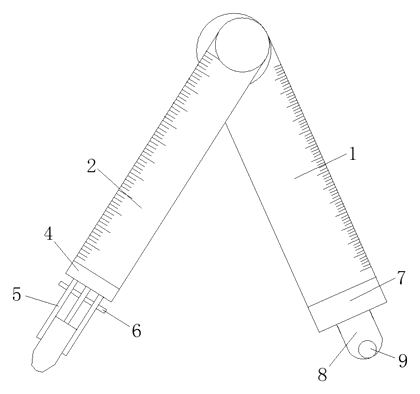
Drawings reproduced from the public patent document for reference.