At a glance
| Patent number | CN109177897B (application CN201811372990) |
| Type | China invention patent (发明专利) - protects product shape, structure and method |
| Original title | License plate frame of automobile (一种汽车牌照架) |
| Patent owner | Cai Haiqiang |
| Inventors | Wang Cheng |
| Filing date | 2018-11-19 |
| Grant date | 2020-04-17 |
| Status (China) | In force - in force in China until at most 2038-11-19 (if annual fees are paid) |
| Patent family | Chinese filings only - no US, European, Japanese, PCT or other filings listed |
| Cited by | 1 later document |
| Source | Google Patents (search for CN109177897B) |
What the claims cover, in plain language
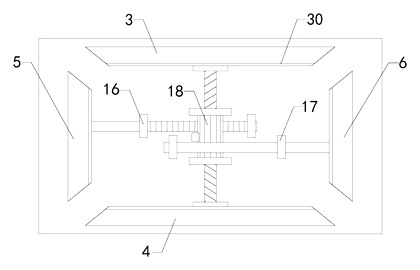
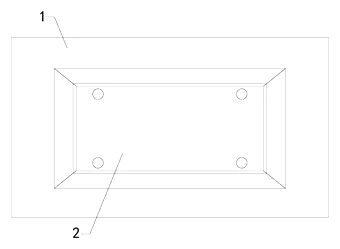
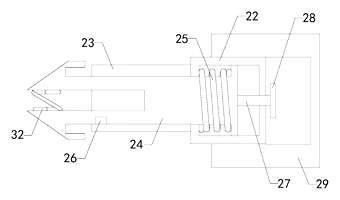
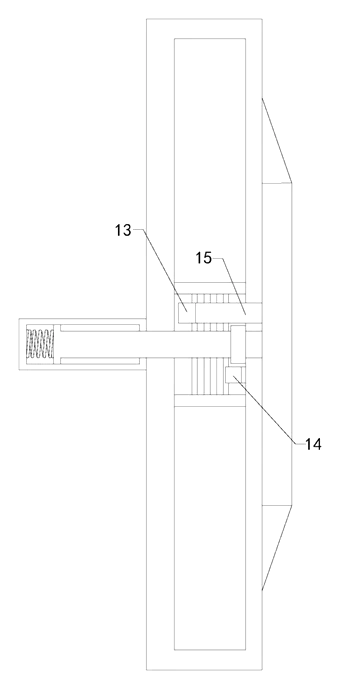
Claim 1 - an automobile license plate frame comprising a fixing plate (1) and a license plate (2) having four groups of fixing holes. The frame includes an upper fastening plate (3), a lower fastening plate (4), a front fastening plate (5), a rear fastening plate (6), upper and lower limiting rings (7, 8), upper and lower threaded rods (9, 10), two groups of adjusting rings (11), two groups of driving rods (12), a front rack (13), a rear rack (14), two groups of connecting rods (15), front and rear limiting rings (16, 17), a power gear (18), a driving rack (19), a pushing rod (20) and a limiting spring (21). A working cavity is arranged inside the fixing plate. The driving rods penetrate longitudinal sliding holes to connect the adjusting rings to the upper and lower fastening plates. The adjusting rings have positive and negative internal threads mating with the threaded rods. The power gear sits between the upper and lower limiting rings, meshing with the front and rear racks. The connecting rods penetrate transverse sliding holes to link the racks to the front and rear fastening plates. The pushing rod contains a telescopic cavity communicating with the working cavity.
This is a simplified reading for orientation only. The legal scope is defined by the exact claim wording in the official Chinese document.
What this means for US production
This patent was filed only in China and is currently in force. Making or selling this exact license plate frame design in China needs the owner’s permission. There is no US or other foreign counterpart registered based on available records.
Two points to settle early:
- Other patents may exist. Innomotion AG holds a later European patent (EP4116960A1) citing this document, indicating ongoing development in the license plate mounting field. Other automotive accessory makers may hold US patents covering plate frames, locking mechanisms or gear-driven clamps, so a freedom-to-operate (FTO) review of the gear, rack and threaded rod arrangement is recommended before tooling.
- Plate dimensions and hole spacing. US license plates have specific dimensions and mounting hole patterns that differ from other regions. The positions of the four groups of fixing holes and the travel distance of the fastening plates must be calculated for the target market’s standard plates.
Customization and manufacturing
What can be customized
| Area | Options |
|---|---|
| Material | Aluminum alloy, stainless steel, zinc alloy or reinforced polymer for the fixing plate and fastening plates |
| Finish | Powder coating, anodizing, chrome plating, matte black or color-matched paint |
| Dimensions | Sized to fit standard US 12x6 inch plates or regional equivalents; cavity depth adjusted accordingly |
| Actuation | Tool-specific interface for the pushing rod or driving rack to control who can operate the mechanism |
| Mounting interface | Bracket styles for different vehicle bumper curves, tow hitch mounts or trunk lid configurations |
| Springs and seals | Spring rates for the limiting spring and pushing springs; rubber baffles for weather sealing the cavity |
Things to plan for (US market)
- FMVSS / State regulations - US states have specific rules regarding license plate visibility, illumination and obstruction. The frame must not cover any characters, registration stickers or state names on the plate.
- Corrosion resistance - automotive exterior parts face road salt, UV exposure and moisture. Material selection and coatings should meet standard automotive environmental testing protocols.
- California Prop 65 - plated finishes, polymers and lubricants used in the gear mechanism must be screened for listed chemicals.
How a project runs
- Inquiry - target vehicle types, materials, finish and estimated volumes.
- Design - adapting the working cavity, gear ratios and rod lengths to US plate dimensions; CAD modeling of the fixing plate and fastening components.
- Prototype - machining or 3D printing samples to verify gear meshing, rack travel and clamping force on standard plates.
- Pilot run - producing a small batch using intended materials to test corrosion resistance, vibration durability and actuation reliability.
- Production - die casting or stamping the fixing plate, machining threaded rods and gears, molding or forming fastening plates, assembling springs and baffles, final finishing.
Quantities & timeline
The fixing plate requires a die-casting mold or progressive stamping die depending on the chosen metal. The power gear, racks and threaded rods need precision machining or dedicated tooling. Assembly involves fitting the limiting rings, springs and baffles inside the working cavity. Weather sealing tests and vibration durability checks take significant development time. Send us your target vehicle application, material preference, finish, quantity and target price and we will reply with options.
Patent drawings
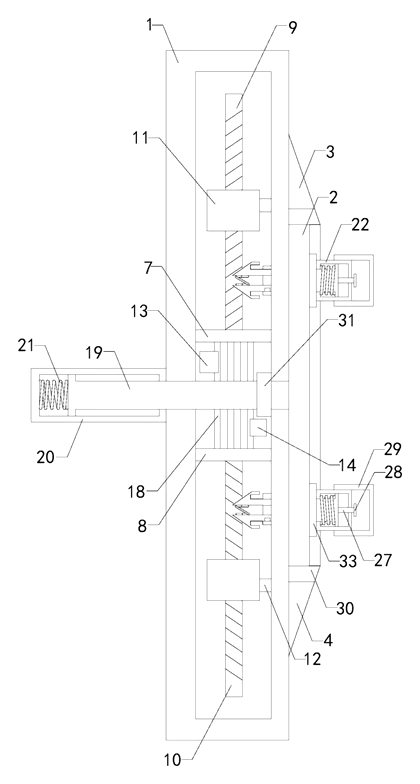
Drawings reproduced from the public patent document for reference.