
Patent CN109340594B
Updated November 3, 2026Camping LED Lamp with Integrated Mosquito Repellent Fan
Standard camping lanterns provide light but leave users vulnerable to insects in open-air environments. Passive repellents often fail to disperse effectively without wind. This design integrates an active air circulation system directly into the lamp housing. By placing mosquito coils or liquid agents in a dedicated lower chamber and using rotating blades to push the vapor outward through a filter mesh, the device creates a localized barrier against pests. Furthermore, addressing the common issue of harsh glare when waking up at night, the patent describes a sound-responsive mechanism. Upon detecting specific sounds, the system engages a hydraulic adjustment component that alters the tension of the drive belts, simultaneously activating the light adjuster to ramp up brightness smoothly, avoiding sudden shocks to the eyes.
- China invention patent - active
- No filings outside China
- Outdoor lighting & pest control
- Mechanical fan dispersion, sound-activated dimming
Splat! What let you down?
🦟
Active Dispersion
Internal blades rotate to blow mosquito coil vapor or liquid scent out through a filter screen.
🔇
Ash Containment
A mesh filter surrounds the repellent chamber, keeping solid residue inside while letting air pass.
📢
Sound Activation
The electric control module detects sound to trigger gradual light adjustment, avoiding sudden glare.
⚙️
Belt-Driven Control
A hydraulic rod adjusts belt tension to coordinate the fan motor and light intensity mechanisms.
Bring this product to market
- ✓ Patent vetted China-only family and legal status checked
- 2 Product brief · now How it works, uses and options written up
- 3 Prototype First samples for buyers to review
- 4 Pilot run Small first batch for launch customers
- 5 Volume production Repeat orders at scale
Buyer interest
– of 100 buyers needed to start prototyping
One click, no sign-up. Each vote is one real visitor, and products with the most interest go to prototyping first.
Build team: no members yet. Need a partner, co-funding or skills to build this? Join and we introduce the team once it forms.
The problem
Camping in open areas presents two distinct challenges: exposure to biting insects and poor visibility management at night. Traditional mosquito repellents rely on passive diffusion, which is ineffective in breezy or large tent environments, requiring constant reapplication or multiple devices. Meanwhile, standard camping lanterns offer binary on/off functionality. When a camper wakes up in the middle of the night, turning on a bright light suddenly can cause significant eye discomfort and disrupt sleep cycles for everyone nearby. Finding the switch in the dark adds further inconvenience. There is a need for a compact device that actively disperses repellents to create a protective zone while offering smart, gradual lighting controls suited for overnight use.
The solution
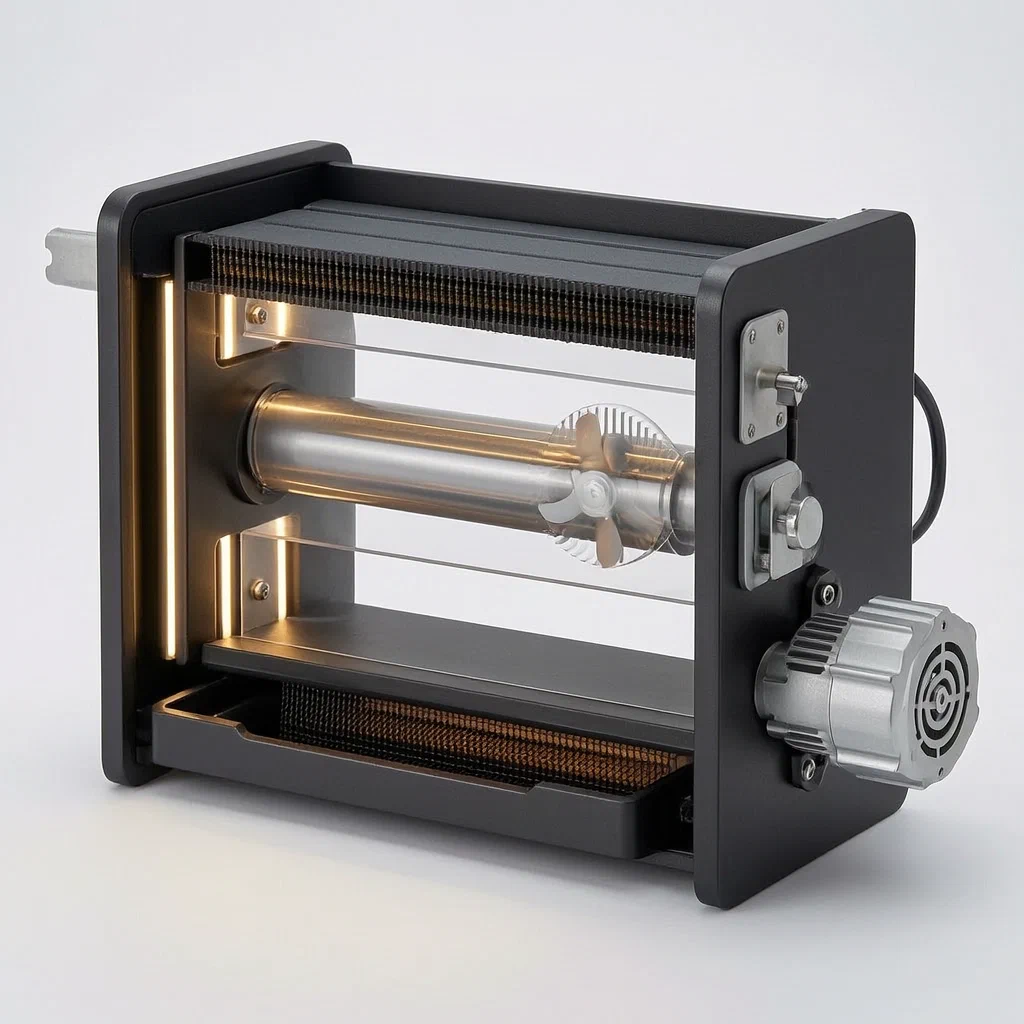
The patent describes a single housing unit that integrates lighting, air circulation, and mechanical adjustment systems.
- An outer casing (1) serves as the main body, with LED lamps (8) mounted on its side walls to light the area around the lamp.
- Inside the lower part of the casing sits a mosquito repellent chamber (2). This compartment holds either burning mosquito coils or liquid repellent agents.
- Surrounding this chamber is a filter screen (3), which allows air to pass through but blocks solid ash or debris from exiting the device.
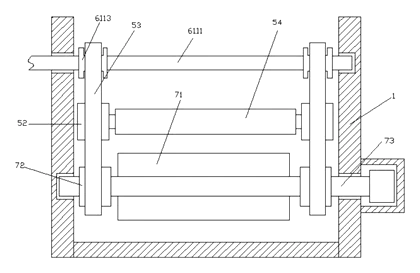
- A transmission assembly (7) is positioned above the chamber. It consists of a transmission shaft (73) connected to a motor. Attached to the shaft are several blades (71).
- When the motor runs, the blades rotate, forcing air upward from the repellent chamber and pushing the vaporized repellent outward through the filter screen.
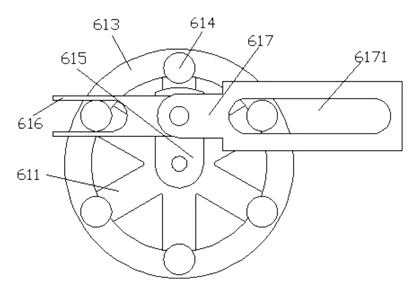
- An adjustment component (5) uses a hydraulic rod (51) to modify the position of an adjustment shaft (54). This changes the tension of the conveyor belt (53) that links the power assembly (61), transmission assembly (7), and adjustment component (5).
- A light adjuster (62) is coupled to the power assembly. As the belt tension changes, the power assembly drives the light adjuster, altering the electrical connection to the LEDs to change their intensity.
- An electric control component monitors ambient sound. Upon detecting a sound source, it activates the hydraulic rod, initiating the sequence that turns on the lights and adjusts their brightness gradually.
Who it is for
- Outdoor gear brands looking to differentiate their product lines by combining lighting and pest control into a single SKUs, reducing packing volume for campers.
- Glamping site operators who need durable, low-maintenance lighting solutions that also help manage guest comfort regarding insects without separate spray applications.
- Wholesalers targeting Asian markets where integrated multi-function camping gadgets are popular, seeking products with patented structural designs to avoid generic commodity competition.
- Product designers exploring mechanical linkages for smart lighting, interested in how belt-tension adjustments can correlate physical airflow with electrical output.
How it works
The main parts
The device relies on a coordinated system of motors, belts, and sensors.
| No. | Part | What it does |
|---|---|---|
| 1 | Outer Casing | Houses all components; supports side-mounted LEDs. |
| 2 | Repellent Chamber | Holds coils or liquids; generates the deterrent vapor. |
| 3 | Filter Screen | Mesh barrier; prevents ash escape while allowing airflow. |
| 7 | Transmission Assembly | Motor-driven shaft with blades (71) to fan the vapor. |
| 5 | Adjustment Component | Hydraulic rod (51) and shaft (54) to alter belt tension. |
| 61 | Power Assembly | Rotating shaft (6111) and pulleys driving the light adjuster. |
| 62 | Light Adjuster | Mechanism that varies LED intensity based on power assembly rotation. |
| 53 | Conveyor Belt | Connects power, transmission, and adjustment units mechanically. |
Operating steps
- Setup: Place a mosquito coil or liquid agent in the bottom chamber (2). Ensure the filter screen (3) is intact.
- Activation: The user triggers the device via sound detection or manual input. The electric control component receives the signal.
- Mechanical Engagement: The hydraulic rod (51) extends or contracts. This moves the adjustment shaft (54), tightening or loosening the conveyor belt (53).
- Fan Operation: The motor spins the transmission shaft (73). The attached blades (71) rotate, drawing air through the repellent chamber and expelling the treated air through the filter screen.
- Lighting Adjustment: Simultaneously, the belt drives the power assembly (61). The rotation of the first rotating shaft (6111) interacts with the light adjuster (62), changing the current flow to the LEDs (8). This results in a gradual increase or decrease in brightness, rather than an abrupt switch.
Applications
Family Camping Trips
Families with children benefit from the dual function. Parents do not need to carry separate bug sprays and flashlights. The gradual light activation is designed to avoid a sudden bright beam when someone wakes at night.
Solo Backpacking
Solo travelers value weight savings. Combining the lantern and repellent dispenser reduces pack bulk. The sound-activation feature allows hands-free operation when setting up tents or moving around the campsite at night.
Glamping Tents
High-end glamping sites require amenities that enhance comfort without clutter. These lamps provide ambient lighting while the fan disperses repellent around the tent.
Fishing and Wildlife Blinds
In stationary positions like fishing banks or wildlife observation blinds, staying still is crucial. The fan moves repellent vapor out through the screen instead of letting it drift from a passive coil, so users can remain focused on their activity.
Outdoor Dining Areas
Restaurants with patio seating can use these units to keep tables free of insects. The enclosed chamber prevents ash from scattering onto food or tables, maintaining cleanliness better than traditional hanging coils.
Where it is less suitable
- Extreme Wind Conditions: The fan-based dispersion may be overwhelmed by strong natural winds, reducing the effectiveness of the repellent cloud.
- Long-Duration Battery Use: The motor for the fan and the mechanics for adjustment consume more power than a simple static LED torch, potentially limiting battery life in remote off-grid scenarios unless high-capacity cells are used.
- Silent Environment Requirements: The sound-activation mechanism might trigger falsely in noisy urban parks or festivals, causing unintended light changes.
Frequently asked questions
How does the mosquito repellent actually work?
The device uses a mechanical fan. A motor spins blades located above a chamber containing mosquito coils or liquid repellent. The blades push air through the chamber, carrying the vaporized repellent out through a filter screen. This creates an active cloud of deterrent around the lamp, rather than relying on passive smell diffusion.
Does the filter screen get clogged?
The patent describes a filter screen surrounding the repellent chamber. Its primary purpose is to block solid ash from mosquito coils from escaping into the environment. In practice, regular cleaning is required to prevent buildup of residue that could restrict airflow over time.
How does the sound-activated light work?
The lamp has an electric control component that listens for sound. When it detects a noise (like someone getting up or talking), it triggers a hydraulic rod. This rod adjusts the tension of a conveyor belt connecting the fan motor and the light adjuster. This mechanical linkage causes the LED brightness to ramp up gradually instead of snapping on instantly, reducing eye strain.
Can I use any brand of mosquito coil?
The chamber dimensions are fixed by the design. Standard-sized flat mosquito coils should fit, but oversized or uniquely shaped products may not. Liquid repellents would require a compatible wick or container that fits inside the designated chamber space.
Is this safe to use indoors?
While designed for camping, the principle applies indoors. However, users should ensure adequate ventilation because the device circulates air containing repellent vapors. The combination of heat (from coils) and electricity requires careful placement away from flammable materials.
What happens if the battery dies?
If the power source fails, the fan stops, halting the active dispersion of repellent. The LED lights will also turn off. Unlike a pure passive lantern, this device relies on power for both its lighting and pest-control functions.
Can this design be made and sold in the US?
The patent is active in China but has no US counterpart. You can manufacture and sell this design in the US without infringing this specific Chinese patent. However, you must verify that no other US patents cover similar combinations of active fan dispersion and sound-activated dimming. We recommend a freedom-to-operate check before mass production.
Are you affiliated with the patent owner?
No. IP2M is an independent design and manufacturing service working from the public patent document.
Request a quote
Click Request a Quote below to see our email address - copy it, or open your email app with a ready-made message. Please mention patent CN109340594B in the subject.
Helpful details to include:
- Your company and channel (outdoor gear brand, distributor, glamping supplier)
- Target retail price and expected margins
- Key specs (battery capacity, lumen output, desired airflow rate)
- Material preferences (plastic type, color, finish)
- Estimated quantity for the first order
- Timeline - when you need prototypes and when you want to launch
You can also reach us at (332) 203-9997.
Explore this product
Interested in building this?
Tell us your target market, quantity and timeline. We reply with options for prototyping, small-batch runs or volume production.
Send your inquiry to
Please put CN109340594B in the subject line and tell us your company, country, estimated quantity and timeline.
Prefer to talk? Call (332) 203-9997.
More product-ready patents
All Lighting patents →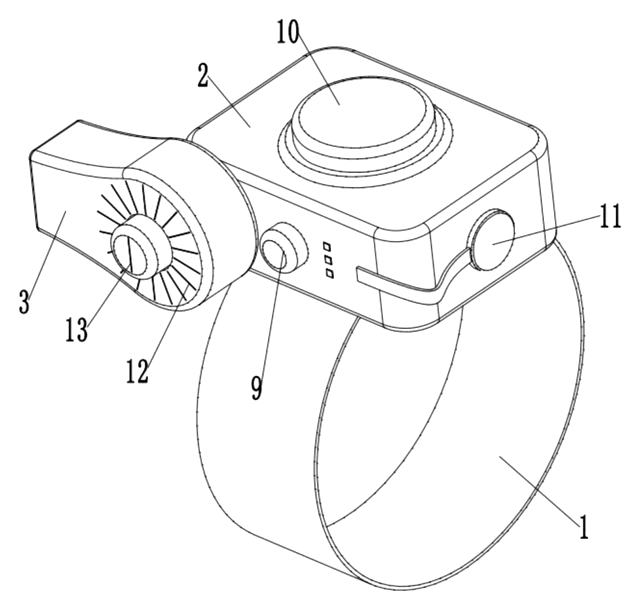
Lighting
Wrist-Worn Flashlight with Click-Lock Angle Adjustment
Rechargeable wrist flashlight whose lamp turns and locks at an angle with a push button.
Patent CN113915544B
Lighting
Self-Folding Desk Lamp That Turns into a Phone Stand
Desk lamp with a shape-memory stem that unfolds when warm and folds into a phone stand.
Patent CN213237087U
Lighting
Ring-Shaped Outdoor Lantern That Lifts Off a Power-Bank Charging Base
Ring lantern with a battery handle that docks in a cone base with its own battery, clamp and charging plug.
Patent CN212408329U
Lighting
LED Flameless Candle with an Outside Flame Shade and Wax Dish Top
Battery LED candle: flame shade stands above a dished wax top, angled LEDs light a printed wick.
Patent CN205424561U
Lighting
Telescoping Tripod Portable Work Light with Fold-In Light Panels
Telescoping tripod work light with dual light panels that fold flat into the base.
Patent CN207298471U
Lighting
Self-Cooling and Self-Cleaning LED Street Light with Rainwater Harvesting
LED street lamp that harvests rain to cool its heat sink and spray-wash the lens automatically.
Patent CN205480639U
Browse by category
- Apparel & Accessories (31)
- Baby & Kids (23)
- Bags & Luggage (14)
- Bath & Personal Care (23)
- Car Accessories (19)
- Furniture, Bedding & Storage (17)
- Garden & Outdoor (25)
- Health & Wellness (11)
- Home, Kitchen & Cleaning (36)
- Lighting (18)
- Packaging & Containers (9)
- Pet Products (8)
- Phone & Camera Accessories (7)
- Retail Display (19)
- School, Office & Art (27)
- Sports & Recreation (33)
- Tools & Workshop (41)
- Toys & Games (18)
This page is based on the public patent document CN109340594B, assigned to Linquan County Fuxinya Optoelectronic Technology Sales Co ltd. IP2M is an independent manufacturing service and is not affiliated with, endorsed by or licensed by the patent owner. Images marked as concept renderings are illustrations, not photos of an existing product. Patent status information is provided for reference only and is not legal advice; confirm freedom to operate for your market before production. Full disclaimer.