
Patent CN109555995B
Updated November 2, 2026Adaptive Outdoor Portable LED Lantern with Adjustable Light Intensity
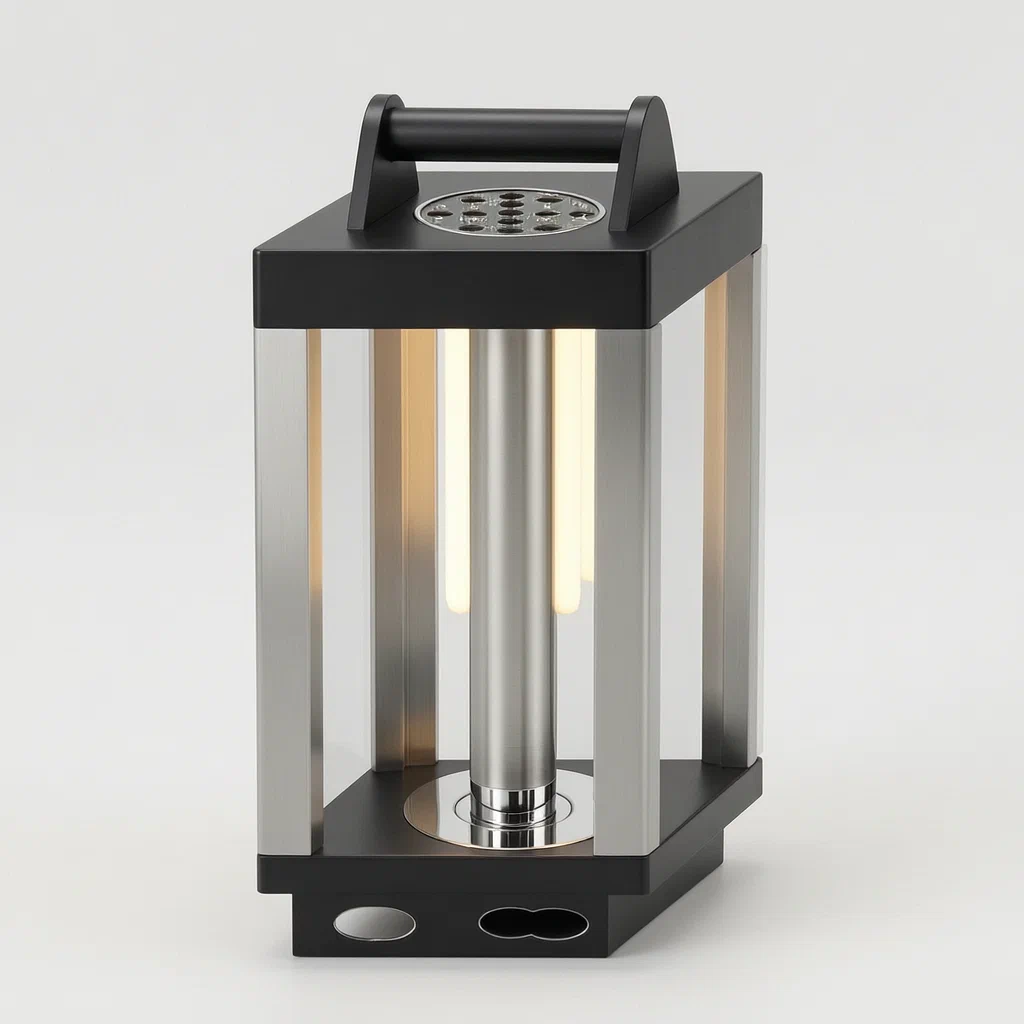
Standard camping lanterns often offer fixed brightness levels that are either too dim for reading or too harsh for ambient lighting, draining batteries quickly when full power isn't needed. This adaptive design solves this by combining electronic voltage control with a mechanical light-management system in the base. The reflective base contains an angle-changing device and a light-absorbing column. By adjusting these components, users can physically alter the light output intensity, reducing glare and saving energy without relying solely on battery drain. The modular construction allows the LED tube and movable frame to be detached from the main cover, making repairs easier. The hollow support bar connects the lamp cover to the base, ensuring stability during use.
- China invention patent - active
- No filings outside China
- Outdoor & Camping Lighting
- LED, ABS/PC housing, Reflective Base
Splat! What let you down?
💡
Dual Control
Adjusts brightness via voltage on the circuit board and mechanically through the base.
🔋
Energy Saving
The light-absorbing column reduces intensity without wasting battery power on low settings.
🛠️
Modular Design
Movable frame and LED tube are detachable for easy replacement and cleaning.
🌲
Outdoor Ready
Dust-proof plate and reflective base protect internals and manage light direction.
Bring this product to market
- ✓ Patent vetted China-only family and legal status checked
- 2 Product brief · now How it works, uses and options written up
- 3 Prototype First samples for buyers to review
- 4 Pilot run Small first batch for launch customers
- 5 Volume production Repeat orders at scale
Buyer interest
– of 100 buyers needed to start prototyping
One click, no sign-up. Each vote is one real visitor, and products with the most interest go to prototyping first.
Build team: no members yet. Need a partner, co-funding or skills to build this? Join and we introduce the team once it forms.
The problem
Many portable outdoor lamps rely exclusively on electronic dimming, which can still consume significant power even at lower settings if the driver efficiency is poor. Furthermore, standard designs often lack physical mechanisms to diffuse or absorb excess light, leading to glare that disturbs nearby campers or fails to provide adequate ambient illumination for tasks like reading. Repairing these units is also difficult because the LED components are frequently sealed inside the housing, requiring the entire unit to be discarded if the light source fails. There is a need for a lamp that offers both electronic and mechanical means to adapt light intensity, while maintaining a structure that allows for component-level maintenance.
The solution
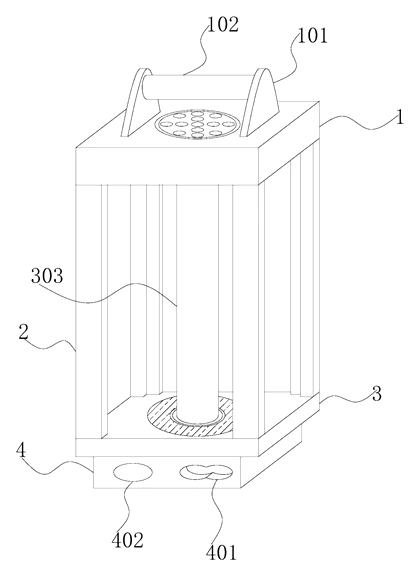
- The lamp consists of a lamp cover (1), a hollow support bar (2), a reflective base (3), and a power box (4). These parts connect via detachable joints.
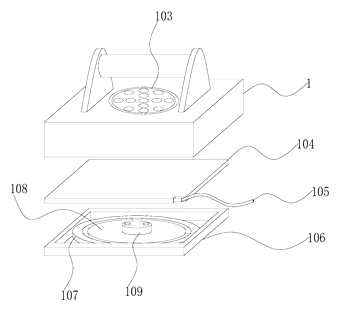
- Inside the lamp cover, a circuit board (104) is fixed at the top, controlling the voltage supplied to the LED lamp tube (107).
- The LED tube sits within a movable frame (106), which can be detached from the cover’s bottom. A dust-proof plate (108) protects the inner ring of the LED tube.
- The reflective base (3) features a lower groove (301) containing an angle changing device (302) and a light absorbing column (303).
- The angle changing device uses a reflector (3021) and arc strip (3022) to direct light, while the absorbing column helps reduce overall intensity mechanically.
Who it is for
- Camping Gear Brands looking for lanterns with unique dual-mode brightness control to differentiate their product lines.
- Emergency Preparedness Suppliers needing durable, repairable lighting solutions that conserve battery life during extended outages.
- Outdoor Retailers targeting hikers and campers who require adjustable light intensity for both task lighting and ambient mood setting.
- Industrial Safety Managers seeking portable site lighting that minimizes glare for workers operating in close proximity.
How it works
The main parts
| No. | Part | What it does |
|---|---|---|
| 1 | Lamp Cover | Houses the electronics and LED source; includes handle and heat vents. |
| 104 | Circuit Board | Controls voltage to the LED, enabling electronic dimming. |
| 106 | Movable Frame | Holds the LED tube; detachable for maintenance. |
| 107 | LED Lamp Tube | The primary light source. |
| 108 | Dust-proof Plate | Protects the LED internals from debris. |
| 2 | Hollow Support Bar | Connects the cover to the base; provides structural stability. |
| 3 | Reflective Base | Contains the mechanical light adaptation system. |
| 302 | Angle Changing Device | Reflector and arc strip to direct light paths. |
| 303 | Light Absorbing Column | Mechanically absorbs part of the light to lower intensity. |
| 4 | Power Box | Ring-shaped battery compartment attached to the base. |
Operating Steps
- Power On: Activate the switch (402) on the power box. The circuit board supplies current to the LED tube.
- Electronic Adjustment: Use the interface on the circuit board to change the voltage, altering the LED’s luminous brightness.
- Mechanical Adaptation: Adjust the position of the light-absorbing column (303) within the lower groove (301). This physically blocks or absorbs a portion of the emitted light, further reducing intensity and glare.
- Directional Control: Utilize the angle changing device (302) to reflect light towards specific areas if needed.
Applications
Camping and Hiking
Campers can lower the brightness electronically for sleeping ambiance and then use the absorbing column to reduce glare further without draining the battery faster than necessary.
Emergency Kits
During power outages, the dual-control system allows users to stretch battery life significantly by using mechanical absorption instead of relying solely on electronic drivers that may have standby losses.
Workshop and Garage
Mechanics working in tight spaces benefit from the ability to direct light precisely using the reflective base while keeping the overall area illumination soft enough to avoid eye strain.
Fishing and Night Activities
Anglers can use the adaptive light to illuminate bait or equipment without spooking fish, as the mechanical absorption reduces the harsh point-source glare typical of standard LEDs.
Where it is less suitable
- Extreme Weather Conditions: While dust-proof, the patent does not specify IP ratings for heavy rain or submersion; specialized waterproof gear is better for storms.
- High-Lumen Industrial Floodlighting: This design focuses on portability and adaptation rather than maximum raw output; dedicated floodlights are more efficient for large-area coverage.
- Fixed Installation Sites: The modular, portable nature makes it over-engineered for static ceiling fixtures where wiring is permanent.
Frequently asked questions
How does the “adaptive” lighting work?
It combines two methods. First, the circuit board adjusts the voltage to the LED, changing its electronic brightness. Second, a mechanical light-absorbing column inside the base can be adjusted to physically block or absorb some of the light, reducing intensity and glare without changing the electrical input.
Can I replace the LED bulb myself?
Yes. The design features a movable frame that holds the LED tube. This frame is detachable from the bottom of the lamp cover, allowing you to swap out the LED tube if it fails, extending the product’s lifespan.
Is it waterproof?
The patent mentions a dust-proof plate and general outdoor suitability, but it does not specify an IP rating (like IP65 or IP67). For heavy rain or submersion, additional sealing measures would need to be confirmed in the final production design.
How long does the battery last?
Battery life depends on the capacity of the cells used in the ring-shaped power box and the brightness level. Because the mechanical absorption can reduce perceived brightness without lowering power consumption, users can balance visibility and runtime based on their needs. Specific hours are set in design and confirmed on prototypes.
Why is the base called “reflective”?
The base contains an angle-changing device with a reflector and arc strip. This structure helps direct light outward or upward, improving efficiency and reducing the amount of light trapped inside the fixture.
Is the mechanism fragile?
The moving parts (absorbing column and lifting ring) are housed within the base’s lower groove. The patent describes locking docks and compensating tanks to keep them stable during use, protecting them from accidental shifts.
Can this design be made and sold in the US?
The patent is filed only in China and is currently in force there. Since there is no US patent, you can manufacture and sell this specific design in the US without infringing this patent. However, a freedom-to-operate check is recommended to ensure no other US patents cover similar adaptive lighting mechanisms.
Are you affiliated with the patent owner?
No. IP2M is an independent design and manufacturing service working from the public patent document.
Request a quote
Click Request a Quote below to see our email address - copy it, or open your email app with a ready-made message. Please mention patent CN109555995B in the subject.
Helpful details to include:
- Your company and channel (camping brand, emergency kit supplier, industrial distributor)
- Target specs (battery capacity, desired brightness range, materials)
- Quantity and estimated order volume
- Timeline - when you need samples and mass production
- Certifications required (UL, FCC, etc.)
You can also reach us at (332) 203-9997.
Explore this product
Interested in building this?
Tell us your target market, quantity and timeline. We reply with options for prototyping, small-batch runs or volume production.
Send your inquiry to
Please put CN109555995B in the subject line and tell us your company, country, estimated quantity and timeline.
Prefer to talk? Call (332) 203-9997.
More product-ready patents
All Lighting patents →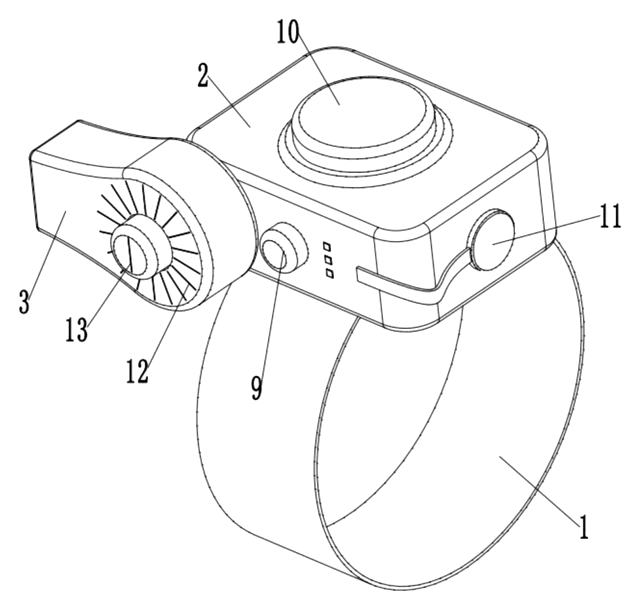
Lighting
Wrist-Worn Flashlight with Click-Lock Angle Adjustment
Rechargeable wrist flashlight whose lamp turns and locks at an angle with a push button.
Patent CN113915544B
Lighting
Self-Folding Desk Lamp That Turns into a Phone Stand
Desk lamp with a shape-memory stem that unfolds when warm and folds into a phone stand.
Patent CN213237087U
Lighting
Ring-Shaped Outdoor Lantern That Lifts Off a Power-Bank Charging Base
Ring lantern with a battery handle that docks in a cone base with its own battery, clamp and charging plug.
Patent CN212408329U
Lighting
LED Flameless Candle with an Outside Flame Shade and Wax Dish Top
Battery LED candle: flame shade stands above a dished wax top, angled LEDs light a printed wick.
Patent CN205424561U
Lighting
Telescoping Tripod Portable Work Light with Fold-In Light Panels
Telescoping tripod work light with dual light panels that fold flat into the base.
Patent CN207298471U
Lighting
Self-Cooling and Self-Cleaning LED Street Light with Rainwater Harvesting
LED street lamp that harvests rain to cool its heat sink and spray-wash the lens automatically.
Patent CN205480639U
Browse by category
- Apparel & Accessories (30)
- Baby & Kids (20)
- Bags & Luggage (13)
- Bath & Personal Care (21)
- Car Accessories (16)
- Furniture, Bedding & Storage (15)
- Garden & Outdoor (21)
- Health & Wellness (10)
- Home, Kitchen & Cleaning (32)
- Lighting (16)
- Packaging & Containers (8)
- Pet Products (7)
- Phone & Camera Accessories (6)
- Retail Display (17)
- School, Office & Art (24)
- Sports & Recreation (31)
- Tools & Workshop (36)
- Toys & Games (16)
This page is based on the public patent document CN109555995B, assigned to Ningbo Royalux Lighting Co ltd. IP2M is an independent manufacturing service and is not affiliated with, endorsed by or licensed by the patent owner. Images marked as concept renderings are illustrations, not photos of an existing product. Patent status information is provided for reference only and is not legal advice; confirm freedom to operate for your market before production. Full disclaimer.