
Patent CN109674128B
Updated October 26, 2026Foldable Helmet with Origami-Style Protruding Structures
Standard helmets take up a lot of room when not in use, making them awkward to carry in bags or store in small lockers. This foldable helmet solves the space problem through a geometric design. It is built from multiple protruding structures linked along two perpendicular lines. When you need it, the structures extend simultaneously along both lines to pop into a curved helmet shape. When you are done, they contract back along those same lines until the entire helmet lies flat. Each protruding structure uses four outer fold lines meeting at a single vertex, guided by two inner fold lines that control the folding motion. The result is a helmet that transitions between a protective curved form and a compact flat profile without separate hinges or loose parts.
- China invention patent - in force
- No filings outside China
- Sports & recreation headwear
- Geometric folding structure
Splat! What let you down?
📐
Perpendicular folding
Protruding structures connect along two mutually perpendicular straight lines to form the helmet body.
↔️
Flat to curved
The structures extend simultaneously into a curved surface or contract into a flat structure.
🔺
Vertex geometry
Four outer fold lines and two inner fold lines intersect at a single vertex on each structure.
🎒
Compact storage
Contracting along both lines reduces the helmet volume for easy carrying and storage.
Bring this product to market
- ✓ Patent vetted China-only family and legal status checked
- 2 Product brief · now How it works, uses and options written up
- 3 Prototype First samples for buyers to review
- 4 Pilot run Small first batch for launch customers
- 5 Volume production Repeat orders at scale
Buyer interest
– of 100 buyers needed to start prototyping
One click, no sign-up. Each vote is one real visitor, and products with the most interest go to prototyping first.
Build team: no members yet. Need a partner, co-funding or skills to build this? Join and we introduce the team once it forms.
The problem
Helmets protect the head during cycling, skating, climbing and other activities, but their rigid, curved shells occupy a large amount of space when not being worn. Commuters who ride part of the way and walk the rest must carry a bulky helmet in a bag or on their arm. Travelers packing light struggle to fit a standard helmet into luggage. Shared-mobility users and rental operators face high storage costs because helmets cannot be stacked efficiently. The core issue is that a helmet needs a curved three-dimensional shape to cover the head, yet that same shape wastes space the moment it is taken off.
The solution
This patent describes a helmet whose shell is not a single rigid dome but an assembly of geometric units that change shape together.
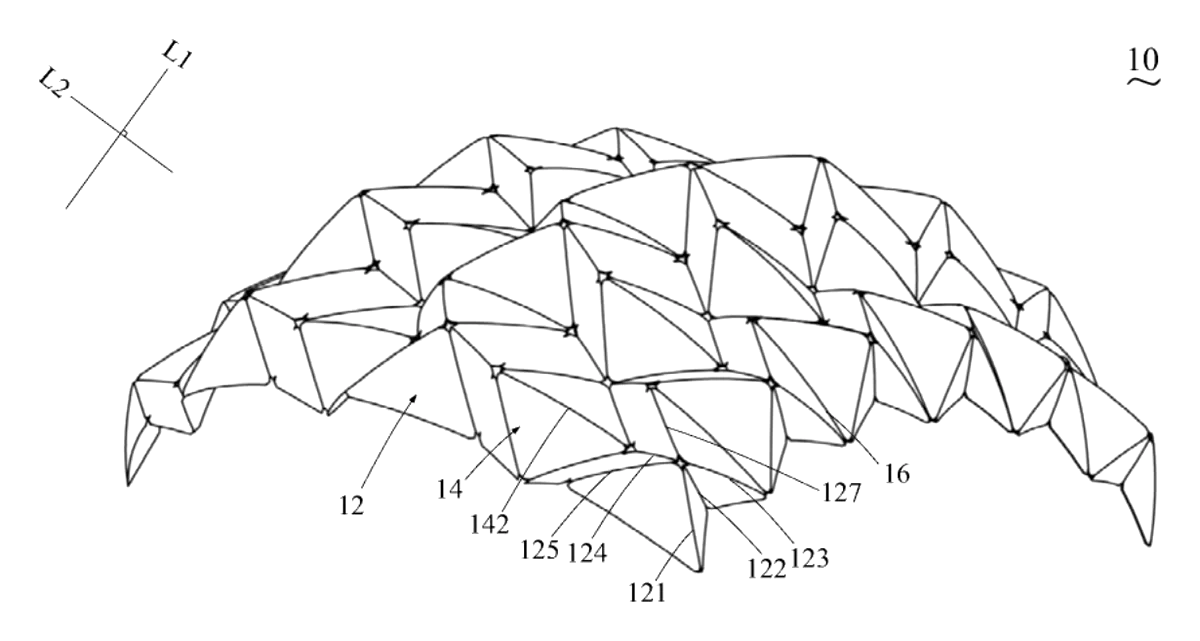
- The helmet consists of multiple protruding structures (12) and connecting portions (14).
- These structures are sequentially and fixedly connected along a first straight line (L1) and a second straight line (L2), which are perpendicular to each other.
- To wear the helmet, the protruding structures extend simultaneously along L1 and L2, forming a curved surface structure.
- To store it, the structures contract simultaneously along the same two lines, collapsing into a flat structure with a much smaller volume.
- Each protruding structure is guided by specific fold lines so the motion is controlled and repeatable.
Who it is for
- Urban commuter gear brands selling to cyclists and e-scooter riders who switch between riding and walking or public transit daily, and need something that slips into a backpack instead of dangling from a handlebar.
- Travel and outdoor equipment companies offering head protection for climbing, skiing or kayaking where luggage space is limited and weight matters.
- Shared mobility and bike-share operators managing fleets of helmets that must be stored in docking stations or vending machines between rides; a flat profile allows denser stacking.
- Wholesale distributors of safety gear supplying schools, camps or clubs where bulk storage of helmets takes up valuable closet or bin space between sessions.
How it works
The main parts
| No. | Part | What it does |
|---|---|---|
| 10 | Foldable helmet | The complete assembly of structures and connections. |
| 12 | Protruding structures | Geometric units that extend into curves or contract flat. |
| 14 | Connecting portions | Placed between every two adjacent protruding structures along the second straight line (L2). |
| 16 | First bending line | Located between every two adjacent protruding structures along the first direction, allowing contraction or extension. |
| 121 | First outer fold line | One of four outer fold lines on a protruding structure; shares a plane with the third outer fold line (125). |
| 123 | Second outer fold line | Shares a plane with the fourth outer fold line (127); coincides with 121 when contracted, separates when extended. |
| 125 | Third outer fold line | Lies in the same plane as the first outer fold line (121). |
| 127 | Fourth outer fold line | Lies in the same plane as the second outer fold line (123); coincides with 125 when contracted, separates when extended. |
| 122 | First inner fold line | Between the first and second outer fold lines; parallel to L2; intersects the second inner fold line at the vertex. |
| 124 | Second inner fold line | Between the third and fourth outer fold lines; parallel to L2; meets the first inner fold line at the vertex. |
Operating steps
- Start flat - the helmet is in its contracted state. The first outer fold line (121) coincides with the second outer fold line (123), and the third outer fold line (125) coincides with the fourth outer fold line (127). The entire assembly forms a flat structure.
- Extend along both lines - pull or push the helmet so the protruding structures (12) expand simultaneously along the first straight line (L1) and the second straight line (L2). The first inner fold line (122) and second inner fold line (124) guide this motion.
- Form the curve - as the structures extend, the outer fold lines separate. The first outer fold line moves away from the second, and the third moves away from the fourth. The flat sheet rises into a curved surface structure shaped to fit a head.
- Contract to store - reverse the motion. The structures shrink along L1 and L2 via the inner fold lines and the first bending lines (16) between adjacent units, returning the helmet to its flat profile.
Each protruding structure (12) is an axially symmetrical structure, ensuring balanced folding on both sides.
Applications
Urban bicycle commuting
Commuters who ride to a train station or office often have no place to put a helmet once they arrive. A helmet that contracts into a flat structure fits inside a laptop bag or briefcase, removing the need to carry a bulky shell by hand or leave it locked to a rack.
Travel and backpacking
Travelers moving between cities or hiking trails need head protection for activities like climbing or cycling but cannot spare suitcase volume. Contracting the helmet along its two perpendicular lines reduces its packed size, freeing room for clothing or gear.
Bike-share and scooter rental stations
Rental operators provide helmets at docking points, but storing hundreds of rigid helmets requires large bins or shelves. Flat-profile helmets can be stacked densely in vending-style dispensers or narrow lockers, lowering the footprint per unit at each station.
School and camp equipment rooms
Youth programs buy helmets in bulk for seasonal sports or field trips. Between uses, the helmets fill entire closets. A design that folds flat lets staff stack them in shallow bins, keeping storage rooms organized and accessible.
Emergency and disaster relief kits
Relief organizations pre-pack safety supplies for rapid deployment. Standard helmets consume disproportionate box space. Foldable helmets that lie flat allow more units per shipping carton, improving logistics when distributing protective gear to affected areas.
Where it is less suitable
- High-speed motorsports - racing environments require rigid, certified composite shells designed for extreme impacts, not folding geometries.
- Industrial hard hats - construction sites follow specific standards for suspension systems and electrical insulation that differ from recreational helmet designs.
- Continuous heavy-impact sports - activities involving repeated high-force collisions may demand solid foam liners rather than articulated folding panels.
Frequently asked questions
How does the helmet change from flat to curved?
The helmet is made of multiple protruding structures connected along two perpendicular straight lines. Each structure has four outer fold lines and two inner fold lines that meet at a single vertex. When the structures extend simultaneously along both lines, the outer fold lines separate and the flat assembly rises into a curved surface. Contracting them along the same lines reverses the process, returning the helmet to a flat profile.
What materials are used for the fold lines?
The patent defines the geometric arrangement of the fold lines and vertices but does not specify materials. The actual polymer, composite or fabric used for the panels and folding joints is set in design and confirmed on prototypes to ensure durability and impact performance.
Does it lock in place when expanded?
The patent describes the structures extending into a curved surface and contracting into a flat structure, but the specific mechanical latch or friction lock that holds the helmet rigid during use is to be confirmed in design. A secure locking state is necessary for any safety application.
What sizes are available?
Head circumference dimensions and the number of protruding structures required for different sizes are not given in the patent. Size ranges are set in design and confirmed on prototypes to match standard adult or youth headforms.
Is it safe for cycling?
Safety depends on passing the relevant impact and retention tests, not just the folding geometry. For the US market, a bicycle helmet must meet CPSC 16 CFR 1203. The folding design must be engineered with appropriate materials and locks to satisfy those requirements.
How small is it when folded flat?
The patent states that contracting the structures reduces the volume for convenient storage, but exact folded dimensions depend on the overall helmet size and panel count. Final measurements are set in design and confirmed on prototypes.
Can this design be made and sold in the US?
The patent was filed only in China and is in force there until at most 2039-01-22 (if annual fees are paid). It has no US counterpart, so it does not restrict making or selling the design in the United States. However, foldable helmets may be covered by other US patents - see Patent & Production - so we recommend a freedom-to-operate check before volume production.
Are you affiliated with the patent owner?
No. IP2M is an independent design and manufacturing service working from the public patent document.
Request a quote
Click Request a Quote below to see our email address - copy it, or open your email app with a ready-made message. Please mention patent CN109674128B in the subject.
Helpful details to include:
- Your company and channel (commuter brand, outdoor gear distributor, shared-mobility operator, wholesale safety supplier)
- Target activity (cycling, skating, climbing, general recreation)
- Head sizes or age groups
- Material preferences for the panels and fold lines
- Estimated quantity and target price
- Timeline - when you would like prototypes and the first shipment
You can also reach us at (332) 203-9997.
Explore this product
Interested in building this?
Tell us your target market, quantity and timeline. We reply with options for prototyping, small-batch runs or volume production.
Send your inquiry to
Please put CN109674128B in the subject line and tell us your company, country, estimated quantity and timeline.
Prefer to talk? Call (332) 203-9997.
More product-ready patents
All Sports & Recreation patents →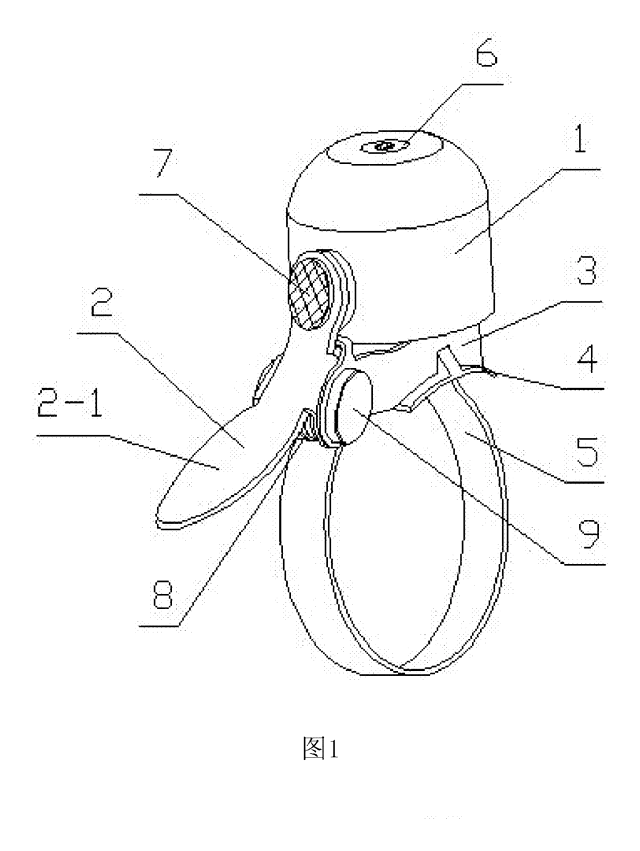
Sports & Recreation
Compact Torsion-Spring Bike Bell
Mini bike bell with a standard torsion spring and a rubber-floated dome - small size, clear tone, quick strap mount.
Patent CN205819384U
Sports & Recreation
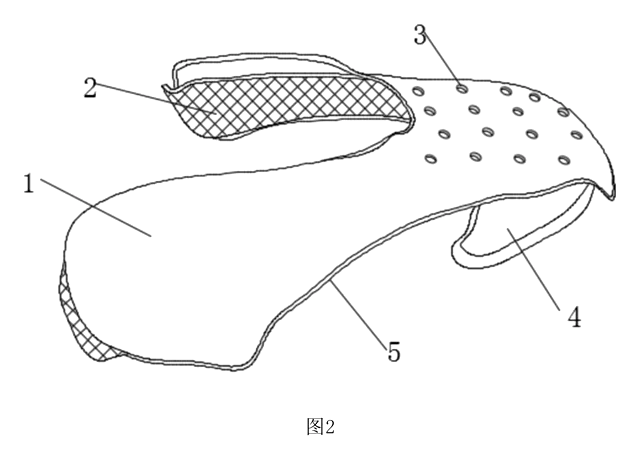
Padded Toe-Box Shield for Sneakers
Ventilated, silicone-lined toe-box insert that supports the front of a sneaker and cushions the toes.
Patent CN209473731U
Sports & Recreation
Reversible Fishing Seat-Box Lid with Backrest
Fishing seat-box lid that flips on removable hinge pins: cushion, backrest and storage on one face.
Patent CN208624426U
Sports & Recreation
Swivel-Pin Skateboard Truck with Rubber Sleeve
Skateboard truck with a turning center pin, a tilting axle clamp and a rubber sleeve that centers it.
Patent CN216777880U
Sports & Recreation
Full-Face Bike Helmet with Magnetic Detachable Chin Bar
Full-face cycling helmet whose chin bar clips on and off with magnetic, latching side connectors.
Patent CN206630067U
Sports & Recreation
Bike Phone Holder with Built-In Flashlight Clamp
Handlebar mount with a phone cradle on top and a flashlight clamp below, on one arm.
Patent CN206077485U
Browse by category
- Apparel & Accessories (22)
- Baby & Kids (16)
- Bags & Luggage (9)
- Bath & Personal Care (16)
- Car Accessories (10)
- Furniture, Bedding & Storage (12)
- Garden & Outdoor (18)
- Health & Wellness (8)
- Home, Kitchen & Cleaning (24)
- Lighting (12)
- Packaging & Containers (6)
- Pet Products (6)
- Phone & Camera Accessories (4)
- Retail Display (13)
- School, Office & Art (19)
- Sports & Recreation (25)
- Tools & Workshop (27)
- Toys & Games (12)
This page is based on the public patent document CN109674128B, assigned to Shenzhen Advanced Technology Research Institute Co Ltd. IP2M is an independent manufacturing service and is not affiliated with, endorsed by or licensed by the patent owner. Images marked as concept renderings are illustrations, not photos of an existing product. Patent status information is provided for reference only and is not legal advice; confirm freedom to operate for your market before production. Full disclaimer.