At a glance
| Patent number | CN109674128B (application CN201910058472) |
| Type | China invention patent (发明专利) - protects product shape, structure and method |
| Original title | Foldable helmet (可折叠头盔) |
| Patent owner | Shenzhen Advanced Technology Research Institute Co Ltd |
| Inventors | You Zhong, Liu Dan |
| Filing date | 2019-01-22 |
| Grant date | 2023-12-29 |
| Status (China) | In force in China until at most 2039-01-22 (if annual fees are paid) |
| Patent family | Chinese filings only - CN109674128B |
| Cited by | 0 later documents |
| Source | Google Patents (search for CN109674128B) |
What the claims cover, in plain language
Claim 1 - a foldable helmet comprising multiple protruding structures fixedly connected in sequence along a first straight line and a second straight line that are perpendicular to each other. The protruding structures can extend simultaneously along both lines to form a helmet with a curved surface structure, or contract simultaneously along both lines to form a helmet with a flat structure. Each protruding structure has a first, second, third and fourth outer fold line. The first and third outer fold lines share one plane; the second and fourth share another. All four intersect at a single vertex. A first inner fold line sits between the first and second outer fold lines, and a second inner fold line sits between the third and fourth outer fold lines. Both inner fold lines are parallel to the second straight line and intersect at the vertex. The structure contracts or extends along both straight lines via these inner fold lines.
Claim 2 - each protruding structure is an axially symmetrical structure.
Claim 3 - the first outer fold line, second outer fold line and first inner fold line are not in the same plane. When contracted, the first outer fold line coincides with the second outer fold line; when extended, they separate.
Claim 4 - the third outer fold line, fourth outer fold line and second inner fold line are not in the same plane. When contracted, the third outer fold line coincides with the fourth outer fold line; when extended, they separate.
Claim 5 - a first bending line is provided between every two adjacent protruding structures arranged along the first direction, allowing them to contract or extend along that direction.
This is a simplified reading for orientation only. The legal scope is defined by the exact claim wording in the official Chinese document.
What this means for US production
This patent was filed only in China and is currently in force there. Because it has no US or other foreign counterpart, it does not restrict making or selling this helmet design in the United States. However, making or selling this exact design in China needs the owner’s permission while the patent remains active.
Two points to settle early:
- Other patents may exist. The foldable and collapsible helmet field contains numerous US and international patents held by various sporting goods companies covering different folding mechanisms, hinge systems and materials. A freedom-to-operate (FTO) review of the specific protruding-structure geometry and folding lines is needed before tooling for any market.
- Material selection for fold lines. The patent describes the geometric relationships of the fold lines and vertices but does not specify materials. The choice of polymer, composite or fabric for the living hinges or articulated joints determines fatigue life and impact behavior, and must be confirmed on prototypes.
Customization and manufacturing
What can be customized
| Area | Options |
|---|---|
| Size range | Adult and youth head circumferences, to be confirmed in design |
| Number of structures | The count of protruding structures along L1 and L2 to achieve the target curvature |
| Materials | Thermoplastic polymers, composites or coated fabrics for the panels and fold lines |
| Retention system | Chin straps, dial-fit adjusters or padding attached to the inner surface |
| Ventilation | Openings integrated into the protruding structures or connecting portions |
| Surface finish | Matte, gloss, printed graphics or reflective coatings |
Things to plan for (US market)
- CPSC 16 CFR 1203 - the mandatory US safety standard for bicycle helmets, covering impact attenuation, retention system strength and peripheral vision. Any helmet sold for cycling in the US must comply.
- ASTM F1492 - standard specification for skateboarding and trick roller skating helmets, if marketed for board sports.
- California Prop 65 - materials, coatings and plastics must be screened for listed chemicals.
How a project runs
- Inquiry - intended activity, target sizes, material preferences and estimated quantities.
- Design - mapping the protruding structures, fold lines and vertices to a specific headform; engineering the locking mechanism for the extended state.
- Prototype - 3D printing or molding initial samples to verify the flat-to-curved transition and folding fatigue.
- Testing - impact and retention tests against CPSC 16 CFR 1203 or ASTM F1492; adjusting panel thickness and joint geometry based on results.
- Production - tooling for injection molding or thermoforming the structures, assembling connecting portions, adding straps and pads.
Quantities & timeline
Manufacturing requires molds or dies for the protruding structures and connecting portions, sized for each helmet dimension. If the fold lines act as living hinges, the mold design must control wall thickness precisely. Certification testing under CPSC 16 CFR 1203 involves multiple sample sets and lab scheduling. Send us your target activity, head sizes, material preferences, quantity and timeline and we will reply with options.
Patent drawings
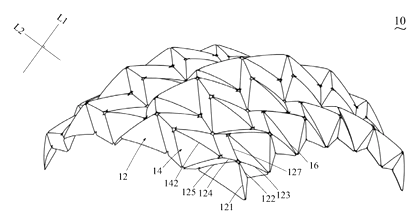
Drawings reproduced from the public patent document for reference.