
Patent CN111207314B
Updated November 8, 2026Tactical Flashlight with Integrated Retractable Wire Saw
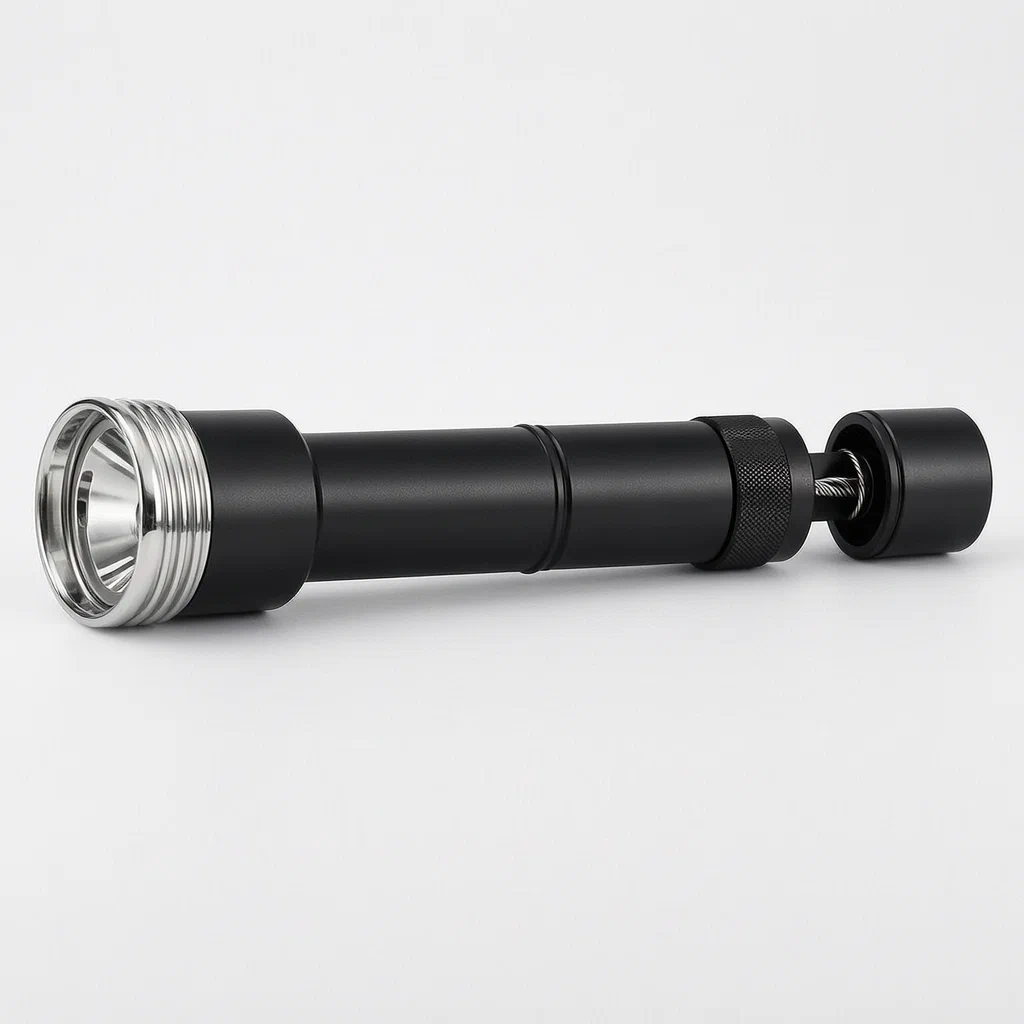
Standard tactical flashlights require carrying separate tools for emergency tasks like cutting rope or clearing vegetation. This design combines a high-output light with a retractable wire saw housed within the tail cap. The saw is stored safely inside two threaded sleeves connected by a spring-loaded reel system. Unscrewing the sleeves deploys the blade for immediate use, while twisting them back engages the springs to retract it. Additionally, the head uses a simple sliding ring to adjust the focal length, providing versatile illumination for field operations.
- China invention patent - in force
- No filings outside China
- Tactical & Outdoor Lighting
- Integrated wire saw, adjustable focus
Splat! What let you down?
🔦
Adjustable Focus
A movable ring shifts the light-gathering cover to change the irradiation range.
✂️
Hidden Wire Saw
A steel wire rope with toothed blades is concealed within the tail cap sleeves.
🔄
Spring Retraction
Planar spiral springs automatically reel in the saw when the sleeves are closed.
🔩
Threaded Assembly
The tail cap sections screw together to lock the tool away securely.
Bring this product to market
- ✓ Patent review Patent family and legal status reviewed in the relevant jurisdictions.
- 2 Product brief · now How it works, uses and options written up
- 3 Prototype First samples for buyers to review
- 4 Pilot run Small first batch for launch customers
- 5 Volume production Repeat orders at scale
Buyer interest
– of 100 buyers needed to start prototyping
One click, no sign-up. Each vote is one real visitor, and products with the most interest go to prototyping first.
Build team: no members yet. Need a partner, co-funding or skills to build this? Join and we introduce the team once it forms.
Patent Rights & Team Participation
Before joining a development team, participants should ensure they have the necessary rights or authorization to participate in the project.
Participation is generally appropriate where:
- You own the relevant patent rights or have obtained permission or a license from the rights holder.
- The relevant patent rights have expired or have been legally invalidated in the jurisdictions where the planned activities will take place.
- The planned development, manufacturing, and commercialization activities have been independently assessed and do not infringe applicable patent rights in the relevant jurisdictions.
Important: Being located outside a country where a patent is protected does not automatically exempt you from patent infringement risks. Patent rights may apply based on where development, manufacturing, use, sale, or import activities take place.
IP2M does not grant any patent license or authorization through team participation. Joining a project does not provide permission to use, manufacture, or commercialize patented technology.
The problem
Field survival and tactical operations often require both illumination and cutting capability. Carrying a separate flashlight and a wire saw adds bulk and weight to a kit. Existing multi-tools may lack the specific high-output lighting needed for night operations, or they fail to integrate the cutting tool safely, leading to accidental deployment or damage during transport. Furthermore, adjusting the beam width on many compact lights requires complex electronic controls or multiple lenses, which can be fragile or slow to operate in stressful conditions. A solution is needed that combines robust lighting with a safe, instantly accessible cutting tool in a single handheld unit.
The solution
The patent presents a flashlight where the body itself houses the cutting mechanism.
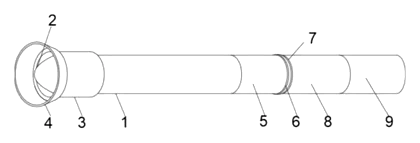
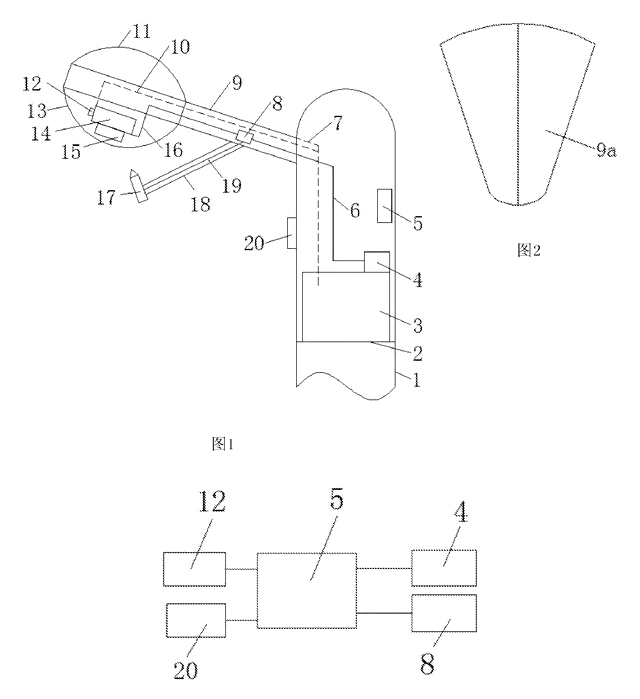
- The lamp body (1) serves as the central chassis. On its left end, a movable ring (3) allows the light-gathering cover (4) to slide closer to or further from the light source, adjusting the beam spread mechanically.
- The right end of the lamp body connects to a first sleeve (5). This connection is secured via a locating pin engaging a positioning groove and a threaded ring.
- The first sleeve threads onto a second sleeve (8), forming the tail cap assembly. An extension end (9) is fixed to the second sleeve.
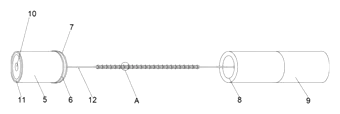
- Inside the gap between the first and second sleeves lies the wire saw (12). It consists of a steel wire rope (121) with a mounting ring (122).
- Attached to the mounting ring are rectangular pyramids holding toothed blades (123, 124).
- Both sleeves contain elastic mechanisms. These include a sleeve (13), a planar spiral spring (15), and a rotating rod (14) with a recovery stick (16). The wire rope winds around these rods.
Who it is for
- Police and security equipment buyers looking for multifunctional field gear that reduces item count in kits.
- Outdoor and survival retailers who stock tactical flashlights with integrated tools for camping and hiking enthusiasts.
- Military surplus distributors interested in rugged, mechanical designs that do not rely on complex electronics for secondary functions.
- OEM manufacturers specializing in tactical lighting who want to differentiate products with unique mechanical integration features.
How it works
The main parts
| No. | Part | What it does |
|---|---|---|
| 1 | Lamp Body | Central housing containing the light source. |
| 3, 4 | Movable Ring & Cover | Adjusts the distance to the lens for focus control. |
| 5, 8 | First & Second Sleeves | Threaded tail cap sections that house the saw. |
| 12 | Wire Saw | Cutting tool made of steel rope and toothed blades. |
| 15 | Planar Spiral Spring | Provides tension to retract the saw. |
| 16 | Recovery Stick | Winding post for the wire rope. |
Operating Steps
- To Deploy: The user unscrews the first sleeve (5) from the second sleeve (8). As they pull the sleeves apart, the wire saw is exposed from the cavity between them.
- To Cut: The exposed wire saw, with its toothed blades, can be used for cutting ropes or vegetation.
- To Retract: The user screws the sleeves back together. The action pulls the wire rope ends, causing the recovery sticks (16) to rotate against the resistance of the planar spiral springs (15).
- Storage: Once fully closed, the spring tension keeps the saw tightly wound inside the sleeves, hiding the blades completely.
Applications
Night Patrols and Security
Security personnel need reliable light and quick access to tools. The integrated saw allows guards to cut through barriers or clear obstacles without reaching into a belt pouch, keeping hands free and eyes on the environment.
Wilderness Survival Kits
Hikers and campers benefit from the reduced weight of a combined tool. The ability to adjust the beam focus helps in signaling over long distances or illuminating close-up tasks like setting up shelters, while the saw handles firewood preparation or emergency repairs.
Emergency Response Teams
First responders in disaster zones often face debris and tangled materials. The flashlight’s high output aids visibility in dark rubble, and the instant-deploy saw assists in freeing trapped individuals or cutting through damaged structures quickly.
Law Enforcement Training
During field training exercises, officers practice using various equipment. This flashlight simulates real-world scenarios where lighting and utility must work together seamlessly, testing the durability of the mechanical threading and the reliability of the retraction system under repeated use.
Where it is less suitable
- Extreme Heavy-Duty Industrial Use: The plastic or lightweight metal construction typical of such consumer tactical lights may not withstand harsh industrial environments requiring explosion-proof certifications.
- Precision Optics Needs: The simple sliding ring adjustment offers basic focus changes but lacks the precision zoom found in high-end photographic or search-and-rescue spotlights.
Patent & Production
At a glance
| Patent number | CN111207314B (application CN202010174221) |
| Type | China invention patent - protects product shape, structure and function |
| Original title | Strong Light Flashlight for Police Personnel Field Survival (一种警备人员野外生存用强光手电筒) |
| Patent owner | Anhui Lanjian Police Equipment Manufacturing Co ltd |
| Inventors | Liu Bin |
| Filing date | 2020-03-13 |
| Grant date | 2022-05-17 |
| Status (China) | In force - valid until at most 2040-03-13, subject to annual fee payments |
| Patent family | Public record shows Chinese filings only - no US, European, Japanese, PCT or other filings listed |
| Cited by | 0 later documents |
| Source | Google Patents (search for CN111207314B) |
What the claims cover, in plain language
Claim 1 defines a flashlight comprising a lamp body, a movable ring at the left end, and a light-gathering cover. The right side of the body has a detachable first sleeve that threads onto a second sleeve, ending in an extension tip. A wire saw is elastically connected inside these sleeves. The saw includes a steel wire rope, a mounting ring, and toothed blades. An elastic mechanism inside the sleeves uses planar spiral springs and recovery sticks to wind the rope.
Claim 2 specifies that a highlight lamp cover is installed on the left side of the lamp body and fits over the light-gathering cover.
Claim 3 details the connection method: the first sleeve has a threaded ring groove and a positioning groove. The lamp body has a locating pin that inserts into the groove and a threaded ring that screws into the sleeve’s groove.
Claim 4 describes a limiting ring and a threaded sleeve ring connecting the first and second sleeves to ensure proper alignment and closure.
Claim 5 states that the two ends of the steel wire rope are fixedly connected to the side surfaces of the two recovery sticks.
This is a simplified reading for orientation only. The legal scope is defined by the exact claim wording in the official Chinese document.
What this means for US production
This patent was filed in China and is currently in force. Making or selling this specific design in China requires the owner’s permission. The public record shows no US or other foreign counterpart.
Two points to settle early:
- Other patents may exist. Tactical flashlights with integrated tools are a competitive field. While no foreign patents citing this one are listed, broader patents covering retractable blades in handles or adjustable focus mechanisms may exist. A freedom-to-operate (FTO) review is recommended before tooling.
- Battery and Safety Standards. Since this is a battery-powered device with potential hazardous components (the saw), strict adherence to safety regulations is required for US import and sale.
Customization and manufacturing
What can be customized
| Area | Options |
|---|---|
| Light Source | LED type, color temperature, and lumen output based on available driver boards. |
| Materials | Aluminum alloy or reinforced polymer for the body and sleeves. |
| Saw Blade | Tooth profile, wire gauge, and material hardness for different cutting tasks. |
| Finish | Anodizing colors, knurling patterns, or rubberized grips. |
| Focus Mechanism | Range of movement for the movable ring and lens diameter. |
| Sealing | O-ring configurations for water resistance levels. |
Things to plan for (US market)
- UN 38.3 - Mandatory testing for lithium-ion batteries if shipped with the device.
- CPSC / State Laws - Regulations regarding sharp objects in consumer goods; labeling requirements for knives/tools sold in certain states.
- FCC - If the light includes any wireless connectivity (e.g., Bluetooth charging cases), FCC certification is needed. Purely analog lights are exempt.
- FDA - Not applicable unless marketed for medical use, but general consumer product safety applies.
How a project runs
- Inquiry - Define lumen output, battery type, and quantity.
- Design - Finalize the mechanical fit of the spring mechanism and threading pitch.
- Prototype - 3D print housings and assemble off-the-shelf LEDs to test the retraction smoothness.
- Pilot run - Cycle test the spring mechanism and verify IP ratings.
- Production - Injection molding for plastics, die-casting for aluminum, PCB assembly, and final assembly.
Quantities & timeline
Tooling for the threaded sleeves and spring housings requires precise molds. The complexity lies in the interaction between the recovery sticks and the spiral springs. Testing focuses on the durability of the retraction cycle. Send us your target lumens, battery preference, quantity and target price and we will reply with options.
Production notes
Tooling and process
Injection molding is likely used for the internal sleeve components to hold the spring mechanisms, while die-cast aluminum may form the external lamp body for heat dissipation. Threads on the sleeves typically require precision mold inserts or secondary tapping processes depending on the material choice.
Cost drivers
Heat sink size typically affects material costs and machining time. Driver quality influences the reliability of the light source. IP sealing adds cost due to the need for precise tolerances and additional gasket components. Battery cells represent a significant portion of the BOM.
Prototyping path
Initial prototypes typically use 3D-printed housings to validate the mechanical interference between the wire saw and the recovery sticks. Off-the-shelf drivers are used for thermal tests. IP samples are created to check seal integrity before full tooling.
What we would change before tooling
We might adjust the spring rate consistency to prevent jamming. Ensuring the thread engagement is robust enough to withstand repeated opening and closing cycles is critical. Edge hardness of the saw blades needs verification to avoid premature wear.
Common failure points
Water ingress at the seal can compromise the internal mechanism. Spring fatigue is a risk after many retraction cycles. Heat buildup in the LED module can affect nearby plastic components. Flicker at low dimming settings may occur if the driver is not properly matched to the load.
Patent drawings
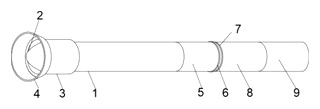
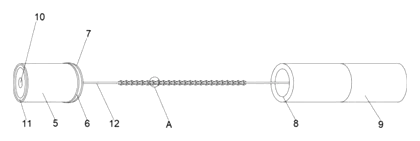
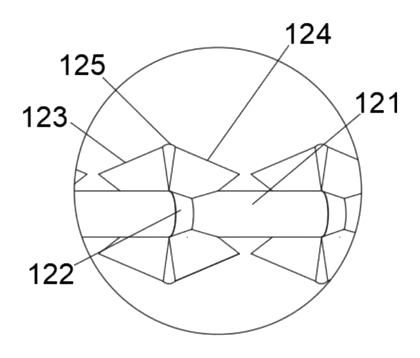
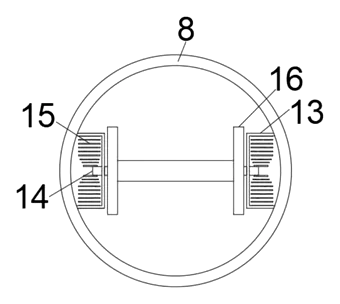
Drawings reproduced from the public patent document for reference.
Frequently asked questions
How does the wire saw retract?
The saw is attached to two recovery sticks inside the tail sleeves. Planar spiral springs are connected to these sticks. When you screw the sleeves together, the physical movement rotates the sticks against the spring tension, winding the wire rope back into the housing. When unscrewed, the springs release, pushing the sticks out to deploy the saw.
Is the focus adjustment electronic?
No. The focus is purely mechanical. You slide the movable ring forward or backward along the lamp body. This changes the distance between the light source and the gathering cover, altering the beam from a narrow spot to a wider flood.
Can I replace the batteries myself?
The patent describes the general structure but does not specify the exact battery compartment design or replacement method. Typically, such flashlights use removable lithium-ion cells or built-in rechargeable packs. Specific battery compatibility is set in design and confirmed on prototypes.
Is the saw safe to carry?
When the sleeves are fully threaded together, the saw is completely enclosed within the cavity between the first and second sleeves. The toothed blades are hidden, preventing accidental cuts during storage or transport.
What materials are used for the body?
The patent mentions a lamp body and sleeves but does not restrict the material. For production, aluminum alloys are common for durability and heat management, while reinforced polymers might be used for internal components. Material selection depends on the final design specifications.
Does it have waterproofing?
The patent does not explicitly state an IP rating. However, the threaded connections between the sleeves suggest a design capable of some level of environmental protection. Water ingress at seals is a known failure point in such mechanisms, so custom gaskets would likely be added in production to meet specific IP standards.
Can this design be made and sold in the US?
The patent is in force in China, and the public record shows no US counterpart. Therefore, this specific Chinese patent does not restrict making or selling the design in the US. However, other US patents may cover similar tactical lighting features, so a freedom-to-operate review is recommended.
Are you affiliated with the patent owner?
No. IP2M is an independent design and manufacturing service working from the public patent document.
Request a quote
Click Request a Quote below to see our email address - copy it, or open your email app with a ready-made message. Please mention patent CN111207314B in the subject.
Helpful details to include:
- Your company and channel (tactical gear distributor, outdoor retailer, security supplier)
- Light specifications (lumens, color temperature, battery type)
- Saw preferences (blade length, tooth style, wire thickness)
- Material and finish (aluminum grade, anodizing color)
- Estimated quantity and target price
- Timeline - when you would like samples and the first shipment
You can also reach us at (332) 203-9997.
Page editor: Emily Zhang, Product Editor · IP2M
Last updated November 8, 2026. If something on this page looks wrong, email [email protected] and we will check it against the patent.
Interested in building this?
Tell us your target market, quantity and timeline. We reply with options for prototyping, small-batch runs or volume production.
Send your inquiry to
Please put CN111207314B in the subject line and tell us your company, country, estimated quantity and timeline.
Prefer to talk? Call (332) 203-9997.
More product-ready patents
All Lighting patents →
Lighting
Wrist-Worn Flashlight with Click-Lock Angle Adjustment
Rechargeable wrist flashlight whose lamp turns and locks at an angle with a push button.
Patent CN113915544B
Lighting
Self-Folding Desk Lamp That Turns into a Phone Stand
Desk lamp with a shape-memory stem that unfolds when warm and folds into a phone stand.
Patent CN213237087U
Lighting
Ring-Shaped Outdoor Lantern That Lifts Off a Power-Bank Charging Base
Ring lantern with a battery handle that docks in a cone base with its own battery, clamp and charging plug.
Patent CN212408329U
Lighting
LED Flameless Candle with an Outside Flame Shade and Wax Dish Top
Battery LED candle: flame shade stands above a dished wax top, angled LEDs light a printed wick.
Patent CN205424561U
Lighting
Telescoping Tripod Portable Work Light with Fold-In Light Panels
Telescoping tripod work light with dual light panels that fold flat into the base.
Patent CN207298471U
Lighting
Self-Cooling and Self-Cleaning LED Street Light with Rainwater Harvesting
LED street lamp that harvests rain to cool its heat sink and spray-wash the lens automatically.
Patent CN205480639U
Browse by category
- Apparel & Accessories (51)
- Baby & Kids (30)
- Bags & Luggage (17)
- Bath & Personal Care (33)
- Car Accessories (27)
- Furniture, Bedding & Storage (25)
- Garden & Outdoor (34)
- Health & Wellness (15)
- Home, Kitchen & Cleaning (52)
- Lighting (25)
- Packaging & Containers (13)
- Pet Products (12)
- Phone & Camera Accessories (10)
- Retail Display (27)
- School, Office & Art (38)
- Sports & Recreation (49)
- Tools & Workshop (57)
- Toys & Games (24)
This page is based on the public patent document CN111207314B, assigned to Anhui Lanjian Police Equipment Manufacturing Co ltd. IP2M is an independent manufacturing service and is not affiliated with, endorsed by or licensed by the patent owner. Images marked as concept renderings are illustrations, not photos of an existing product. Patent status information is provided for reference only and is not legal advice; confirm freedom to operate for your market before production. Full disclaimer.