
Patent CN111317250B
Updated November 6, 2026Double-Rotation Electric Bottle Brush with Synchronized Side and Tip Cleaning
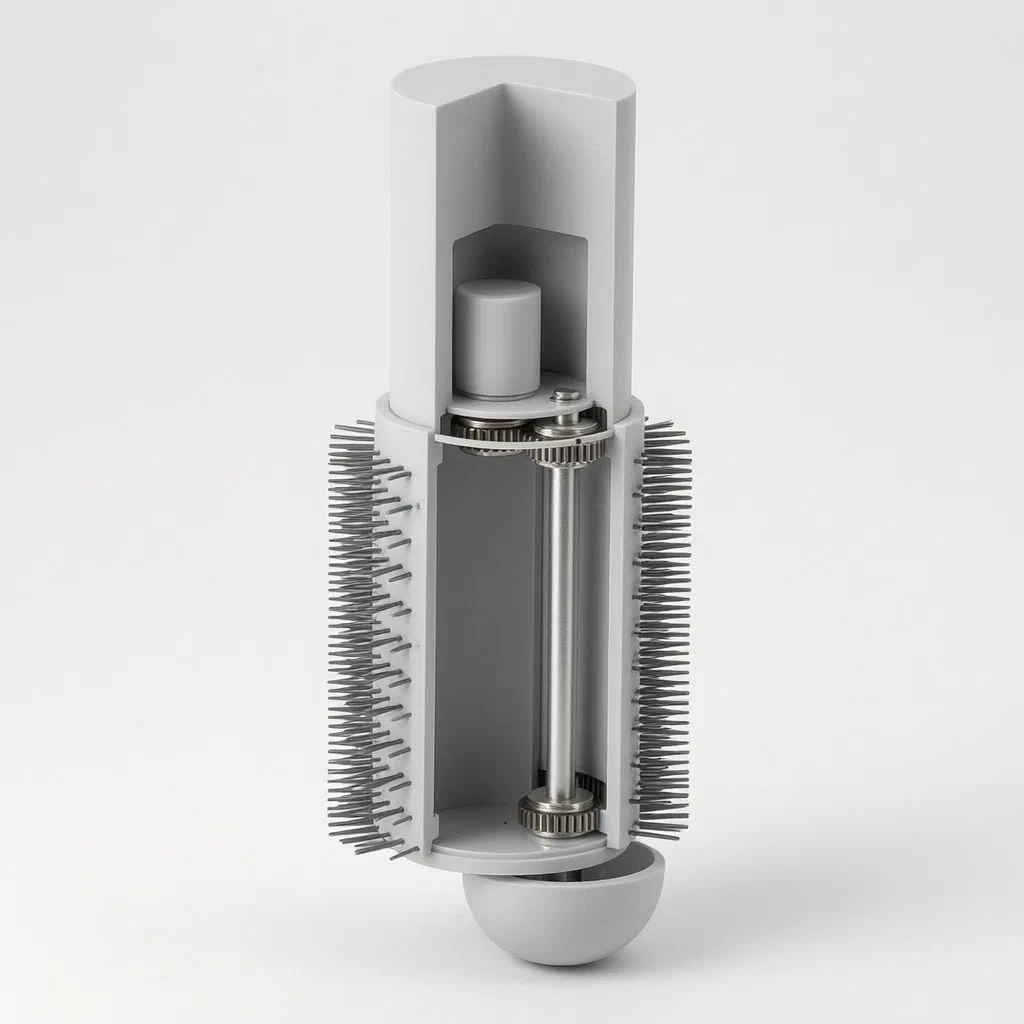
Cleaning tall, narrow bottles is often frustrating: manual brushes miss the bottom, and rotating them requires awkward wrist movements. Standard electric brushes usually only spin the main shaft, leaving the sides uncleaned. This patent describes a double-rotation bottle brush where the outer sleeve and the inner tip move together. A motor drives a central shaft; gears mesh the shaft with the outer brush body, causing it to spin. Simultaneously, the shaft rotates an eccentric tip brush at the end. Because both parts turn in synchronization, the brush cleans the vertical walls and the base of the container in one pass. The handle houses the motor and battery (or power source), while the brush section is sealed against water leakage using specific groove-and-ring configurations.
- China invention patent - in force
- No filings outside China
- Kitchen & cleaning tools
- Gear-driven dual rotation, sealed housing
Splat! What let you down?
🔄
Synchronized Rotation
The outer brush body and inner tip rotate together via a gear transmission system.
💧
Water-Sealed Design
Sealing rings fit into specific grooves on the handle and brush spigots to protect the motor.
🔌
Modular Assembly
The brush head detaches from the handle for replacement or cleaning of the mechanism.
🧹
Full Coverage
Eccentric tip brushing combined with side rotation cleans bottle bottoms and walls efficiently.
Bring this product to market
- ✓ Patent review Patent family and legal status reviewed in the relevant jurisdictions.
- 2 Product brief · now How it works, uses and options written up
- 3 Prototype First samples for buyers to review
- 4 Pilot run Small first batch for launch customers
- 5 Volume production Repeat orders at scale
Buyer interest
– of 100 buyers needed to start prototyping
One click, no sign-up. Each vote is one real visitor, and products with the most interest go to prototyping first.
Build team: no members yet. Need a partner, co-funding or skills to build this? Join and we introduce the team once it forms.
Patent Rights & Team Participation
Before joining a development team, participants should ensure they have the necessary rights or authorization to participate in the project.
Participation is generally appropriate where:
- You own the relevant patent rights or have obtained permission or a license from the rights holder.
- The relevant patent rights have expired or have been legally invalidated in the jurisdictions where the planned activities will take place.
- The planned development, manufacturing, and commercialization activities have been independently assessed and do not infringe applicable patent rights in the relevant jurisdictions.
Important: Being located outside a country where a patent is protected does not automatically exempt you from patent infringement risks. Patent rights may apply based on where development, manufacturing, use, sale, or import activities take place.
IP2M does not grant any patent license or authorization through team participation. Joining a project does not provide permission to use, manufacture, or commercialize patented technology.
The problem
Manual bottle brushes require significant physical effort to reach deep into narrow containers, and users often struggle to clean the bottom corners without tilting the bottle excessively. Existing electric bottle brushes typically drive only the main shaft, meaning the side bristles do not rotate independently or effectively enough to scrub the vertical walls while the tip cleans the base. This results in uneven cleaning, requiring repeated passes or additional manual scrubbing. Furthermore, many electric designs lack adequate sealing between the wet brush area and the dry motor housing, leading to corrosion or electrical failure when exposed to soapy water. There is a need for a tool that automates the scrubbing action across all surfaces of the bottle interior while protecting its internal mechanics from water damage.
The solution
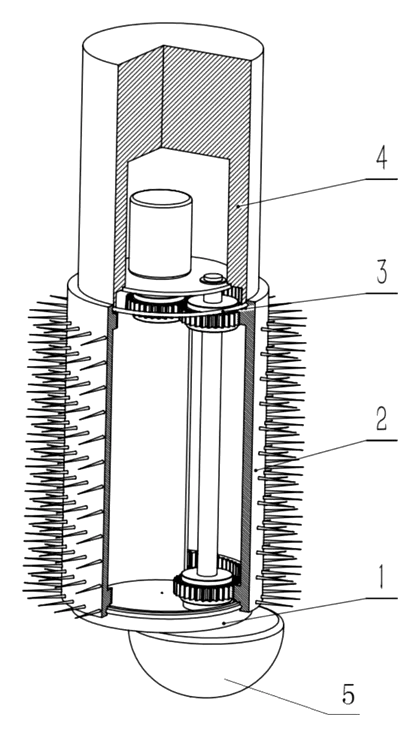
This patent introduces a double-rotation bottle brush comprising a side brush body, a brush head, a transmission mechanism, and a handle. The core innovation lies in the transmission mechanism, which synchronizes the movement of the outer and inner cleaning elements.
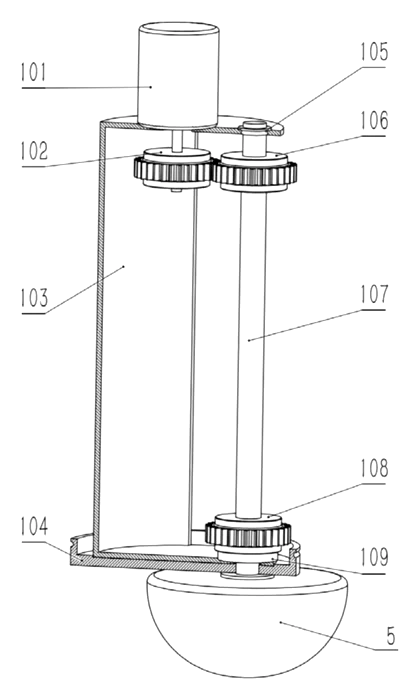
- Transmission Structure: The mechanism includes an inner shell and a transmission shaft running along its length. One end of the shaft connects to a motor via a gear set, while the other end connects to the brush head.
- Dual Gear Meshing: An external gear is located near the brush head end of the shaft. Both the motor-side gear set and this external gear mesh with an internal gear housed inside the side brush body. This arrangement ensures that when the motor turns the shaft, the side brush body rotates simultaneously.
- Eccentric Tip: The brush head is mounted eccentrically below the side brush body on the transmission shaft. As the shaft rotates, the brush head sweeps in a circular path, cleaning the bottom of the bottle. The side surface of the brush head protrudes beyond the side surface of the side brush body to ensure contact with the container floor.
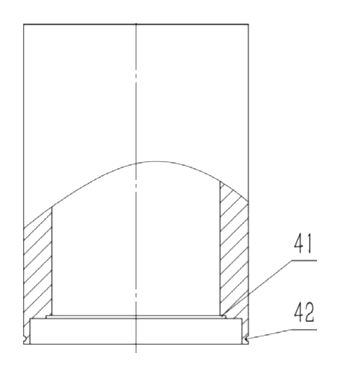
- Sealing System: To prevent water from entering the handle cavity, sealing rings are installed in specific grooves. One ring sits between the outer wall of the handle and the inner wall of the side brush body. Another configuration involves mounting grooves on the limiting spigots of the brush body and corresponding grooves on the cover plate and handle, ensuring a watertight barrier at the junction points.
- Detachable Connection: The side brush body is detachably connected to the handle, allowing for disassembly. The inner shell forms a semi-closed structure using a side baffle and two mounting discs, providing structural support for the gears and shaft while maintaining compactness.
Who it is for
- Kitchenware Brands: Companies looking to differentiate their cleaning accessories by offering a motorized, hands-free option for baby bottles, thermoses, and wine decanters.
- Amazon Sellers: Private label sellers seeking a product with clear functional advantages over static manual brushes, capable of commanding a higher price point due to the complex gear mechanism.
- Industrial Cleaning Suppliers: Firms serving laboratories or food processing plants where consistent, automated cleaning of glassware or small containers is required for hygiene standards.
- Gadget Manufacturers: Innovators interested in integrating simple gear-based automation into handheld tools without relying on expensive electronic sensors or complex robotics.
How it works
The main parts
| No. | Part | What it does |
|---|---|---|
| Handle | Houses the motor and power source; provides grip. | |
| Side Brush Body | Cylindrical outer brush with bristles; rotates around the axis. | |
| Brush Head | Eccentric tip brush; rotates to clean the bottle bottom. | |
| Transmission Shaft | Connects motor to brush head; carries external gear. | |
| Inner Shell | Semi-closed housing supporting the shaft and gears. | |
| Internal Gear | Located inside the side brush body; meshes with external gears. | |
| Sealing Rings | Prevent water ingress at the handle-brush interface. | |
| Cover Plate | Seals the far end of the brush body; contains positioning spigots. |
Operating Steps
- Activation: The user inserts the brush into a bottle and activates the motor (via switch on the handle).
- Power Transmission: The motor drives the transmission shaft through the gear set.
- Side Rotation: The external gear on the shaft meshes with the internal gear fixed within the side brush body. This causes the entire side brush body to rotate around the central axis, scrubbing the vertical walls of the bottle.
- Tip Rotation: Simultaneously, the shaft continues to rotate the brush head. Because the brush head is mounted eccentrically, it spins in a circle rather than just around its own center. This sweeping motion cleans the bottom and lower corners of the bottle.
- Synchronization: The gear ratio ensures that the side body and the tip move in a coordinated fashion, covering the full interior volume in a single insertion.
- Protection: Throughout operation, the sealing rings positioned in the mating grooves of the handle and brush body prevent liquid from reaching the motor and gears inside the handle cavity.
Applications
Baby Bottle Cleaning
Parents often struggle to clean milk residue from the narrow necks and curved bottoms of baby bottles. This brush’s dual rotation removes formula buildup from both the sides and the base without vigorous manual scrubbing, reducing fatigue and improving hygiene.
Thermos and Flask Maintenance
Deep, narrow stainless steel flasks are difficult to reach with standard sponges. The synchronized side and tip action cleans the long vertical walls and the flat bottom of the flask, preventing odor-causing bacteria from accumulating in hard-to-reach areas.
Laboratory Glassware
In educational or professional labs, beakers and test tubes require precise cleaning to avoid contamination. This tool offers a controlled, uniform scrubbing action that can clean multiple pieces quickly, ensuring the bottom sediment is removed effectively.
Wine Decanter Care
Wine decanters have wide bases but narrow necks, making them tricky to clean manually. The eccentric tip brush reaches the broad bottom curve while the side brush handles the neck and shoulder, preserving the clarity of the glass without risking breakage from excessive pressure.
Where it is less suitable
- Very Wide Open Containers: For buckets or large pots, the narrow diameter of this brush may not cover the surface area efficiently compared to a larger sponge or pad.
- Extreme Length Bottles: If the bottle is significantly longer than the brush shaft, the torque loss or inability to reach the top might reduce effectiveness; custom lengths would be needed.
- Delicate Hand-Painted Ceramics: The mechanical rotation and bristle friction might be too aggressive for fragile, decorative items that require gentle hand-washing.
Patent & Production
At a glance
| Patent number | CN111317250B (application CN202010228972) |
| Type | China invention patent (发明专利) - protects product structure and method |
| Original title | Double-rotation type bottle brush (一种双转动式瓶刷) |
| Patent owner | Shandong University |
| Inventors | Li Jianyong, Xia He, Zhang Chao, Ren Xiuhua, Li Jianfeng, Man Jia, Zhang Shanguo |
| Filing date | 2020-03-27 |
| Grant date | 2022-07-19 |
| Status (China) | In force - valid until at most 2040-03-27, provided annual fees are paid |
| Patent family | Public record shows Chinese filings only - no US, European, Japanese, PCT or other filings listed |
| Cited by | 0 later documents |
| Source | Google Patents (search for CN111317250B) |
What the claims cover, in plain language
Claim 1 defines a double-rotation bottle brush consisting of a side brush body, a brush head, a transmission mechanism, and a handle. Key structural features include:
- The transmission mechanism has an inner shell and a transmission shaft.
- One end of the shaft connects to a motor via a gear set; the other end connects to the brush head.
- The side brush body surrounds the transmission mechanism.
- An external gear on the shaft near the brush head and the gear set near the motor both mesh with an internal gear inside the side brush body.
- This meshing causes the side brush body and brush head to rotate synchronously.
- The brush head is mounted eccentrically below the side brush body, with its side surface protruding outward.
- Sealing rings are placed between the handle and the side brush body, utilizing specific mounting grooves on the limiting spigots of the brush body and the handle.
- The inner shell is formed by a side baffle and two mounting discs (first and second).
- The brush head is made of flexible materials.
Claim 2 specifies that the cover plate at the end of the brush body has a second positioning spigot and a third mounting groove on its outer side, which matches with the second mounting plate/spigot configuration to secure the seal.
This is a simplified reading for orientation only. The legal scope is defined by the exact claim wording in the official Chinese document.
What this means for US production
This patent was filed in China and is currently in force. Making or selling this specific gear-synchronized design in China requires the permission of the patent owner (Shandong University). However, the public record shows no US counterpart or foreign family members. Therefore, under current records, this specific Chinese patent does not restrict manufacturing or sales in the United States.
Two points to settle early:
- Other patents may exist. Motorized cleaning tools and gear mechanisms are common fields. While this specific combination is patented in China, there may be broader US patents covering electric bottle brushes, eccentric cleaning tips, or waterproof motor housings. A freedom-to-operate (FTO) review is strongly recommended before mass production in the US to ensure no infringement of existing US utility patents.
- Component sourcing. The gear set and internal/external gear meshing must be precisely manufactured to ensure smooth synchronous rotation. Tolerances affect noise and lifespan.
Customization and manufacturing
What can be customized
| Area | Options |
|---|---|
| Brush Material | Nylon, silicone, or natural fibers for bristles; soft TPE for the tip. |
| Motor Type | DC brushed motor (cost-effective) or brushless (longer life, quieter). |
| Battery/Power | Rechargeable Li-ion, AA/AAA batteries, or USB-C wired power. |
| Housing Color | Injection molded ABS or PP in various Pantone colors. |
| Shaft Length | Adjustable based on target bottle depth (e.g., 20cm, 30cm). |
| Sealing Grade | IPX4 splash-proof vs. IPX7 submersible (requires tighter tolerances). |
Things to plan for (US market)
- FDA 21 CFR: Since this is a kitchen item contacting food/drink residues, materials must be food-safe. BPA-free plastics are standard expectations.
- UL / FCC: If using rechargeable batteries, UN 38.3 transport certification is required for shipping. If the motor controller emits radio frequencies (unlikely for simple DC, but possible if wireless charging is added), FCC Part 15 compliance applies.
- CPSC Safety: Ensure no sharp edges or pinch points in the gear mechanism accessible to children, as this is a household cleaning tool.
- California Prop 65: Check plasticizers and heavy metals in seals and casings.
How a project runs
- Inquiry - Define target bottle sizes, power preference, and aesthetic direction.
- Design - CAD modeling of the gear train, sealing interfaces, and ergonomic handle.
- Prototype - 3D printed shells and CNC machined gears for fit testing.
- Pilot Run - Small batch injection molding, motor assembly, and durability testing.
- Production - Full mold tooling, component sourcing, final assembly, and packaging.
Quantities & timeline
Tooling for the multi-part housing (handle, inner shell, side brush body) takes 8-12 weeks. Gears require precision molds to minimize backlash. Send us your target retail price, estimated annual volume, and desired power source (battery/wired) and we will reply with options.
Production notes
Tooling and process
The inner shell and side brush body likely require injection molding with multi-cavity molds to manage part count. The transmission shaft and gears may be molded or stamped depending on load requirements. Silicone molding is typical for the flexible brush head to ensure it conforms to bottle curves. Final assembly involves snap-fit casing connections and press-fit bearings and gears.
Cost drivers
The primary cost factors are typically the number of molds and cavities required for the intricate gear housing and the material grade of the plastics (ABS vs. PP). Part count and assembly steps are high due to the separate sealing rings, gears, and shaft components. Surface finish quality on the visible handle affects perceived value and adds to painting or printing costs.
Prototyping path
We would start with a 3D model and interference check to validate the gear meshing angles. Produce a 3D-printed body to test the ergonomic fit and assembly sequence. Use CNC or simple tool methods initially to check torque transmission. Proceed to functional sample testing to verify the synchronization of the side and tip rotation before committing to steel tooling.
What we would change before tooling
Before finalizing steel molds, we would refine the sealing groove dimensions to ensure compression ratios are optimal for leak prevention without hindering assembly. We might simplify the inner shell structure if it reduces cycle time during injection molding. Adjusting the gear tooth profile slightly could reduce operational noise, which is critical for consumer acceptance.
Common failure points
Potential issues include shaft and bearing alignment errors causing vibration or premature wear. Sealing surface and gasket compression failures can lead to water ingress, corroding the motor. Thin walls warping or sinking in the plastic housing can misalign the gears. Trapped water or residue in crevices behind the side brush body can cause hygiene issues if drainage is not considered in the design.
Patent drawings
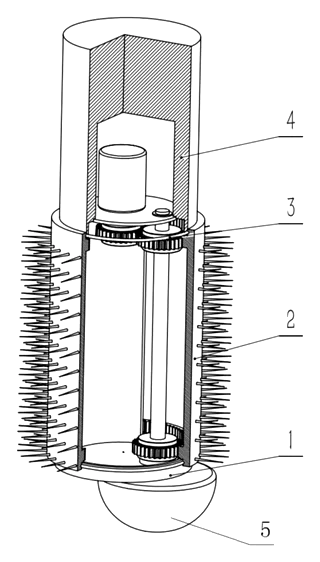
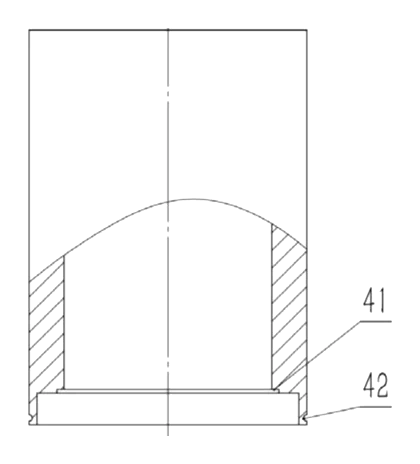
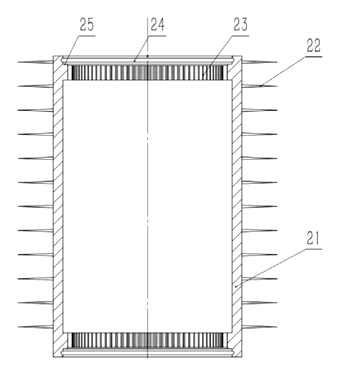
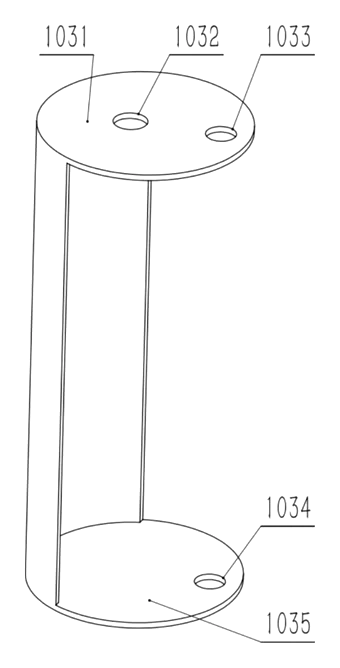
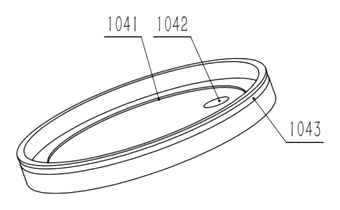
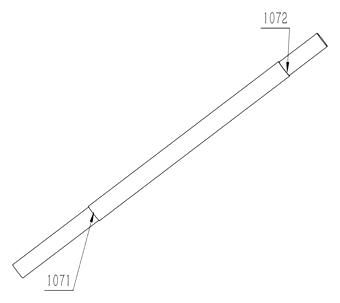
Drawings reproduced from the public patent document for reference.
Frequently asked questions
How does the dual rotation actually work?
The device uses a central transmission shaft driven by a motor. Near the top, a gear set connects the motor to the shaft. At the bottom, an external gear on the shaft meshes with an internal gear inside the outer brush sleeve. When the motor turns, the shaft rotates the tip brush directly, and simultaneously turns the outer sleeve via the gears. This creates two moving cleaning surfaces at once.
Is the brush waterproof?
The design includes specific sealing rings located in grooves between the handle and the brush body, and around the cover plate. These seals are intended to keep water out of the motor housing. However, “waterproof” depends on the quality of assembly and seal compression. It is designed to be splash-resistant during normal use, but should not be submerged unless rated for it.
Can I replace the brush heads?
Yes, the patent describes a detachable connection between the side brush body and the handle. This allows users to swap out worn brushes or different sized heads without replacing the entire motor unit. The modular design supports easy maintenance.
What materials are used for the bristles?
The patent states the brush head is made of flexible materials. In production, this typically means silicone or soft nylon for the tip to avoid scratching glass, and firmer nylon or polypropylene for the side bristles to provide scrubbing power. Specific material grades are determined during the design phase based on the target container type.
Does it require a lot of battery power?
Because it drives two rotating masses (the sleeve and the tip), it consumes more energy than a simple single-shaft brush. However, the gear ratio helps manage torque. Power consumption depends on the motor efficiency and gear friction. Typical designs aim for 30-60 minutes of runtime on a standard rechargeable cell.
Is it safe for dishwasher cleaning?
The motorized handle is generally not dishwasher safe due to the electronics and seals. The removable brush head portion might be dishwasher safe if made of heat-resistant plastics like PP, but you must confirm the temperature rating of the specific materials chosen during manufacturing. Always check the final product labeling.
Can this design be made and sold in the US?
The patent CN111317250B is in force in China. However, the public record shows no US counterpart or international family members. Therefore, this specific Chinese patent does not legally restrict manufacturing or selling this design in the United States. Note that other US patents may cover similar technologies; a freedom-to-operate search is advised before launch.
Are you affiliated with the patent owner?
No. IP2M is an independent design and manufacturing service working from the public patent document. We are not licensed by Shandong University nor involved in any litigation regarding this patent.
Request a quote
Click Request a Quote below to see our email address - copy it, or open your email app with a ready-made message. Please mention patent CN111317250B in the subject.
Helpful details to include:
- Your company and channel (kitchenware brand, Amazon seller, industrial supplier)
- Target container types (baby bottles, thermoses, lab glassware)
- Power preference (rechargeable lithium, disposable batteries, or USB)
- Estimated quantity for first order and annual volume
- Timeline - when you would like prototypes and the first shipment
You can also reach us at (332) 203-9997.
Page editor: Daniel Chen, Product Research Editor · IP2M
Last updated November 6, 2026. If something on this page looks wrong, email [email protected] and we will check it against the patent.
Interested in building this?
Tell us your target market, quantity and timeline. We reply with options for prototyping, small-batch runs or volume production.
Send your inquiry to
Please put CN111317250B in the subject line and tell us your company, country, estimated quantity and timeline.
Prefer to talk? Call (332) 203-9997.
More product-ready patents
All Home, Kitchen & Cleaning patents →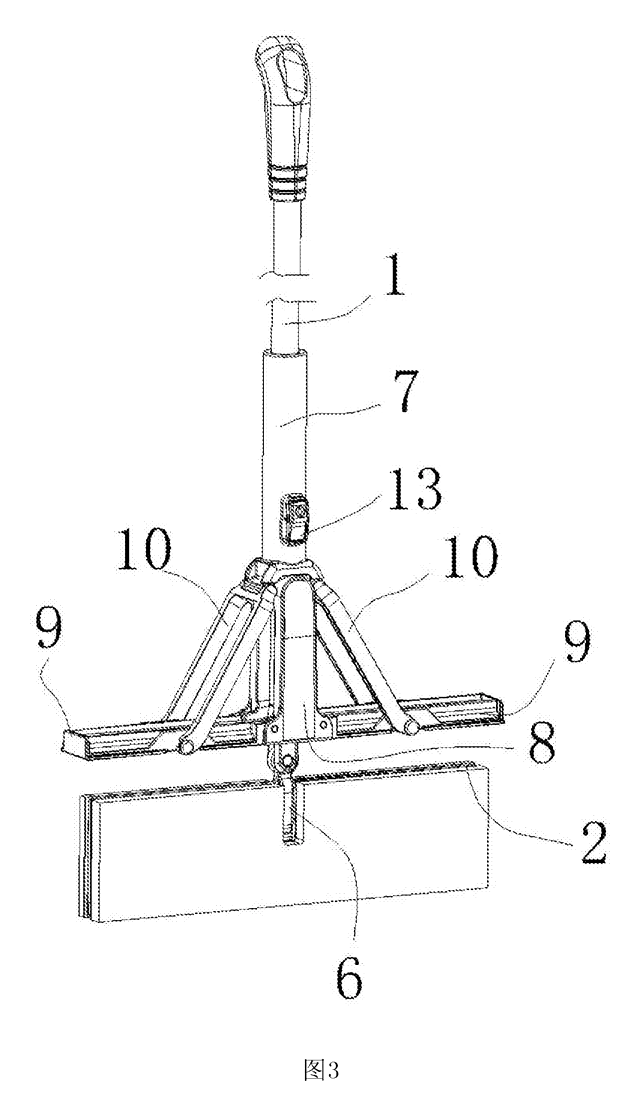
Home, Kitchen & Cleaning
Self-Wringing Flat Mop with Fold-Away Wringer
Flat mop with a built-in wringer that opens only when you wring and folds flat against the pole when you mop.
Patent CN207734114U
Home, Kitchen & Cleaning
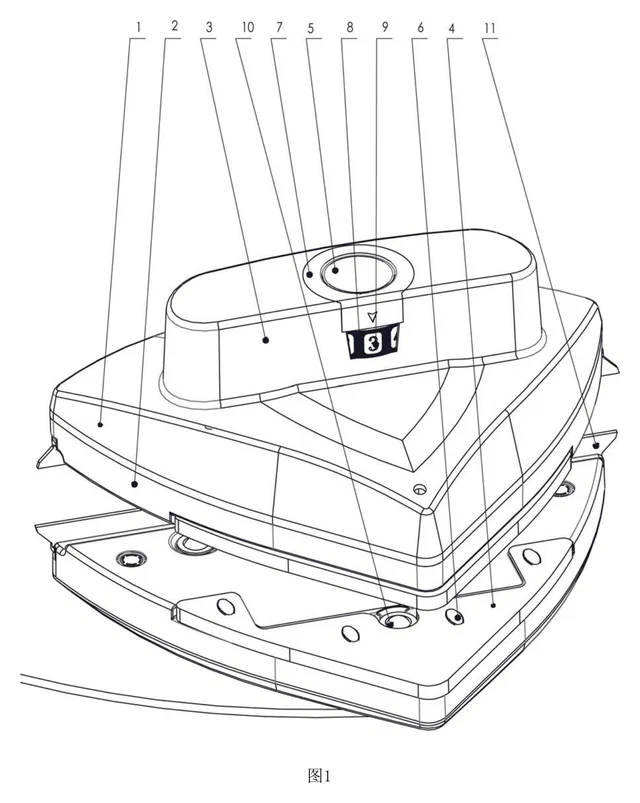
Magnetic Double-Sided Window Cleaner with Dial-Set Magnet Strength
Magnetic window cleaner with a sealed, sliding magnet, dial-set strength for different glass thicknesses and a spring-held idle position.
Patent CN209360543U
Home, Kitchen & Cleaning
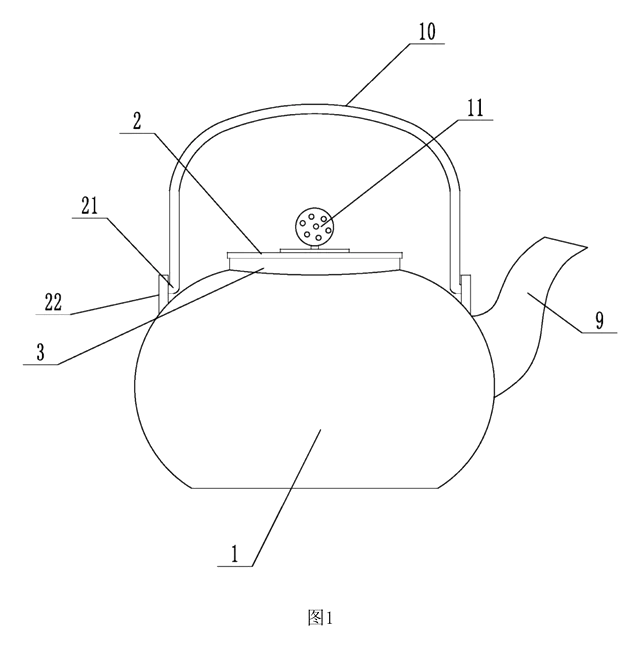
Metal Kettle with Magnetic Lid That Stays On When Pouring
Metal teapot/kettle with a magnet-held lid that does not fall off when pouring, and an insulated, vented lid knob.
Patent CN210540477U
Home, Kitchen & Cleaning
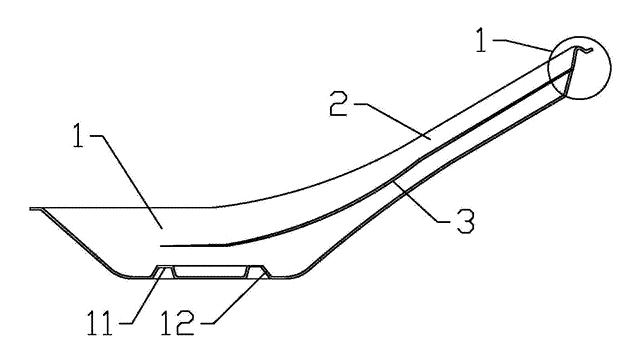
Reinforced Disposable Soup Spoon
Disposable soup spoon with a handle-to-bowl rib, stiffened edges and a ring foot to resist breaking.
Patent CN206964482U
Home, Kitchen & Cleaning
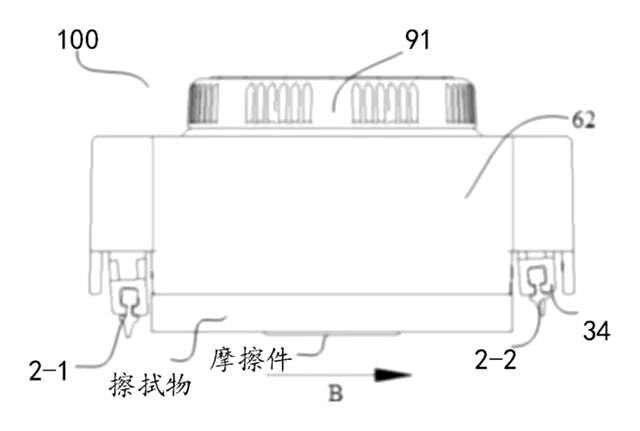
Self-Switching Double-Squeegee Window Cleaner
Cleaning head with two squeegee blades that switch automatically with the direction of movement.
Patent CN212630655U
Home, Kitchen & Cleaning
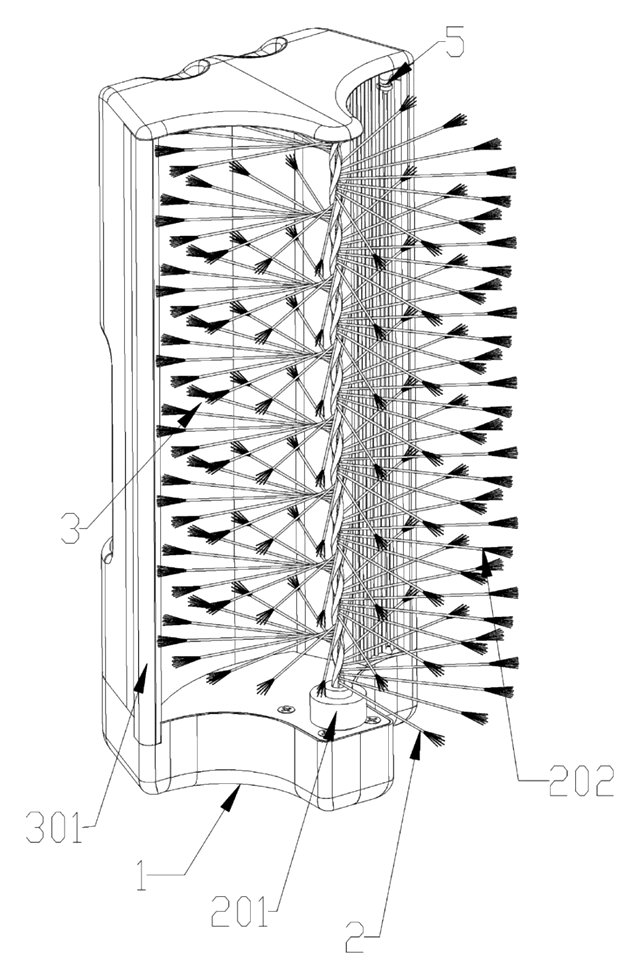
Self-Rinsing Roller Scrub Brush with Dirty-Water Tank
Powered roller brush that rinses and spins its bristles clean inside the body and stores the dirty water.
Patent CN210076909U
Browse by category
- Apparel & Accessories (43)
- Baby & Kids (28)
- Bags & Luggage (16)
- Bath & Personal Care (29)
- Car Accessories (23)
- Furniture, Bedding & Storage (22)
- Garden & Outdoor (29)
- Health & Wellness (13)
- Home, Kitchen & Cleaning (46)
- Lighting (22)
- Packaging & Containers (11)
- Pet Products (10)
- Phone & Camera Accessories (9)
- Retail Display (23)
- School, Office & Art (33)
- Sports & Recreation (41)
- Tools & Workshop (50)
- Toys & Games (21)
This page is based on the public patent document CN111317250B, assigned to Shandong University. IP2M is an independent manufacturing service and is not affiliated with, endorsed by or licensed by the patent owner. Images marked as concept renderings are illustrations, not photos of an existing product. Patent status information is provided for reference only and is not legal advice; confirm freedom to operate for your market before production. Full disclaimer.