At a glance
| Patent number | CN111762253B (application CN202010672213) |
| Type | China invention patent (发明专利) - protects product method and structure |
| Original title | Garden Landscape Flowerpot Carrying Vehicle (一种园林景观花盆搬运车) |
| Patent owner | Luban Art Group Co ltd |
| Inventors | Rao Mingquan |
| Filing date | 2020-07-14 |
| Grant date | 2022-12-20 |
| Status (China) | Lapsed - terminated for non-payment of annual fees (recorded 2026-07-24) |
| Patent family | Chinese filings only - no US, European, Japanese, PCT or other filings listed |
| Cited by | 0 later documents |
| Source | Google Patents (search for CN111762253B) |
What the claims cover, in plain language
Claim 1 - defines a garden landscape flowerpot carrying vehicle comprising a collection box, a fixed placement plate, a drive motor, a first gear, support plates, wheels, a moving mechanism, and a blocking component. The moving mechanism consists of symmetrically arranged sliding plates with racks. One rack meshes with the first gear. Guide sleeves and support rods connect to the racks. Swing bars are rotatably connected to the support rods and linked by extrusion springs. Rollers on the swing bars contact inclined plates fixed to the box. Guide rods slide within the sleeves and connect to a carrying frame at the bottom.
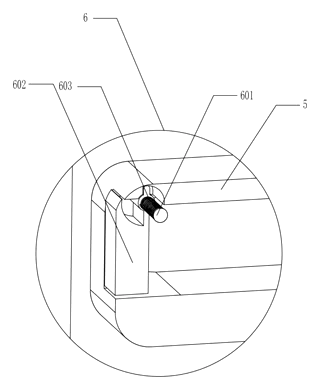
Claim 2 - specifies the blocking component includes a first fixed shaft, a swinging block, and a torsion spring, positioned on the inclined plates to prevent backward sliding of the pots.
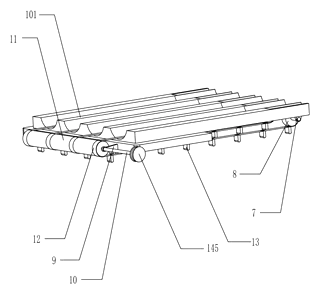
Claim 3 - adds a pushing mechanism with fixing bases, transferring wheels, rotating shafts, and belts, allowing manual movement of the cart when the motor is not engaged.
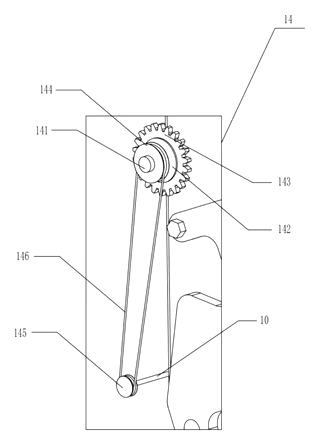
Claim 4 - details the transmission member involving a second rotating shaft, an overrunning clutch, gears, and pulleys/belts to manage power distribution and potentially allow coasting or disengagement.
This is a simplified reading for orientation only. The legal scope is defined by the exact claim wording in the official Chinese document.
What this means for US production
This patent was filed only in China and has lapsed due to non-payment of annual fees. It currently holds no active rights in China or elsewhere. It has no US or other foreign counterpart.
Two points to settle early:
- Other patents may exist. Automated material handling and garden machinery are competitive fields with many existing patents covering similar gear-rack lifts and motorized carts. A freedom-to-operate (FTO) review is essential before tooling to ensure no US patents restrict the specific combination of the incline-lever lift and gear drive.
- Motor Safety Standards. Since the device uses an electric motor and battery (implied or external), electrical safety standards must be met for US market entry.
Customization and manufacturing
What can be customized
| Area | Options |
|---|---|
| Capacity | Number of pots per lift cycle (adjust frame size) |
| Power Source | Battery voltage, wired AC, or hybrid manual push |
| Materials | Steel vs. aluminum frame for weight reduction; stainless steel for wet environments |
| Wheel Type | Pneumatic tires for rough terrain vs. solid rubber for smooth floors |
| Controls | Simple toggle switch vs. remote control or timer-based automation |
| Finish | Powder coating colors for branding; rust-resistant treatments |
Things to plan for (US market)
- OSHA General Duty Clause: Employer responsibility to provide safe equipment; pinch points and moving parts must be guarded.
- UL 588 / UL 60335: If electric motors and controls are integrated, electrical safety certification is typically required for commercial equipment sold in the US.
- ANSI B11 Series: Safety standards for machine tools and industrial equipment, relevant if used in commercial nursery operations.
- California Prop 65: Warning labels may be needed if lead or phthalates are present in plastics or coatings.
How a project runs
- Inquiry - Define pot sizes, weights, and desired lift height.
- Design - Finalize gear ratios, incline angles, and motor selection.
- Prototype - Build functional models for lift speed and stability testing.
- Pilot Run - Test durability in real-world garden conditions (dirt, moisture).
- Production - Stamp frames, mold plastic parts, assemble motors, wire electronics.
Quantities & timeline
Tooling for stamped metal frames and injection-molded gear housings takes several weeks. Motor sourcing depends on supplier availability. Certification tests for electrical safety add time. Send us your capacity requirements, power preference, target quantity and we will reply with options.
Production notes
Tooling and process
Likely involves steel tube forming for the main frame and support structures. PP or ABS injection molding would be typical for gear covers, roller housings, and the blocking component’s plastic parts. Motor assembly requires integrating the drive unit with the gearbox output.
Cost drivers
Part count is typically significant due to the multiple rollers, springs, and linkages. Material certification for metals exposed to soil and water usually adds cost. Safety testing for pinch points and electrical components is mandatory.
Prototyping path
Prototyping typically starts with a 3D-printed fit sample to verify the incline-lever geometry. Proceed to a load sample using actual pots to test the swing bar strength. Conduct a small-parts and pinch test to identify guarding needs.
What we would change before tooling
We would likely adjust the spring rate consistency to ensure uniform lifting across all pots. Reinforcing the motor mount area is critical to prevent cracking under vibration. Ensuring shaft and bearing alignment tolerances are tight will reduce noise and wear.
Common failure points
Pinch points between the swing bars and inclined plates are a primary safety concern. Tipping may occur if the center of gravity shifts during lift. Spring fatigue could lead to uneven lowering. Phthalate content in molded parts should be verified for compliance.
Patent drawings
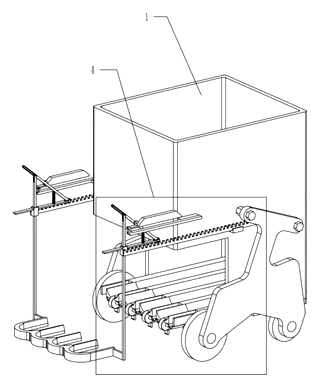
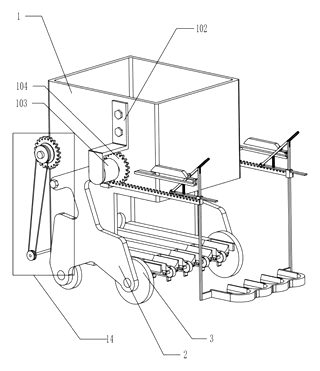
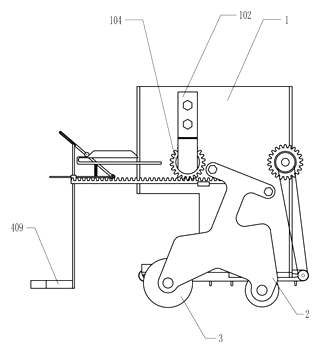
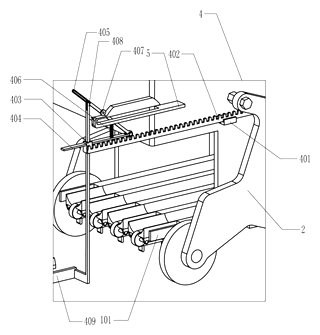
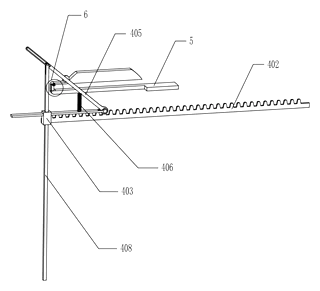
Drawings reproduced from the public patent document for reference.