
Patent CN112091901B
Updated November 3, 2026Variable Angle Implant Torque Wrench with Ratchet Control
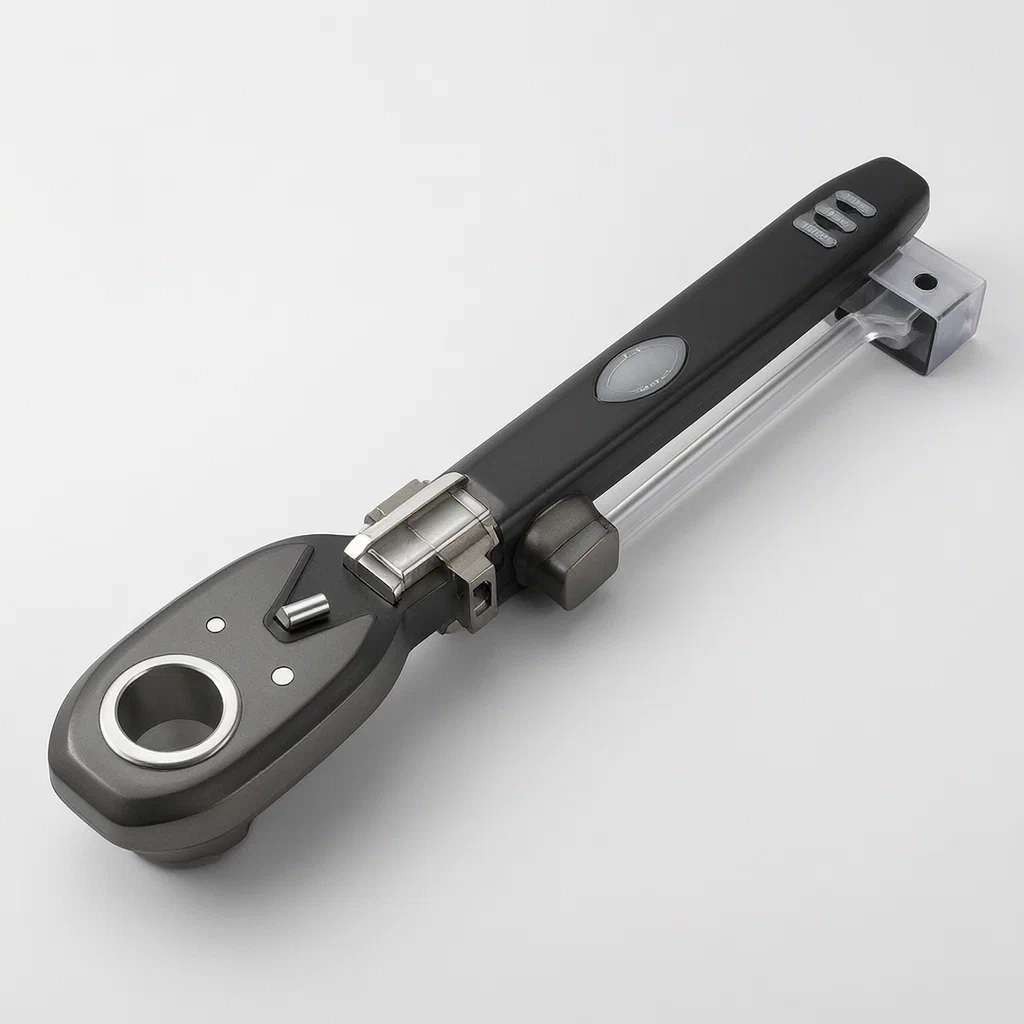
Standard straight screwdrivers struggle when implant abutments are angled or space is tight. This tool solves that by allowing the driver head to pivot to a working angle selected by the operator. The user presses a release tab to rotate the head to the desired angle, then releases it to lock the position. A three-position switch on the head controls the ratchet direction, enabling quick switching between tightening and loosening without changing tools. A elastic arm on the side forms part of the torsion controller; the patent does not establish an automatic torque cutoff or a calibrated feedback threshold.
- China invention patent - active
- No filings outside China
- Dental implant tools
- Adjustable head angle, ratchet control, torsion controller
Splat! What let you down?
🔄
Pivoting Head
The head rotates relative to the handle to reach angled implants.
🔒
Ratchet Direction Switch
A movable clip locks the ratchet for clockwise, counter-clockwise, or free spin.
⚖️
Torque Controller
Side-mounted elastic arm provides resistance feedback during tightening.
🧩
Modular Design
Head and body connect via a square protrusion joint for easy cleaning and part replacement.
Bring this product to market
- ✓ Patent vetted China-only family and legal status checked
- 2 Product brief · now How it works, uses and options written up
- 3 Prototype First samples for buyers to review
- 4 Pilot run Small first batch for launch customers
- 5 Volume production Repeat orders at scale
Buyer interest
– of 100 buyers needed to start prototyping
One click, no sign-up. Each vote is one real visitor, and products with the most interest go to prototyping first.
Build team: no members yet. Need a partner, co-funding or skills to build this? Join and we introduce the team once it forms.
According to the patent, this mechanism is intended for access to implant components. The description is a technical proposal, not evidence of clinical performance or validated torque accuracy.
The problem
In dental implant procedures, surgeons often face limited mouth opening and awkward angles. When an implant fixture is placed at an angle, or the screw access hole faces distally or lingually, a standard straight-handled screwdriver cannot engage the component properly. This leads to poor grip, potential stripping of the screw head, and difficulty applying precise torque. Additionally, switching between tightening and loosening usually requires flipping the tool or changing drivers, which slows down the procedure. There is a need for a single instrument that can adjust its working angle, change rotation direction quickly, and provide basic torque control.
The solution
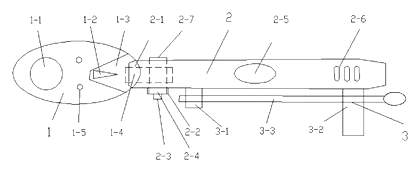
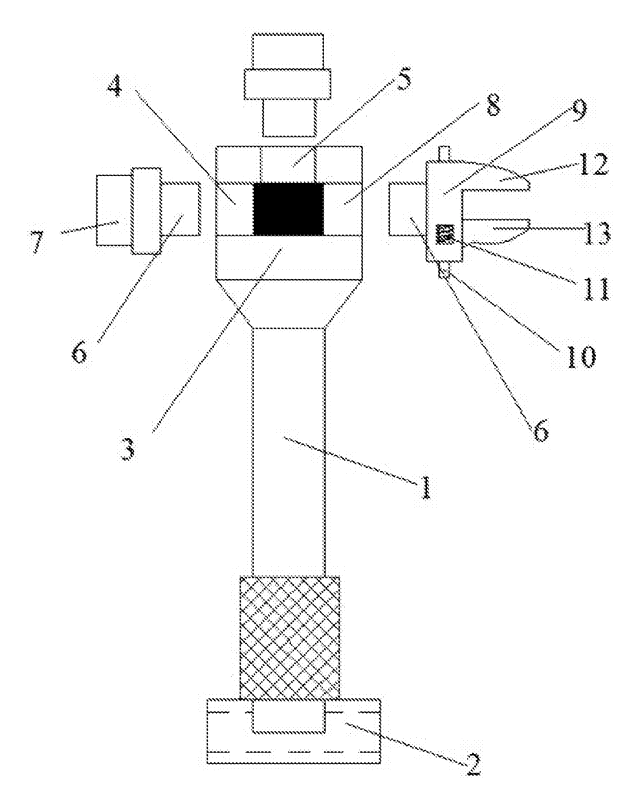
- Adjustable Head: The tool consists of a head (1) and a body (2). The head connects to the body via a movable joint (2-1) featuring a square protrusion (1-4).
- Angle Mechanism: A rotation angle device (2-2) allows the head to pivot. By pressing a movable pressing piece (2-3), the gear disengages from a cylindrical bulge (2-4), allowing the head to rotate around a shaft (2-7). Releasing the piece locks the head at the chosen angle.
- Ratchet Control: The head has a ratchet groove (1-1) and a sector dial (1-3). A movable elastic piece (1-2) slides across three scale marks. Left position locks clockwise motion; right position locks counter-clockwise; middle position allows free rotation.
- Torque Feedback: A torsion controller (3) is mounted on the side of the body. It uses two connectors of different heights and an elastic arm (3-3) as part of the torsion controller. Calibrated performance and operator feedback require separate validation.
Who it is for
- Dental Instrument Manufacturers: Companies looking to add advanced ergonomic tools to their implant surgery kits.
- OEM Brands for Dental Supplies: Brands needing custom-branded torque wrenches with specific angle ranges or torque settings.
- Surgical Tool Distributors: Wholesalers seeking differentiated products for oral surgery departments.
- Clinic Equipment Suppliers: Providers stocking consumable and reusable surgical instruments for private practices.
How it works
The main parts
| No. | Part | Function |
|---|---|---|
| 1 | Head | Contains the ratchet mechanism and drive interface. |
| 1-1 | Ratchet Groove | Holds interchangeable ratchet wheels of various sizes. |
| 1-2 | Movable Elastic Piece | Slides on the dial to select rotation direction or free mode. |
| 1-3 | Sector Dial | Displays scale marks for direction selection. |
| 2 | Body | Main handle housing the angle adjustment and torque control. |
| 2-1 | Movable Joint | Connects head to body via square protrusion for disassembly. |
| 2-2 | Rotation Angle Device | Allows pivoting of the head relative to the handle; usable limits require design verification. |
| 2-3 | Movable Pressing Piece | Release lever for adjusting head angle. |
| 3 | Torsion Controller | Side-mounted unit with elastic arm for torque resistance. |
| 3-3 | Elastic Arm | Forms part of the scale-marked torsion-control arrangement. |
Operating Steps
- Select Ratchet: Insert the appropriate ratchet wheel into the head’s groove based on the implant screw size.
- Set Angle: Press the movable piece (2-3) to unlock the head. Rotate the head to the required angle (to a suitable working position). Release to lock.
- Choose Direction: Slide the elastic piece (1-2) to the left mark to block clockwise rotation, right mark to block counter-clockwise rotation, or center for free spinning.
- Apply Force: Turn the body. Follow a separately validated torque procedure. The patent describes an elastic arm and scale-marked connector, not an automatic stop signal at a preset torque.
Applications
Angled Implant Placement
When implants are inserted at an angle due to bone density or anatomical constraints, the pivoting head allows the surgeon to adjust the driver approach to the screw axis, with engagement and slippage to be assessed on prototypes.
Limited Mouth Opening
In patients with restricted jaw movement, a straight handle may not fit. The adjustable angle feature enables the tool to work within tighter vertical clearances by angling the head away from the body.
Distal or Lingual Access
If the screw access hole faces backward or toward the tongue, the ratchet direction switch allows quick reversal of rotation without removing the tool from the mouth, speeding up the restoration process.
Torque Verification During Development
According to the patent, the side-mounted controller incorporates an elastic arm and a connector with torque scale values. Buyers should define a calibration and validation plan rather than assume an automatic torque limit or proven prevention of screw damage.
Where it is less suitable
- High-Precision Digital Surgery: This is a manual tool; it does not integrate with electronic torque meters or data logging systems.
- Very High Torque Requirements: The patent does not provide a validated load range. Do not select the device for a clinical torque requirement without appropriate engineering and regulatory evaluation.
- Single-Use Sterile Kits: The complex moving parts make thorough sterilization challenging compared to simpler, solid-shaft disposable drivers.
Frequently asked questions
How does the head angle adjustment work?
The head is attached to the body by a pivot mechanism. You press a small lever (the movable pressing piece) to disengage a locking gear. While pressed, you can rotate the head to a suitable working position. When you release the lever, the gear re-engages, locking the head firmly in place at that angle.
Can I change the direction of rotation easily?
Yes. There is a sliding switch on the top of the head called the movable elastic piece. The patent says the left position blocks clockwise rotation and the right position blocks counter-clockwise rotation. This is a direction lock, not a statement that either position always tightens a particular implant. Placing it in the middle allows the ratchet to spin freely in both directions.
Does it have a digital torque meter?
No. This tool uses a mechanical torque controller. An elastic arm on the side of the body bends as you apply force. The patent does not describe a digital display, automatic cutoff, or an established warning threshold. Torque accuracy and any feedback mechanism need to be verified on the finished instrument.
Is it compatible with all implant brands?
The patent describes a generic ratchet groove that can accept different ratchet wheels. To make it work with specific brands (like Nobel or Straumann), you need to manufacture or source ratchet tips that match those brand’s screw interfaces. The tool body remains the same; only the tip changes.
Can this tool be sterilized?
The design aims for cleanability. The head and body can be detached via the square joint. The patent does not specify validated sterilization cycles or establish which parts are plastic or metal. Select materials and validate cleaning, disinfection and sterilization instructions for the finished reusable instrument.
Why is the head detachable?
The movable joint allows the head to be separated from the body. This makes it easier to clean hard-to-reach areas inside the ratchet mechanism for cleaning; infection-control performance requires separate validation. It also allows for repair or replacement of worn parts without discarding the whole tool.
Can this design be made and sold in the US?
The patent CN112091901B is valid only in China. There is no corresponding US patent in this family. Therefore, you can legally manufacture and sell this design in the US regarding this specific patent. However, dental tools are heavily patented by other companies. We strongly recommend a Freedom-to-Operate search to ensure no other US patents block the sale of this specific configuration.
Are you affiliated with the patent owner?
No. IP2M is an independent design and manufacturing service working from the public patent document. We do not represent WUXI MENTAL HEALTH CENTER or hold any license from them.
Request a quote
Click Request a Quote below to see our email address - copy it, or open your email app with a ready-made message. Please mention patent CN112091901B in the subject.
Helpful details to include:
- Your company and channel (dental supply distributor, instrument manufacturer, clinic group)
- Target implant system (which brand’s screws/ratchets do you need to fit?)
- Torque requirement (approximate Newton-centimeters needed for your applications)
- Material preferences (specific stainless steel grades or polymer types)
- Estimated quantity and target price
- Timeline - when you would like prototypes and the first shipment
You can also reach us at (332) 203-9997.
Explore this product
Interested in building this?
Tell us your target market, quantity and timeline. We reply with options for prototyping, small-batch runs or volume production.
Send your inquiry to
Please put CN112091901B in the subject line and tell us your company, country, estimated quantity and timeline.
Prefer to talk? Call (332) 203-9997.
More product-ready patents
All Tools & Workshop patents →
Tools & Workshop
Rolling Tool Box with Telescoping Step Ladder
Telescoping A-frame ladder with an attached rolling tool box that slides to your working height.
Patent CN206290197U
Tools & Workshop
Folding 3-Handle Wrench Multi-Tool
Folding three-handle wrench multi-tool with magnetic screwdriver bits, saw, file and bottle opener.
Patent CN205290875U
Tools & Workshop
Rolling Auto-Repair Tool Cabinet with Built-In Lights
Lockable rolling tool cabinet for car repair with interior lights, a lubricant tray, parts drawers and a tool bay.
Patent CN205989314U
Tools & Workshop
Wide-Opening Folding Bolt Cutter
Bolt cutter with linked, gear-meshing handles that open up to 190° and fold in half for storage.
Patent CN207206226U
Tools & Workshop
Nail-Holding Hammer with Fold-Out Drivers
Hammer with a nail-holding T-slot in the head and fold-out drivers stored in the handle.
Patent CN205254927U
Tools & Workshop
Modular Wrench with Screw-On Heads
Wrench handle with a three-way threaded hub for screw-on adjustable and hex heads, plus a pipe sleeve.
Patent CN206216564U
Browse by category
- Apparel & Accessories (33)
- Baby & Kids (24)
- Bags & Luggage (14)
- Bath & Personal Care (24)
- Car Accessories (19)
- Furniture, Bedding & Storage (18)
- Garden & Outdoor (26)
- Health & Wellness (11)
- Home, Kitchen & Cleaning (39)
- Lighting (18)
- Packaging & Containers (9)
- Pet Products (8)
- Phone & Camera Accessories (7)
- Retail Display (19)
- School, Office & Art (27)
- Sports & Recreation (33)
- Tools & Workshop (42)
- Toys & Games (18)
This page is based on the public patent document CN112091901B, assigned to WUXI MENTAL HEALTH CENTER. IP2M is an independent manufacturing service and is not affiliated with, endorsed by or licensed by the patent owner. Images marked as concept renderings are illustrations, not photos of an existing product. Patent status information is provided for reference only and is not legal advice; confirm freedom to operate for your market before production. Full disclaimer.