At a glance
| Patent number | CN112091901B (application CN202010966139) |
| Type | China invention patent (发明专利) - protects technical solutions and methods |
| Original title | Variable bending angle implant torque wrench tool (可变弯曲角度的种植体扭矩扳手工具) |
| Patent owner | WUXI MENTAL HEALTH CENTER |
| Inventors | Dong Haidong |
| Filing date | 2020-09-15 |
| Grant date | 2023-05-16 |
| Status (China) | In force - valid until at most 2040-09-15, subject to payment of annual fees |
| Patent family | Chinese filings only - no US, European, Japanese, PCT or other filings listed |
| Cited by | 0 later documents |
| Source | Google Patents (search for CN112091901B) |
What the claims cover, in plain language
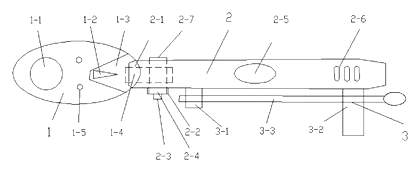
Claim 1 describes a torque wrench tool comprising a head (1), a body (2), and a side-mounted torsion controller (3). Key features include a ratchet groove (1-1) on the head with a sector dial (1-3) and a movable elastic piece (1-2) that locks the ratchet in clockwise, counter-clockwise, or free modes. The head connects to the body via a movable joint (2-1) and includes a rotation angle device (2-2) with a pressing piece (2-3) and shaft (2-7) that allows the head to pivot relative to the handle. The torsion controller (3) uses an elastic arm (3-3) connected by high and low connectors to provide torque resistance.
Claim 2 specifies that the ratchet groove (1-1) accommodates various types of ratchet wheels, which can be swapped out by positioning the movable elastic piece (1-2) in the middle of the dial (1-3).
This is a simplified reading for orientation only. The legal scope is defined by the exact claim wording in the official Chinese document.
What this means for US production
This patent was filed only in China and is currently in force. Making, selling, or importing this specific design in China would require permission from the owner. However, since there are no corresponding patents in the United States, Europe, or other regions, the design itself is not protected internationally by this family.
Two points to settle early:
- Other patents may exist. Dental implant tools are a crowded field with many existing patents held by major manufacturers like Straumann, Nobel Biocare, and Zimmer Biomet. Features such as torque limiting mechanisms and multi-angle drivers may be covered by other independent patents in the US market. A freedom-to-operate (FTO) review is strongly recommended before launching any product derived from this design in North America.
- Material Biocompatibility. While the patent focuses on mechanics, the actual materials used (stainless steel grades, polymers for the elastic arm) must meet medical device standards for biocompatibility and corrosion resistance if sold for clinical use.
Customization and manufacturing
What can be customized
| Area | Options |
|---|---|
| Angle Range | Select head travel limits during CAD development; the directional dial marks are not a validated head-pivot range. |
| Torque Setting | The elastic arm (3-3) stiffness can be tuned by changing material thickness or alloy temper. |
| Ratchet Compatibility | Head groove dimensions can be machined to fit specific brand ratchet interfaces (e.g., Hex, Torx, proprietary). |
| Handle Grip | Anti-slip grooves (2-5) and stripes (2-6) can be modified for ergonomic preferences or branding textures. |
| Materials | Select candidate alloys and polymers during development; the patent does not assign these materials to particular parts. |
| Finish | Passivation, electropolishing, or colored coatings for identification. |
Things to plan for (US market)
- FDA device classification and intended use: Establish the finished instrument’s classification and applicable premarket, registration and listing requirements with a qualified regulatory reviewer. A patent does not establish clearance or an exemption.
- ISO 10993 biological evaluation: Plan evaluation according to the actual contact type, duration and selected materials; do not assume every instrument requires the same test battery.
- Reusable-device reprocessing: Develop and validate cleaning and sterilization instructions for the chosen materials and assembled geometry. The patent’s detachable construction is not sterilization validation.
- Torque and mechanical verification: Define accuracy, head-lock retention and wear acceptance criteria with the instrument manufacturer before clinical-use claims are made.
How a project runs
- Inquiry - Define target implant system compatibility, torque requirements, and quantity.
- Design Review - Adjust CAD models for angle limits, ratchet fit, and material selection.
- Prototyping - CNC machine initial samples to test mechanical action and ergonomics.
- Testing - Verify torque consistency, angle locking strength, and sterilization cycles.
- Production - Injection molding for plastic parts, precision machining for heads/bodies, assembly, and packaging.
Quantities & timeline
Manufacturing routes depend on material selection and the validated instrument design. Plan fixture development, torque verification, reprocessing validation and any required biological evaluation before committing to a production schedule. Send us your target implant interface, torque range, material preferences, estimated quantity and we will reply with options.
Patent drawings
Drawings reproduced from the public patent document for reference.