At a glance
| Patent number | CN112137264B (application CN202010927375) |
| Type | China invention patent (发明专利) - protects product shape, structure, and method |
| Original title | Mobile Suitcase with Cushion (一种带有坐垫的移动皮箱) |
| Patent owner | Xiamen Huisen Luggage Industry Co ltd |
| Inventors | Not disclosed (不公告发明人) |
| Filing date | 2020-09-07 |
| Grant date | 2022-11-08 |
| Status (China) | In force - valid until at most 2040-09-07, subject to payment of annual fees |
| Patent family | Chinese filings only - no US, European, Japanese, PCT or other filings listed |
| Cited by | 0 later documents |
| Source | Google Patents (search for CN112137264B) |
What the claims cover, in plain language
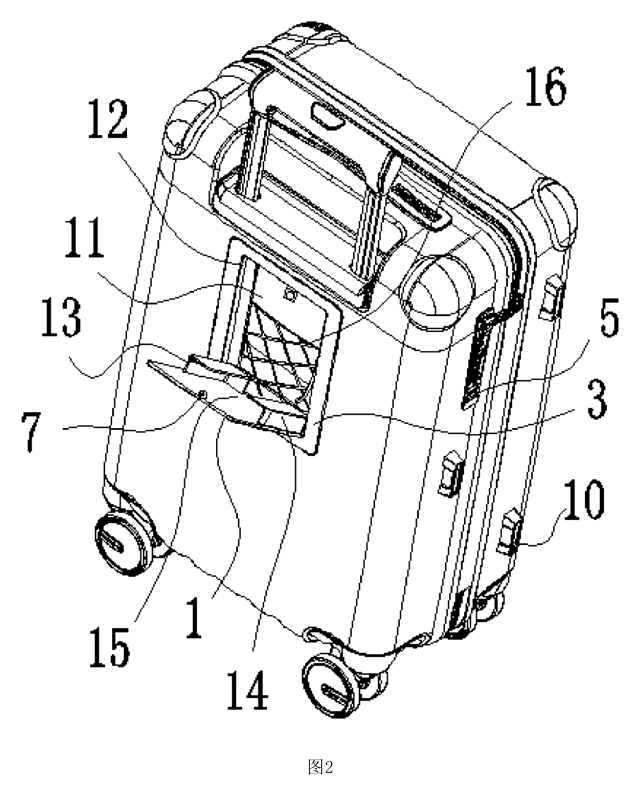
Claim 1 defines a suitcase with a bottom-mounted wheel set and a top-mounted seat assembly. Key elements include fixed shafts on the box top, grooved guide rails that slide on these shafts, a front protective frame connecting the rails, a mesh belt on the frame, and a soft seat cushion between the rails. A side protection assembly is connected to the telescopic pull rod.
Claim 2 details the side protection assembly: a mounting rod on the pull rod, at least four hinged protective rods, connecting rods linking the side rods, and a grooved limit rod on the front frame that receives the ends of the protective rods to lock them in place.
Claim 3 adds a backrest assembly: guide rods sliding through the mounting rod, a back board, tension springs connecting the board to the mount, and a pushing block linked to the side guards’ connecting rod.
Claim 4 specifies a folding/unfolding assembly involving a guide sleeve, a rack, a return spring, a gear meshing with the rack, a clamping rod, and a limiting seat to control the extension and locking of the seat mechanism.
This is a simplified reading for orientation only. The legal scope is defined by the exact claim wording in the official Chinese document.
What this means for US production
This patent was filed only in China and is currently in force. Making or selling this specific configuration in China would require permission from the patent owner. However, since there are no US patents in this family, the patent itself does not restrict manufacturing or selling in the United States.
Two points to settle early:
- Other patents may exist. The luggage industry has many active patents regarding convertible seats, stroller attachments, and folding mechanisms. A freedom-to-operate (FTO) review is strongly recommended to ensure no existing US patents cover similar “luggage-with-seat” functionality before tooling begins.
- Safety Standards. Child-carrying products face strict scrutiny. The mechanical locks (springs, gears, hinges) must be robust enough to prevent accidental collapse while a child is seated.
Customization and manufacturing
What can be customized
| Area | Options |
|---|---|
| Shell Material | PC, ABS, or PP depending on weight/cost targets |
| Seat Fabric | Waterproof nylon, leatherette, or breathable mesh |
| Guard Color | Anodized aluminum or powder-coated steel |
| Wheel Type | Silent spinner wheels vs. standard inline skate wheels |
| Locking Mechanism | Push-button release vs. manual lever for seat rotation |
| Capacity | Adjust rail length for different child sizes (e.g., 15kg vs 25kg max) |
Things to plan for (US market)
- ASTM F963 / CPSIA: While primarily for toys, components accessible to children must meet lead/phthalate limits.
- CPSC Guidelines: If marketed as a “ride-on” toy, specific tip-over and entrapment standards apply.
- Structural Integrity: Drop tests and load-bearing tests for the seat hinges and pull-rod connections are critical to avoid liability.
- California Prop 65: Warnings required for certain plastics and metals used in the hardware.
How a project runs
- Concept Review: Confirm dimensions, target child weight, and aesthetic direction.
- Mechanism Design: CAD modeling of the folding seat, side guards, and backrest linkages.
- Prototype Build: CNC machined or 3D printed parts for functional testing of the folding sequence.
- Safety Testing: Static load test on seat; dynamic test on wheels and guards.
- Tooling & Pilot: Injection molds for hardware, die-cutting for fabric, final assembly line setup.
Quantities & timeline
Tooling for the complex hinge assemblies and custom-molded plastic gears will drive initial costs. Lead times depend on the availability of specialized injection molding for the locking mechanisms. Send us your target retail price, estimated volume, and desired launch date and we will reply with options.
Production notes
Tooling and process
Likely involves sewing for the seat cushion and zipper assembly for the inner compartment, with EVA or PC shell forming for the outer shell. Gears and brackets are molded nylon parts, while the structural rods are typically an aluminum frame or bent steel tube. Sewing operations are required for the seat cushion and mesh belt integration. Assembly relies heavily on rivets and screws to secure the movable joints.
Cost drivers
Hardware complexity is typically a major driver due to the multiple hinging and locking mechanisms. Shell material grade affects durability and cost. Packaging needs to accommodate the extended handle and protruding seat components without damage.
Prototyping path
Sewn first samples are typically the starting point for the cushion fit. Use 3D-printed or machined hardware to verify the folding geometry and lock engagement. Perform wheel and handle test cycles early to check stress points. Move to functional samples once the mechanism is validated.
What we would change before tooling
Depends on the final design, but simplifying the rack-and-pinion system to a simpler detent pin could reduce mold complexity. Increasing wall thickness on pivot bosses is likely necessary to prevent cracking under load.
Common failure points
Spring fatigue and rate consistency are critical for the backrest and locking mechanisms. Hinge boss and pivot wear may occur over repeated folding cycles. Shaft and bearing alignment issues can cause the seat rails to bind. Seam failure in the fabric attachment points should be reinforced.
Patent drawings
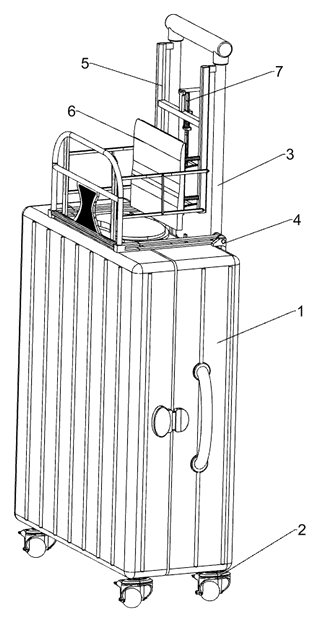
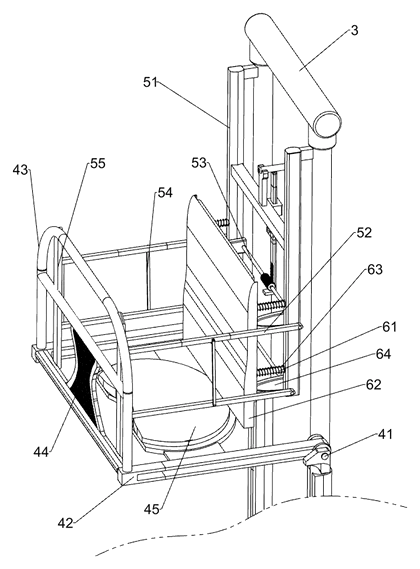
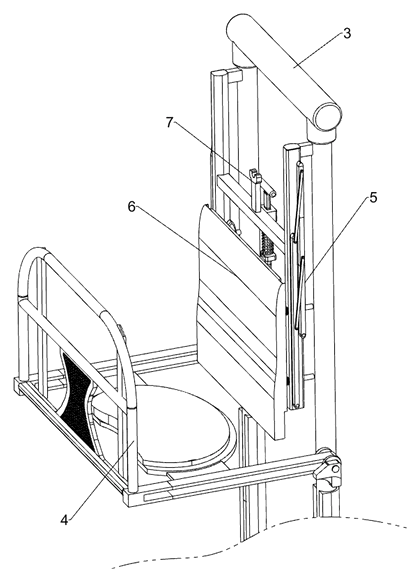
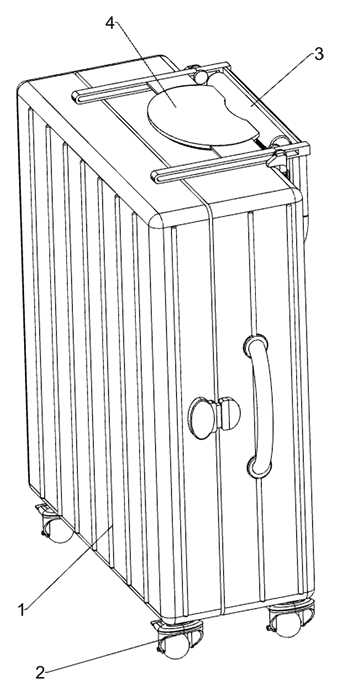
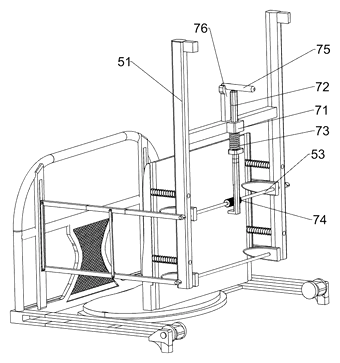
Drawings reproduced from the public patent document for reference.